MAKE / FREE GUIDE
Make Your Own Project Materials Inventory
Identify usable craft stock, reserve exact project quantities, and return tools to safe storage
Download the complete free guide
Build a practical craft materials inventory with usable, reserved and available quantities, safe storage locations, example calculations and two printable planning worksheets.
Includes complete illustrated instructions and any printable worksheets or templates.
Download free PDFRead the complete free guide online
The instructional text is below. For exact-size patterns, illustrations and printable records, use the complete free PDF above.
STEADLEAF PRESS / MAKE STP-MAKE-F021 / FREE GUIDE
MAKING SKILLS / MATERIALS & ORGANIZATION Make Your Own Project Materials Inventory
Know what is usable, what is reserved, and where it belongs
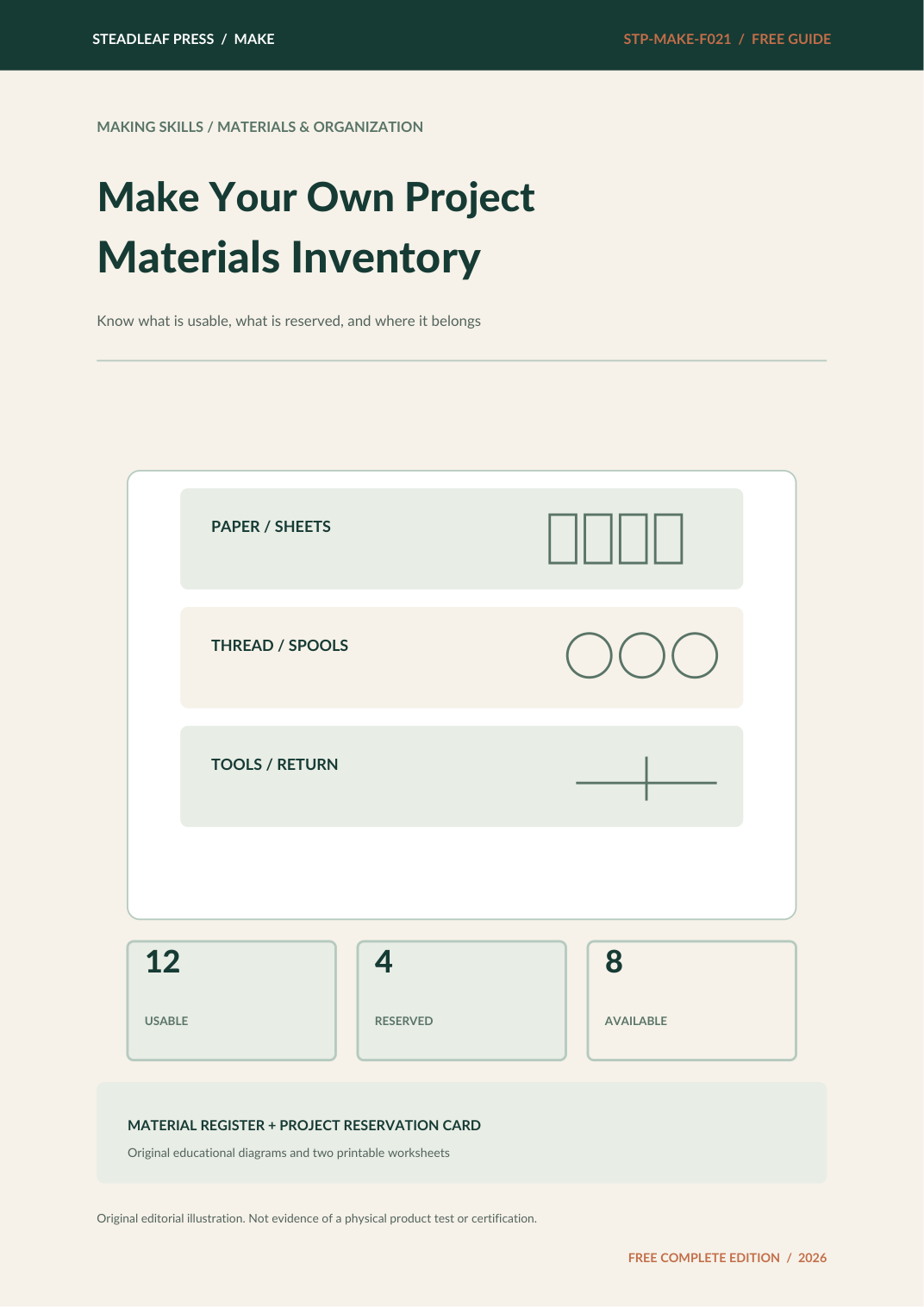
PAPER / SHEETS
THREAD / SPOOLS
TOOLS / RETURN
12 4 8
USABLE RESERVED AVAILABLE
MATERIAL REGISTER + PROJECT RESERVATION CARD Original editorial illustration. Not evidence of a physical product test or certification.Original educational diagrams and two printable worksheets
FREE COMPLETE EDITION / 2026
STEADLEAF PRESS / MAKE / F021 Make Your Own Project Materials Inventory
Steadleaf Press / MAKE / M01 Making Skills, Tools & Design / STP-MAKE-F021 / FREE PRACTICAL GUIDE / COMPLETE EDITION
A small reusable material-and-tool register, a project reservation sheet, and a practical storage and replenishment routine.
The fastest way to buy the same packet of thread twice is to forget that a partly used packet already exists in a drawer. A project can also stop halfway because your “full” roll of tape is nearly empty, a sheet has been reserved for something else, or a glue container has lost its label. A useful inventory is not an elaborate warehouse database. It is a short, accurate record of what you have, where it is, what is usable, and what is already promised to another project.
This guide helps an adult home crafter create a small inventory on paper or in a simple spreadsheet. It includes a two-page printable material list and project reservation card, examples using sheets, lengths and individual tools, and a safe-return plan. It does not require buying storage containers, counting the contents of hazardous mixtures, decanting chemicals, or handling unfamiliar sharp tools. A clean list improves your decisions; it does not certify a material's safety, authenticity, shelf life or suitability for a structural project.
1. Give every record a job
A material inventory should answer four questions: What specific thing is this? How much is available for a project? Where can it be retrieved without creating a hazard? When should it be inspected, restocked or discarded under the original instructions? If a line does not answer one of these questions, decide whether you need it at all.
Start with one small workspace: a sewing box, a drawer of paper, or a craft shelf. Do not empty every cupboard on the same day. Choose a manageable section, prepare a stable clear table, and return items as you finish each category. If a container has an unknown chemical label, a leaking cap or an exposed sharp object, do not open or handle it just to complete a count. Isolate the area safely and follow the product label or applicable local disposal instructions.
Do not let the inventory imply that ownership equals readiness. “One unknown bottle of glue” is not equivalent to “one usable water-based craft adhesive suitable for this card.” “Three needles” is only a reliable tool count if all three are accounted for, identifiable and safely stored. A visually appealing photograph of full jars tells you less than one honest note that the quantity or contents remain uncertain.
2. Classify before you count
Divide your first records into four practical groups. Consumables include paper sheets, thread, tape, clean card, ribbon and other items used up or cut during a project. Reusable tools include rulers, craft scissors, sewing needles, clips and safe cutting accessories. Reusable materials include sound offcuts or previously made components that could serve a future project. Uncertain or restricted items include damaged blades, unlabeled containers, partly cured chemicals and materials whose history is unknown. Keep uncertain items out of the available stock count.
Health Canada's arts-and-crafts safety guidance recommends keeping products in their original labelled containers, following manufacturer storage directions, maintaining hygiene, and keeping hazardous materials away from children and pets. [1] This is a safety boundary for the inventory, not permission to test old chemicals yourself. Do not transfer a craft liquid into an unlabelled kitchen jar, mix partially used adhesives, or open a solvent container to smell whether it is still good.
For sewing tools, Utah State University Extension's beginner supplies checklist distinguishes basic supplies and advanced tools and highlights storage and safe handling for items such as pins, seam rippers and shears. [2] Record a tool's type and safe location, not just its existence. A box that says “scissors, 2” is less useful than “paper scissors, one pair, drawer A” and “fabric shears, one pair, closed sheath, sewing box.”
Original practical guide · FREE COMPLETE EDITION 2
STEADLEAF PRESS / MAKE / F021 Make Your Own Project Materials Inventory
3. Use seven fields, not a complicated system
Give each record a short identifier that stays stable when you move the object to another drawer. PAPER-01 or THREAD-02 is enough for an informal project. Do not make a barcode service or registration step a prerequisite.
Field What to write Example
ID / item Recognizable name and exact type PAPER-01 / white card
Specification Size, colour, material, type if known A4 / 200 gsm / uncoated
Unit One consistent way to count sheets
Usable on hand Count of sound, identified stock 12
Reserved Amount promised to named projects 4
Available Usable on hand minus reserved 8
Safe location / next check Retrievable place and reason to recheck Shelf B / before next print
The example arithmetic is intentionally simple: 12 usable sheets - 4 reserved sheets = 8 available sheets. It assumes those twelve sheets are genuinely usable, not that twelve have merely been seen in a package. A wet, creased or unidentified sheet may be present but not appropriate for the selected task. If available quantity would be negative, your reservation exceeds usable supply; mark a shortage instead of recording “minus three sheets” as physical stock.
For material measured by length, write the unit on every line: 2.4 metres is not 2.4 centimetres. For fabric, dimensions can matter more than area. A single 20 × 30 cm offcut is not equivalent to six small pieces with the same total area when a pattern requires one continuous rectangle. Describe individual usable pieces instead of summing them into a misleading total. For tools, record a count and condition, not “3 metres of needles.”
4. Inventory a small shelf without disrupting it
First, set a boundary. Select a drawer and make a photograph or quick sketch of where larger containers normally belong if helpful. Check whether small children, pets or household members might reach the work. Move only familiar, safe items onto a clear surface. Leave chemicals and unfamiliar sharp tools in their safe storage location while recording the label and visible condition.
Second, identify. Read the original package name, size or unit. Compare labels with the actual item: a container that once held 100 pins may now contain fewer. If the material is not labelled or is visibly damaged, record it as unknown / unavailable and do not make an unqualified claim about its contents or use.
Third, inspect usable condition. Paper should be reasonably dry and clean for the intended craft. Thread should not show obvious decay or entanglement that prevents safe use. A needle must have a safe storage plan and an identifiable type if the task requires one. This is a visual and organizational check, not an engineered durability test. If you cannot judge whether a material is suitable, mark it for a separate manufacturer-guided decision.
Fourth, count safely. Count intact sheets by hand; measure remaining fabric when doing so is straightforward; identify rolls as “full, partial, or unknown” when precise length cannot be checked without unwinding and wasting material. Close open scissors and put small sharp objects in a suitable container before writing the numbers. Never scatter pins on a carpet to get a more accurate count.
Original practical guide · FREE COMPLETE EDITION 3
STEADLEAF PRESS / MAKE / F021 Make Your Own Project Materials Inventory
Fifth, record the location. Use a simple location such as shelf A / paper folder, sewing box / needle case, or cabinet C / labelled original container. Record location at a level that helps you find the thing without publishing your address or inviting unsafe access. Location is for your own retrieval, not for sharing on social media.
Sixth, set a next action. Mark each row use, inspect, reserve, restock, return to secure storage or dispose under directions. Do not allow an inventory checkmark to override actual product labels or changing safety advice.
Seventh, reset the workspace. Put materials back in their recorded locations, close containers as instructed, account for needles and pins, clean the table, and wash hands after handling craft products. A finished inventory that leaves loose blades on the table has failed its most important practical test.
5. Reserve materials for a real project When a project moves from an idea to a real plan, create a small reservation card. Name the project, choose a realistic start period and write exactly what it needs. An unfinished project can reserve stock, but a vague wish list should not lock everything in the cupboard for months. Review old reservations periodically and release items that are no longer committed.
For example, suppose a paper bookmark project requires four A4 card sheets and a temporary tape roll. Your PAPER-01 line reports twelve usable sheets. Put 4 sheets / bookmark project in the reservation field, leaving eight unreserved. The tape roll may be partial; sufficiency not measured; do not silently mark its quantity as “one full roll.” If the project also requires a sharp tool, record use a safe, suitable tool in original storage rather than moving blades into a materials bag ahead of time.
The reserve formula is available = usable stock - current reservations. When the project is actually completed, reduce usable stock by what was consumed and remove the corresponding reservation. Do not subtract the same four sheets a second time as an additional “reservation expense.” A small event log helps: Nov 20: counted 12 usable and reserved 4 for this project; Nov 22: used 3 of those 4 reserved sheets, released the remaining 1 unused; now 9 usable and zero reserved. This is an illustrative accounting example, not a record of an actual workshop. Verify your own figures before updating the card.
What if the project changes? If the planned pattern now needs six sheets, update the reservation from four to six only after you confirm that six usable sheets are available. If the material was cut, it is not a whole sheet anymore; create a new offcut line with real dimensions if keeping it is useful. Resist recording partial damaged sheets as full stock to make a project plan appear ready.
6. Decide whether to buy, substitute or wait
A sensible reorder decision needs a known project, an identified shortage and a realistic storage plan. Do not buy a large new set solely because an online photo suggests your craft corner needs one. Ask in order: Is the item already on hand? Is the available quantity genuinely enough? Is an appropriate substitution described in the actual project instructions? Could the work be reduced safely? Will the remainder have a place to be stored?
A substitution is a decision, not a synonym. Light paper is not automatically interchangeable with thick coated card; thread of the same colour may have a different fibre or strength; a water-based adhesive may not bond to every surface. Write the original item and proposed substitute on the reservation card, then check the material's label, the project's requirements and any limitations before use. When uncertain, postpone or choose a simpler project. Do not mix chemical products, use an unknown bottle or improvise with an exposed blade to avoid a purchase.
Keep a small reorder prompt only for things your household actually uses. Example: “If usable white card falls below five sheets and the next planned project needs eight, add it to the next shopping list.” This is not a universal threshold; it is a
Original practical guide · FREE COMPLETE EDITION 4
STEADLEAF PRESS / MAKE / F021 Make Your Own Project Materials Inventory
decision rule tied to real use. If you can finish the project with materials already present, the absence of a shopping trip is a positive result.
Separate damaged stock from ordinary shopping reminders. A blunt or damaged tool may need replacement or professional maintenance under manufacturer directions, not a quick unverified sharpening experiment. Waste, chemical disposal and recycling rules vary locally; record the relevant local guidance instead of assigning a disposal category from a generic craft blog.
7. Store with safety, access and clarity in mind
Labels matter as much as containers. Store clean paper flat or upright in a protective folder where it will not bend or become wet. Keep fabric scraps clean, dry and sorted by usable dimensions if a future pattern needs a continuous piece. Put thread in a box where tangles are less likely. Keep pointed items in a secure needle case or suitable sharps holder and cutting tools closed or sheathed according to their instructions.
Health Canada's general advice is to retain product labels and original containers for chemical craft materials and to follow manufacturer directions. [1] Do not set a universal temperature, ventilation arrangement, shelf life or child-proof classification for every solvent, paint or glue. The safest inventory entry for a product you cannot identify is a visible warning that it is not available for the project, along with an appropriate next step under the actual packaging or local regulations.
If your craft area is shared, a note such as sharp tools returned / needle count correct should be part of finishing every session. Avoid sticking labels over safety symbols, ventilation instructions or expiration information. If one storage location is becoming unsafe or overloaded, reorganize under the product and household safety requirements rather than forcing more items onto the shelf.
8. Maintain the list with three small habits
At the start of a project: Check the items you plan to use; reserve the quantities you genuinely need and verify the tool's location and safe condition. A line marked “available” last month may no longer be correct after someone else has used the paper.
When you finish: Record consumed amounts, release unused reservations, return intact reusable tools to storage and note offcuts in dimensions that will matter later. Do not automatically keep every tiny scrap; a container full of unusable fragments is not proof of responsible reuse.
Once a month or when a shelf changes: Recheck high-use consumables, any unknown items, and damaged or ageing materials. The calendar is a reminder, not a certification schedule. Follow product-specific expiry and storage guidance where it exists. Archive old project cards separately so the current list remains readable; a paper folder works as well as a spreadsheet.
For a digital list, keep columns in the same order as the printed sheet and use simple formulas if you already know spreadsheet software. Do not rely on formulas alone to inspect physical condition. If you share the sheet with collaborators, avoid publishing private storage addresses, family information, household access codes or photographs that reveal sensitive details. Back up a working copy before reorganizing large groups of rows.
Original practical guide · FREE COMPLETE EDITION 5
STEADLEAF PRESS / MAKE / F021 Make Your Own Project Materials Inventory
9. Troubleshooting an inventory that does not quite add up
The packet says 50 sheets but I counted 12. Record twelve usable if that is what you verified. The printed package capacity is not current stock.
The roll is partly full but the remaining length is unknown. Write partial / unmeasured, not a fabricated length. Resolve it before committing to a project that requires a minimum continuous piece.
The same materials appear on two project cards. Check whether the same stock is reserved twice. Release or reschedule one project instead of counting the same usable sheet as two.
My fabric scraps have different shapes. List the useful individual dimensions and fibre information if known. A pile measured by weight does not tell you whether a required one-piece pattern will fit.
I found old glue with a missing label. Mark unavailable and keep others away from it. Do not smell, mix, decant or test it to discover its identity. Use local guidance or the original supplier's information if identification can be established safely.
The needle count is wrong. Stop, prevent unsafe access and account for the missing sharp item before storing the project. A digital green checkmark is not a substitute for finding the needle.
I bought a duplicate. Record both identified usable items honestly, then adjust the replenishment rule. The inventory is there to improve the next decision, not to conceal a small mistake.
10. Finish one inventory pass
Complete the printable materials register for one drawer or box. Then complete one project reservation card using real or clearly marked example quantities. Verify the card's available-stock calculation and put every item safely back. If you could retrieve one item, identify its safe storage location, and avoid an unnecessary second purchase, the inventory has already become useful.
Illustrative example only: Rowan makes a first record for paper, thread and tools. Twelve sound sheets are present and four are reserved for two cards, leaving eight genuinely available. The thread is partly used and left “quantity unknown,” so Rowan postpones a project requiring a full continuous length. A needle is unaccounted for; Rowan stops that portion of the check and keeps the workspace off-limits until it is found. None of these are publisher-observed counts or a real safety inspection.
A reliable inventory is not the one with the most rows. It is the one that tells the truth about your materials today, helps you plan the next project, and makes returning everything safely part of the habit.
Sources and editorial boundaries
[1] Health Canada, Arts and crafts safety — labelled containers, product hazard instructions, hygiene and storage away from children and pets. Read source
[2] Utah State University Extension, Basic Sewing Supplies — beginner sewing tool types, safe handling, seam-ripper covers and supply storage. Read source
The available-stock formula, example stock quantities, replenishment prompt, worksheet structure, project reservation card and example scenarios are original Steadleaf Press editorial tools. No existing proprietary inventory form or third-party artwork has been copied. No chemical condition, tool integrity, expiry, physical quantity, workshop availability or safety certification was independently tested or verified for this release; examples are expressly illustrative. Always follow actual material labels and locally applicable instructions.
Original practical guide · FREE COMPLETE EDITION 6
CRAFT MATERIALS / FIRST INVENTORY
One drawer or box. Count only sound, identified stock that is genuinely usable.
Storage area (private description): ___________________________________________
ID / ITEM SPEC / UNIT USABLE RESERVED AVAILABLE
PAPER-01 A4 card / sheets 12 4 8
Available = usable on hand - reserved (never count damaged stock as usable).
Leave uncertain quantities as UNKNOWN; never open chemicals for a count.
Tools / secure storage / count of pointed items: STP-MAKE-F021 / Original Steadleaf Press worksheet / FREE 1
Unknown, unlabelled or damaged items excluded from available count:
PROJECT RESERVATION & SAFE RETURN
Record the real quantity committed to one project; remove reservations when used.
Project / next work period:
Material ID / required specification and unit:
Usable quantity before reservation:
Quantity reserved for this project:
Other reservations still active:
Available after all reservations:
If short: substitute under instructions / change project / shop later:
Exact storage location (private):
Unknown labels, sharp-tool or product-safety issues:
Actual quantity consumed after making:
Unused reservation released / usable stock updated:
Stock figures are only as accurate as the actual safe count and current reservations.
STP-MAKE-F021 / Original Steadleaf Press worksheet / FREE 2
SAFE RETURN / Close tools; count needles and pins; keep original labels and containers.