MAKE / FREE GUIDE
Store Handmade Projects without Damage
Material-aware storage choices and an honest condition record
Download the complete free guide
Store everyday handmade paper, textile and dimensional craft projects with a material-specific risk check, protected locations and printable condition records.
Includes complete illustrated instructions and any printable worksheets or templates.
Download free PDFRead the complete free guide online
The instructional text is below. For exact-size patterns, illustrations and printable records, use the complete free PDF above.
STEADLEAF PRESS / MAKE F024 / FREE GUIDE
MAKING SKILLS / PROJECT STORAGE Store Handmade Projects without Damage
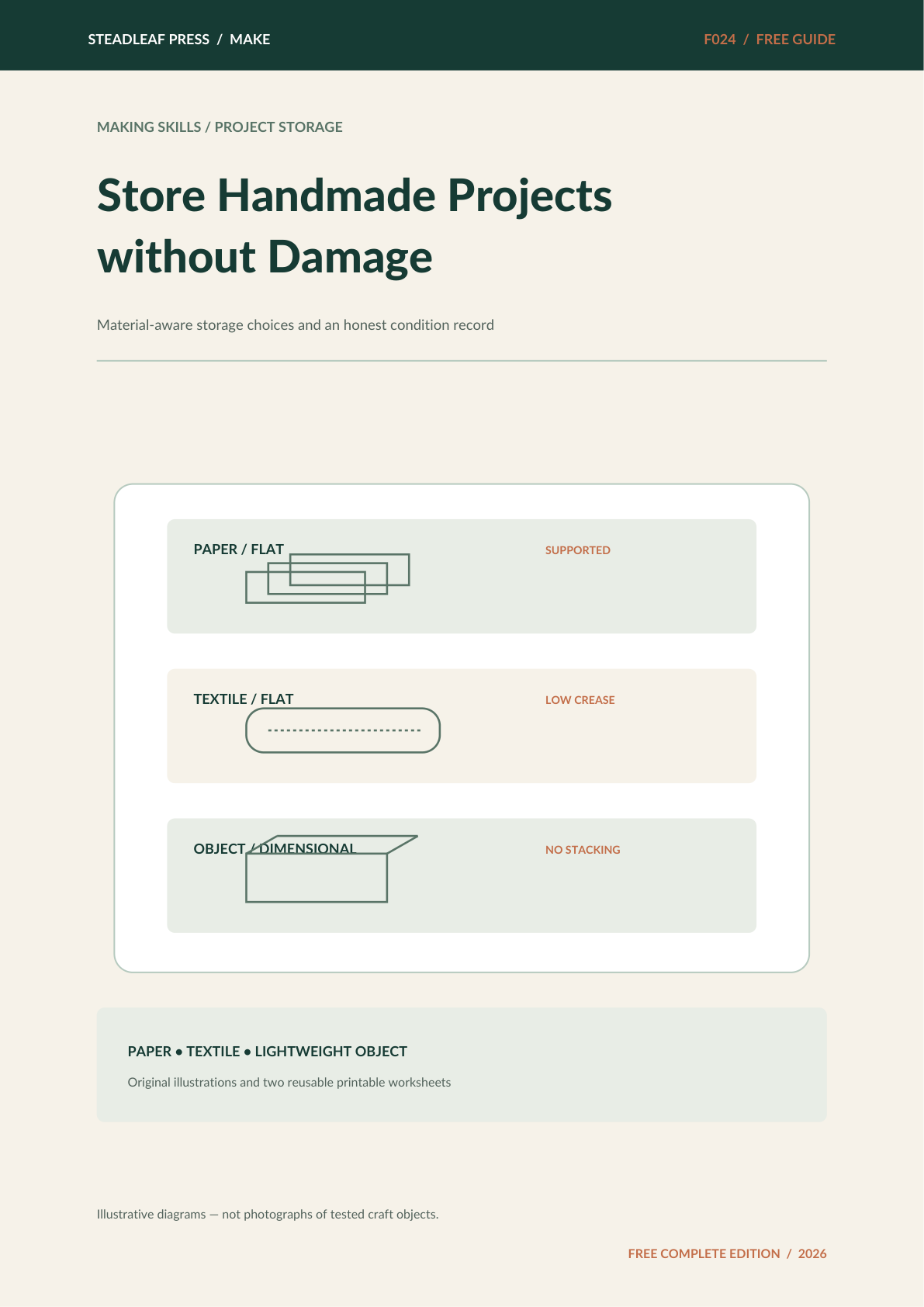
PAPER / FLAT SUPPORTED
TEXTILE / FLAT LOW CREASE
OBJECT / DIMENSIONAL NO STACKING
PAPER • TEXTILE • LIGHTWEIGHT OBJECT
Original illustrations and two reusable printable worksheets
Illustrative diagrams — not photographs of tested craft objects.
FREE COMPLETE EDITION / 2026
STEADLEAF PRESS / MAKE / F024 Store Handmade Projects without Damage
Steadleaf Press / MAKE / M01 Making Skills, Tools & Design / STP-MAKE-F024 / FREE practical guide / COMPLETE EDITION
A practical home storage plan, material-by-material decisions, and a printable condition-and-location record.
The moment a handmade project is finished, it acquires a second job: surviving until you want it again. A card can curl in a damp drawer. A fabric sampler can be creased beneath heavy objects. A small paper box may be flattened by a shelf that looks tidy but has too little headroom. More storage products will not necessarily fix these problems. A sound plan begins with the actual object, its condition, and the risks of the place where it will rest.
This guide helps an adult home maker decide where to put ordinary handmade paper, small textiles, and lightweight mixed-media projects. You will complete a brief condition check, choose support rather than compression, identify a storage place, and record when the item should be looked at again. The accompanying Storage Decision Sheet and Condition & Retrieval Card can be printed without buying special stationery. This is preventive care for everyday craft objects, not a claim that one household method is suitable for artworks of monetary, historic, or conservation value.
1. Separate an everyday craft from a valuable original Before choosing a container, ask whether you can afford to replace or alter the object. A birthday card you made yesterday and a signed drawing inherited from a relative may both be paper, but they do not justify the same experiments. An embroidered sampler used for practice can be moved and inspected more freely than a brittle historic garment with uncertain dyes. A family keepsake that cannot be recreated deserves professional conservation advice when the correct storage material or method is in doubt.
Object or condition First sensible route Avoid
Ordinary flat card or paper Support it flat in a suitably sized folder or shallow box Tight elastic bands; curling it into a small tube pattern, clean and dry
Small clean fabric sampler Lay flat with minimal folds and a clean, supportive Sharp creases under heavy objects covering
Lightweight paper box or Give it its own space so nothing presses on the raised Stacking books on the lid or delicate rim dimensional decoration shape
Mixed material, unknown paint, Keep separate and verify labels, condition and drying Sealing tacky, wet or unknown materials fresh adhesive guidance first together
Irreplaceable, very fragile, Stop improvised treatment; seek qualified preservation Testing household adhesive, water or solvent valuable or actively deteriorating guidance on the original item
The Library of Congress recommends clean handling, protective enclosures and reduced light exposure for works on paper [1]. The Canadian Conservation Institute (CCI) discusses supported storage for textiles and warns against over-handling, excessive folds and unsuitable materials [2]. These recommendations inform sensible precautions; neither institution has assessed or certified your particular homemade project.
2. Check the object before you put it away
Use a clean, uncluttered table and clean, dry hands. Remove jewellery or accessories that might catch threads on a delicate textile. Photograph the object if it helps you remember its shape, but do not replace a condition note with a flattering picture. Look gently rather than tugging at seams or opening a fold that already shows cracking. The inspection is observational; it is not a durability test.
STEADLEAF PRESS / MAKE / F024 Store Handmade Projects without Damage
Record only what you can establish: whether the object is dry to the degree required by its actual adhesive or finish instructions, whether surfaces are tacky, whether an edge is curling, whether a stitch is loose, and whether pieces are about to detach. A paper project using glue needs its manufacturer's full curing instructions, not merely the absence of a visible puddle. A washed fabric should be completely dry before storage; damp folded fabric can encourage mould and staining. If you suspect mould or pests, avoid spreading the item through shared storage. Isolate it safely and obtain appropriate advice; do not brush or spray uncertain contamination in a living area.
For a multi-part project, list the parts. A separate paper lid, instruction card, folded pattern and spare decorative strip can be kept together in a labelled enclosure, but the enclosure must not press against delicate surfaces. Put a small detached component in a clearly identified separate envelope only if doing so will not rub, adhere to, or chemically affect the object. Never hide a cracked hinge or loose button beneath an adhesive label to make a stored piece look complete.
Useful finish line: one honest description such as “paper tray, dry, one corner slightly raised, lid separate, no heavy items on top.” That statement is far more useful than “perfect condition” when you have only looked at it briefly.
3. Choose the storage environment before the box
Avoid the most obvious household risks: water leaks, condensing windows, direct sunlight, radiators, heating ducts, and unstable attics or basements. Seek a reasonably clean, dry, temperature-stable interior shelf or drawer, away from food and craft chemicals. A box cannot make a persistently damp room safe. CCI's guidance for paper storage and textiles emphasizes protection against moisture, light, dust, and unstable environments [2, 3]. This is not an instruction to impose a single numeric humidity target on every domestic project.
Think in three dimensions. A flat folder requires enough depth to slide in without rolling the paper. A paper flower needs headroom above its petals. A fabric sample needs a reasonably wide, clean support rather than being packed into an overfilled tin. A heavy object on an upper shelf may be difficult to retrieve safely; place heavier supplies lower down and keep decorative items protected from falling objects. Do not obstruct vents, electrical equipment, smoke detectors or doors in the name of tidying craft storage.
Write a private location you can actually use: “study cabinet, top flat drawer” is better than “somewhere safe.” Do not publish your home storage map, access codes or addresses with a publicly shared inventory. If several people use the space, label the container plainly enough that no one stacks a tool case on a fragile project by mistake.
4. Store flat paper with full support
For an ordinary handmade card, drawing or paper template that is fully dry, use a clean folder larger than the object and support its complete footprint. Avoid folding the object to make it fit an undersized folder. Do not place loose rubber bands, metal clips or pressure-sensitive tape directly on a special paper surface; the Library of Congress specifically cautions against these materials for works on paper [1]. When the work is important enough for long-term preservation, consult archival guidance about acid-free and pH-appropriate enclosures rather than accepting a casual “archive-safe” sales label.
Put the folder inside a sturdy shallow box or supported drawer, without overfilling. If ordinary papers are stored together, a clean interleaf may reduce direct rubbing, but media can react differently: friable charcoal, pastel, soft paints and flaking decoration demand special handling. Do not slide a clear plastic sleeve over a powdery drawing merely because it looks transparent; electrostatic attraction may lift the surface. The Library of Congress notes that polyester sleeves can create static, which is particularly relevant to friable media [1].
For a large flat item, first try a larger flat support. Rolling may be an option for suitable flexible paper but is not a casual method for a stiff, painted or valuable original. Do not forcibly flatten an old curl with books, steam, an iron or a wet cloth. Record “requires a larger folder” and choose another location instead.
STEADLEAF PRESS / MAKE / F024 Store Handmade Projects without Damage
5. Store small textiles without crushing the work
A finished fabric sampler should be clean and fully dry, with needles and pins accounted for and removed. Lay a small flat piece on a supportive clean surface, leaving room around raised embroidery or appliqué. For more sensitive textiles, CCI recommends suitable flat storage with minimal folding and appropriate support [2]. A plain household cotton cloth is not automatically a suitable long-term protective layer; the fibre, laundering state and purpose matter.
Avoid placing a heavy stack on a seam, tassel or raised stitch. If a larger textile cannot be stored flat, folds should be broad and gently supported when materials and value justify it. CCI discusses padding folds with appropriate tissue or clean textile support [2]. Do not assume every tissue paper works for every fibre or dye, and do not fill a valuable textile with unknown household stuffing. Keep sharp pins, needle packets, rough zippers and tool blades in their own secure storage away from fabric.
Textiles should not be packed damp or pressed directly against wet adhesives. Follow the fabric's real laundering guidance before cleaning. A faded dye or unknown finish is a reason to avoid experimenting with soap, bleaching or heat merely to make the piece storage-ready. If condition is uncertain, document and separate it instead of inventing a cleaning routine.
6. Give dimensional and mixed-material pieces their own space A lightweight folded-paper box needs room for the lid and walls. Put it on a flat support with the lid beside it or positioned as appropriate without pressure, leaving a little clearance around the walls. A fragile hanging decoration may be safer in a partitioned enclosure than suspended from its own paper loop. If an object can collapse under normal stacking, label it DO NOT STACK and arrange the shelf so the label is not the only protection.
For a collage with glued paper and fabric, verify that each adhesive and finish has cured according to its original instructions before enclosing it. Avoid wrapping a decorated surface tightly with material that can stick, leave an imprint or transfer colour. For identified paint or finishes, allow the material to set and cure under the actual manufacturer instructions, including required ventilation, before any enclosure. Never seal wet or curing chemicals in an airtight bag to conceal odour. For unknown finishes, stop and obtain appropriate safety guidance instead of enclosing the object. Refer to product labels and Health Canada's craft-material safety guidance [4].
Separate potentially incompatible objects. A metal embellishment with a sharp point should not scrape an adjacent soft fabric piece. A loose button can go in a labelled accessory pouch without sharing space with a delicate drawing. For valuable or deteriorating multi-material work, stop at documentation and obtain specialist advice instead of guessing at a universal liner or glue.
7. Create a simple retrieval and condition card
On the first printable page, identify the object, broad material group, condition, principal risk, support and proposed storage location. Mark “unknown” when you have not confirmed a material or finish. On the second page, record the actual date stored, the date or event for next inspection, what you saw, and what you changed. If the piece is given away, record the destination only with the recipient's permission and without unnecessarily storing personal information.
Use a short label like PAPER-CARD-01 or TEXTILE-SAMPLE-02. This is a household locator, not a museum accession number. You may find the original PDF and project notes by that ID, but do not imply the record proves quality, conservation suitability or value. A person who finds the folder later should be able to understand what belongs inside and whether it can be handled normally.
Example, not a physical storage trial: Mina finishes a decorative paper keepsake tray. She notices one corner is slightly raised and the glue needs more time under the label directions. She leaves the tray safely supported and uncovered while it dries, keeps the lid separate, and writes “check corner after drying.” Only after the manufacturer's recommended cure
STEADLEAF PRESS / MAKE / F024 Store Handmade Projects without Damage
period does she move it into a shallow box with no weight stacked above. This is an illustrated decision, not a storage outcome observed by Steadleaf Press.
8. Make storage a reversible choice When the project is retrieved, pause before moving it. Check for changed colour, new warping, loose thread, insect evidence, unexpected odour or moisture. If a problem is visible, do not perform an aggressive fix on the spot. Photograph and note it; move the piece only as safety allows; consult relevant material or professional guidance for valuable objects. You can adjust ordinary craft storage based on documented experience, but never use the word “protected” as a substitute for looking at the actual piece.
It is also reasonable not to keep every experiment forever. A trial paper fold that has served its instructional purpose can be recycled or disposed of under local rules if it is safe to handle, unlike an irreplaceable keepsake. Prioritize a small number of meaningful objects, clearly labelled, rather than squeezing all projects into a container that damages them. Record disposal of unsafe, contaminated or chemically uncertain materials according to applicable instructions; do not improvise disposal methods from this storage guide.
Completion check: the object is safely accessible; its support does not bend or crush it; the storage area is reasonably dry and stable; materials that should not touch remain separate; a person can find the piece without guesswork; and the next condition check has a clear reason. Those are practical safeguards, not a long-term preservation guarantee.
References and boundaries [1] Library of Congress — Care, Handling and Storage of Works on Paper. Clean handling, flat protective housing and specific cautions about pressure-sensitive tape, fasteners and electrostatic film. Read sourceloc.gov/preservation/care/paper.html
[2] Canadian Conservation Institute — Basic care: Textiles. Dry, supported storage, reduced folding and handling, appropriate protective materials for textiles. Read sourcetion-institute/services/care-objects/textiles-costumes/basic-care-textiles.html
[3] Canadian Conservation Institute — Storing Works on Paper, CCI Notes 11/2. Protective enclosures, appropriate handling and selection of storage environment. Read sourcetion-institute/services/conservation-preservation-publicatio ns/canadian-conservation-institute-notes/storing-works-paper.html
[4] Health Canada — Arts and crafts safety. Product-label requirements, safe craft-material handling, storage and disposal considerations. Read sourcelth-canada/services/home-garden-safety/use-arts-crafts-materials-safely.html
The storage decision tables, printable condition card, example scenes and original diagrams in this edition are original Steadleaf Press educational material. No institutional graphic or photograph is reproduced. No household artifact was physically stored, preservation-tested or certified for this release. This guide does not replace a conservator for historically significant, fragile or irreplaceable work.
PROJECT STORAGE DECISION SHEET
Everyday crafts only; uncertain valuable items need qualified advice.
Object ID / name
Primary material / coating / adhesive
Paper / fabric / dimensional / mixed / uncertain
Current condition
Dry / wet or tacky / fragile / warped / uncertain
Main observed risks
Crush / bend / light / moisture / loose part / sharp edge
Special value / irreversible damage?
Ordinary replaceable craft / sentimental or valuable: seek guidance
Protective support selected
Flat folder / flat textile layer / shallow box / individual compartment
Enclosure / contact materials verified
Known appropriate / requires advice / no new enclosure
Stop or isolate condition
Mould/pests suspected / uncured material / loose hazardous part / none
Proposed safe storage location
Record privately; avoid windows, leaks, heat, heavy stacks
Next inspection reason
Date / seasonal change / after adhesive cure / before next use
No item has been physically stored or tested by Steadleaf Press.
STP-MAKE-F024 / Original printable worksheet / FREE 1
CONDITION & RETRIEVAL CARD
Record what you actually saw, not an assumed preservation result.
Object ID and recorded location
Date stored; original condition
Support / folding / separated parts
Actual item status after label curing
Fully ready / still curing / uncertain / not applicable
Next visual check date or event
Date retrieved / handled by
Condition compared with previous record
Unchanged / new bend / staining / loosened seam / uncertain
Action taken; material stayed safe
Next inspection / specialist advice needed
Where original project PDF / notes are saved
Do not use household tape, glue, steam or water to “repair” a valuable original.