MAKE / FREE GUIDE
Test a New Craft Material Before the Full Project
A controlled offcut comparison, safe stop rules, and a factual log
Download the complete free guide
Compare identified low-risk craft materials on expendable swatches using a blank control, label-directed handling and printable observation and decision cards.
Includes complete illustrated instructions and any printable worksheets or templates.
Download free PDFRead the complete free guide online
The instructional text is below. For exact-size patterns, illustrations and printable records, use the complete free PDF above.
STEADLEAF PRESS / MAKE F026 / FREE GUIDE
MAKING SKILLS / MATERIAL SWATCH
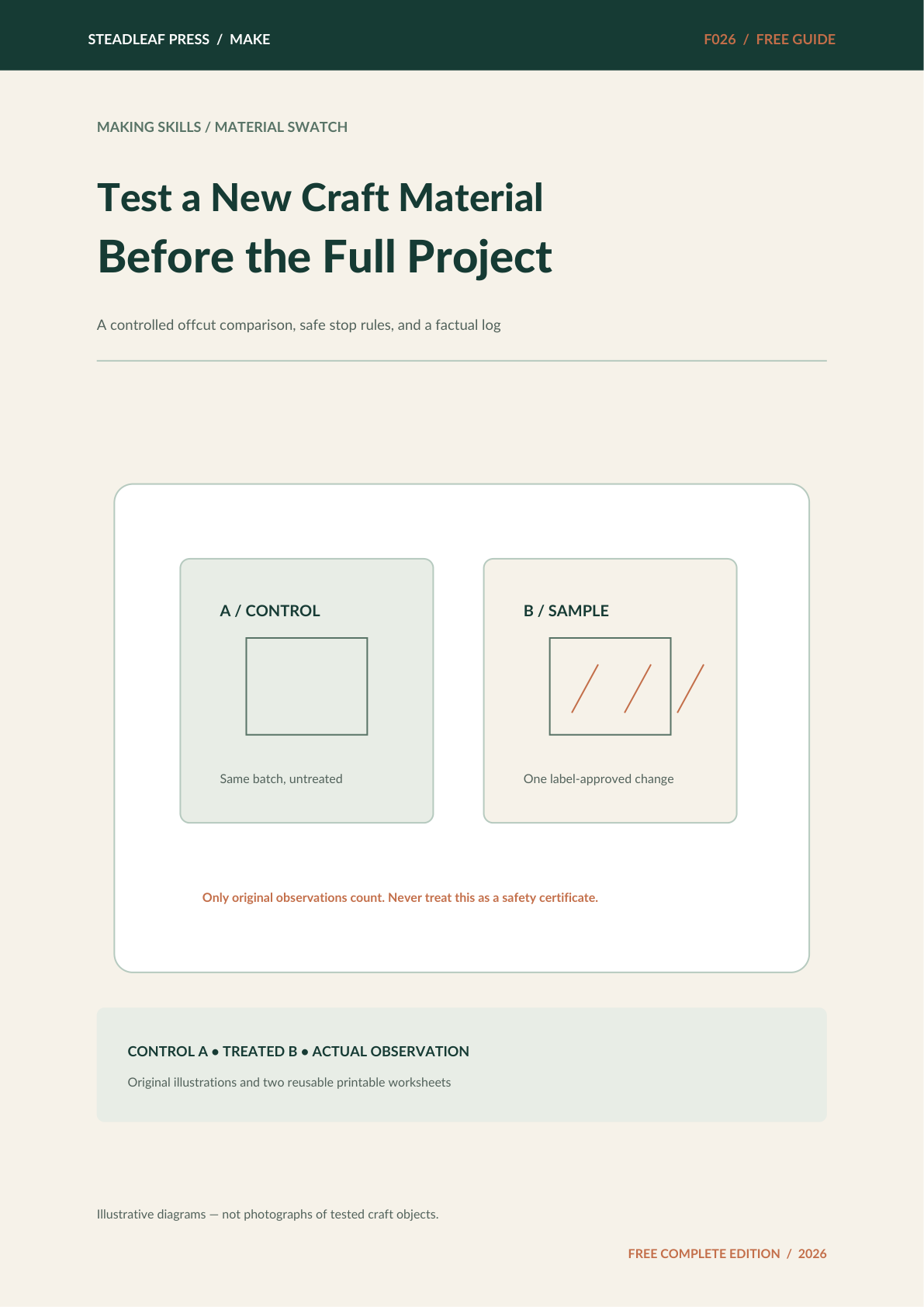
A / CONTROL B / SAMPLE
Same batch, untreated One label-approved change
Only original observations count. Never treat this as a safety certificate.
CONTROL A • TREATED B • ACTUAL OBSERVATION
Original illustrations and two reusable printable worksheets
Illustrative diagrams — not photographs of tested craft objects.
FREE COMPLETE EDITION / 2026
STEADLEAF PRESS / MAKE / F026 Test a New Craft Material Before the Full Project
Steadleaf Press / MAKE / M01 Making Skills, Tools & Design / STP-MAKE-F026 / FREE practical guide / COMPLETE EDITION
A small, controlled swatch comparison, a stop-before-damage rule, and a printable material decision record.
A lovely craft material can behave badly at the wrong moment. A marker bleeds through the paper after you have lettered an entire card. A water-based glue wrinkles an unexpected stock. A fabric marking pen leaves a pale line where the seam will be visible. These problems are easier to discover on an inexpensive test piece than on a finished gift. But a swatch is only useful if you know what it can and cannot demonstrate. A small, careful trial helps you choose a process for the material in front of you; it cannot certify that a product is non-toxic, fire-safe, food-safe or suitable for load-bearing work.
This guide is for adult beginners working with ordinary identified, low-risk paper, fabric and manufacturer-approved water-based craft materials. It offers a repeatable comparison with a blank control, an observed sample and a short decision record. It is not an instruction to mix chemicals, test unknown finishes, heat unfamiliar plastics, burn textiles, expose the skin to dyes, or perform destructive tests on valuable objects. The two printable pages are a Swatch & Conditions Log and a Proceed / Change / Stop Decision Card.
1. Set a narrow question before choosing the swatch Do not begin with the vague question “Is this material good?” Instead ask something you can examine safely: “Does my chosen pen remain legible on this spare card after the recommended drying period?” “Does the intended paper fold crack on an expendable strip?” “Does this already identified fabric marker wash away according to its own directions on a spare piece of the same cloth?” “Does a small spot of labelled water-based craft adhesive cause visible wrinkling on a spare matching paper?”
These questions do not establish universal safety, strength, colourfastness or longevity. A label, safety data sheet where applicable, manufacturer instructions, and the actual use conditions still control whether a material is appropriate. Health Canada's craft safety guidance calls for reading labels, avoiding hazardous mixtures and choosing safer materials where possible [1]. A material that is unsuitable or unknown at the outset must be excluded, not “tested to see what happens.”
Write the question on the log before any material is handled. Include the expected observation, not a predetermined PASS. For example: “Compare a blank offcut with one pen-marked offcut for bleeding and clarity after the labelled drying interval.” Do not write “prove waterproof,” “prove safe for children,” or “prove the glue is archival.” Those conclusions are not available from the exercise.
2. Pass the safety screen before touching the material Start with identity. Can you read the actual product name and instructions? Are there hazard symbols, required ventilation, gloves, protective eyewear or age limits? Does the material have an appropriate, clean storage history? Is the surface ordinary scrap stock rather than a photograph, heirloom, certificate, valuable print, food-contact item or children's toy? If any critical item is unclear, the appropriate outcome is STOP. Do not open a leaking bottle, smell an unknown solvent, scrape an unidentified coating, mix two craft products or put anything on your skin in the name of a “patch test.”
Prepare a stable, clean, protected work surface away from food and drinks. Secure scissors and needles; account for sharps before and after. Use only familiar tools suitable for the particular operation. Keep children and pets out of reach of small offcuts, dyes, glues and loose cords. Where a label requires ventilation or personal protection, follow it. This beginner exercise deliberately excludes heat guns, soldering, curing ovens, open flames, aerosol spraying, reactive resins and unknown adhesives. If your project requires those techniques, consult the relevant manufacturer and qualified instructional sources instead of substituting this guide.
STEADLEAF PRESS / MAKE / F026 Test a New Craft Material Before the Full Project
A cut scrap is not an excuse to ignore a label. Some products are unsuitable for home use or for the intended surface regardless of how small a test you attempt. Do not override a warning because a swatch seemed unchanged or because a previous craft tutorial used a similar-looking product.
3. Keep the controls simple and honest
Prepare two small, comparable offcuts from the same known batch wherever practical. Mark the first A / unmodified control and the second B / proposed treatment on a removable note or a sacrificial edge. If marking the material itself could alter the result, label the nearby backing instead. Use the same lighting and inspection method for both. A third spare can be kept for one deliberate change if a first trial is inconclusive, but there is no requirement to sacrifice many pieces.
Record the batch, size, thickness if known, surface finish, age or storage information if relevant, and the treatment product's name. Unknown quantities stay unknown rather than being replaced with a plausible number. “Two plain card strips from the same packet” may be enough; “paper guaranteed 200 gsm and acid-free” is not appropriate unless those properties were actually documented by the supplier.
A control answers a basic question: was the observed change caused by the proposed handling, or was the paper or cloth already uneven, faded, wavy or marked? Comparing A and B does not create a laboratory experiment or guarantee repeatability. It simply keeps your decision more informative than inspecting only the treated piece.
4. Example A — examine a simple paper fold For ordinary inexpensive paper or light card, make an expendable strip wide enough to fold comfortably without touching a sharp tool. Mark the planned crease line on a removable label if possible. Fold one strip gently along the intended line using clean hands or a suitable blunt creasing tool on a protective surface. Leave the control uncreased. Compare the visible outside of the fold with the flat control: is there whitening, a rough edge, cracking or a strong tendency to spring open?
Paper grain direction, coating, stiffness and thickness can affect folding. Cornell University Library describes grain and the tendency of paper to fold differently along and across it [2]. If you want to compare two directions, use two equivalent spare strips oriented at 90 degrees to each other, record the changed orientation, and avoid claiming you have measured the precise machine direction without stronger evidence. On a thin sheet the difference may be too small to decide. Record unclear if appropriate.
Do not wet, tear, scorch or force an irreplaceable original to identify grain. Do not use scoring as a cure-all for coated stock that fractures. If both orientations crack, the sensible next action may be to change paper or project design, not to press harder.
5. Example B — check writing or marking on spare stock Choose a familiar water-based paper pen or a fabric marker explicitly suitable for the surface under its instructions. On spare stock, draw a short line and two legible letters in a known area. Leave the control blank. Record the brand and product variant if known, paper/fabric type, time applied, and relevant labelled drying or removal directions. Then allow the recommended setting or drying time before handling. Do not invent an interval based on the appearance of the surface alone.
After the labelled setting or drying time, inspect for spreading, feathering, show-through and colour change. Only check for rubbing or transfer when the product directions explicitly allow that handling; do not rub a wet mark or deliberately expose skin. A fabric marker sold as removable may require a specific washing or air-erasing process; use those instructions on a sacrificial matching sample only when safe and appropriate. A mark that disappears quickly in one room
STEADLEAF PRESS / MAKE / F026 Test a New Craft Material Before the Full Project
is not proof it will vanish from every fibre or after a long delay. Conversely, a stain on scrap may be reason enough to switch tools before marking the finished piece.
For important paper or cloth, avoid experimental cleaning. If it is historic, delicate, valuable, unknown or already damaged, do not perform a household trial on it. The Library of Congress recommends preventive handling rather than improvised tape, water or glue treatments on important works on paper [3].
6. Example C — assess a labelled craft adhesive on a paper scrap Use this example only if you already possess an identified, appropriate water-based adhesive whose actual label permits the intended paper-to-paper use. Work in the conditions and with the precautions prescribed by that product. Put a minimal amount between two small matching expendable pieces, leaving the control untreated. Observe whether the sheets curl, show a stain, misalign or develop an obvious bubble. Do not open a different product to compare them or mix adhesives to improve the result.
Follow the manufacturer's application, setting, full-curing and cleanup directions. A surface that looks dry after a few minutes may not have reached its specified cure. The small swatch does not establish safe structural bonding, non-toxicity, archival suitability, wash resistance or food compatibility. Avoid pulling a glued joint to failure, heating it, or applying it to valuable paper just to collect more observations. If the label does not identify an appropriate use or the workspace cannot meet its safety instructions, select a glue-free design or stop.
A visible wrinkling result is still useful. You can adjust the amount only within instructions, choose paper known to be more suitable, or change construction so the joint is not needed. Do not claim the test proves the new approach will work; it identifies a reason for a different choice.
7. Record time and conditions without inventing precision A fair comparison notes room and surface conditions only to the level you actually know. “Ordinary indoor light, room felt dry” is an observation. “Relative humidity 45%” is not an observation unless you actually used a suitable measuring device. Record the method of application, number of layers, any label-directed setting time, and when you inspected the sample. For paper and textile projects, you may find a second check after full drying informative; do not let an arbitrary timer replace product instructions.
Use the Swatch & Conditions Log to separate three things: planned question, actual observation and decision. The result can be PROCEED WITH CAUTION, CHANGE ONE THING or STOP / SEEK GUIDANCE. “Proceed” means the small ordinary craft trial did not show a disqualifying visible defect under the recorded conditions. It is not a certificate for a whole garment, toy, food container, personal-care product, valuable artwork or safety-critical use.
When changing one variable, name it: thinner paper, a different fold orientation, a compatible pen, a new batch, or a no-adhesive design. If you change paper, tool, pressure and drying period simultaneously, the record will not tell you which change mattered. Starting small is useful precisely because the next step is easy to document.
8. Understand what a swatch cannot tell you
A small paper bend cannot predict the fatigue of an object that will be folded every day. A dry adhesive patch cannot establish long-term chemical stability. A coloured pen mark cannot certify colourfastness after repeated washing, UV exposure or contact with skin. A fabric or paper scrap cannot certify strength, fire resistance or an absence of harmful chemicals. Where the intended project involves heat, food, babies, jewellery skin contact, electricity, hanging loads or protective equipment, do not rely on this generic swatch guide. Follow product standards and specialist guidance appropriate to the actual use.
STEADLEAF PRESS / MAKE / F026 Test a New Craft Material Before the Full Project
Different materials may also hide damage. A glossy coating can look smooth until repeated movement. A thread line may appear straight while the fibre underneath is fraying. A household swatch comparison does not replace mechanical testing, expert conservation evaluation, or a manufacturer's published performance limits. It is a practical screening tool for ordinary low-risk craft choices only.
Distinguish a reader's later physical test from this publication. Steadleaf Press has supplied instructions, original diagrams and blank records, but has not performed your test, tested your material, certified any product, or witnessed an outcome. The illustrative examples that follow are fictional planning decisions, not documentation of a real trial.
9. Two example decisions and a useful way to finish Fictional example — paper fold. Nia wants to make a cream card. A spare strip folds across its short direction without visible roughening while another strip shows slight whitening. She records the direction she used, her approximate handling, and which visible fold looked better. She decides to try an inexpensive blank card in that orientation. She does not label the result “grain definitively measured” or promise that all cards from the packet will behave identically.
Fictional example — adhesive. Jules owns a labelled water-based craft glue suitable for paper. The manufacturer requires a longer cure than Jules expected. Jules follows the instructions on expendable stock and sees slight wrinkling. Instead of sealing a completed keepsake box and calling it sound, Jules changes the planned project to a folded paper form requiring no adhesive. This illustrates a good stop-or-change decision, not a tested outcome from a Steadleaf studio.
At the end, fill in the Decision Card with the exact project, material, test question, observed defect or absence of it, uncertainty and next step. Store the sample only if it is safe to keep and useful to compare; dispose of unwanted scraps and materials according to their labels and applicable local guidance. Clean the area, close containers and account for any sharp tools. An incompletely tested object should never be labelled approved because a worksheet looks tidy.
Finish line: one specific safe question, a known low-risk material, a comparable untouched sample, one controlled handling change, a factual observation and a proportionate next decision. That modest result can prevent avoidable damage to the full craft project without making scientific or safety claims the experiment cannot support.
References and boundaries
[1] Health Canada — Arts and crafts safety. Labels, safer substitutes, ventilation, storage, avoidance of mixing products and hazardous handling. Read sourcelth-canada/services/home-garden-safety/use-arts-crafts-materials-safely.html
[2] Cornell University Library — Paper: Library Preservation and Conservation Tutorial. Paper grain, folding behavior and related handling considerations. Read sourcetiontutorial.library.cornell.edu/content/paper/
[3] Library of Congress — Care, Handling and Storage of Works on Paper. Preventive handling and limits of improvised treatment for important paper materials. Read sourceloc.gov/preservation/care/paper.html
[4] Utah State University Extension — Basic Sewing Supplies. Fabric marking tools, appropriate tools and the value of checking removal on a fabric scrap. Read sourcetension.usu.edu/sewing/research/basic-sewing-supplies
All swatch scenarios, worksheet fields, decision levels and illustrative diagrams here are original Steadleaf Press educational content. No third-party art was copied, and no physical material testing, adhesive trial, solvent handling, colourfastness evaluation, safety certification or material performance verification was conducted for this publication.
SWATCH & CONDITIONS LOG
Blank control A; one known, label-approved treatment B.
Project / narrow test question
Exact product name / batch / instructions
Known low-risk surface / material
Paper / stable fabric / other label-approved ordinary craft
Safety screen
Identity confirmed / instructions read / safe workspace / STOP
Control A and treatment B differ only by
Size / same batch / room observations
What I did on B, under product directions
Drying / cure / removal instruction (if applicable)
Time when actual samples were observed
A untreated / B actual observations
Bleeding / roughening / curl / no visible change / uncertain
No material is certified safe or durable from this record.
STP-MAKE-F026 / Original printable worksheet / FREE 1
MATERIAL DECISION CARD
Choose a proportionate action and name what remains unknown.
Project / exact sample identification
Original question / intended use
Control A: what was already there?
Treatment B: what changed after setting time?
Any visible defect or material uncertainty
Decision
PROCEED WITH CAUTION / CHANGE ONE THING / STOP / SEEK GUIDANCE
If changing one factor, which factor?
What this swatch DOES NOT establish
No chemistry / strength / food / skin / flame / archival certification
Actual sample date / recorder (optional)
Container closed / sharps returned / safe disposal
Done / not applicable / pending under label instructions
Never use unknown chemicals, open flames, heat guns, mixing or valuable originals.