MAKE / FREE GUIDE
Choose Paper Weight for Boxes versus Flowers
A material-choice method using measured paper coupons, not a universal gsm rule
Download the complete free guide
Compare paper weight, thickness, grain, scoring and surface finish for a small box versus a layered paper flower; includes original cut coupons and a decision log.
Includes complete illustrated instructions and any printable worksheets or templates.
Download free PDFRead the complete free guide online
The instructional text is below. For exact-size patterns, illustrations and printable records, use the complete free PDF above.
These are original printable digital plans for adult paper crafts. Dimensions are calculated; every finished size is nominal. Paper thickness, printer scaling, adhesive, cutting accuracy and folding technique can change the fit. There has been no physical printing, cutting, folding, gluing, fit test or durability test. Work at a clear table, keep sharp edges and wet adhesive away from children, and use only materials and adhesives that are suitable for the intended craft according to their labels. Keep food, flame, heat and electrical loads away from these objects.
The decision you can make
A single sheet can behave differently in a rigid-sided box and a curving paper flower. For a box, you generally want walls that do not slump under the intended light decorative use, corners that score cleanly, and tabs that bond without buckling. For a flower you usually want petals that can be curved by hand without cracks and overlapped neatly at their bases. Neither result comes automatically from the number printed on a paper pack.
This guide provides an original side-by-side material choice exercise. You will identify up to four small expendable sheets, compare their declared grammage in grams per square metre (gsm), cut identical coupons, make simple trial folds, try one small box-wall sample and one petal shape, and record a decision. The included vector pages are measuring aids, not claims that any supplied material was physically tested by Steadleaf Press.
The useful result is a specific material choice for a specific low-risk object with a written reason. You may find that one sheet is suitable for both projects, two different sheets work better, or none of your stock is appropriate. A documented PAUSE is a legitimate outcome. Do not buy a new stack just because a guide names a paper-weight range.
What paper weight means and what it cannot tell you
Gsm describes the mass of a sheet with one square metre of area, not its measured thickness in millimetres. Two sheets can have the same gsm yet differ in caliper, stiffness, fibre mix, surface coating, manufacturing grain direction and absorbency. Terms such as cover, text, index and bond are not directly interchangeable with gsm. The same numerical gsm cannot prove that paper is archival, washable, food-contact safe, colourfast, printer-compatible or rigid enough for a particular load.
For a first comparison, consider four illustrative bands: 100-139 gsm for easy bending experiments, 140-179 gsm for medium-weight folded paper, 180-239 gsm for many decorative cards and light paper structures, and 240 gsm or above for thicker stock that may demand different equipment or scoring. These are NOT hard product specifications or guaranteed performance windows. A coated 180 gsm sheet may crack more than an uncoated 220 gsm sheet; real behaviour takes precedence over the bands.
Grain direction can change the fold. The University of Brighton book-arts resource explains that folding with the grain usually gives a smoother crease than folding against it. This is background teaching, not approval of any particular stock. Do not impose a grain assumption from a printed page label: identify your actual pack information if given, or compare gentle bends in two perpendicular directions on scraps before scoring.
Prepare four comparable trial coupons
Use ordinary adult craft supplies: a millimetre ruler, pencil, blunt scoring tool, safe scissors, clean dry worktop, and if needed a clearly labelled paper craft adhesive. Choose four clean pieces whose source and claimed gsm are known when possible. When a package is unlabelled, write UNKNOWN rather than inventing its grammage. Save any packaging or printer recommendations.
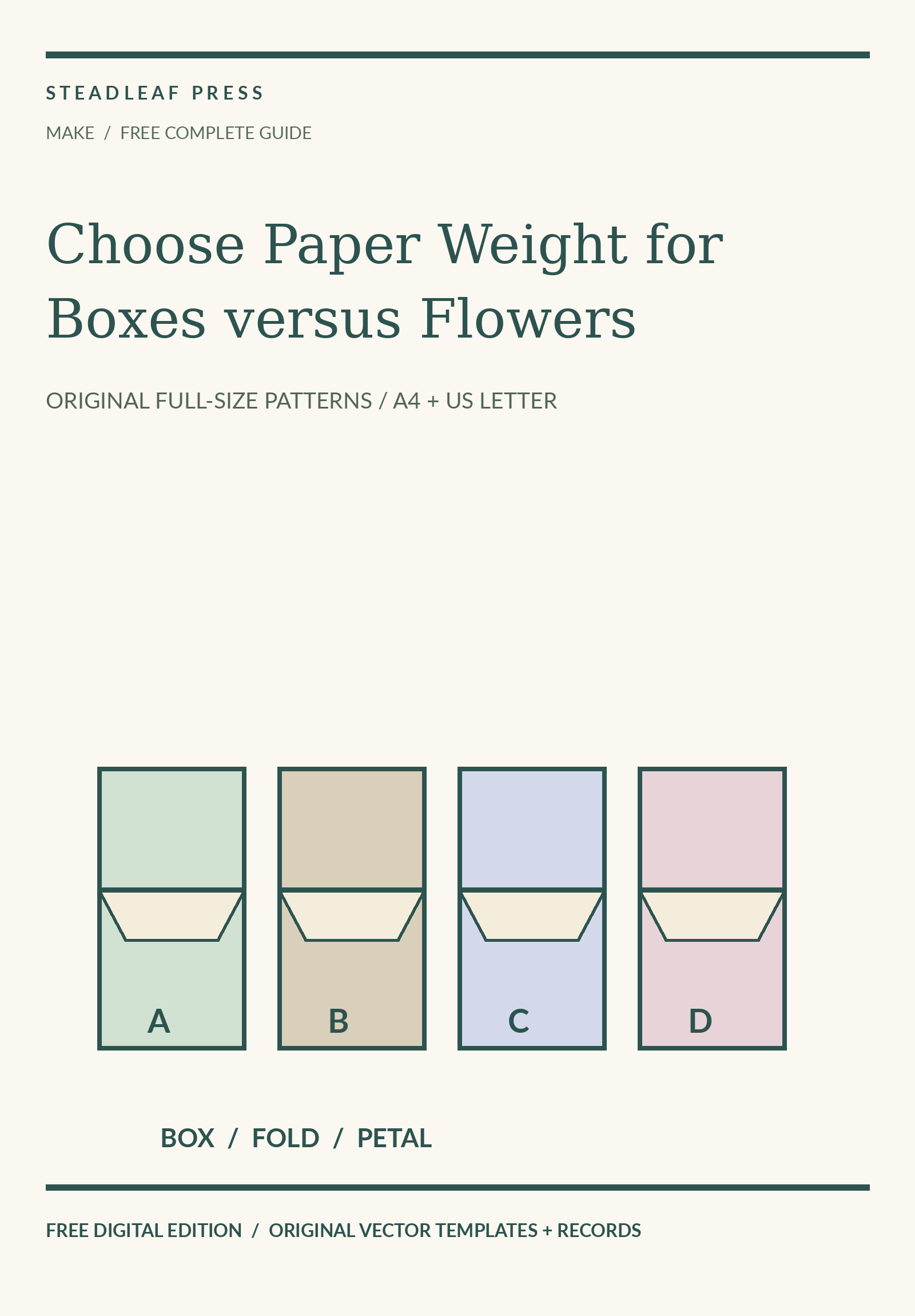
Our first original page lays out FOUR identical 30 x 90 mm reference coupons, each with a single transverse score at 45 mm along its length. The printed outlines are transfer patterns; printing them on ordinary copier paper does not turn that copier paper into four test stocks. Transfer each 30 x 90 mm outline to the actual separate sample sheet and identify it A, B, C or D. Measure each with a real ruler. Make every cut with scissors away from fingers.
The second original sheet gives a 90 x 65 mm box-wall practice rectangle with one score 20 mm from its lower edge, and an 18 x 38 mm single-petal reference. Neither is a complete box or a complete flower; the purpose is to compare two behaviours before committing to a full project. Print at Actual Size or 100%, check the 50 mm calibration mark on BOTH template sheets, and check the cut path for clipping. If scaling is inaccurate, draft the written millimetre sizes by hand.
Follow this original comparison method
1. Define your objects before choosing paper. Write BOX = a small decorative, dry, unloaded practice shape; FLOWER = a layered flat or shallow-relief paper accent. Note whether the object will be handled, folded repeatedly or glued to a backing. Exclude packaging for food, candles, electronics, liquids or protected items.
2. List up to four candidate sheets. Record the pack name, any gsm, visible coating, colour on both faces and printer or adhesive warnings. Keep samples away from valuable letters and photographs. Do not infer a gsm number from how a sheet feels.
3. Print the two original cut-coupon pages at Actual Size and measure EACH 50 mm bar. Confirm the 30 x 90 mm rectangular coupons, 90 x 65 mm wall coupon and 18 x 38 mm petal dimensions before tracing onto actual trial materials.
4. Cut one 30 x 90 mm coupon from each candidate. Put a pencil A/B/C/D on the back, not in the score line. Mark the centre line 45 mm from the short end. Keep the long edges roughly parallel; a crooked trial adds a measurement error.
5. On a scrap offcut, bend gently along one axis and then the other. If one orientation bends more willingly, mark the estimated grain and rotate a second coupon if you have enough stock. This is an observation by the reader, not a laboratory measurement of grain.
6. Score the 45 mm line lightly with a ruler and blunt tool. Fold each coupon once through a comparable angle. Observe surface cracking, spring-back, whitening, unevenness and whether fibres tear. Use gentle hand pressure; never push through a resistant laminate to claim success.
7. With a candidate for a box, transfer the 90 x 65 mm wall coupon. Score a line parallel to the 90 mm edge, exactly 20 mm above the lower edge, then raise the 20 mm wall to roughly a right angle. The remaining 45 mm region represents the base. Note whether the wall can stand as a shape in your hand without a sharp crease breaking. This is not a measured strength test.
8. With a candidate for a paper flower, trace and cut the 18 x 38 mm petal. Reserve the lowest 8 mm as a flat attachment foot and gently curve the remaining 30 mm with fingers. Do not use a knife edge, hot tool or pointed curling instrument. Record if the tip cracks or the coating flakes.
9. If the actual project requires adhesive, try a tiny label-appropriate amount on separate expendable scraps and allow the specified drying period before deciding. Never interpret a wet trial as a finished bond or claim archival safety from general craft glue.
10. Compare results without pretending that the numerical weights predict everything. Write CHOOSE for a particular project only if the observed sheet behaves acceptably for that intended decorative use; write ADJUST if a score or grain orientation should be changed; write PAUSE if a safe, tidy result seems unlikely.
11. Save the coupons and record. The next time you face two similar sheets, compare the real conditions and finish rather than repeating an ungrounded paper rule. If you later change brand, finish or grain, treat it as a new candidate material.
Use the results to choose deliberately
Example A (hypothetical): one labelled 160 gsm uncoated sheet makes a clean curved petal with a relatively gentle crease, while an unrelated coated sheet at 200 gsm whitens along its scored edge. For a shallow flower accent, the actual clean-curving sheet may be the more useful candidate even though its stated weight is lower. This illustration does not represent a trial undertaken by the publisher.
Example B (hypothetical): a stiffer paper keeps a small wall upright when held by the reader but produces brittle corners if sharply forced. A sensible response is to reduce scoring pressure or choose a different paper, not to infer the wall will carry a load. A real box has additional corner tabs, fold allowances, adhesive and other failure points; the wall coupon alone cannot certify box construction.
If a flower has many layers, added adhesive and a mounting disc can change the outcome. If a box has several walls, seams and a lid, the whole system must be evaluated by the maker for the planned decorative purpose. Your comparison does not address gift shipping strength, food hygiene, moisture barrier, flame resistance, child safety or preservation-grade storage.
Troubleshooting and what to record
If a fold splits, check whether the sheet was cut instead of scored, whether the material is heavily coated or whether you folded against an unfavourable grain. Stop and compare a new expendable sample rather than concealing cracks with adhesive. If a coupon springs open, record it honestly and try different stock or a gentler decorative design; do not call it an unqualified box failure.
If print calibration is off, do not silently resize the measured dimensions. Adobe states that Actual Size is unscaled and may crop content that lies outside the printer area. The only trustworthy response is to check the ruler bar and outline, change print settings or transfer the given numerical measurements yourself.
The printable two-page record includes sample identifiers, claimed gsm or UNKNOWN, measured dimensions, with/against-grain observation, box-wall response, petal-curving response, adhesive observations if relevant, and final CHOOSE/ADJUST/PAUSE. A blank or NOT TESTED entry is better than a fabricated measurement.
Sources, original rights and limitations
University of Brighton Visual Communication Technical Resource, Grain Direction: https://blogs.brighton.ac.uk/viscommtech/bookarts/worksheets-for-bookbinders/grain-direction/ . General background on paper fibre alignment and folding direction, not a rating for this specific stock.
Adobe Acrobat Help, Adjust page size for printing PDFs: https://helpx.adobe.com/acrobat/desktop/print-documents/set-up-and-print-pdfs/page-size.html . Explains Actual Size and Fit; does not certify a printer or paper.
Health Canada, Use arts and crafts materials safely: https://www.canada.ca/en/health-canada/services/home-garden-safety/use-arts-crafts-materials-safely.html . Supports reading materials labels and prudent adult craft handling; not a test endorsement.
The comparison framework, 30 x 90 mm fold coupon, 90 x 65 mm wall coupon, 18 x 38 mm petal coupon, charts and two records are newly drawn original teaching assets. No third-party chart or pattern artwork has been copied. The publisher has not physically printed, cut, folded, curved, glued, loaded, or durability-tested any of the materials described here.
Printable diagrams and build record follow on the next pages.
The original full-size diagrams, patterns and printable records are in the complete free PDF above.