GROW / FREE GUIDE
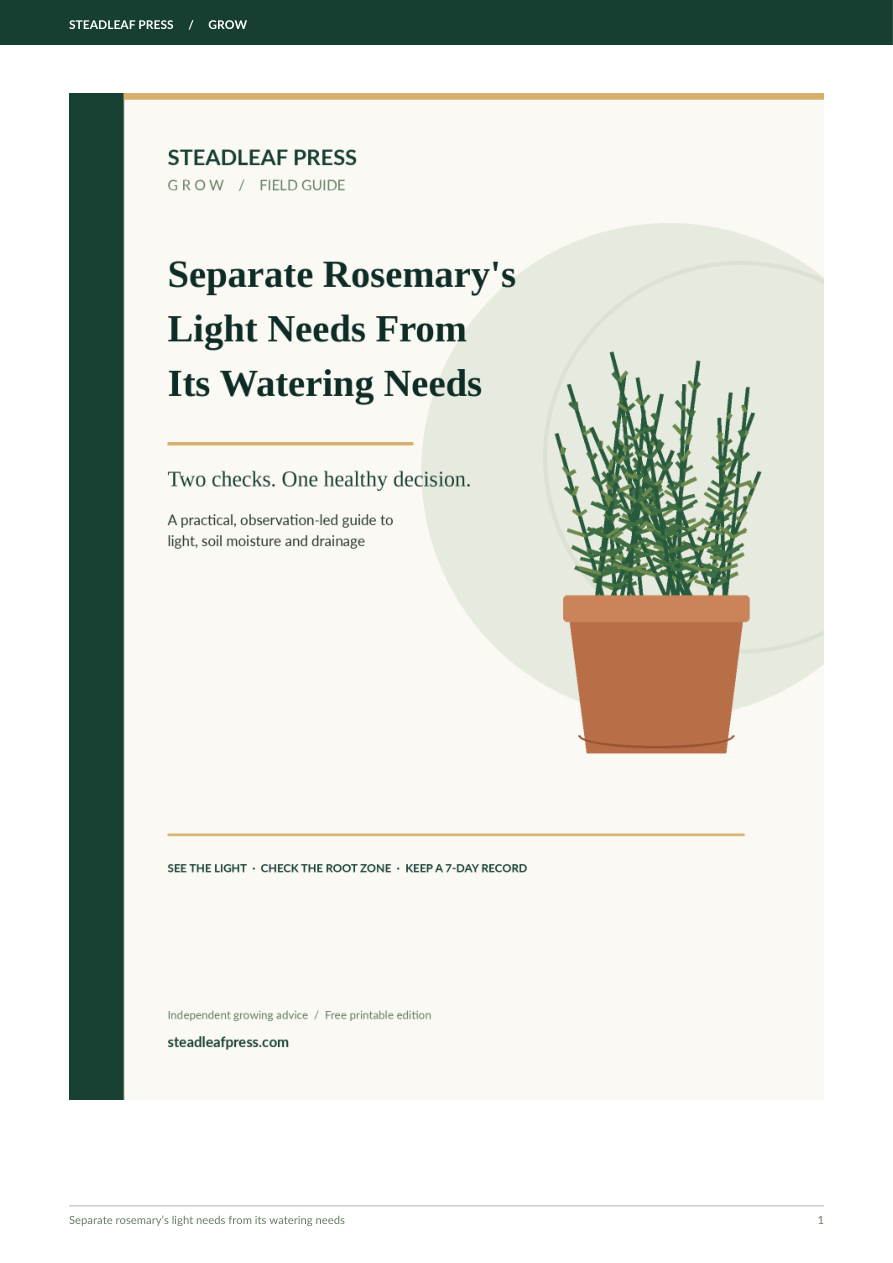
Separate Rosemary's Light Needs From Its Watering Needs
Two checks. One healthy decision.
Download the complete free guide
Understand rosemary's light requirements separately from the moisture and drainage of its pot using a practical two-factor guide and seven-day care record.
Includes complete illustrated instructions and any printable worksheets or templates.
Download free PDFRead the complete free guide online
The instructional text is below. For exact-size patterns, illustrations and printable records, use the complete free PDF above.
STEADLEAF PRESS / GROW
Separate rosemary’s light needs from its watering needs 1
STEADLEAF PRESS / GROW
Two checks. One healthy decision.
An observation-led, two-factor care guide for a potted rosemary plant
Rosemary can look thirsty while its roots are sitting in damp compost. It can also look perfectly green in a dim window and then slowly become sparse. Those situations need different responses. More water will not replace daylight, and a sunny position will not cure a pot that never drains.
This guide gives you two separate checks–light and water/root conditions–before you decide what to change. It is written for one ordinary, culinary rosemary plant (Salvia rosmarinus) in a movable container, not for an established hedge in garden soil. You will leave with a two-column record and one cautious action for the next week, rather than a rigid watering calendar.
First, identify your starting point
Look at the actual plant and its position for two minutes. Is the pot indoors, outside or moving between the two? Does it have drainage holes? Is it inside a decorative outer pot? When did anyone last water it? Does the plant look firm, pale, sparse, newly transplanted, or plainly wilted? Write observations before interpreting them.
Do not diagnose by colour alone. Yellowing, brown tips and drooping can arise from several interacting causes. Check the growing medium and light exposure; a single leaf cannot tell you which one is responsible. If the roots are black and soft or the pot smells sour, possible rot deserves more attention than any routine adjustment. If you cannot safely lift the pot or assess a large shrub, seek local gardening advice instead of pulling apart healthy roots.
Separate rosemary’s light needs from its watering needs 2
STEADLEAF PRESS / GROW
Check A: light, without touching the watering can
Rosemary is a sun-loving Mediterranean herb. The Royal Horticultural Society recommends a full-sun position with free-draining growing medium. For an indoor culinary plant, University of Maryland Extension suggests a bright south-or west-facing window with at least five hours of sun for many herbs, and notes that supplemental lighting may be necessary in winter. University of California Master Gardeners likewise notes that indoor rosemary needs strong light or appropriate supplemental lighting. Those are useful starting references, not a guarantee that every window receiving five hours will support healthy growth: glass, screens, overhangs, neighbouring buildings, season and latitude change the amount of light actually reaching the foliage.
To measure your real exposure, record three intervals on one ordinary day: morning, midday and late afternoon. At each check, mark whether the rosemary foliage receives direct sun, bright indirect light, or a visibly dim position. Direct sun means that sunlight itself reaches the leaves, not merely that the room feels bright. Note window obstructions. Repeat on another day if clouds make the first observation unrepresentative. Do not use compass direction as a substitute for looking.
Possible light shortage: persistent weak or stretched new shoots; a plant leaning steadily toward the window; thinning growth despite reasonable root conditions. These signs suggest reviewing light but do not, by themselves, prove a diagnosis. A sudden move from a dim room into intense midday sun may scorch foliage: adapt a plant gradually, especially outdoors after winter. Keep it away from radiator blasts and very hot glass.
What to change if light is the likely limit: move the same pot to a brighter appropriate position, keeping water decisions separate. If that is impossible, a suitable horticultural light could help, but follow the lamp manufacturer's safe distance and timing instructions and reassess the result. Do not call a dim kitchen counter a viable sunny growing site merely because the plant survives there for a short time.
Check B: water and drainage, without moving the pot first
Now check the growing medium, not the clock. Place a finger carefully into the upper medium where accessible, away from the stem base, and compare surface dryness with moisture slightly deeper. If you cannot reach the compost, lift the container before and after a normal watering to learn its approximate weight; compare only the same pot. Where the surface is dry but the lower profile is still very damp, another drink may be premature. A small pot and a large pot can dry at very different rates even in identical sun.
An ordinary pot should have open drainage holes and a medium that drains freely. If rosemary sits in a solid decorative sleeve or saucer of water, empty the standing water; remove the inner pot to water and let it drain before replacing it. A deep pot full of heavy, wet medium is not made safe by simply skipping a day. If the plant has been recently repotted, check for excess unused wet compost around a small root ball. Do not promise that adding stones to the bottom will fix poorly draining medium; choose a suitable pot and potting mix instead.
The RHS describes rosemary as drought tolerant once established, but that does not mean a small newly transplanted or heat-exposed container can go indefinitely without water. Penn State Extension advises allowing rosemary to dry slightly between waterings. In prolonged hot, windy weather a container may need frequent checking; in cool, low-light winter conditions it may take much longer to dry. Use what you observe, not “water every Sunday.”
If water is genuinely needed: water the medium carefully and thoroughly enough for it to wet evenly and drain, provided the pot and medium work as intended. Discard drainage promptly. Avoid repeated tiny splashes that moisten
Separate rosemary’s light needs from its watering needs 3
STEADLEAF PRESS / GROW
only the surface. Do not water heavily again just because the plant is wilting if the compost remains persistently wet. If the mix has become hard, water-repellent or very compacted, the problem may require a considered repotting rather than a series of increasingly large watering attempts.
The two-factor decision table
Make one decision from the combined observations, not from the appearance of a single leaf.
Light check Medium / drainage check Most useful next move What not to do
Clearly dim; medium still Persistently damp or water Remove standing water, verify Do not add water to 'perk it up' or give a wet for days trapped in outer pot drainage, and improve light gradually large fertiliser dose
Clearly dim; medium has No obvious drainage Improve light first, then monitor Do not water more solely because the dried normally problem medium as conditions change leaves look thin
Sunny; surface and root Water can run freely from Water thoroughly, drain, and reassess Do not impose the same interval on every zone unusually dry, pot base later future week light
Sunny; medium wet or Wet roots or blocked Stop routine watering, empty outer Do not assume sun compensates for musty, pot heavy drainage are plausible pot, inspect drainage, seek advice if waterlogging decay appears
Mixed or uncertain No urgent damage visible Change just one variable and keep a Do not relocate, repot, fertilise and soak evidence seven-day record simultaneously
This table is a cautious triage tool, not a definitive plant-disease diagnosis. When stems are dead, roots show obvious decay, or multiple plants have unexplained symptoms, extension advice or a local nursery may be more appropriate.
Set up one container correctly
Choose a stable pot with working drainage holes. Give the roots room without moving a tiny plant into a very large reservoir of compost. Rosemary generally favours a free-draining medium and good air movement. The RHS advises a substantial container for long-term rosemary growth (roughly 30 cm wide and deep for a garden-sized plant); a smaller nursery plant can initially remain in a smaller appropriately sized pot, with repotting based on root growth and actual conditions. Do not treat a single pot dimension as mandatory for every cultivar and growth stage.
Place the container so that it will not fall from a balcony or sill and runoff will not damage a building or a neighbour's property. Check building rules and local freeze risk. Rosemary cold tolerance varies by cultivar, exposure and whether roots are protected by the ground; container roots can freeze more readily. Plan a bright protected winter location where needed. When bringing a plant inside, inspect it for insects before placing it beside other houseplants. Keep wet pots clear of electrical equipment and heater outlets.
Because this guide is about identifying two independent causes, do not repot as the first reaction to every yellow leaf. Repot only with a reason–such as poor drainage, a severely unsuitable medium, or a genuinely crowded root system–and then observe the result before adjusting fertiliser or pruning.
Separate rosemary’s light needs from its watering needs 4
STEADLEAF PRESS / GROW
A seven-day rosemary care record
Use this compact record for one pot. Write “not checked” when you missed a day; guessing will not improve your diagnosis.
Day Light observed (direct / Top and deeper medium (dry / Pot weight or drainage note Plant change and single action indirect / dim) partly damp / wet)
1
2
3
4
5
6
7
At the end, answer three short questions: Was the light actually adequate for the season? Did the medium dry between appropriate waterings? Was there one small change followed by a useful observation? A steady plant with healthy new growth does not need to be changed simply to fill in a care checklist.
Four practical scenarios
The kitchen rosemary beside a bright-looking north window. The room is pleasant but direct light rarely reaches the leaves. Before changing the watering schedule, find a genuinely sunnier position or suitable grow light, then check how faster or slower drying changes the watering decision. Window directions vary in usefulness between hemispheres and with surrounding buildings; observe the leaf level.
The rosemary in an attractive ceramic outer pot. Its plastic nursery pot has drainage holes, but water collects invisibly inside the decorative cover. Lift the inner pot after watering, let it finish draining and empty the outer pot. The solution is access to drainage, not a ritual of withholding every future drink.
The windy summer balcony. Direct sun is ample, but a small dark container dries quickly and feels very light. Check it more frequently during heat and wind; give needed water and drain it. Once the weather cools, reduce the frequency of checks or watering based on the new observations rather than extending a summer timetable into autumn.
The rosemary brought indoors for winter. Daylight drops, indoor air may be dry, and compost may remain wet longer than expected. Improve light, avoid heating vents, ensure moving air and compare soil moisture before watering. Warm dry air does not mean the roots need water daily. Never assume the outdoors and indoors share a watering interval.
Separate rosemary’s light needs from its watering needs 5
STEADLEAF PRESS / GROW
Troubleshooting without overcorrecting
• A few brown tips after a move: inspect the change in light intensity, wind, soil wetness and temperature before deciding what caused it. Do not immediately cut off all new growth.
• Wilting with very wet medium: do not blindly flood the pot. Check the drainage path and root condition; persistent root problems may require expert help.
• Dry surface but heavy pot: wait to understand deeper moisture, unless there is compelling evidence of a dry root ball. The surface alone can mislead.
• Sparse winter growth: first check actual daylight, heat and air movement. Fertiliser is not a replacement for light.
• A plant sold as a tiny holiday topiary: decorative shape and a small peat-based pot can make care less forgiving. After purchase, inspect its container, light location and drainage rather than assuming it is a permanent low-light decoration.
These are possible interpretations, not promises of recovery. A severely damaged plant may not survive even when its environment is improved. Do not use pesticides or household chemical treatments based on this guide alone; identify the cause and follow local regulations and product labels if a specific pest is confirmed.
Before harvesting
Only use an accurately identified culinary rosemary plant intended for food. Ornamental plants may have received treatments not suitable for edible harvest; ask the supplier if the growing history is uncertain. Wash harvested sprigs as appropriate for food preparation and avoid harvesting from roadside or otherwise contaminated sites. Take modest leafy tips from a healthy plant rather than stripping its bare woody framework. If the plant is struggling with light or root problems, stabilising care is more valuable than maximising a harvest this week.
Your one-page conclusion
Light diagnosis: __________________________ Evidence: __________________________
Water/drainage diagnosis: __________________ Evidence: __________________________
The one change I will make first: _________________________________________________
When I will check the result: __________________ What would change my mind: __________________
Rosemary asks for sunlight and well-drained roots, but those are two separate conditions. Check each honestly. Make one change, watch the plant, and let the next action follow the evidence rather than the calendar.
Source notes and further reading
These are horticultural reference sources, not claims that an authority has reviewed this specific guide. Read them for regional nuance and cultivar differences.
1. Royal Horticultural Society – How to Grow Rosemary. Full-sun preferences, free-draining pots, winter care and container size for mature rosemary. 2. Penn State Extension – Growing Herbs Indoors. Indoor drainage, rosemary drying slightly between waterings, general container guidance. 3. University of Maryland Extension – Growing Herbs in Containers and Indoors. Indoor light, seasonal adjustment and drainage. 4. University of California Master Gardeners of Santa Clara County – Rosemary. Light, soil, relative drought tolerance, indoor supplemental lighting, cultivar variation.
Separate rosemary’s light needs from its watering needs 6
STEADLEAF PRESS / GROW
5. Iowa State University Extension – What Growing Conditions Are Best for Indoor Herbs?. Light as a limiting factor, pots, avoiding overpotting, winter feeding cautions. 6. Chicago Botanic Garden – Rosemary Topiary. Indoor winter light, air movement, damp-medium risk and the effects of heat.
Visual & production credits
Original botanical illustration, two-factor care diagram, page design and worksheet: Steadleaf Press. No external photograph is represented as an actual site or cultivar-specific specimen. This visual edition preserves the reviewed source text; production-only metadata is omitted.