GROW / FREE GUIDE
Choose a Balcony Tomato That Fits Its Pot
A support, exposure and container checklist before you bring a plant home.
Download the complete free guide
Use a practical site and cultivar checklist to decide whether a balcony tomato can be supported, lit, watered and safely accommodated before purchase.
Includes complete illustrated instructions and any printable worksheets or templates.
Download free PDFRead the complete free guide online
The instructional text is below. For exact-size patterns, illustrations and printable records, use the complete free PDF above.
STEADLEAF PRESS / GROW
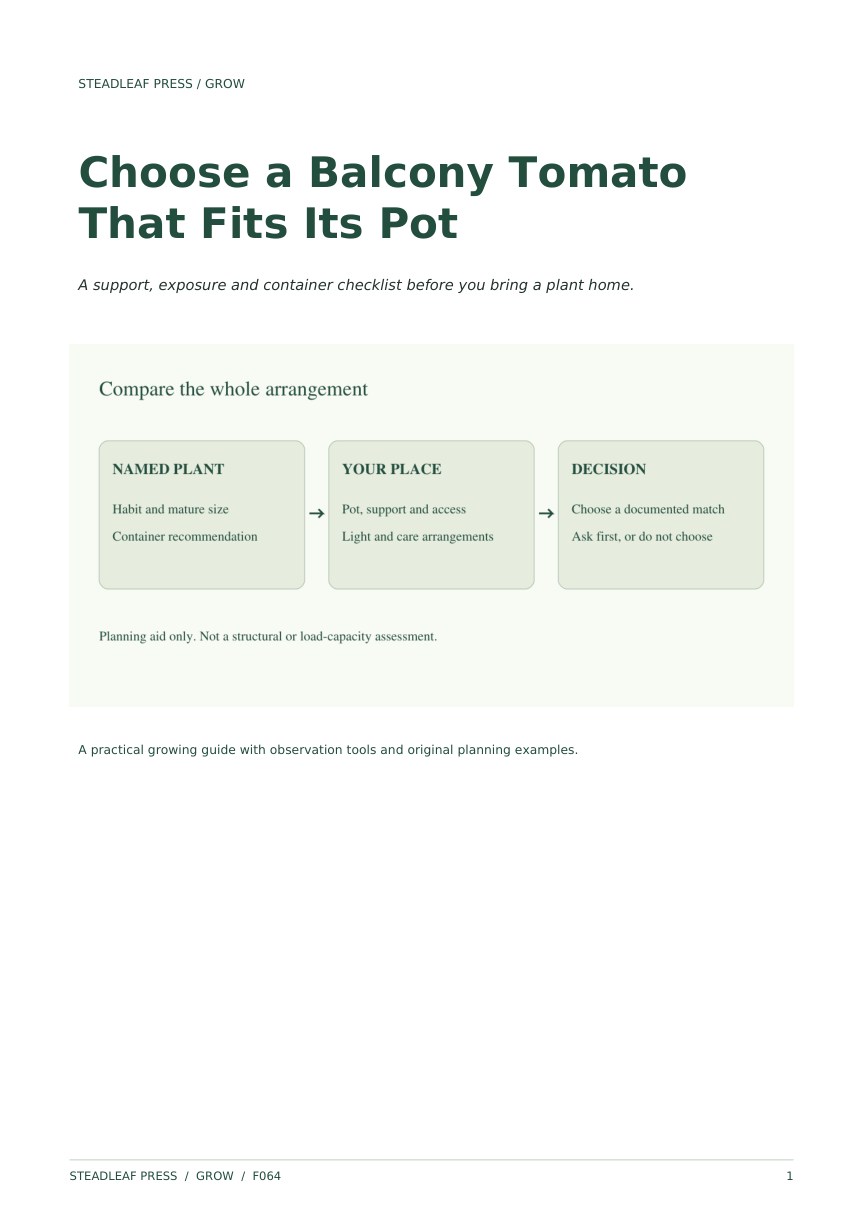
A practical growing guide with observation tools and original planning examples.
STEADLEAF PRESS / GROW / F064 1
The plant in the nursery is small. The plant you need to accommodate is the one it will become. Start with that difference and a balcony tomato becomes a more manageable choice.
Your result from this guide is one of three decisions: a documented match, a question to resolve before buying, or a decision not to grow a tomato in that spot this season. A full shopping bag is not the measure of success.
1. Describe the place before the plant
Stand where the pot could actually sit, not where you wish it could sit. Record the space available after keeping doors, access and everyday use clear. Include the room a plant and its support would occupy above the pot.
Write down direct sunlight observed at the growing position, rather than calling the whole balcony “bright.” Iowa State Extension describes six or more hours of direct sunlight for tomatoes. Its container guidance also warns that sun and wind speed drying, so a sunny place still needs a realistic watering plan. [1]
Do not infer balcony capacity from how substantial the floor looks. Where permission, loading, attachments or drainage arrangements are uncertain, resolve them with the responsible building contact before choosing a heavy filled container. This guide cannot certify a balcony, railing, bracket or support. Do not hang a new load from a railing on the strength of a photograph.
Site note
- Proposed position: ______
- Direct sun observed, with date: ______
- Available width, depth and height: ______
- Door and access kept clear: ______
- Watering access and acceptable drainage route: ______
- Building restrictions checked, or question still open: ______
An unanswered field is useful information. Keep it visible instead of replacing it with a guess.
2. Read the growth habit, not just the fruit picture
RHS distinguishes tall cordon tomatoes from more compact bush types and dwarf or trailing varieties. A small fruit does not, by itself, identify a small plant. Look for the named cultivar and its growth description. A label that says only “cherry tomato” leaves an important question unanswered. [2]
Ask the supplier: “How large does this cultivar grow, what container does it need, and what support is recommended?” Keep the answer with the cultivar name. Do not combine one variety's attractive fruit photograph with another variety's convenient height.
STEADLEAF PRESS / GROW / F064 2
Label information What to establish before choosing
Dwarf or compact Actual expected dimensions and container recommendation
Bush / determinate Spread, fruit-bearing support needs and space around the pot
Cordon / indeterminate Available support height and the ongoing training required
Trailing Where stems can extend without blocking access or hanging into an unsafe space
Habit missing Obtain the cultivar information before deciding
Iowa State identifies determinate and dwarf types as generally easier container candidates because they are less likely to outgrow the arrangement. This is a useful shortlist, not a promise that every dwarf variety fits every pot. [1]
3. Match the container to that named plant
Do not use the temporary nursery pot as the mature-container specification. RHS gives a general range of 30–45 cm diameter for one tomato plant in a pot. Treat this as context, then check the chosen cultivar and the container's usable dimensions. Diameter alone does not tell you how much mix a shallow bowl holds. [2]
Check drainage holes and choose a suitable container-growing medium rather than filling the pot with dense garden soil. Iowa State explains the advantages of a well-draining potting mix for container roots. [1]
Record the manufacturer's capacity if available, along with diameter and depth. Keep the original units. A number described merely as “gallons” can be ambiguous between measurement systems; ask which capacity is meant rather than silently converting it.
Your comparison is between the plant's documented needs and the pot you actually have. If the match fails, change the candidate or the container. Do not rename the mismatch an experiment unless you are prepared for it not to produce a worthwhile crop.
4. Include support in the choice
Choose the support at the same time as the plant. Ask how it is installed, how much space it takes and whether you can reach the plant for normal care without leaning over an edge. A support that fits an empty pot may occupy the only usable walkway once a plant spreads around it.
Keep growing-habit instructions separate. RHS advises removing side shoots for cordon training, whereas bush tomatoes retain theirs. Do not apply a cordon pruning routine merely because a video showed someone pinching a tomato. [2]
STEADLEAF PRESS / GROW / F064 3
This guide specifies no improvised building attachments, ballast calculation or wind rating. If the site needs an engineered anchoring solution, pause rather than inventing one from household materials.
5. Compare two real candidates on paper
Use one column per named cultivar. Blank fields mean “not confirmed,” not “probably fine.”
Question Candidate A Candidate B
Cultivar and source of information ______ ______
Growth habit ______ ______
Expected height and spread ______ ______
Recommended container dimensions/capacity ______ ______
My actual container matches? ______ ______
Support and required space ______ ______
Growing position and season suitable? ______ ______
Care access possible without obstruction? ______ ______
Question remaining ______ ______
Choose / ask / do not choose ______ ______
Attach or retain the plant label. Do not copy a generic “days to harvest” number into a promised date for your balcony. If local season or outdoor planting timing is uncertain, ask for locally applicable advice.
Fictional example: the misleading cherry label
Rina has selected a place and a pot but not a plant. One label shows tiny red fruit and says nothing about habit. A second names its cultivar and gives a compact growth description. Rina does not assume the first plant is smaller because its tomatoes look smaller. She asks about both, then completes the support and container fields before choosing. The useful action is the missing-information check, not a preference for one fruit size.
Fictional example: a pot that fits but a plant that does not
Owen measures a narrow space beside a door. His proposed container fits on the floor. Once he adds the documented plant spread and support footprint to his sketch, the arrangement would obstruct the door. He rejects that position. He has not failed at gardening; he has avoided buying a plant for a space he cannot use.
STEADLEAF PRESS / GROW / F064 4
6. Make a care commitment you can actually keep
Before purchase, name who will check the container when you are away and how they will reach it. Write “no arrangement yet” if that is the truth. Do not assume a larger container or a drought-tolerant marketing phrase removes the need for care.
For container tomatoes, Iowa State advises checking watering needs frequently, wetting the root zone and allowing excess to drain; both drying completely and persistent overwatering cause problems. [1] The practical commitment is regular observation, not an identical jug of water on a fixed schedule.
Record fertilizer instructions from the actual product and growing mix rather than adding a universal recipe to this checklist. This is a selection guide, so detailed feeding, pest diagnosis and harvest handling belong to appropriate crop guidance, not guesses made at the shop.
7. Your before-purchase decision
Complete one sentence:
I will choose ______ because its documented habit, container and support requirements fit ______. The unresolved question is ______.
If the last blank concerns permission, safe placement or basic plant requirements, resolve it before purchase. If you cannot make a match, keep the notes. They will make the next comparison faster.
A suitable tomato is not simply the smallest plant on the display. It is a named plant whose eventual size, pot, support and care fit the place you can genuinely offer.
STEADLEAF PRESS / GROW / F064 5
Sources and production boundaries
[1] Iowa State University Extension and Outreach, Aaron Steil, Growing Tomatoes in Containers, reviewed April 2024; accessed November 18, 2026. Used for container habit, sunlight, growing medium and watering principles. Regional harvest dates and fertilizer recipes are not transplanted into this guide. https://yardandgarden.extension.iastate.edu/how-to/growing-tomatoes-containers
[2] Royal Horticultural Society, How to Grow Tomatoes, accessed November 18, 2026. Used for growth types, general pot-diameter context and the distinction between cordon and bush side-shoot management. Cultivar-specific advice remains necessary. https://www.rhs.org.uk/vegetables/tomatoes/grow-your-own
All comparisons, worksheets and examples are original editorial material. Examples are fictional, not test results. No third-party diagrams or photographs are reproduced.