GROW / FREE GUIDE
Grow Spring Onions From Seed in a Pot
A small sowing, enough room to grow, and a harvest you can account for.
Download the complete free guide
Grow spring onions from named seed in a draining container, with a practical spacing plan and separate records for whole-plant harvest and clipped leaves.
Includes complete illustrated instructions and any printable worksheets or templates.
Download free PDFRead the complete free guide online
The instructional text is below. For exact-size patterns, illustrations and printable records, use the complete free PDF above.
STEADLEAF PRESS / GROW
A practical growing guide with observation tools and original planning examples.
STEADLEAF PRESS / GROW / F066 1
There is a particular pleasure in taking just the few spring onions you need and leaving the rest growing. To get there, begin with seed meant for this crop and decide how you will use it. Pulling a whole onion and clipping a leaf are different harvests. Confusing them makes a small pot seem either more productive or less successful than it really is.
This project takes you from one labeled sowing to a first useful harvest. It does not promise a certain number of meals, a fixed finish date or continuous regrowth.
1. Buy seed, not an assumption
“Spring onion,” “salad onion,” “scallion” and “bunching onion” can overlap in everyday use. RHS describes salad varieties of both Allium cepa and Allium fistulosum. Choose a packet explicitly intended for salad or bunching onions and retain its variety name and directions. [1]
This guide starts with seed. A leftover supermarket base in water is a different project. Bulb-onion sets and a packet for large storage onions are not interchangeable starting materials.
On the label for your pot, write the variety and actual sowing date. On the back, write where the packet is stored. That small habit saves a later search when you need to check spacing or whether the variety forms a small bulb.
2. Prepare a pot you can reach
RHS recommends a pot at least 30 cm wide for salad onions. Oregon State's bunching-onion guidance specifies a container at least six inches deep with drainage holes. Check the actual internal dimensions and any more specific recommendation for your variety; do not count a decorative base as growing depth. [1][2]
Use a container with a known, suitable history, working drainage and appropriate potting compost. RHS names peat-free multipurpose compost for this crop. Place it where you can inspect and harvest comfortably. [1] A pot balanced on a narrow ledge is not a solution to limited floor space.
Before filling it, answer three practical questions: Where will excess water go? Can I reach the plants without leaning over an edge? Does the position comply with any building restrictions? No planting instructions in this guide certify the structural capacity of a balcony or shelf.
Oregon State describes full sun or part shade for bunching onions. [2] Record the light at the pot itself. Do not assume a dim indoor corner will behave like an outdoor position simply because a window is nearby.
3. Sow a modest patch
Read the packet before opening it. RHS's container method is to scatter seed thinly and cover with about 1 cm of compost. Its guidance thins seedlings to about 2.5 cm apart. Use your packet's cultivar-specific directions where they differ. [1]
For a first pot, choose one sowing date rather than mixing several unmarked batches. Keep the packet over a tray while handling seed so an accidental spill does not turn into an unintended dense sowing. After covering and watering gently, put the dated label in place.
STEADLEAF PRESS / GROW / F066 2
Write down what you did:
Variety: ______
Sown on: ______
Depth used and source of instruction: ______
Planned final spacing: ______
Growing position: ______
These are records of your actions, not a form the plant must obey.
4. Give the emerged plants room
Oregon State advises spacing bunching onions at least one inch apart, keeping weeds away and maintaining even moisture. [2] Compare the emerged plants with the spacing instruction you chose. A crowded tuft is not automatically a more generous future harvest.
When thinning, work carefully around the plants you intend to keep. Do not postpone every spacing decision until harvest just because removing seedlings feels wasteful. Record the approximate number remaining, or describe the planted area if counting would serve no useful purpose.
Look at the pot before watering. Containers and ground beds do not dry at the same rate. Keep drainage functioning; “evenly moist” is not a direction to leave the container standing in water. If growth declines, record what you see and check conditions before naming a disease or buying a treatment. This guide is not a pest-identification key.
A quiet first-week routine
Choose a moment that fits your day to look at the pot, its surface and its label. Do not dig up seed to check whether it is alive. Record emergence when you first see it, leaving that field blank until then. If the packet's expected window passes without shoots, review the seed and conditions instead of inventing an emergence date to keep the chart complete.
5. Choose what to harvest
RHS describes lifting individual young salad onions as required, commonly around 15 cm tall, with timing varying by crop and conditions. [1] Oregon State also describes clipping leaves from bunching onions for regrowth, or loosening the soil when lifting the whole plant. [2]
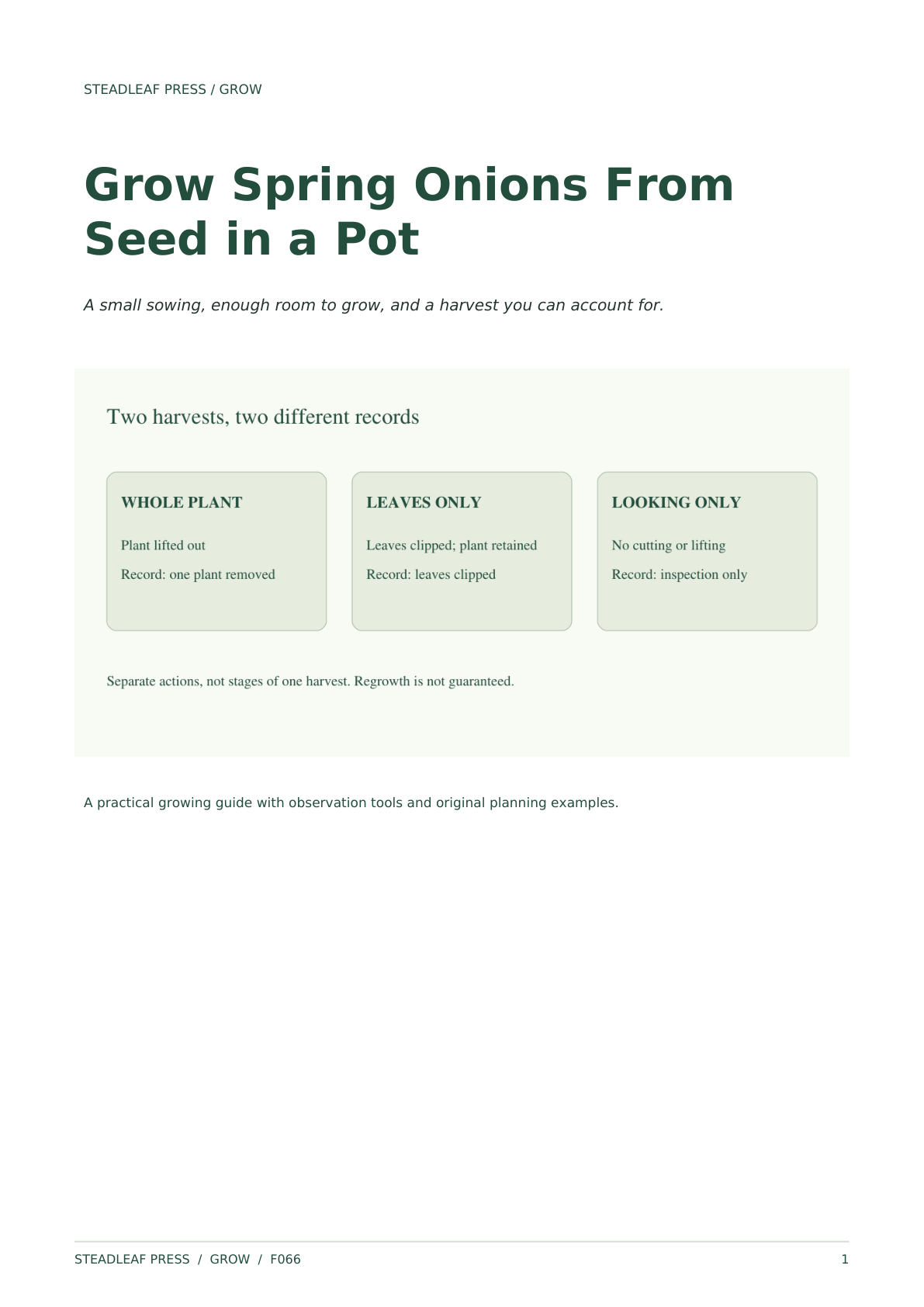
For your first trial, the simplest record is a whole-plant harvest: take a suitable individual plant, record it as removed, and leave the others undisturbed as far as possible. Do not count the same plant as still available next week.
If your variety and its instructions suit leaf clipping, keep a separate record of that action. A clipped leaf is not a whole onion harvested. Do not apply a promise of indefinite regrowth: keep observing the plant and follow its crop guidance.
STEADLEAF PRESS / GROW / F066 3
What you did Record it as What remains
Lifted an entire plant One plant removed A gap; the neighboring plants remain
Clipped leaves from a retained Leaves clipped That plant remains for further plant observation
Looked at the crop without Inspection only No harvest to count harvesting
Use clean hands and tools. Rinse harvested onions before use; discard spoiled produce and do not use an unknown spray history as a reason to assume a crop is safe. Follow appropriate food-handling guidance outside this growing project.
6. Two small decisions that change the experience
Fictional example: only three are needed. Dev reaches for the pot intending to pull a handful. He realizes he wants three whole spring onions, not the whole planting. He selects three, records them as removed, and leaves the rest. His next check begins with what remains, not with the number of seeds originally sown.
Fictional example: the wrong kind of harvest total. Leena writes “six onions” after clipping six leaves. Later she cannot understand why the pot still contains the same plants. She changes the entry to “six leaves clipped.” Nothing about the growing has changed; her record now describes it accurately.
Neither example predicts yield or tells you how much a particular plant can spare. Their purpose is to keep the observation honest.
STEADLEAF PRESS / GROW / F066 4
7. Finish one cycle before promising the next
Date Stage observed Action actually Plants removed or Next question taken leaves clipped
______ ______ ______ ______ ______
______ ______ ______ ______ ______
______ ______ ______ ______ ______
______ ______ ______ ______ ______
When you have made a useful harvest, note what helped and what you would change. Perhaps the pot was easy to reach but the sowing was crowded. Perhaps the harvest was smaller than you imagined but well suited to how you cook. Those are better starting points for another batch than a promise to be self-sufficient.
A later sowing gets a new date and its own label. Check whether local conditions and the packet still suit sowing. Keep regional calendars in their context; an Oregon or British planting month is not a worldwide instruction.
The result you are aiming for is modest: a correctly identified crop, enough room for it, and a clear account of what you harvested. That is a repeatable beginning.
Sources and editorial boundaries
[1] Royal Horticultural Society, How to Grow Salad Onions, accessed November 18, 2026. Crop identity, pot width, compost, sowing depth, thinning and whole-plant harvesting. https://www.rhs.org.uk/vegetables/salad-onions/grow-your-own
[2] Oregon State University Extension, Onions (Bunching), January 2022; accessed November 18, 2026. Container depth/drainage, light, moisture, spacing and distinction between leaf and whole-plant harvest. Oregon regional dates are not adopted as a universal calendar. https://extension.oregonstate.edu/imported-publication/onions-bunching
All examples and recording tools are original. No growing trial has been conducted for this manuscript.