GROW / FREE GUIDE
Start a Compact Pepper Plant in Warm Conditions
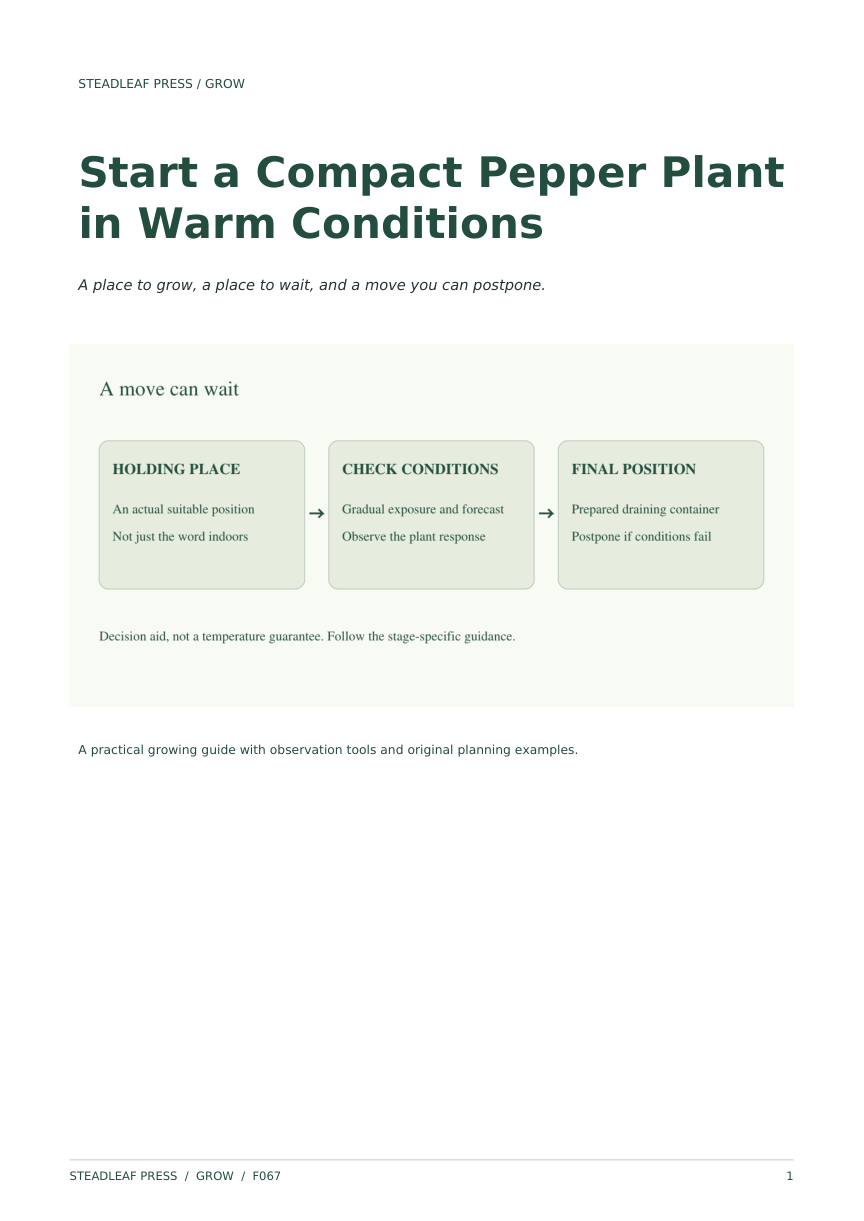
A place to grow, a place to wait, and a move you can postpone.
Download the complete free guide
Choose a compact sweet-pepper variety and a realistic warm-location plan for seed starting, transplant timing and temporary shelter without promising harvests.
Includes complete illustrated instructions and any printable worksheets or templates.
Download free PDFRead the complete free guide online
The instructional text is below. For exact-size patterns, illustrations and printable records, use the complete free PDF above.
STEADLEAF PRESS / GROW
A practical growing guide with observation tools and original planning examples.
STEADLEAF PRESS / GROW / F067 1
The tempting part of a pepper plant is often already on its label: glossy fruit, a small pot, a promise of summer. The useful question comes before that picture. Where will this plant spend a cold night?
For a first attempt, plan for one named compact sweet-pepper variety. This guide helps you decide whether to raise it from seed or start with a young plant, then make an outdoor move based on conditions rather than impatience. Success at this stage means an established plant in a suitable place. A fruit count is not part of the promise.
1. Give the plant two addresses
Write down a final growing position and a temporary holding position. “The balcony” and “indoors” are not yet precise enough. Name the actual patch of floor or shelf, and check that the plant and its pot fit there.
The holding position matters even if you buy a plant rather than sow seed. A purchase date does not make the weather ready. UMN advises treating mail-order young plants like home-raised seedlings when they arrive before outdoor planting conditions. [2]
Before buying, record:
- The full variety name, not just “patio pepper.”
- Whether it is sold as an edible sweet pepper.
- The stated mature height and spread.
- The supplier's container and growing-location guidance.
- The space you have measured, including access around the pot.
- Who will move the plant back under cover if the weather changes.
Do not substitute an unidentified ornamental plant for an edible crop. Keep the original label with your notes rather than relying on a photograph of its fruit.
2. Choose a starting point you can support
Choose a young plant if your aim is one pot and you cannot provide a suitable seed-raising setup. Look for a sturdy plant rather than choosing by height alone; UMN recommends avoiding plants with spotted leaves. [2]
Choose seed if you want to manage the earlier stages and can follow the packet's temperature, depth and timing instructions. Work backward from a realistic local outdoor-planting window, not from the date you would like to eat a pepper. UMN's home-garden guidance uses roughly eight weeks of indoor preparation, but that is a planning reference rather than a universal calendar. [2]
A seed packet containing many seeds is not an obligation to raise many plants. Count your final places first. Keep a few clearly labeled starts if you have space, but decide in advance where any extras would go.
STEADLEAF PRESS / GROW / F067 2
3. Separate the temperatures
A germination setting is not an outdoor night threshold. A warm afternoon is not evidence about either.
For sweet peppers, RHS gives these stage-specific references: germination at 18–21°C (65–70°F); seedlings in bright light at 16–18°C (60–64°F); outdoor planting only when nights are reliably above 12°C (54°F), with growth better above 15°C (59°F). Temperatures above 30°C (86°F) can reduce fruiting. These are horticultural references, not a guarantee for every variety or location. [1]
Use the seed supplier's directions for your chosen variety. Record what you are measuring: air near the plant or the seed-starting medium. Do not silently treat one as the other.
A minimum/maximum thermometer can make the question more concrete. Place and use it according to its instructions; a device heated by direct sun may not represent the surrounding air. Record its location so that tomorrow's reading is comparable. Check the forecast as well as past measurements. Neither tells you with certainty what a small balcony corner will do next week.
Decision Evidence to write down If the answer is missing
Start seed now? Packet instructions and available Read the packet and prepare the growing space space first
Buy a young plant now? A usable holding place Delay purchase or arrange a suitable place
Begin outdoor acclimatisation? Mild conditions and time to Keep the current arrangement supervise
Leave outside overnight? Local forecast, measured Bring it back to the holding place conditions and plant response
Make the final move? All the above plus a prepared Postpone the move, not the container observation
The table is a decision aid, not a substitute for local growing advice.
4. Prepare the destination before moving day
RHS recommends one sweet pepper in a container at least 30cm (1ft) wide, filled with peat-free multipurpose compost. Choose a draining container and follow any larger requirement for your variety; a wide, shallow decorative dish is not an equivalent growing pot. [1]
Put the empty container in its intended position before filling it. Check the route to the holding place, including doorways and steps. If you cannot move the filled pot comfortably, do not make repeated lifting the central feature of your weather plan. Arrange an accessible setup before planting.
STEADLEAF PRESS / GROW / F067 3
Have the potting mix, label, water and any required support ready. Leave room to reach the plant without stepping around unstable objects. This guide does not assess balcony load capacity, rail attachments or wind safety.
5. Acclimatise, then transplant
RHS advises gradual hardening off for about two weeks before outdoor planting. This is a transition, not a test of how much stress the plant can withstand. [1]
UMN describes starting in a wind-protected position with a short sun exposure, increasing exposure gradually, and returning plants indoors when nights become too cool. It also recommends transplanting on a calm, cloudy day or in late afternoon. [2]
Use a simple entry each day: where it stood, how long, the conditions, and what you noticed afterward. Do not extend the next outing merely because the previous one was on the calendar. If conditions are unsuitable, pause.
For transplanting, water the young plant beforehand, make room for its root ball, and handle it without unnecessarily disturbing the roots. Keep the old soil level at the new surface, firm gently, and water in. These steps follow UMN's transplant guidance. [2]
After the move, record the actual date. Leave the planned date visible beside it. The difference is useful information, not a failed deadline.
6. Two ordinary decisions
These are fictional planning examples, not growing trials.
Nina has a sunny balcony but no holding place. She finds a compact plant at a weekend market. Rather than buying it and improvising later, she takes down the variety name and asks about another delivery date. Her next action is to clear and assess a suitable temporary position. She has not failed to start; she has avoided a plant with nowhere to wait.
Owen has raised a seedling and pencilled in Saturday for transplanting. His notes show acceptable daytime conditions, but the forecast changes. He crosses out only the move, not the whole project. He keeps the label, prepared pot and observation sheet ready. When conditions improve, he can make a measured decision instead of repeating all the preparation.
Neither example predicts a harvest. Both protect the usefulness of the work already done.
STEADLEAF PRESS / GROW / F067 4
Your one-plant move sheet
Variety: ____________________
Seed or young plant: ____________________
Packet/supplier directions kept at: ____________________
Final position: ____________________
Holding position: ____________________
Container dimensions and drainage checked: ____________________
Temperature measuring location: ____________________
Local advice/forecast source: ____________________
Date Position and Temperature Plant observation Next action exposure observation / forecast
Planned transplant date: ____________________
Actual transplant date: ____________________
Reason for any change: ____________________
Keep this sheet after the move. Next season, the most useful note may be the reason you waited.
STEADLEAF PRESS / GROW / F067 5
Sources and limits
[1] Royal Horticultural Society: How to grow sweet peppers, checked 18 November 2026. Stage temperatures, outdoor transition and container reference. The source's UK month-based timetable is not presented here as a global calendar.
[2] University of Minnesota Extension: Growing peppers in home gardens, checked 18 November 2026. Starting-point choices, gradual exposure and transplant handling. Regional garden advice is not a guaranteed container harvest schedule.
The worksheet and scenarios are original editorial planning tools. No physical growing trial, harvest test or site-safety inspection was performed.