GROW / FREE GUIDE
Choose Edible Crops for a Four-Hour-Sun Site
A practical light-and-harvest expectation matrix
Download the complete free guide
Measure real sunlight and choose modest edible container crops matched to a four-hour sun site, using a crop comparison matrix and observation log.
Includes complete illustrated instructions and any printable worksheets or templates.
Download free PDFRead the complete free guide online
The instructional text is below. For exact-size patterns, illustrations and printable records, use the complete free PDF above.
STEADLEAF PRESS / GROW
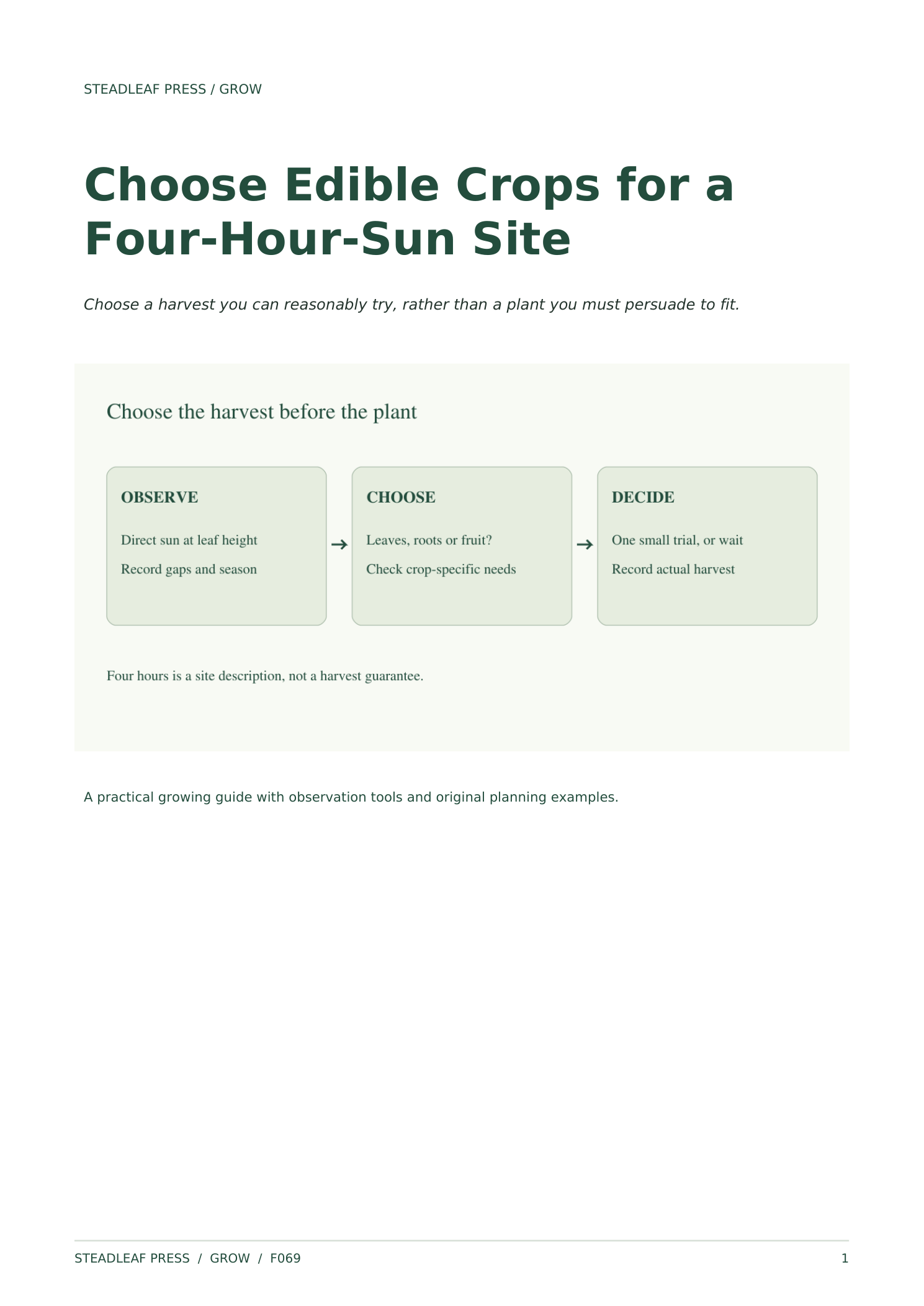
Choose a harvest you can reasonably try, rather than a plant you must persuade to fit.
A practical growing guide with observation tools and original planning examples.
STEADLEAF PRESS / GROW / F069 1
A pot can look green and still produce very little of the food you hoped to pick. A tomato plant with leaves is not yet a tomato harvest. At a position receiving roughly four hours of direct sun, that distinction belongs on your shopping list, before the plant goes into the pot.
This guide helps you choose one outdoor edible-crop trial, or decide to wait. Its result is a short statement: I want to harvest ____. At this position, my best-supported candidate is ____, provided ____; I will reconsider if ____. It is not a growing calendar or a promise that four hours will produce a particular yield.
1. Check what the four hours describe
Use the position where the crop's leaves would actually be, not a sunny patch elsewhere on the balcony. Record the date, the direct-sun periods you observed, and any gaps you did not observe. If you saw sunlight at ten and again at two, you have two observations, not proof of four continuous hours.
A simple check is enough to start:
- Position and intended leaf height: ____
- Date and weather: ____
- Direct sun observed from ____ to ____; other observed interval ____
- Unobserved periods: ____
- Main obstruction: building / tree / overhang / other ____
- Does the proposed growing season differ from the observation season? ____
Do not look directly at the sun. Note its effect on the growing position instead. When the start or end is unknown, write “duration uncertain” and observe again rather than rounding upward.
Four hours is a rough description, not a measured light dose. RHS defines partial shade in terms of three to six hours of direct sun at midsummer and notes that midday sunshine supplies more light than morning or evening sunshine. Tree cover and buildings also create different shade conditions. A November observation is not a midsummer forecast, or the reverse. [1]
This guide's shortlist concerns outdoor partial sun. Do not automatically transfer it to a dim indoor shelf because a window faces the same direction.
2. Decide which part you want to eat
At limited-light sites, a leaf harvest is generally a more promising aim than a fruit harvest. Iowa State identifies leafy crops as better candidates for partial shade than crops that must flower and set fruit, and warns that production may take longer in suboptimal light. [2]
The advice is not a single agreed numerical boundary. Iowa State's FAQ includes several leafy vegetables at three to four hours; Maryland gives three to five hours for cool-season crops such as lettuce and spinach. Rutgers uses four to five hours for leafy crops, five to six for roots, and at least eight for fruiting vegetables. These are planning guides, not contradictory guarantees about your particular pot. [3,4,5]
Treat a four-hour site as a reason to narrow the trial, not to select every crop described somewhere as “shade tolerant.”
STEADLEAF PRESS / GROW / F069 2
The light-and-harvest expectation matrix
The decisions below are this guide's conservative starting choices, not a reproduced university ranking. Check the cultivar and local season before buying.
Candidate Harvest you are choosing Decision at roughly four What not to assume observed hours
Loose-leaf lettuce Edible leaves A reasonable first A head-sized harvest, candidate when the repeated picking forever, season and container suit or a fixed completion it. [3,4] date.
Spinach Edible leaves Another candidate to That a suitable light investigate against local reading also means seasonal guidance. [3,4] suitable temperature.
Swiss chard or kale Edible leaves Consider one named That buying a small variety if its mature size seedling means the fits the space. Both mature plant needs little appear in Iowa State's room. partial-shade advice. [3]
Radish for its swollen Roots, not merely visible A conditional experiment, That healthy-looking root foliage not the first choice for a leaves prove a useful dependable root harvest root is forming. here. Iowa State lists it as a partial-shade possibility; Rutgers gives root crops a higher light allowance. [3,5]
Tomato, pepper or Fruit Seek a sunnier suitable That fertilizer, a large pot squash position rather than or the word “compact” making this the first removes the light four-hour trial. Maryland limitation. gives these warm-season crops six to eight hours of direct sun. [4]
Choose something you actually intend to use. If you only want tomatoes, it is reasonable to decline this location rather than grow unwanted lettuce simply to fill it.
STEADLEAF PRESS / GROW / F069 3
3. Give the candidate three more tests
Season. Find the named crop's local sowing or planting guidance. Do not import the months from a different climate. If the packet and local guidance do not support starting now, write a later assessment date. A few hours of shade are not a universal remedy for an unsuitable season.
Room. Check the variety's recommended container dimensions, final spacing and mature spread. This selection sheet deliberately supplies no universal pot depth: the crop you choose determines that requirement. Plan for drainage and ordinary access without blocking a doorway or balancing a pot on an improvised support. Obtain appropriate building guidance if the suitability of a balcony or loaded support is uncertain; this guide does not assess loads.
Care you can actually provide. Decide how you will reach the pot with water and inspect it. Maryland highlights both water access and heat released by surrounding hard surfaces as site considerations. A partially shaded pot beside hot paving is not necessarily a cool growing place. [4]
A failed test is useful information. Change the candidate, change the position safely, or postpone. Do not erase an unresolved test by calling the plant an experiment.
STEADLEAF PRESS / GROW / F069 4
4. Make one modest commitment
Avoid buying five crops to discover whether the site works. Select one candidate and write what would count as a useful result for you: for example, a small picking of sound leaves, rather than enough vegetables for a household.
Keep the expected harvest and the observed harvest in different boxes. A seed packet's maturity estimate belongs with your planning notes; it is not a date on which the crop owes you food. If nothing has been picked, record “none yet,” not the amount you hope to obtain.
Decision record Your entry
Named crop and variety ____
Part I intend to harvest ____
Light evidence, date and remaining uncertainty ____
Local seasonal guidance checked ____
Container and final spacing requirement checked ____
My useful small-trial result ____
Actual sowing or planting date, if any ____
Review date I chose ____
Actual harvest so far ____
Next decision and its reason ____
At the review, compare the plant with its own earlier condition. Ask whether new usable growth is appearing, whether leaves are crowded, and whether the light pattern has changed. A lack of harvest is not automatically proof of insufficient sun: inspect the other conditions and consult crop-specific advice before changing treatment. Keep a record of what you changed so the next observation has a clear context.
STEADLEAF PRESS / GROW / F069 5
5. Two choices that both count as progress
Fictional example: a leaf trial. Amira has observed the same outdoor position through several clear days in the current growing season. She wants salad leaves, has a suitable draining pot, and finds local guidance supporting a loose-leaf lettuce sowing now. Her record says “try one small sowing,” with no promised harvest weight. When she next checks, the plants are still small. She records their stage and leaves the harvest box at “none yet.” She has information, not a failed deadline.
Fictional example: declining the site. Daniel wants ripe peppers. His four-hour estimate comes from a single morning and an afternoon glance; part of the interval is unknown. He also has no suitable place for the mature container. He does not buy a pepper and hope that extra feed will settle both questions. His next action is to investigate another accessible position. If none is suitable, he does not start this crop.
Neither example reports a growing trial. They illustrate how to keep a preference, evidence and a decision separate.
6. Keep the boundary clear
This is a crop-selection guide, not a declaration that anything grown in a pot is safe to eat. Use positively identified edible seed or plants and suitable growing materials. Before harvesting, follow the crop's handling guidance and any applicable pesticide-label restrictions. Light suitability does not establish food safety.
Your completed result may be one promising leaf crop, a clearly labelled uncertain root trial, or a decision not to plant. The useful change is that you know which harvest you are testing and which question remains open.
STEADLEAF PRESS / GROW / F069 6
Sources and scope
Primary pages opened on 18 November 2026:
[1] Royal Horticultural Society, Shade gardening. Definitions, time-of-day differences and kinds of shade. https://www.rhs.org.uk/garden-design/shade-gardening
[2] Iowa State University Extension and Outreach, Growing Edible Plants in Shady Areas. Relative suitability of leaf harvests and slower production under limited light. https://yardandgarden.extension.iastate.edu/how-to/growing-edible-plants-shady-areas
[3] Iowa State University Extension and Outreach, Which vegetables will grow in partial shade? Candidate crops and its three-to-four-hour leafy-crop guidance. https://yardandgarden.extension.iastate.edu/faq/which-vegetables-will-grow-partial-shade
[4] University of Maryland Extension, Growing Vegetables in Containers and Salad Tables. Crop-group light ranges, water access and surrounding heat. https://extension.umd.edu/resource/growing-vegetables-containers-and-salad-tables
[5] Rutgers Cooperative Extension, Planning a Vegetable Garden, FS129. Its separate planning ranges for leafy, root and fruiting crops. https://extension.rutgers.edu/fs129
The matrix, record sheet and examples are original editorial tools, not calibrated light measurements or reported crop trials. No yield, physical growing test, structural assessment or universal planting season is claimed. No third-party illustration is reproduced.