GROW / FREE GUIDE
Plan a Two-Pot Salad Garden
A two-crop container and succession calendar
Download the complete free guide
Plan separate lettuce and radish pots, with a crop-stage and succession calendar that can be adapted to real conditions.
Includes complete illustrated instructions and any printable worksheets or templates.
Download free PDFRead the complete free guide online
The instructional text is below. For exact-size patterns, illustrations and printable records, use the complete free PDF above.
STEADLEAF PRESS / GROW
Pair two useful ingredients, then give each its own place on the calendar.
A practical growing guide with observation tools and original planning examples.
STEADLEAF PRESS / GROW / F070 1
A bowl of salad suggests a mixture. A small garden does not have to put that mixture into a single pot. One container of loose-leaf lettuce and another of short-rooted salad radishes can offer two different ingredients without asking you to manage their spacing as one crop.
This plan is for two separate outdoor containers in a suitable growing season. It helps you decide what each pot contributes, when space will actually become available, and whether another sowing still makes sense. It does not promise that the two crops will be ready for the same meal. Buying the missing ingredient is allowed.
1. Choose a pair for the plate, not a companion-planting claim
The worked pairing is loose-leaf lettuce for leaves and salad radishes for roots. They are paired for their different uses in the kitchen, not because one is claimed to protect or improve the other. Neither pot needs to share compost with its neighbour.
Choose named varieties before assigning dates. A packet of winter radish or long-rooted daikon is not a substitute for the short-rooted salad radish in this plan. RHS distinguishes these groups and their different growing habits. Its salad-radish guidance favours a sunny site, with some light shade acceptable in midsummer. [1]
Lettuce is the continuing leaf ingredient in the plan; the radish pot supplies a crop that is lifted out. RHS describes loose-leaf lettuce as suitable for repeated picking over several weeks, rather than the single whole-head harvest of a hearting type. That is a possible harvest pattern, not an unlimited lifespan. [2]
Planning question Pot A: loose-leaf lettuce Pot B: short-rooted salad radish
What do I want from this pot? Leaves for a small salad Roots for crunch or a garnish contribution
What does harvest do to the Leaf picking can leave plants Lifting a plant removes it, but the space? occupying it rest of the batch may remain
What ends this batch? A decision to finish the crop, not The remaining plants are merely one picking harvested or the batch is otherwise ended
When can I assign the whole pot After it is genuinely clear and After the whole batch is finished again? assessed for reuse and the pot is assessed
Write your own use beside each ingredient. If nobody will eat the radishes, do not grow them to complete the diagram. Choose another positively identified edible crop using its own local guidance, or begin with one pot. A replacement crop needs a new plan; it does not inherit the radish dates.
STEADLEAF PRESS / GROW / F070 2
2. Confirm that both containers are real growing spaces
A pair of empty decorative pots is not yet a pair of suitable crop containers. Check usable dimensions, drainage, growing medium, access and placement before buying seed.
For its container recommendations, RHS specifies at least 30 cm width and depth for short-rooted salad radishes, and the same minimum dimensions when planting young lettuces in a container. These are separate crop recommendations, not a calculation of how many plants your pots will hold. Follow the selected variety's spacing guidance rather than packing plants into every visible gap. [1,2]
Use an appropriate container growing medium and functioning drainage. Maryland's container guide emphasises access to water and checking the light and heat of the actual site. Two pots next to each other can still need separate moisture checks. [3]
Keep both containers on a suitable stable surface, with access and exits clear. Do not assume that a balcony, shelf or improvised support can carry filled containers; obtain appropriate guidance if its capacity is uncertain. This guide does not assess structural loads. Do not plan on repeatedly lifting a heavy planted pot to compensate for an unsuitable position.
Before proceeding, complete these six checks:
- Pot A dimensions and drainage checked: ____
- Pot B dimensions and drainage checked: ____
- Named varieties and their final spacing: ____
- Direct-sun evidence at each growing position: ____
- Local sowing window for each variety: ____
- Who can inspect and water them during the proposed period? ____
An unresolved answer stays unresolved. “They are salad crops” does not establish that both suit today's conditions.
STEADLEAF PRESS / GROW / F070 3
3. Put three kinds of dates on the calendar
Use a calendar with separate columns for planned, observed and decided. The distinction is more useful than an attractive succession arrow.
Planned dates come from local seasonal advice, packet information and your availability. A packet's time-to-maturity estimate is a planning clue, not a harvest appointment. Check whether the estimate begins at sowing or transplanting before using it.
Observed dates record what actually happened: sowing, emergence, a first picking, lifting a root, or clearing a pot. Leave an event blank until it happens. If a crop is not ready, do not move a future estimate into the observed column.
Decided dates are commitments you control: inspect again, keep the current crop, finish it, or leave the space empty. A review date can be fixed even when the harvest date cannot.
Your two-crop calendar
Fill this in for one locally suitable season. It is an original planning worksheet, not a regional planting timetable.
Event Pot A: lettuce Pot B: salad radish
Local sowing window and source ____ ____
Proposed first sowing date ____ ____
Actual first sowing date ____ ____
Packet estimate and what it counts ____ ____ from
First review date I choose ____ ____
Actual first harvest, if any ____ ____
Date whole batch ended and pot ____ ____ cleared
Next crop or another batch of ____ ____ same crop
Is its local sowing window still ____ ____ open?
Earliest feasible new sowing after ____ ____ clearance and preparation
Actual next sowing, or reason for ____ ____ leaving empty
The last three rows are the succession plan. They require available space and a suitable season, not just a number of days since the first sowing.
STEADLEAF PRESS / GROW / F070 4
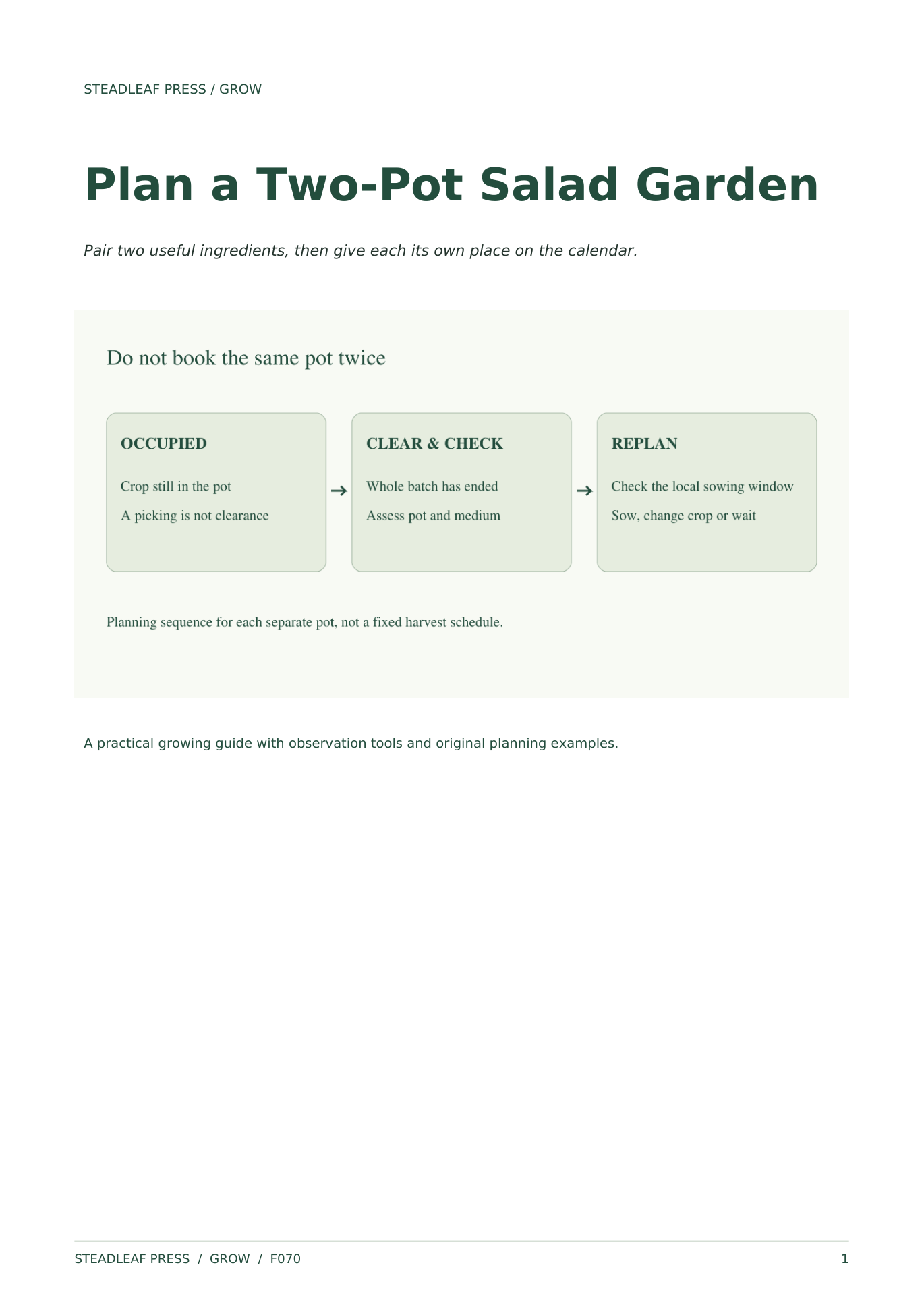
4. Do not book the same pot twice
RHS explains that small repeat sowings can spread harvests, but their interval should respond to growth and conditions rather than run automatically. Weather can even bring differently timed sowings to maturity together. Its advice also requires leaving actual room for the next sowing. [4]
With only two containers, both may already be fully occupied. In this plan, use a straightforward whole-pot rule: the next batch waits until its assigned pot is clear and suitable for preparation. Do not add new seeds among an established crop merely because the calendar says to sow again. Do not buy extra seedlings without a confirmed destination.
This rule accepts gaps. A lettuce picking does not release the lettuce pot. Pulling two radishes does not necessarily release the radish pot for another full batch. Mark the pot “occupied” until the remaining crop is finished.
When a pot becomes free, assess the previous crop and the condition of the container and medium. A pest, disease or contamination concern calls for appropriate advice before reuse, not an automatic refill-and-repeat instruction. Check the next crop's requirements and any growing-medium or feeding directions separately. This calendar supplies no blanket fertiliser dose or claim that old medium is always safe to reuse.
If uninterrupted harvests matter more than keeping exactly two pots, you would need a different, properly resourced plan. Do not conceal that extra space inside a two-pot promise.
STEADLEAF PRESS / GROW / F070 5
5. A worked decision, not a growing trial
Fictional example. Rosa wants a few lettuce leaves and sliced radishes. She selects varieties that local guidance supports for the same current season and prepares two suitable containers. She writes separate sowing records and sets a review date. She does not write “salad dinner” against a predicted harvest day.
At a later review, the lettuce is still worth keeping. The radish batch has ended, and that pot is now clear. Rosa's original plan said “another batch of radishes.” Before sowing, she checks the local window again and finds that the next period is unsuitable for her chosen variety. She crosses out the proposed sowing date, not the actual clearance date. The empty pot remains empty.
Her next note is an assessment date for a later suitable season. Meanwhile, she can use whatever sound lettuce leaves are ready without pretending that the whole planned meal came from the two pots.
This example reports no real yield or crop trial. Its point is the changed decision: a free pot is an opportunity to reassess, not an obligation to fill it.
6. Finish with a useful plan
Read the two calendar columns aloud. Can you explain what you want from each crop, where it will grow, and what must happen before its replacement is sown? If the plan relies on a pot being both occupied and empty on the same date, revise it now.
Keep crop-specific growing and food-handling guidance alongside the calendar. This is not a substitute for those instructions or a food-safety assessment. A harvest recorded here means an event occurred; it does not certify the produce's safety.
The result can be two different ingredients at different times, a second sowing after a genuine gap, or one crop retained while the other pot rests. The plan has worked when the next action fits the space and conditions you actually have.
STEADLEAF PRESS / GROW / F070 6
Sources and scope
Primary sources opened on 18 November 2026:
[1] Royal Horticultural Society, How to grow radishes. Radish groups, site and container guidance. https://www.rhs.org.uk/vegetables/radishes/grow-your-own
[2] Royal Horticultural Society, How to grow lettuce. Loose-leaf harvest pattern and container planting guidance. https://www.rhs.org.uk/vegetables/lettuce/grow-your-own
[3] University of Maryland Extension, Growing Vegetables in Containers and Salad Tables. Site, water access and container growing considerations. https://extension.umd.edu/resource/growing-vegetables-containers-and-salad-tables
[4] Royal Horticultural Society, Successional sowing. Variable intervals, room for another sowing and environmental effects on timing. https://www.rhs.org.uk/vegetables/successional-sowing
The pairing comparison, calendar, whole-pot planning rule and fictional example are original editorial tools. They are not companion-planting evidence, a fixed regional calendar, a yield guarantee or a report of physical testing. No third-party illustration is reproduced.