GROW / FREE GUIDE
Support a Cucumber Vine in a Container
A support and safe-access selection guide
Download the complete free guide
Check container cucumber variety, growing space, support installation limits and safe access before setting up a climbing system.
Includes complete illustrated instructions and any printable worksheets or templates.
Download free PDFRead the complete free guide online
The instructional text is below. For exact-size patterns, illustrations and printable records, use the complete free PDF above.
STEADLEAF PRESS / GROW
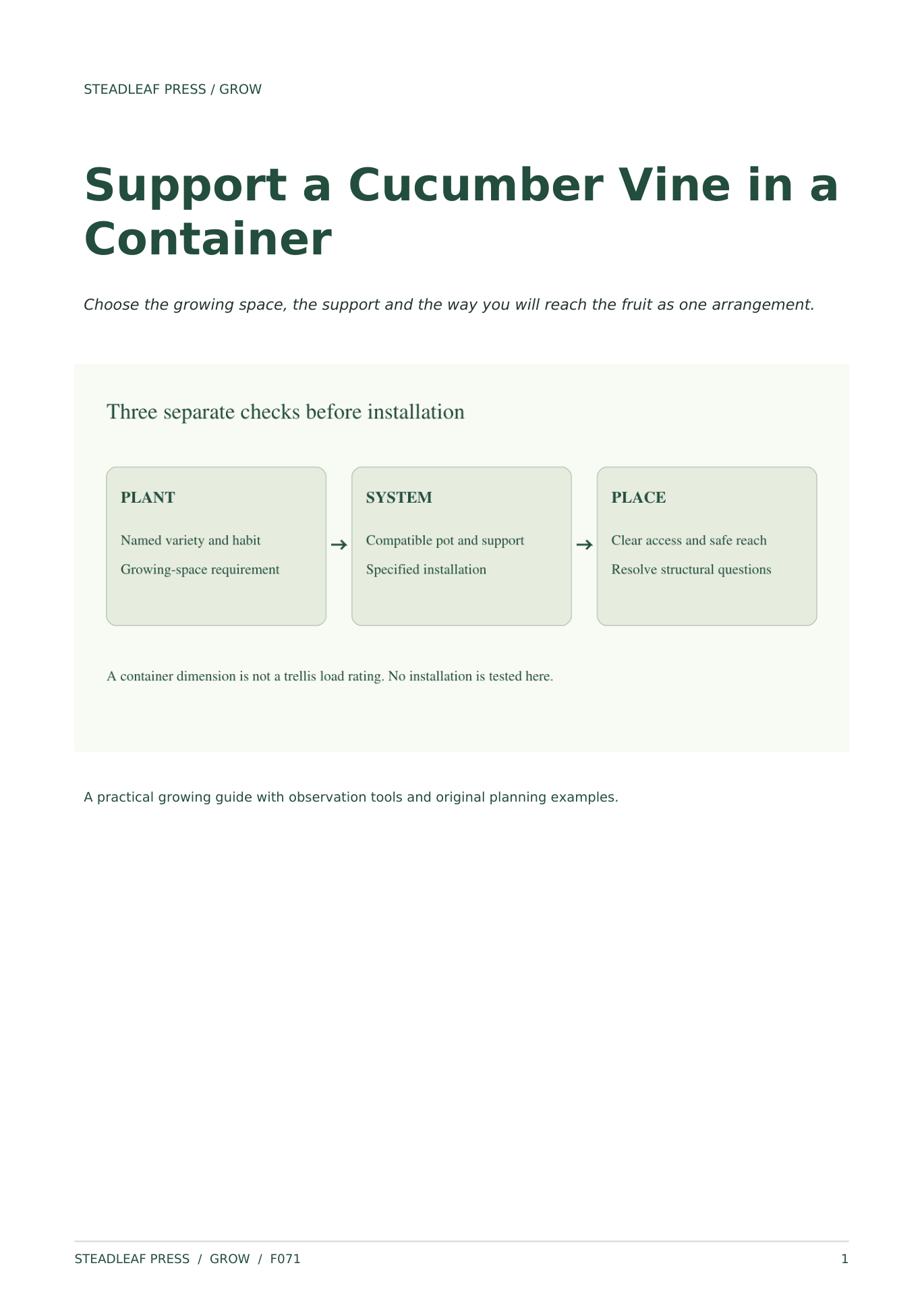
Choose the growing space, the support and the way you will reach the fruit as one arrangement.
A practical growing guide with observation tools and original planning examples.
STEADLEAF PRESS / GROW / F071 1
The cucumber in a small nursery pot has not yet shown you the space it will occupy. Its future vine is one consideration; the support carrying that growth is another. A tall trellis can solve a spreading problem while creating a stability or access problem.
This guide helps you specify a container-support arrangement before the vine becomes tangled in it. It is a selection and inspection guide, not a construction drawing, wind rating or balcony-load assessment. If the proposed location needs structural approval or uncertain fixings, resolve those questions before installing anything.
1. Start with a named plant
Write down the variety and whether its supplier recommends it for your outdoor conditions or for protected growing. RHS distinguishes greenhouse cucumbers from outdoor types and describes outdoor planting sites as warm, sunny and sheltered. It also gives a container starting recommendation of at least 30 cm width and depth. That dimension concerns growing space; it does not certify a tall trellis as stable in that pot. [1]
Do not use fruit size as a substitute for vine size. “Mini cucumber” on a label may describe the fruit. Ask for the variety's growth habit and support guidance if they are missing. Choose a manageable plant rather than planning to keep an unsuitable vine small by improvised pruning.
Your starting note should contain:
- Variety and source of growing advice: ____
- Outdoor or protected-growing recommendation: ____
- Expected growth habit and training guidance: ____
- Required container dimensions and spacing: ____
- Intended support type: ____
This guide does not prescribe flower removal or pruning. Those instructions can differ with cucumber type and growing system; use the guidance for the plant you actually have.
STEADLEAF PRESS / GROW / F071 2
2. Measure the usable support, not just its label
A support has at least three different dimensions: its total height, the climbing height available above the growing medium, and the space its base occupies. Keep all three in your notes. The advertised height alone cannot tell you how much climbing area remains after installation.
University of Minnesota guidance illustrates this distinction with a ground-installed stake: a six-foot stake driven one foot into the ground leaves five feet above it. That is a ground example, not permission to drive a stake one foot into a container or through a paved surface. The same guidance makes support strength dependent on the plant, stake and installation. [2]
For context, Minnesota's cucumber guide describes a three- to four-foot trellis for garden rows. It does not establish a universal container trellis height. Use the named variety's needs and a support system's intended use to select your arrangement, rather than copying a garden dimension without its installation context. [3]
The sizing sheet
Measurement or requirement What to record What the answer does not prove
Container usable width and depth Actual internal growing space, That it anchors any support that allowing for the product's shape happens to fit
Support total height Manufacturer's dimension The height available for climbing after installation
Installed climbing height Height above the medium or That all fruit will be reachable relevant mounting point
Base footprint Width and depth of the assembled That feet may obstruct a path or system rest on an unsuitable surface
Mesh or opening arrangement Whether you can inspect both vine A safe load rating and developing fruit
Installation requirements Intended container, anchoring Approval to modify a building or method and limitations railing
Access Reach to ties, fruit, water and Permission to stand on a pot or drainage lean beyond a barrier
If the instructions specify a compatible planter, use that specification. If they only show stakes installed in open ground, ask the supplier whether the product is intended for your container setup. “It fits inside” is not an answer to that question.
STEADLEAF PRESS / GROW / F071 3
3. Separate plant support from building safety
Maryland notes that tall or vining vegetables need support for their growth and ripening crop. It advises installing supports while plants are young, with care to avoid root damage. [4]
That horticultural purpose is separate from the safety of the whole installation. The vine and fruit are not its only components: the pot, wet growing medium, support and any attachments also belong to the arrangement. Exposure to wind adds another consideration. This guide gives no universal kilogram limit, ballast quantity or fixing pattern.
For a rented balcony, roof terrace, elevated deck or uncertain shelf, obtain the relevant property permission and competent advice about the proposed location and fixing method. Permission to keep plants does not automatically approve drilling, tying into a guardrail or attaching a tall screen. Do not improvise extra weight to cure movement without establishing whether the surface can take it.
At an ordinary suitable ground-level site, still follow the support manufacturer's installation requirements and keep paths clear. Avoid projecting sharp ends and damaged components. A hand check may reveal looseness, but passing that check is not proof of wind resistance or structural capacity.
If the arrangement is unresolved, postpone the vine. A different growing position or a more manageable plant is a better outcome than a precarious support hidden behind healthy leaves.
STEADLEAF PRESS / GROW / F071 4
4. Install before the plant makes the decision for you
Lay out the intended arrangement while the container is empty or the plant is still young, following the system's instructions. Check the relationship between the pot, support and access route before the vine grows through the mesh. Keep the installation compatible with drainage and ordinary watering.
Do not force stakes through an established root ball to recreate a photograph. If a plant is already growing, determine a suitable support approach without unnecessary root disturbance; ask the supplier or a local horticultural adviser when that cannot be done confidently.
Plan where the first new growth will meet the support. Minnesota recommends gently guiding growing vine tips through mesh openings as they lengthen. It also warns that developing cucumber fruits can become caught between wires. [2] The aim is a supported plant you can inspect, not a tightly threaded ornament.
Work with flexible new growth. Do not wrench a stiff stem around a rung, tighten a tie around a swelling stem, or pull the plant to straighten the support. Use plant-support ties appropriate to the system where needed, leaving room for growth and checking them subsequently. Remove or adjust constricting ties before they damage the stem.
No amount of careful vine training compensates for a loose frame. Correct the support problem separately and safely; do not make the stem carry it.
STEADLEAF PRESS / GROW / F071 5
5. Inspect the arrangement as it changes
Look at the base before looking for fruit. Then follow the support upward and inspect the vine where it contacts ties or mesh. Keep developing cucumbers clear of openings that could trap them as they enlarge. Do not wait for a fruit to wedge tightly before noticing its position.
Use this short record at routine plant checks and when conditions or the arrangement change:
What I see My next action
Vine growth has reached an unsupported gap Guide suitable flexible growth using the chosen system; do not force it
A tie is pressing into the stem Loosen or replace the tie appropriately
A developing fruit is entering a narrow opening Address its position gently before it becomes trapped; do not yank the vine
A connection has loosened or a component is Stop treating the installation as ready for use; arrange damaged safe correction
Pot or support is shifting, tilting or obstructing access Keep people clear and obtain appropriate help; do not try to catch a falling assembly
Top growth or fruit is beyond safe reach Reassess the plan; do not climb on furniture or lean over a barrier
In hazardous weather, do not go out to make emergency adjustments to an exposed installation. Make weather-related plans in advance using appropriate local advice and the system's limitations. A photograph taken on a calm day is not a stability test.
STEADLEAF PRESS / GROW / F071 6
6. A measurement that changes the choice
Fictional example. Arun finds a narrow trellis whose package height seems suitable. Before buying it, he checks the installation drawing. It is designed for ground stakes, while his proposed location is a paved terrace. The description gives no container installation method.
He does not shorten the stakes and assume that the result is equivalent. He asks about a purpose-designed planter-and-support system and measures its assembled footprint. That footprint would block his only comfortable watering route. He rejects this second arrangement too and looks for another location before choosing a cucumber plant.
The sizing sheet has done useful work even though nothing has been installed. It has prevented a planting decision from becoming an improvised engineering task.
Finish with an arrangement you can explain
You should be able to name the plant, the container and the support; identify how the support is meant to be installed; and reach the parts you will need to inspect. Any unresolved structural or permission question remains a stop point, not a note to revisit after planting.
Keep crop care and food-handling guidance separately. This guide does not certify a harvest as safe to eat, supply a growing calendar, or demonstrate a tested support. Its result is a documented choice with clear limits and a practical inspection routine.
STEADLEAF PRESS / GROW / F071 7
Sources and scope
Primary pages opened on 18 November 2026:
[1] Royal Horticultural Society, How to grow cucumbers. Growing types, site and container guidance. https://www.rhs.org.uk/vegetables/cucumbers/grow-your-own
[2] University of Minnesota Extension, Trellises and cages to support garden vegetables. Ground-stake example, installation factors, vine guidance and fruit entrapment. https://extension.u mn.edu/garden-and-home/yard-and-garden/gardening-in-minnesota/trellises-and-cages
[3] University of Minnesota Extension, Growing cucumbers in home gardens. Garden-row trellis example, not a container engineering specification. https://extension.umn.edu/garden-and-home/y ard-and-garden/gardening-in-minnesota/growing-cucumbers
[4] University of Maryland Extension, Growing Vegetables in Containers and Salad Tables. Supporting growth and crop weight; installation while young and avoiding root damage. https://extension.umd.edu/resource/growing-vegetables-containers-and-salad-tables
The sizing sheet, selection gates and fictional example are original editorial tools. No load-bearing design, wind-resistance rating, physical installation test or growing trial is claimed. No third-party illustration is reproduced.