GROW / FREE GUIDE
Know When to Stop Harvesting a Tired Container Crop
A crop reset and careful disposal decision guide
Download the complete free guide
Decide when to pick, pause or reset a container crop and how to handle plant remains, growing medium and equipment conservatively.
Includes complete illustrated instructions and any printable worksheets or templates.
Download free PDFRead the complete free guide online
The instructional text is below. For exact-size patterns, illustrations and printable records, use the complete free PDF above.
STEADLEAF PRESS / GROW
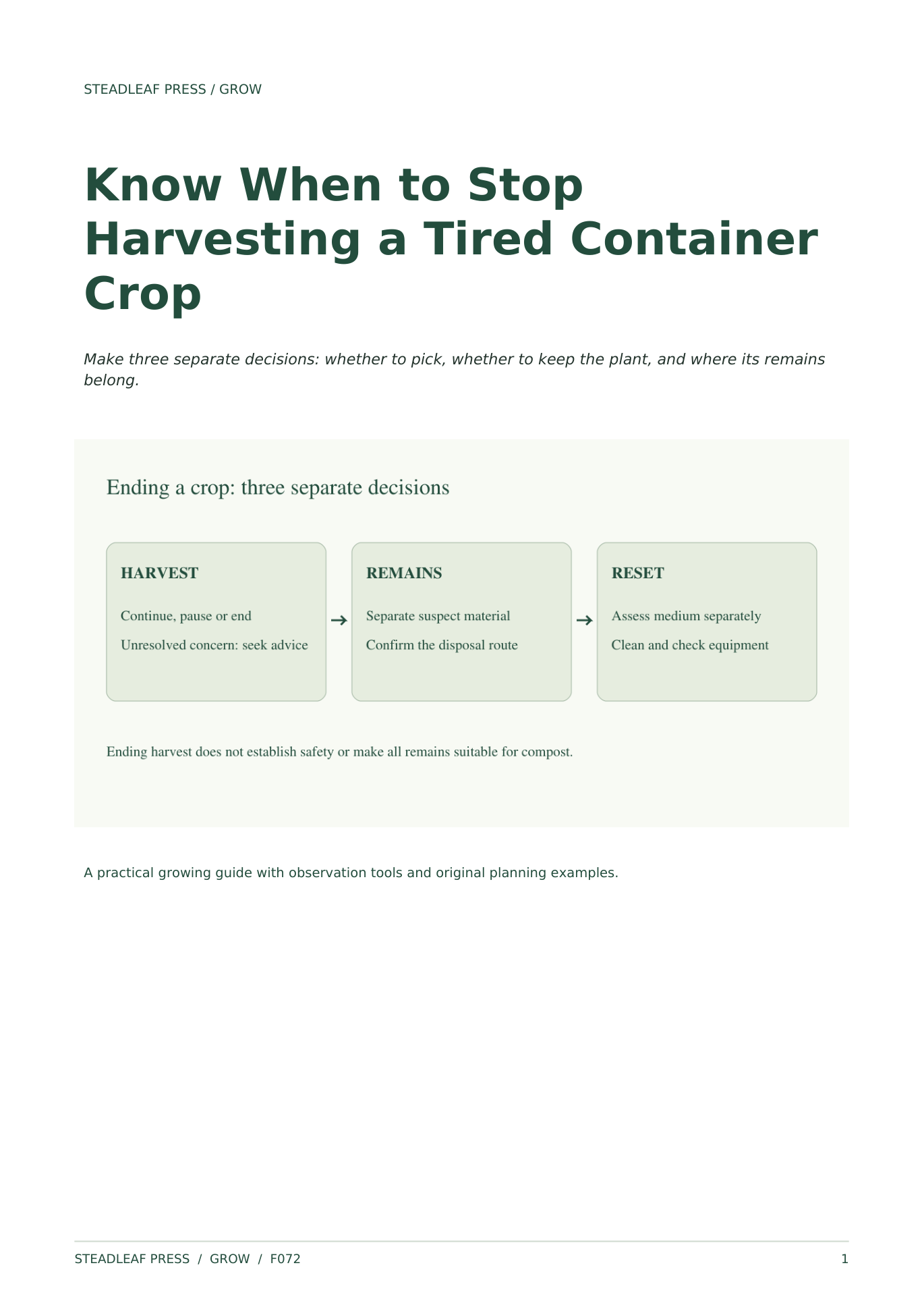
Make three separate decisions: whether to pick, whether to keep the plant, and where its remains belong.
A practical growing guide with observation tools and original planning examples.
STEADLEAF PRESS / GROW / F072 1
The last small handful can take more persuasion than the first. A lettuce pot that once supplied useful leaves may now offer only a few narrow ones. Elsewhere, a recently productive plant may suddenly collapse. Both can look “finished,” but they do not call for the same response.
This guide concerns short-lived edible container crops. It helps you pause, investigate or end a batch without treating every symptom as exhaustion. It is not a diagnostic key, a food-safety clearance or a rule for discarding perennial plants each year.
1. Replace “tired” with an observation
Before reaching for scissors or tipping out the pot, write what changed. “Three lower leaves yellowed since the last check” is more useful than “the plant is dying.” Record the crop, variety if known, recent harvests, weather, watering and treatments.
Check the growing medium rather than watering automatically. Maryland notes that wilting can result from both too little and too much water. Its container guidance also identifies crowding, insufficient light, root problems and nutrition as possible sources of poor growth. Appearance alone does not establish one cause. [1]
Use the following routes as editorial decision categories, not diagnoses:
What you can establish Immediate decision What remains to check
The crop still has suitable growth Keep it under ordinary care; follow Whether further picking would and no unresolved concern crop-specific harvest guidance leave enough plant for its intended harvest method
A recent change may be Pause picking and investigate Moisture, weather, pests, damage reversible, but the cause is and the crop's normal stage uncertain
The intended short-lived crop has End the batch if it no longer serves Separate decisions for plant clearly reached its planned your purpose remains, medium and container endpoint
Sudden collapse, spreading Hold harvest and seek appropriate Cause, handling and disposal; do lesions, extensive pest activity or advice not assume ordinary ageing possible contamination
A pause is not a promise that the crop will recover. An endpoint is not proof that every remaining leaf is unsafe. These are different questions.
STEADLEAF PRESS / GROW / F072 2
2. Recognise an endpoint without inventing a deadline
For a leaf crop, compare what the plant is now producing with the part you intended to eat. A transition towards flowering may matter more than the number of weeks since sowing. RHS describes bolting as premature flowering or seed production; salad leaves may become bitter and root crops may fail to swell. It also explains that seasonal signals and stress can contribute. [2]
Do not apply that description to every flowering vegetable. Flowers on a fruiting crop such as a cucumber are not, by themselves, the same endpoint as bolting lettuce. Use the crop's own growth pattern.
Ask three questions:
- Is the remaining harvest still the ingredient I wanted?
- Does crop-specific advice support continuing this harvest method at the present stage?
- Do I want to keep allocating this space and care to the current batch?
You may decide to finish an otherwise ordinary short-lived crop because its useful output has declined. Record that as a practical choice, not a disease diagnosis. There is no universal number of cuts after which all container crops must be removed.
Do not take a “last chance” picking to avoid wasting a suspect plant. Unknown contamination or a treatment restriction remains unresolved even if you intend to discard the plant afterwards. This guide does not establish that rinsing makes such produce suitable to eat.
STEADLEAF PRESS / GROW / F072 3
3. If you pause, give the pause a purpose
Choose a next action and review date. For example: inspect the moisture correctly, identify a visible pest with reliable help, or compare new growth with a dated photograph. Avoid adding water, fertiliser and a pesticide together merely to feel that something has been done.
Maryland cautions that excessive fertiliser can damage plants and that product directions must be followed. More feed is not a general response to a failing crop. [1]
When consulting an adviser, provide the whole-plant photograph, a close view of affected areas, the crop identity and recent care notes. Keep suspect material separate from other plants and clean harvested food while you establish the next step. Do not move it through a collection unnecessarily or mix its medium into other pots.
If there is an immediate hazard from a falling support or heavy container, deal with access and personal safety first. Do not lift an awkward pot alone just to complete a plant inspection.
STEADLEAF PRESS / GROW / F072 4
4. Ending the crop does not answer the compost question
There are three things to sort: plant remains, used growing medium, and reusable equipment. They may need different destinations. Remove labels, synthetic ties and other non-compostable pieces from material intended for composting. Do not treat the whole contents of a pot as one bag of green waste.
A conservative sorting guide
Material and known history Starting route Avoid this shortcut
Ordinary crop remains with no Consider your established Assuming every collection accepts known disease, infestation or home-compost system or an the same materials contamination concern accepting local collection
Disease-suspect or substantially Keep separate; identify the issue Putting them into a home heap infested remains and obtain appropriate disposal because it sometimes feels warm guidance
Material with a chemical spill or Follow applicable product Diluting it into clean compost or unresolved treatment concern directions and ask the local waste assuming green-waste acceptance authority about the material
Used potting medium Assess condition and history Treating it as fresh seed compost separately for an appropriate or automatically putting it in a reuse or disposal route plant-waste bin
Pots, supports, ties and labels Sort by material; clean or dispose Mixing plastic or wire into of them appropriately compostable crop remains
This is deliberately cautious for a grower without a confirmed disease identification or verified treatment process. University of Minnesota's home-composting guidance advises against diseased or insect-infested plants and warns that problematic material may not heat sufficiently for decontamination. [3]
RHS provides a more disease-specific account: some less-persistent diseases can be managed through composting, while other material needs a different route. It also says local collection rules vary. [4] These are not grounds for guessing which disease you have. Until you know, do not add suspect material to the ordinary home heap.
Ask the receiving service specifically about diseased plants, growing medium and any chemical concern. Acceptance of grass clippings does not prove acceptance of all three. This guide does not recommend burning, burying suspect waste or putting it into a particular municipal bin without local confirmation.
STEADLEAF PRESS / GROW / F072 5
5. Reset the pot without erasing its history
Once the removal route is settled, clear the crop in manageable amounts. Avoid spreading suspect debris into nearby containers. Keep the label or a photograph of it with your notes rather than losing the crop's identity during cleanup.
Assess the used medium separately. RHS explains that potting compost changes and compacts over time and describes several reuse options, including uses around established plants. Its guidance is not a claim that all old medium is immediately ready for a new edible seed sowing. [5]
Where the crop failed for an unresolved reason, do not transfer that uncertainty into the next pot. Obtain advice about the specific problem before reuse. Where there is no such concern, select a reuse appropriate to the material's condition and intended plants. Follow the relevant guidance rather than applying one universal refresh recipe.
Remove residual debris from reusable equipment and use an appropriate cleaning method. If a disease has been identified, follow its specific sanitation advice and any product directions; this guide supplies no universal disinfectant concentration. Check the container for damage and unobstructed drainage before using it again.
An empty, clean pot is not an instruction to sow today. The next crop still needs a suitable season, growing medium and care arrangement.
STEADLEAF PRESS / GROW / F072 6
6. Two endings, two records
Fictional example: an ordinary finish. Leena's loose-leaf lettuce is forming a flowering stem. She has recorded several pickings, but the new growth no longer suits her intended leaf harvest. With no separate disease or contamination concern identified, she ends that batch and checks the accepted route for its remains. She records the medium assessment separately. Her next sowing stays undecided until she checks the season.
Fictional example: an unresolved decline. Mateo's container crop collapses soon after appearing productive. He does not label it “exhausted” or collect a final serving. He photographs it, records recent care and holds harvest while seeking advice. He keeps its debris and medium out of other pots and his ordinary compost. The record ends at “awaiting identification,” not “successfully reset.”
Neither example is a report of a trial, diagnosis or confirmed safe harvest. They show why the reason for stopping belongs beside the date.
Your end-of-batch record
Crop and variety: ____ Container identifier: ____
What changed, and when: ____
Decision: continue ordinary care / pause harvest / end batch / seek advice
Reason and unresolved questions: ____
Plant-remains destination, and who confirmed acceptance: ____
Growing-medium decision: ____
Equipment cleaning or disposal action actually completed: ____
Next review or planting decision: ____
A clear “not yet decided” is better than a false completion tick. The aim is to stop taking from a crop when that no longer makes sense, then leave the next growing attempt with fewer unknowns.
STEADLEAF PRESS / GROW / F072 7
Sources and scope
Primary pages opened on 18 November 2026:
[1] University of Maryland Extension, Growing Vegetables in Containers and Salad Tables. Moisture, poor growth and fertiliser cautions. https://extension.umd.edu/resource/growing-vegetables-containers-and-salad-tables
[2] Royal Horticultural Society, Bolting in vegetables. Flowering transition, crop quality and contributing conditions. https://www.rhs.org.uk/vegetables/bolting
[3] University of Minnesota Extension, Composting in home gardens. Materials to exclude and limits of decontamination in home compost. https://extension.umn.edu/garden-and-home/yard-and-garde n/gardening-in-minnesota/composting-in-home-gardens
[4] Royal Horticultural Society, Disposing of diseased material. Disease-specific routes and variable local acceptance. https://www.rhs.org.uk/prevention-protection/disposing-of-diseased-material
[5] Royal Horticultural Society, How to reuse spent compost. Condition and possible uses of old growing medium. https://www.rhs.org.uk/soil-composts-mulches/how-to-reuse-spent-compost
The decision tables, record and fictional examples are original editorial tools. No diagnosis, food-safety clearance, pathogen-kill process, physical compost trial or local waste permission is claimed.