GROW / FREE GUIDE
Care for a Spider Plant With Brown Leaf Tips
A water-and-light symptom observation sheet
Download the complete free guide
A practical free guide: a water-and-light symptom observation sheet, with an observation worksheet and cautious plant-care decisions.
Includes complete illustrated instructions and any printable worksheets or templates.
Download free PDFRead the complete free guide online
The instructional text is below. For exact-size patterns, illustrations and printable records, use the complete free PDF above.
STEADLEAF PRESS / GROW
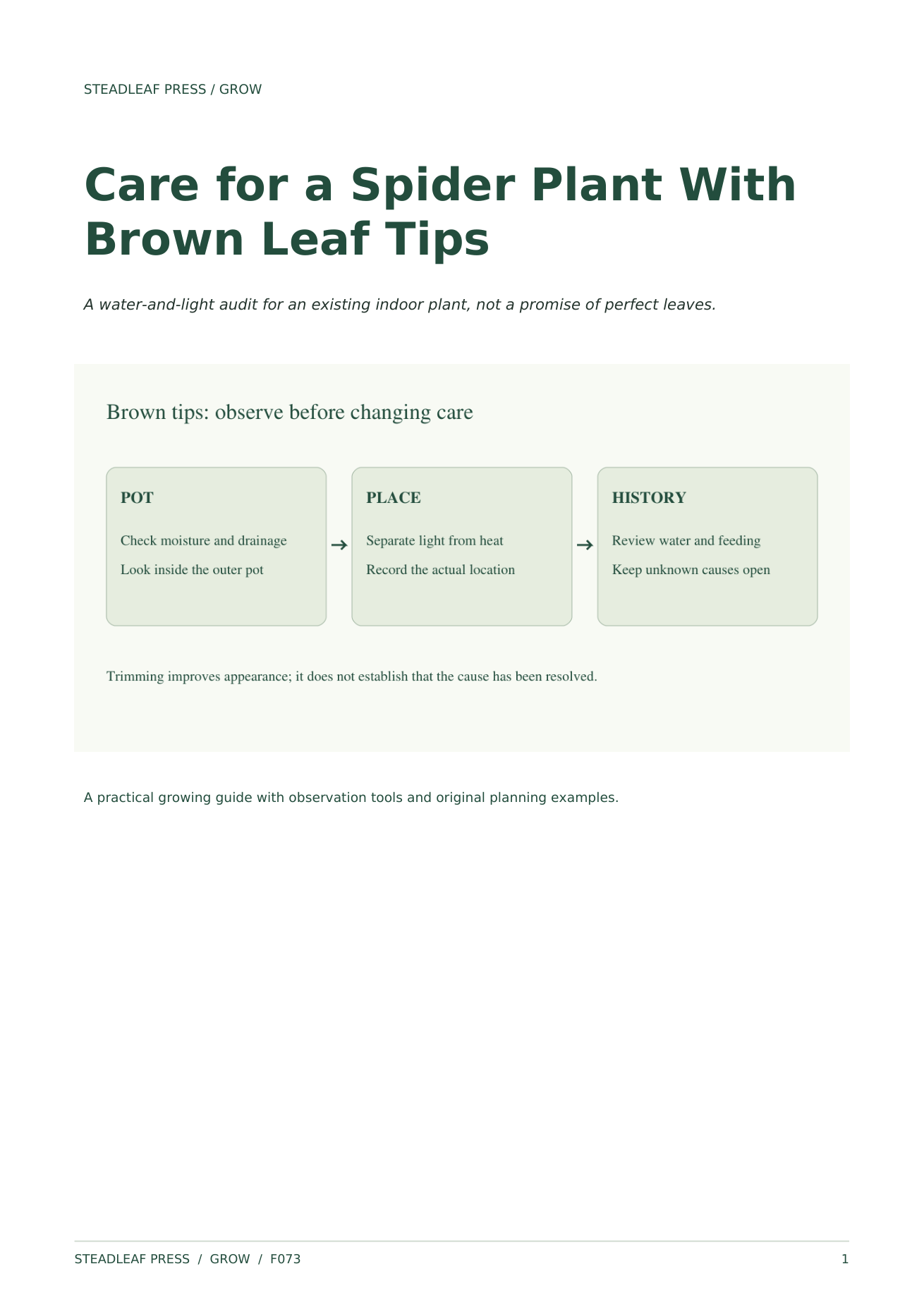
A water-and-light audit for an existing indoor plant, not a promise of perfect leaves.
A practical growing guide with observation tools and original planning examples.
STEADLEAF PRESS / GROW / F073 1
A spider plant can have a green centre, long arching leaves and several untidy brown points at once. It is tempting to make the tips the entire care plan. Before buying a new fertiliser or moving the pot, give the rest of the plant an equal vote.
This guide concerns an identified indoor Chlorophytum comosum, including its striped cultivars. It helps you separate observations about moisture, light and recent care. It does not identify every pest or disease, promise unmarked foliage, or provide a propagation or repotting tutorial.
Your useful result is a short explanation: “I checked ____. I changed ____ because ____. I still do not know ____.” You can finish the audit with a question rather than a treatment.
1. Make the first photograph before the first trim
Choose one affected leaf you can recognise again, and include the plant's centre in a second photograph. Use ordinary, comparable lighting. Record whether you see only dry points, larger patches, whole yellowing leaves, or a change in the plant's overall posture. These categories organise the record; they are not diagnoses.
Add a sentence about timing. “I first noticed this after moving the pot” is more useful than “the window caused it.” A change that preceded the damage is a lead to investigate, not proof.
Iowa State explains that brown edges and tips have several possible causes, including inconsistent watering, excess fertiliser salts and water chemistry. It also notes that trimming changes appearance without removing an unresolved cause. [1] Do not judge a care change solely by whether the old points look tidier afterwards.
A small baseline
Plant identity or label: ____
Location and date: ____
Leaf or photograph used for comparison: ____
What is brown, and what still looks healthy: ____
Most recent move, feeding or watering change: ____
Unknowns worth keeping open: ____
If you bought the plant with brown tips, write that down. You do not have its full growing history. Avoid assigning all existing damage to the few days it has spent in your home.
STEADLEAF PRESS / GROW / F073 2
2. Check the inner pot, not just the decorative cover
At the next moisture check, look at the growing medium and the space beneath the pot. If it sits inside a decorative container, check whether water is trapped there. Keep the plant supported when lifting it; put hanging containers at a safe working height rather than reaching over furniture.
RHS recommends keeping spider-plant compost lightly moist, avoiding prolonged standing water and emptying excess from saucers or outer pots. It advises less frequent watering when winter growth slows. [2] That is a condition-based approach, not an instruction to water every Sunday.
Wisconsin Extension describes allowing slight drying between thorough waterings and warns that overwatering or poorly drained medium can lead to root rot. [3] “Slight drying” does not mean repeatedly leaving the entire pot parched, and “lightly moist” does not mean leaving it submerged.
Use this audit to decide what to check next:
What you actually observe What to record What not to conclude
Water standing inside the outer Whether it can be emptied safely; Brown tips prove the plant needs container condition of the inner pot another drink
Medium seems dry, but the last Where you checked and whether Every dry-looking surface means watering is unknown that check was convincing the whole root zone is dry
Pot remains wet and the plant is How long you have observed it; Extra fertiliser will restore it declining drainage and recent care
Moisture seems reasonable but The observations supporting that Water quantity has been ruled out new tip damage continues judgement permanently
The table is an original record-keeping aid, not a moisture meter. If you cannot assess the pot confidently, ask for help with that specific check rather than applying a fixed volume from another plant's routine.
STEADLEAF PRESS / GROW / F073 3
3. Separate light from heat at the same window
Stand beside the leaves at different times in ordinary daylight. Does a strong beam reach them? Is the pot beside a radiator? Has the blind's normal position changed? A location can be both well lit and heated, so write those observations separately.
RHS favours bright indirect light for spider plants, notes slower growth in low light and warns that strong sun can yellow or brown foliage. It also advises keeping plants away from a heat source when very dry air is a concern. [2]
Do not respond to one brown point by hiding the plant in the darkest part of the room. Instead, describe the mismatch you intend to correct. “The leaves now receive strong afternoon sun after the curtain was removed” supports a more specific adjustment than “it hates the window.”
For the audit, draw a simple line for the window, a circle for the pot and an arrow for the radiator or warm-air source. Mark the place you are considering, then check that it remains reachable for watering. This is a placement sketch, not a measured light or humidity assessment.
If you move the plant, record the old and new positions. Leave enough identifying detail to reconstruct the move later. “Other side of the desk, beyond the direct beam observed at 3 pm” is better than “more shade.”
STEADLEAF PRESS / GROW / F073 4
4. Review additions before adding anything else
Collect the fertiliser label and your last few care notes. Record the actual product, dilution if known, application date and whether the growing medium already contained fertiliser. Write “unknown” where necessary; do not reconstruct a precise dose from memory just to fill the box.
Wisconsin Extension identifies excessive feeding and salt accumulation among possible causes of tip browning. It also lists fluoride or chlorine in tap water and suggests distilled water or rainwater as alternatives. [3] These are possibilities to investigate, not proof that your local supply is responsible.
If watering amount and drainage have been checked but water quality remains a reasonable question, record the water source you are using. Seek relevant supply information or species-specific advice. A labelled trial with an appropriate alternative source is more informative than changing water, pot, fertiliser and location together without notes. Do not assume a product described merely as “filtered water” has removed the substance you are investigating.
Do not add an extra feed to repair the colour of damaged tips. Nor does this guide prescribe a heavy flush through an already wet pot. A known dosing mistake or continuing serious decline calls for advice that considers the product and the plant's condition.
Your additions record
Water source: ____
Fertiliser product and last known application: ____
Recent repotting or fresh medium: ____
What is confirmed versus guessed: ____
Question for the supplier, nursery or plant adviser: ____
STEADLEAF PRESS / GROW / F073 5
5. Choose a response you can evaluate
A useful next action might be correcting trapped water, changing a clearly unsuitable position, or obtaining help with an unresolved decline. The audit does not require an intervention simply because the page has an action box.
For a stable plant, choose a review date and compare the same views, including emerging growth. The date is a reminder to observe, not a deadline by which the plant must look different. If you trim for appearance, photograph first and record the trimming so that shorter brown points are not mistaken for recovery.
RHS permits snipping brown tips or affected leaves as a cosmetic measure while growing conditions are addressed. [2] Use clean scissors with a clear view of the leaf, and keep fingers out of the cutting path. There is no need to turn a few marked ends into a major renovation project.
Do not let the planned review delay help if the plant suddenly collapses, its centre becomes soft, unfamiliar lesions spread, or you find a suspected pest problem. Keep a suspect plant apart from other houseplants while seeking identification. A close-up alone may omit the most useful evidence: include the whole plant, its pot and recent care history.
Fictional example: the tidy plant and the useful record
Nadia photographs the three brown tips that bother her, then checks the centre. She finds that her care notes say only “watered,” with no check of the outer pot. Today she discovers standing water and empties it safely. She does not add feed or claim that she has diagnosed the leaf damage. Her next entry will record moisture and overall condition before deciding whether water is due.
Later she trims the marked ends for appearance. In the record she keeps those two actions separate: correcting an observed condition, and making the plant look neater. The example ends there. It is not a trial result or a promise that the next leaves will be flawless.
STEADLEAF PRESS / GROW / F073 6
6. Close the audit without closing every question
Observation I trust: ____
Action actually completed, if any: ____
Reason for that action: ____
Photograph or leaf to compare: ____
Next review date: ____
Reason to seek help sooner: ____
Question still unresolved: ____
Keep the record short enough to use again. You are caring for a growing plant, not grading every leaf. A defensible adjustment and an honest unknown are better outcomes than a confident explanation based on one brown tip.
STEADLEAF PRESS / GROW / F073 7
Sources and scope
Primary pages opened on 18 November 2026:
[1] Iowa State University Extension, Why does my houseplant have brown leaf tips and edges? Multiple contributing causes and the limits of cosmetic trimming. https://yardandgarden.extension.i astate.edu/faq/why-does-my-houseplant-have-brown-leaf-tips-and-edges
[2] Royal Horticultural Society, How to grow spider plants. Indoor location, watering, tip browning and cosmetic pruning. https://www.rhs.org.uk/plants/spider-plants/growing-guide
[3] University of Wisconsin-Madison Extension, Spider plant, Chlorophytum comosum. Moisture, drainage, fertiliser and water-quality considerations. https://hort.extension.wisc.edu/articles/spider-plant-chlorophytum-comosum/
The audit tables, prompts and fictional example are original editorial tools. No laboratory water test, controlled growth trial, diagnosis, humidity measurement or guaranteed prevention of brown tips is claimed. The plant is treated here as an indoor ornamental, not a food crop or a recommendation for outdoor planting.