GROW / FREE GUIDE
Choose an Indoor Pothos Spot With Scorch Risk in Mind
A two-place light and scorch-risk comparison
Download the complete free guide
A practical free guide: a two-place light and scorch-risk comparison, with an observation worksheet and cautious plant-care decisions.
Includes complete illustrated instructions and any printable worksheets or templates.
Download free PDFRead the complete free guide online
The instructional text is below. For exact-size patterns, illustrations and printable records, use the complete free PDF above.
STEADLEAF PRESS / GROW
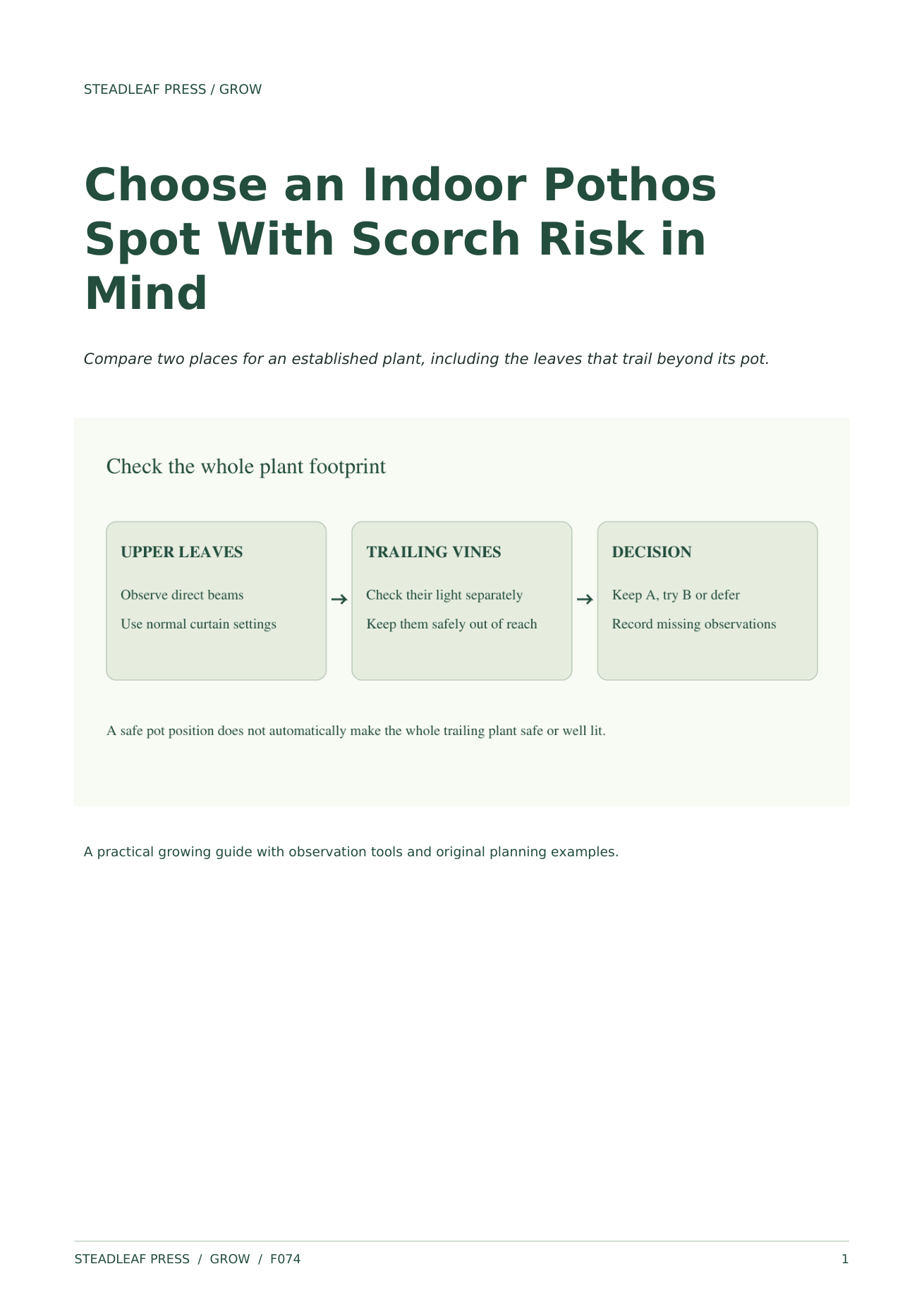
Compare two places for an established plant, including the leaves that trail beyond its pot.
A practical growing guide with observation tools and original planning examples.
STEADLEAF PRESS / GROW / F074 1
The shelf looks bright. The pot fits. Yet the longest vine hangs behind a cupboard, while another leaf rests against the sunny pane. A pothos does not occupy a single point in a room. Its leaves can experience quite different conditions even when its container never moves.
This guide helps you choose a workable indoor position for an established Epipremnum aureum. It is not a rooting-cutting protocol, a grow-light installation guide or a guarantee against leaf damage. The result is a placement decision supported by observations, plus a record of what still needs checking.
1. Name the plant and its usable space
Start with the label or a reliable identification. A heart-shaped leaf alone is not sufficient. NC State distinguishes Epipremnum aureum from superficially similar plants and explains its earlier treatment under the name E. pinnatum 'Aureum'. Different names on older references need checking, not automatic rejection or automatic equivalence. [1]
Record the cultivar if known. If not, describe its existing green, cream or yellow pattern without inventing a name. Photograph one recent, fully opened leaf and an older leaf on the same vine. That gives you your own reference rather than a nursery photograph of a different cultivar.
RHS recommends gloves for handling epipremnums and keeping them away from children and pets. [2] Assess the reachable vines as well as the pot. A high shelf does not solve access if the trailing stems hang within reach. This ornamental is not food.
Draw the plant's current outline on a simple room sketch. Include the pot, the longest trailing stem, the window, nearby furniture and the route you use to water it. The drawing need not be to scale. Its purpose is to expose conflicts that a photograph of the pot alone can conceal.
Space check: Can I support the container safely, inspect the plant and manage drainage without stretching across electrical equipment or balancing on furniture? If not, rule out that position before comparing its light.
STEADLEAF PRESS / GROW / F074 2
2. Compare two places before moving the plant
Call the current place A and one realistic alternative B. Observe both while the plant stays in a safe position. You do not need to carry it back and forth for every check.
RHS advises bright indirect light, avoiding direct sun especially in summer because foliage can scorch. It also notes that too little light can mean poor growth and reduced variegation. [2] The choice is not simply “sunny window” versus “dark corner.”
At each place, check the height of the upper leaves and the likely position of the trailing vine. Write down whether a direct beam reaches those areas under your normal curtain arrangement. Do not stare at the sun to find the beam. If you cannot observe part of the day, label that interval unknown.
Observation Place A Place B
Exact pot position and ____ ____ approximate leaf height
Direct beam seen at upper leaves: ____ ____ time and duration actually observed
Direct beam seen at trailing leaves ____ ____
Curtain or blind in its ordinary ____ ____ position
Furniture or another object ____ ____ shading part of the plant
Nearby heat source or draught ____ ____
Safe watering, drainage and vine ____ ____ access
Observation still missing ____ ____
This chart is an editorial comparison tool, not a light measurement. One cloudy afternoon cannot establish the full exposure of either place. A room's compass direction is useful context, but it does not replace what reaches the leaves through that particular window.
Avoid prescribing a universal distance from glass. Different windows, curtains, seasons and obstructions make the same distance a different situation. Write “beside the bookcase, beyond the afternoon beam observed today,” not “all pothos must be this far from a window.”
STEADLEAF PRESS / GROW / F074 3
3. Give growth clues their proper weight
Wisconsin Extension describes pothos as suited to filtered light and intolerant of much direct sun. It also notes that low light can reduce variegation, while older leaves may yellow and drop naturally. [3] A sparse section of vine or a single yellow leaf therefore does not prove that a particular window is wrong.
Use the following chart to organise questions, not diagnose the plant:
What you notice Useful placement question Other explanation to keep open
Damage appeared after a move Did that move expose leaves to a Watering, temperature and other into strong direct sun beam they previously avoided? changes may have happened too
New growth seems less patterned Is the current position considerably Compare similar leaves rather than than earlier growth dimmer, and is the cultivar two different plants or identified? photographs
Growth is slow, with no clear new Is usable light limited at the actual Season, root condition and care damage leaves? history also need consideration
Only a few old leaves yellow Is there a wider pattern, or just Natural ageing is possible; colour isolated older foliage? alone is not a diagnosis
Margins darken while the medium Is light the only issue being Investigate moisture and roots stays wet considered? rather than merely moving the plant
Wisconsin identifies inadequate or excessive watering and fertiliser salts among causes of darkened leaf margins or tips. It also describes temperature changes as another possible source of brown patches. [3] Calling every mark “sunburn” can hide a different problem.
Do not deliberately expose the plant to stronger sun to see whether damage repeats. A useful placement comparison does not require an injury experiment.
STEADLEAF PRESS / GROW / F074 4
4. Make one placement decision, not a daily shuffle
Choose among three outcomes:
Keep A: the current position has no clear mismatch, and the alternative offers no demonstrated advantage. Complete the missing observations before changing it.
Try B: you have identified a specific advantage, such as avoiding a strong beam while retaining a well-lit, reachable position. Record that reason and the date.
Choose neither: one spot is too exposed and the other is too dark, inaccessible or unsafe. Find a third realistic option rather than declaring the less bad one suitable.
When moving a trailing plant, gather and support loose stems without pulling on them. Check that no vine is caught behind a shelf or attached to an object before lifting the container. Do not force attached growth away merely to complete this exercise. Seek practical help with a heavy or awkward plant.
After any move, recheck the whole outline. A pot may be out of the beam while its longest vine is still in it. Keep foliage clear of routine door, curtain and household movement. Do not secure vines where they create a trip or pulling hazard.
Continue checking moisture rather than transferring an unchanged watering calendar to the new position. RHS advises watering when the compost approaches dryness and warns against keeping roots wet through overwatering or prolonged standing water. [2] This guide supplies no replacement watering frequency.
STEADLEAF PRESS / GROW / F074 5
5. Read the next chapter of growth
Choose a date to review the placement and mark which vine you will follow in your notes or photograph. Do not tie a tight marker around a stem. Compare new, fully opened leaves with your baseline, and note any change in curtains, heating or weather alongside the plant observations.
Keep old damage in the record. A tidier photograph taken after pruning is not evidence that the new spot prevented injury. If you also repotted, fed or pruned, record those actions; you can no longer attribute every difference to placement alone.
Fictional example: the shelf that failed the second check
Owen selects a shelf beside a bright window because the pot itself remains outside the afternoon beam. Before moving his pothos, he traces where the long vine would hang. Its end would cross the beam and reach a low table used by his cat. He rejects that arrangement without testing it on the plant.
His second option is a stable cabinet to one side of the window. He observes it with the curtain in its usual position and checks that the vines and drainage can be managed. He records it as a candidate, with morning exposure still unknown. The decision is not finished merely because the cabinet looks attractive.
The example illustrates a planning choice, not a measured growth trial. No result is invented for Owen's plant.
STEADLEAF PRESS / GROW / F074 6
6. Keep a placement card
Plant and cultivar, if known: ____
Current and candidate locations: ____
Observed advantage of the chosen place: ____
Upper-leaf and trailing-leaf exposure checked: ____
Access, children and pets considered: ____
Move completed, or reason for deferring: ____
Baseline photograph and vine to follow: ____
Next observation date and missing information: ____
Other care changes since the move: ____
If the plant develops rapid decline, soft stems, spreading lesions or an unfamiliar pest pattern, seek plant-specific advice rather than continuing a light experiment. Bring the placement card, whole-plant view and care history. A location can be sensible without being the answer to every problem.
STEADLEAF PRESS / GROW / F074 7
Sources and scope
Primary pages opened on 18 November 2026:
[1] NC State Extension Plant Toolbox, Epipremnum aureum. Identity and nomenclature. https://plants.ces.ncsu.edu/plants/epipremnum-aureum/
[2] Royal Horticultural Society, How to grow epipremnum. Indoor light, handling precautions and moisture guidance. https://www.rhs.org.uk/plants/epipremnum/growing-guide
[3] University of Wisconsin-Madison Extension, Pothos, Epipremmum aureum. Filtered light, leaf ageing and alternative causes of discolouration. https://hort.extension.wisc.edu/articles/pothos-epipremmum-aureum/
The placement charts, prompts and fictional example are original editorial tools. No calibrated light measurement, structural assessment, physical growth trial or guaranteed prevention of scorch is claimed. This guide does not recommend outdoor planting, propagation, or using a houseplant as an air-purification device.