GROW / FREE GUIDE
Read a Peace Lily's Drooping Signals Carefully
A moisture-and-stress differential checklist
Download the complete free guide
A practical free guide: a moisture-and-stress differential checklist, with an observation worksheet and cautious plant-care decisions.
Includes complete illustrated instructions and any printable worksheets or templates.
Download free PDFRead the complete free guide online
The instructional text is below. For exact-size patterns, illustrations and printable records, use the complete free PDF above.
STEADLEAF PRESS / GROW
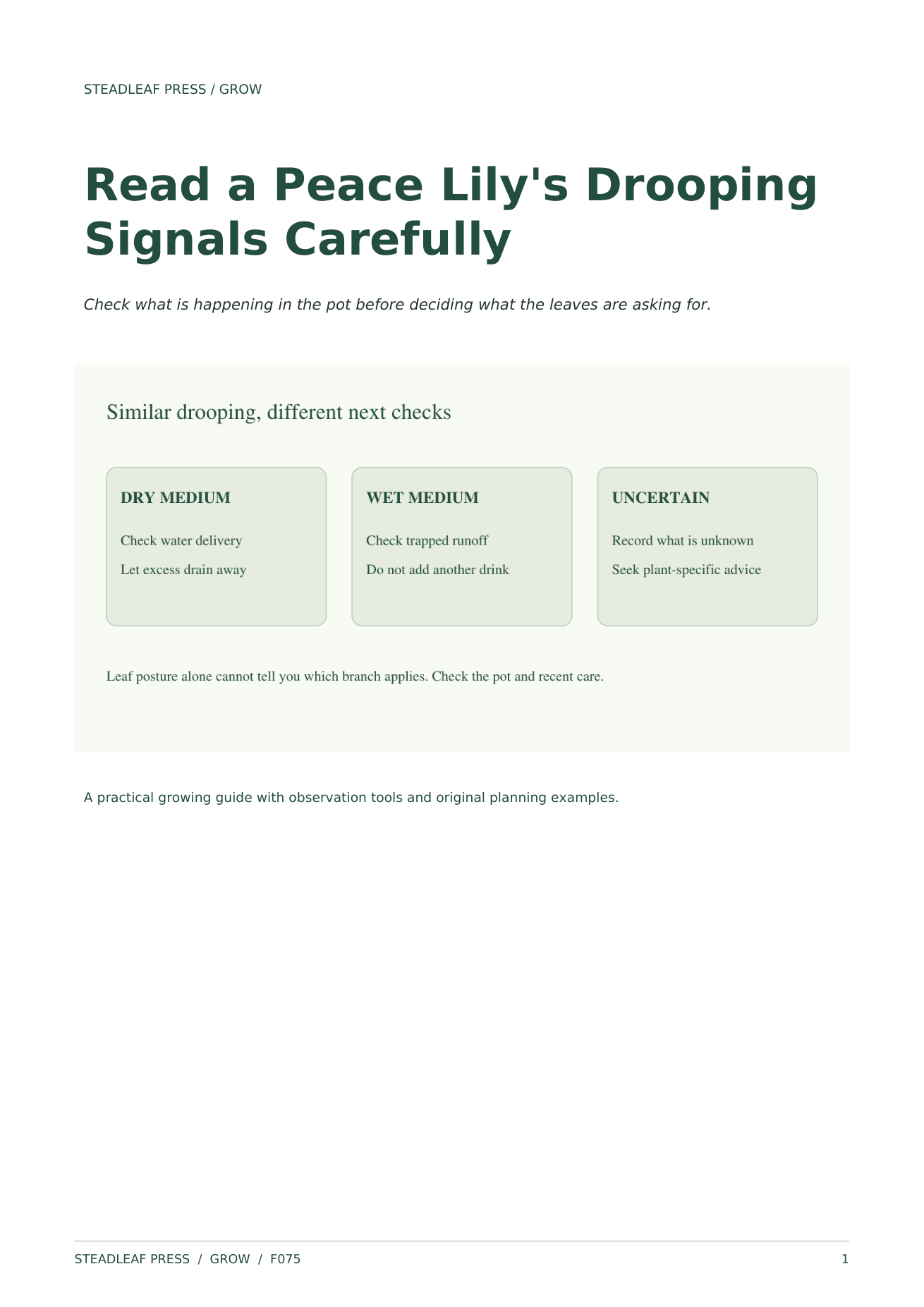
Check what is happening in the pot before deciding what the leaves are asking for.
A practical growing guide with observation tools and original planning examples.
STEADLEAF PRESS / GROW / F075 1
You watered yesterday. Today the peace lily is hanging over the rim again. The familiar response is another drink, but the useful first question is different: what happened to yesterday's water?
This guide is for an established indoor Spathiphyllum in ordinary potting medium. It offers a water-and-stress checklist, not a diagnosis or a guaranteed rescue. It does not cover hydroponic plants, division, root surgery or pesticide treatment.
1. Describe the change before naming the cause
Look at the whole plant. Are many leaf stalks hanging lower than usual, or is one leaf bent? Is the change recent, repeated or gradually worsening? Distinguish leaves from a fading flower stalk. Take a whole-plant photograph before moving anything, provided doing so does not delay an obvious safety correction.
Use a sentence with a time and an observation: “Several leaves were upright yesterday evening and are hanging lower this morning.” Avoid turning that immediately into “It is thirsty.” The second statement proposes a cause you have not yet checked.
Iowa State explains that houseplant wilt can occur when roots cannot supply enough water to the foliage, including both dry-root-ball conditions and root damage in persistently wet conditions. [1] Opposite moisture problems can produce a similar visible result.
Peace lilies are not edible. RHS advises gloves when handling them and keeping them out of children's and pets' reach. [2] Move a manageable pot by supporting its container, not pulling on leaf stalks. Leave a heavy or awkward plant in place and obtain help rather than making inspection a lifting hazard.
STEADLEAF PRESS / GROW / F075 2
2. Find the water before adding more
Check the growing pot and any outer cover separately. A decorative container may conceal a reservoir of drainage water. Note whether the actual growing pot has drainage openings and whether you can inspect them safely.
Assess the medium rather than relying solely on its colour. Record where you checked, how it felt and whether the result was clear. A single dry patch at the surface is not a complete account of the root ball. If your check is inconclusive, write “uncertain” instead of choosing the answer that seems to match the leaves.
RHS's detailed peace-lily watering guidance uses drying of the top few centimetres as a cue and reduces watering when winter growth slows. It also warns against prolonged wetness and root rot. [2] Do not turn either point into a routine of letting the whole plant collapse before every drink.
Choose the next check
Pot observation Useful next step Shortcut to avoid
Medium is clearly too dry for this Water appropriately and allow Repeating the dry-to-collapse cycle plant, with no contradictory normal drainage; record what you as a care method wet-pot signs did
Medium remains wet, or drainage Empty accessible standing water Another drink because the leaves water is trapped below safely and investigate drainage still hang down and care history
Surface is dry but the rest is Improve the moisture assessment Treating surface appearance as a uncertain or ask for help complete root assessment
Water recently ran straight Check absorption rather than Assuming fast runoff proves through but the root ball may not merely counting how much was successful watering have wetted poured
You cannot inspect safely Get help with the pot or the Unpotting or lifting an awkward assessment plant just to complete this chart
These are editorial prompts, not test results. “Wet” is an observation; “root rot” requires more evidence. Do not repeatedly pull the plant from its pot to check whether you have guessed correctly.
STEADLEAF PRESS / GROW / F075 3
3. If water is justified, watch the delivery
For a manageable pot with functioning drainage, water the medium so the root ball receives moisture, then let excess drain away. Do not leave the growing pot standing in the runoff. Keep water away from electrical equipment and protect surfaces where drainage could cause damage.
Iowa State notes that a dry root ball may remain inadequately wetted when water runs down the gap beside it, and that insufficiently thorough watering is another reason roots can lack water. [1] Fast runoff and a wet saucer therefore do not, by themselves, tell you that the roots received what they needed.
If absorption remains uncertain, seek guidance for that pot and medium rather than improvising an indefinite soak. This guide gives no universal volume, soaking time or recovery deadline. A small nursery pot and a large established specimen do not require interchangeable quantities.
After watering, record the time, the drainage you observed and the later moisture condition. Do not add successive small drinks solely because the plant has not immediately changed posture. Recheck the evidence before repeating the action.
RHS notes that a peace lily drooping from lack of water may recover after prompt watering. [2] That does not establish that every drooping plant is dry or that a particular plant must recover within a set number of hours.
STEADLEAF PRESS / GROW / F075 4
4. When wetness and wilt appear together
Keep this branch separate from the dry-pot branch. If the medium stays wet while the plant worsens, do not use extra water as a diagnostic test. Check the recent record: watering frequency, a new outer pot, blocked drainage, repotting or a change in location.
An observation such as “the inner pot has been sitting in water” is worth correcting. It does not prove that this is the only cause, or that emptying the outer container has repaired any damage already present.
NC State advises moist but not soggy conditions for peace lilies and also warns that excessive fertiliser salts can damage roots and leaf tips. [3] Do not add feed as a substitute for understanding a wet, declining plant. Keep any fertiliser packaging and application notes for an adviser rather than attempting to balance one product with another.
Get prompt plant-specific help for rapid collapse, soft or discoloured tissue at the base, spreading lesions, or worsening wilt while the medium remains wet. Provide whole-plant and close-up photographs plus the pot and care history. The useful question is “What should I inspect next?” rather than “Which rescue product should I buy?”
STEADLEAF PRESS / GROW / F075 5
5. Read the room and the recent history
Once immediate moisture and drainage questions are addressed, look beyond the watering can. Was the plant moved beside a heater, into a direct beam, or near a door that now opens frequently? Was it recently repotted? Has more than one person been watering it?
RHS recommends bright indirect light and avoiding hot radiators and cold draughts. [2] Check the actual plant position, not just the general room temperature. If the current location is clearly unsuitable, correct that exposure and record the move. Do not hide the plant in deep shade merely because it looks unhappy.
A recent change is a clue, not a verdict. Keep the timeline in order:
Event Date or time What is known What remains uncertain
Last ordinary watering ____ ____ ____
First observed drooping ____ ____ ____
Recent move or repotting ____ ____ ____
Feeding or other addition ____ ____ ____
Today's moisture and ____ ____ ____ drainage check
Action actually ____ ____ ____ completed
For shared care, make the latest entry visible to everyone who waters. A named person and a dated observation are more useful than two people independently deciding that the leaves need attention.
STEADLEAF PRESS / GROW / F075 6
6. Two similar silhouettes, different decisions
Fictional example: an interrupted routine. Jo returns after missing a normal care check. The peace lily droops and the medium is clearly dry. She waters a safely accessible pot, observes drainage and empties the saucer. She records those actions and plans another observation. The record does not yet say “recovered.”
Fictional example: hidden runoff. Ravi sees a similarly drooping plant, but its medium is wet and its outer pot contains standing water. He empties that water safely and does not add another drink. Because the plant has been declining, he assembles photographs and the recent watering history for advice. He does not label the problem as root rot from the posture alone.
Neither example is a trial report. Their point is the fork in the decision, not a happy ending supplied by the author.
STEADLEAF PRESS / GROW / F075 7
7. Replace the rescue cycle with a usable record
At the next review, compare moisture, drainage and the plant's overall condition with your earlier entry. Record improvement, no clear change or deterioration honestly. A posture change is useful information, but it does not explain every underlying condition or rule out another problem.
If the same drooping pattern repeats, revisit the whole routine rather than waiting for a more dramatic signal. Ask whether water is reaching the medium, whether excess can escape, and whether the plant's location or pot condition deserves assessment. Avoid an automatic bigger pot, major pruning or extra feed without a reason supported by the checks.
Your next decision
Plant identity and pot description: ____
Moisture check, including where and how: ____
Standing water or drainage concern: ____
Recent exposure or care change: ____
Action justified by today's observations: ____
Action deliberately not taken, and why: ____
Follow-up observation time: ____
Reason to seek help sooner: ____
The strongest entry may be “still uncertain; asking for assessment.” Reading the leaves carefully includes knowing when they are not enough.
STEADLEAF PRESS / GROW / F075 8
Sources and scope
Primary pages opened on 18 November 2026:
[1] Iowa State University Extension, Diagnosing Houseplant Problems from Improper Environmental Conditions, especially Wilting. Dry and wet root conditions, incomplete wetting and drainage issues. https://yardandgarden.extension.iastate.edu/how-to/diagnosing-houseplant-problems-improper-env ironmental-conditions
[2] Royal Horticultural Society, How to grow peace lilies. Species-specific watering cues, location, handling and drooping from water shortage. https://www.rhs.org.uk/plants/peace-lilies/how-to-grow-peace-lilies
[3] NC State Extension Plant Toolbox, Spathiphyllum. Moisture conditions and excess fertiliser cautions. https://plants.ces.ncsu.edu/plants/spathiphyllum/
The checklists, timelines and fictional examples are original editorial tools. No physical watering trial, root examination, diagnosis, recovery time or guaranteed outcome is claimed. This is indoor ornamental-plant care, not food, veterinary or medical advice.