GROW / FREE GUIDE
Give a Snake Plant a Suitable Pot and Mix
Give a Snake Plant a Suitable Pot and Mix: a practical observation-led guide and printable decision record.
Download the complete free guide
Give a Snake Plant a Suitable Pot and Mix: a practical observation-led guide and printable decision record.
Includes complete illustrated instructions and any printable worksheets or templates.
Download free PDFRead the complete free guide online
The instructional text is below. For exact-size patterns, illustrations and printable records, use the complete free PDF above.
STEADLEAF PRESS / GROW
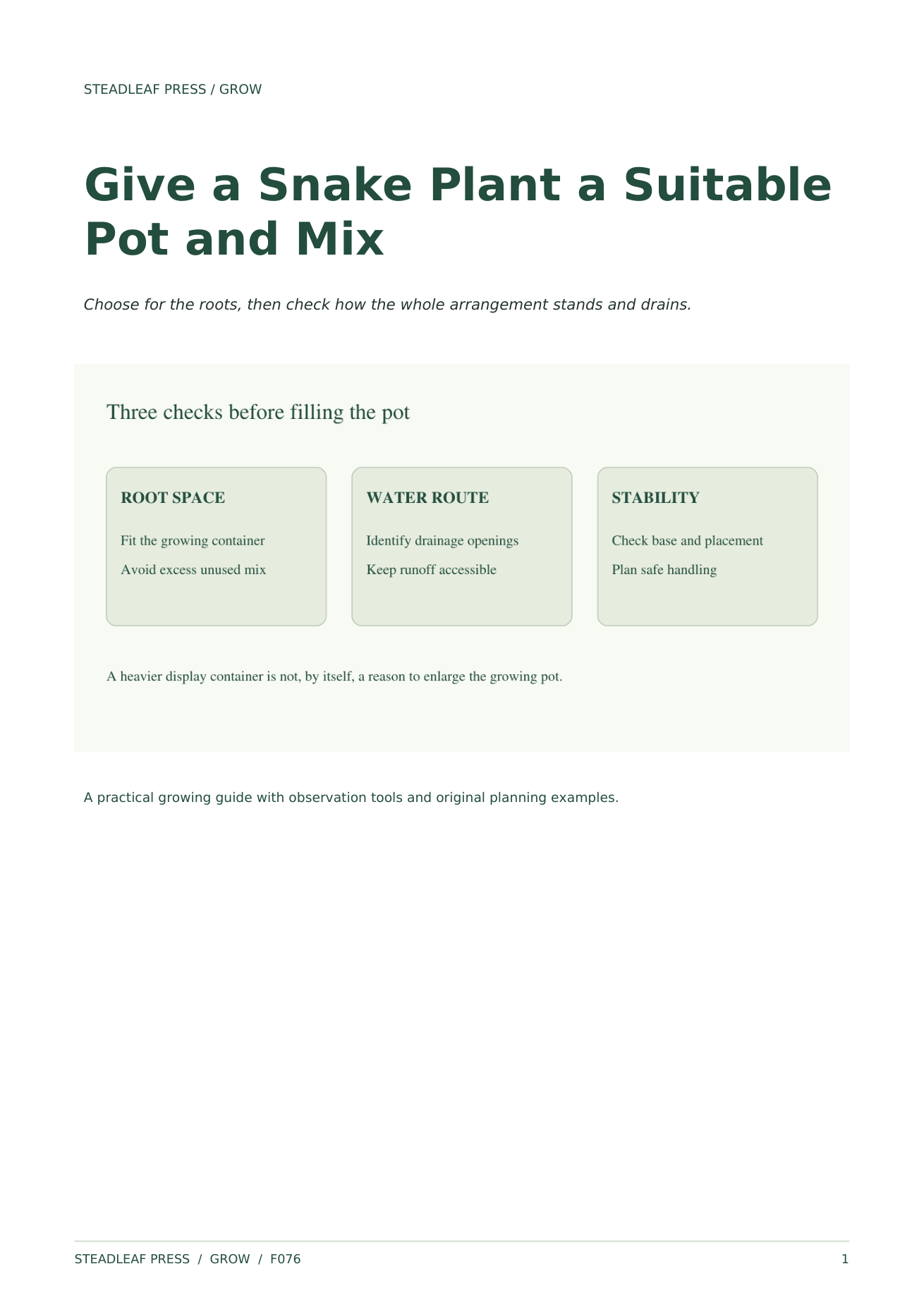
Choose for the roots, then check how the whole arrangement stands and drains.
A practical growing guide with observation tools and original planning examples.
STEADLEAF PRESS / GROW / F076 1
The tall ceramic pot looks steadier than the nursery pot. It also has enough space for several times as much potting mix. Those two observations do not lead to the same decision. Your snake plant may need a more secure place to stand without needing a much larger growing container.
This guide helps you make a pot, mix and drying plan for an established indoor snake plant. It is not a root-cutting procedure or a treatment for a collapsing plant. The familiar sword-leaved species is Dracaena trifasciata, previously called Sansevieria trifasciata. NC State uses the current name; the RHS guide retains Sansevieria. [1, 2] Keep the plant label, especially if yours is another species or a compact cultivar.
1. Decide which problem you are solving
Before shopping, complete this sentence: “I want to change the arrangement because ____.”
A cracked container, a plant that has outgrown its pot, a decorative preference and a pot that rocks on its shelf are different reasons. Do not let the attractive new container supply a reason you did not have before seeing it.
RHS advises keeping these plants in a close-fitting container until growth fills or distorts it, then moving only to a slightly larger pot. Its concern is the surplus medium in an oversized container remaining damp. [1]
For this planning exercise, separate three observations:
Observation What to investigate What it does not establish
The entire container rocks on the Base, surface and safe placement That the roots need more space surface
The plant moves within an Anchoring, recent disturbance and That adding weight will repair the otherwise stationary pot plant condition plant
Growth is filling or distorting the Whether repotting is warranted That the largest available pot is growing pot appropriate
Do not deliberately push a tall plant to the point of tipping. Observe it in ordinary use and correct an obviously unsafe location first. A loose clump, soft base or worsening collapse deserves plant-specific assessment before a cosmetic change conceals it.
A valid decision is to keep the growing pot. You can change a location or investigate an outer container without disturbing healthy roots.
STEADLEAF PRESS / GROW / F076 2
2. Draw the water route
Set the empty candidate container beside the plant if you can handle it safely. Identify which vessel will actually contain the roots and mix.
For direct planting, inspect the growing container's drainage openings. For a double-pot arrangement, identify both the inner growing pot and the outer decorative cover. Iowa State describes this as a way to use a decorative vessel without a drainage hole while retaining a draining inner pot. It also warns that gravel at the bottom does not compensate for a missing drainage opening. [3]
Now trace the route in words:
Water enters the mix → excess leaves the growing pot → runoff is collected → collected water is removed.
That last action needs a practical method. Can you remove the inner pot without catching or bending the leaves? Can you empty the cover without moving an awkward weight? If the answer is no, the arrangement is unfinished, however good it looks.
Do not pour mix around an inner pot simply to hide the gap. Keep the two vessels distinguishable and accessible. Follow the container manufacturer's instructions for its intended use; this guide does not ask you to drill ceramic, glass or a fitted planter.
The access check
- I can identify the growing pot and see how it drains.
- I can remove collected water without spilling it near electrics.
- The inner pot is not jammed into its cover.
- I can support the pot when moving it rather than lifting by the leaves.
- Any help needed for lifting or emptying is available.
- The floor or furniture is protected without blocking drainage.
If you cannot complete one of these checks, choose another arrangement before planting.
STEADLEAF PRESS / GROW / F076 3
3. Choose a mix without inventing a recipe
RHS recommends a free-draining, peat-free cactus compost for snake plants. [1] Here, compost means a potting medium, not a bucket of unfinished garden compost. Use a product intended for container plants and read its handling and use instructions.
For a first attempt, a suitable ready-made medium makes the choice easier to record than an improvised mixture. Write down the product name and retain its label. This guide gives no universal homemade ratio: ingredients sold under similar names can differ, and a recipe cannot make a poorly chosen container appropriate.
Do not confuse two uses of mineral material. Particles incorporated in a formulated potting medium are not the same arrangement as a separate bed of stones beneath all the roots. The latter is not a substitute for drainage holes. [3]
Before opening a bag, choose a stable work surface away from food preparation, children and pets. Follow the bag's precautions for dust and handling. Keep unused material in its original labelled packaging where possible. Stop if an old, unidentified mixture is your only option; identifying what you already have is more useful than adding another unknown ingredient.
Your mix decision should be short enough to explain: “I chose this labelled cactus medium and a draining growing pot that fits the plant.” It need not contain a list of supplements.
STEADLEAF PRESS / GROW / F076 4
4. Check stability separately from pot volume
The intended display surface is part of the plan. Check the base sits fully on it, without overhang, rocking or a soft mat that makes the arrangement unstable. Keep the plant away from a route where people, pets, bags or opening doors can catch it.
A heavy outer cover may be worth considering, but weight alone is not a safety certificate. Check the shape, base, fit and total handling burden. Do not trade a light pot that is easy to empty for a heavy enclosure you cannot manage. This guide provides no safe-load figure for a shelf, stand or floor.
Snake plants can irritate skin and are not for eating; RHS advises keeping them away from children and pets. [1] Choose a location that addresses access as well as appearance. A tall stand is not automatically safe merely because it raises the leaves.
Compare two arrangements before committing
Check Candidate A Candidate B
Growing pot fits the plant rather ____ ____ than the decorative space
Base and supporting surface are ____ ____ suitable
Runoff can be removed safely ____ ____
Leaves clear nearby movement ____ ____ and objects
Children and pets cannot access ____ ____ the plant
Total weight is manageable with ____ ____ available help
Unanswered question before use ____ ____
Choose neither if both leave an important question unanswered. The comparison is a planning aid, not an engineering test.
STEADLEAF PRESS / GROW / F076 5
5. Make drying an observation, not a countdown
NC State specifies well-drained medium and drying between waterings, with much less water in winter. [2] Treat that as plant-care context, not a reminder to pour a fixed amount on a particular date.
RHS's detailed guidance says to check that the medium has dried before watering, keep water out of the rosette centre, and empty drainage water. [1] A new pot or mix is a reason to learn the new pattern rather than copy the old interval.
Record the moisture assessment and how you made it. Surface appearance alone may leave you uncertain about the rest of the medium. If you cannot assess it reliably, seek advice for that pot rather than repeatedly adding water to be safe. A calendar reminder can mean “check”, not “water”.
Do not force a drying deadline by placing the plant beside a heater. Avoid changing the pot, medium, location and feeding all at once merely to see which one works. If safety requires an immediate move, make it and note the reason.
Date Medium Water added, if Runoff removed Change since last observation and justified check method
____ ____ ____ ____ ____
____ ____ ____ ____ ____
____ ____ ____ ____ ____
Repeated wetness, worsening soft tissue or increasing looseness warrants assessment, not another decorative fix. A draining pot reduces one practical problem; it does not prove that the roots are healthy.
STEADLEAF PRESS / GROW / F076 6
6. A plan that does not require repotting today
Fictional example. Leila wants to replace a light nursery pot with a tall planter. The plant appears firmly held in its existing container, and she has not observed a reason to enlarge its root space. Her first candidate is so narrow at the opening that she cannot comfortably remove the inner pot.
She rejects that pairing. A second cover allows access, but the combined weight is awkward on the high shelf she had chosen. She decides to keep the current arrangement in its existing safe location while looking for a more practical option. She has bought nothing and disturbed no roots.
The example ends with a decision, not a claim that the plant grew better. Its useful result is a list of requirements that an attractive container failed to meet.
Your final pot-and-mix plan
Plant identity and current growing pot: ____
Reason for changing anything: ____
Keep the growing pot, repot, or seek assessment first: ____
Chosen growing container and drainage route: ____
Labelled mix, if a change is warranted: ____
How collected water will be removed: ____
Placement and handling questions resolved: ____
What I will observe before watering again: ____
What would make me stop and ask for help: ____
A suitable arrangement serves the roots and remains usable by the person caring for them. You should be able to explain both parts before filling the pot.
STEADLEAF PRESS / GROW / F076 7
Sources and scope
Primary pages opened on 18 November 2026:
[1] Royal Horticultural Society, How to grow sansevierias. Pot fit, cactus compost, handling and watering guidance. https://www.rhs.org.uk/plants/sansevieria/growing-guide
[2] NC State Extension Plant Toolbox, Dracaena trifasciata. Current name, former synonym and drainage/watering context. https://plants.ces.ncsu.edu/plants/dracaena-trifasciata/
[3] Iowa State University Extension, How to Select Quality Plant Containers. Drainage holes, double pots and the limits of a gravel layer. https://yardandgarden.extension.iastate.edu/how-to/how-select-quality-plant-containers
The comparison tables, access checks, record and fictional example are original editorial tools. No physical stability, drying, repotting or growing trial was performed. This is a selection and observation guide, not a guarantee against tipping, root disease or plant loss.