GROW / FREE GUIDE
Clean Dust From Broad Houseplant Leaves Gently
Clean Dust From Broad Houseplant Leaves Gently: a practical observation-led guide and printable decision record.
Download the complete free guide
Clean Dust From Broad Houseplant Leaves Gently: a practical observation-led guide and printable decision record.
Includes complete illustrated instructions and any printable worksheets or templates.
Download free PDFRead the complete free guide online
The instructional text is below. For exact-size patterns, illustrations and printable records, use the complete free PDF above.
STEADLEAF PRESS / GROW
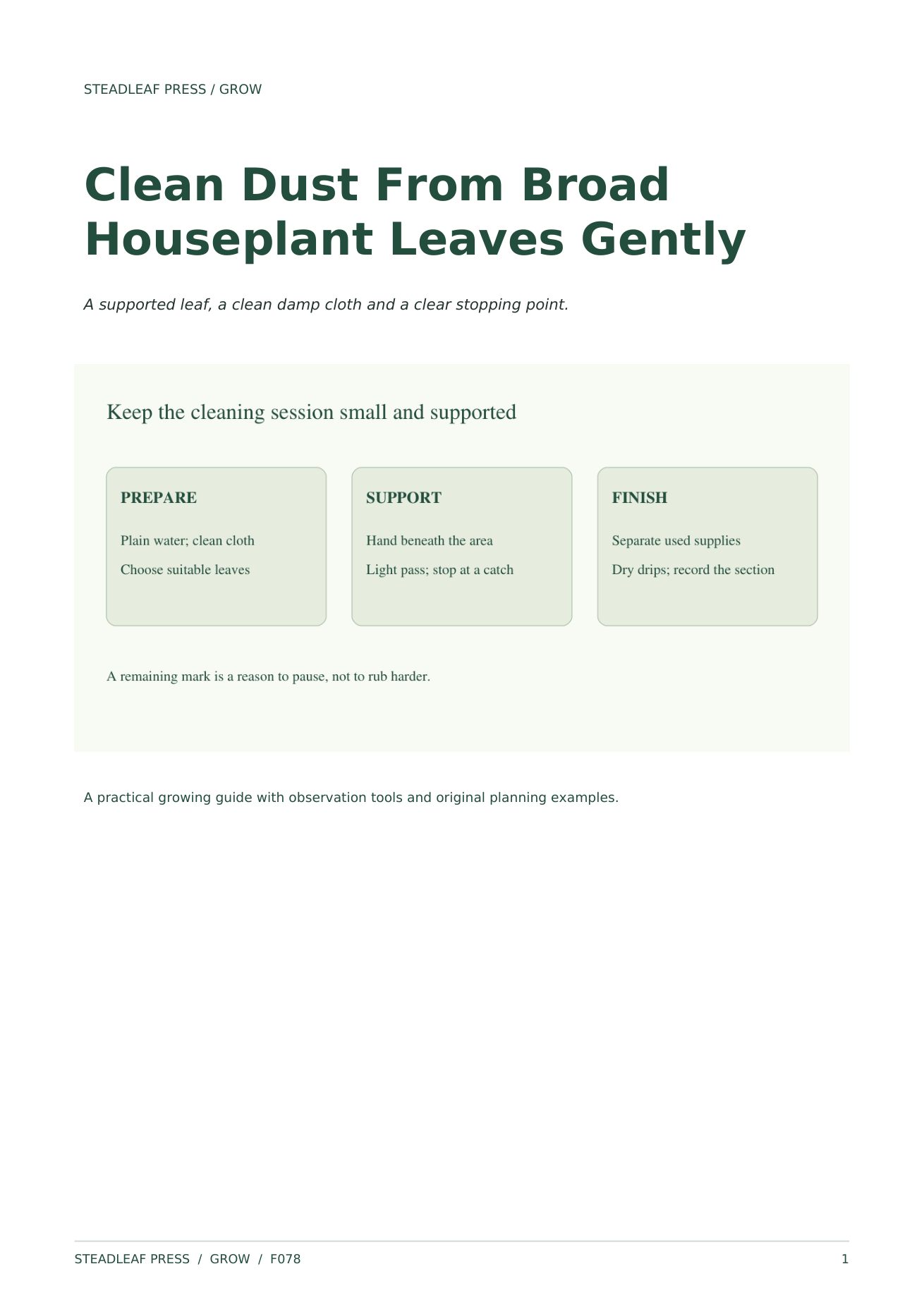
A supported leaf, a clean damp cloth and a clear stopping point.
A practical growing guide with observation tools and original planning examples.
STEADLEAF PRESS / GROW / F078 1
A leaf can look dull because it is dusty. It can also look dull because that is its natural surface. Before trying to make a plant shine, decide what you are actually removing.
This routine is for ordinary loose household dust on accessible, mature, smooth leaves of an identified indoor plant. It is not a treatment for pests, disease, chemical residue or damaged tissue. Hairy leaves, delicate new growth and plants with a natural powdery coating need a different, species-specific decision.
The aim is a cleaner leaf, not a polished one.
1. Set the boundaries of today's session
Select one identified plant with smooth, mature leaves and ordinary loose dust. Exclude hairy or powder-coated surfaces, unfolding leaves and damaged areas. If you see sticky material, webbing or an unfamiliar spreading coating, leave that plant out and investigate separately. This routine begins after you have decided that ordinary dust removal is appropriate; it is not a test for identifying pests.
University of Minnesota Extension notes that accumulated dust can obstruct light and recommends gentle damp wiping for large-leaved plants such as rubber trees and monstera. [1] Cleaning supports ordinary care but does not replace a suitable growing position.
Decide what you can reach comfortably. You might do the front-facing mature leaves today and leave a difficult rear section until someone can help reposition the pot. Make that choice before wetting the cloth, so a partially finished plant does not tempt you into an awkward reach.
A manageable work list
Plant and location: ____
Leaves or section to clean today: ____
Areas deliberately excluded: ____
Help or repositioning needed before another session: ____
A short, explicit work list gives the task an end. It also prevents someone else from treating an untouched delicate leaf as an oversight.
STEADLEAF PRESS / GROW / F078 2
2. Set up a small, controllable job
You need a soft clean cloth, plain water, a small bowl and protection for the work surface. Keep a second cloth available so the first does not become a tool for redistributing dirt.
Iowa State recommends a damp soft cloth or sponge for large leaves and rinsing it as it becomes dirty. It warns that household detergents can damage the leaf's protective surface. [3] For this routine, use plain water rather than mixing a cleaner.
Do not add furniture polish, kitchen oil, fragrance, vinegar or a homemade shine mixture. These are outside the routine, not missing secret ingredients. Minnesota Extension says leaf-shine products are unnecessary. [1] Natural gloss, where the plant has it, is enough.
Check the plant's identity and handling precautions. Some houseplants have irritating sap. Wear appropriate gloves if required and avoid damaged tissue; clean hands and equipment afterwards. This is not a task for children or pets to explore unsupervised.
Keep water away from sockets, lamps and electrical equipment. Place the bowl where you will not knock it over while reaching for a leaf. Do not stand on an unstable chair or pull a tall plant towards you by its stem. If a leaf cannot be reached and supported safely, leave it for a better setup or get help.
Choose a small area of work. Finishing three accessible leaves carefully is preferable to rushing through a whole plant with tired hands.
STEADLEAF PRESS / GROW / F078 3
3. Support the leaf instead of holding its tip
Dampen the cloth and wring it out so it is not dripping. The practical purpose is to pick up dust without sending water into the pot or across the furniture.
Rest your free hand beneath the part of the leaf you are cleaning. Keep the leaf in a comfortable natural position rather than flattening a curved surface against the table. Do not pinch the tip and pull against the leaf stalk.
With the cloth, make a light pass over a small supported area. Move your supporting hand as you move to another area. On a split or perforated leaf, work around the openings; do not drag the cloth across a gap where an edge could catch.
Pause after the first small area. Check the leaf and the cloth. If the leaf bends sharply, catches, creases or begins to tear, stop. A patch that stays in place is not an invitation to press harder.
Refold or rinse the cloth when it collects dust. Replace dirty water. Use a clean cloth for another plant, particularly if there was any uncertainty about the first one's condition.
You may inspect the underside, but do not twist the leaf over to reach it. Clean an underside only if it is suitable for this method and can be supported without strain. If access is awkward, leaving that surface alone is a valid result.
Stop rather than escalate
- The leaf is too fragile to support comfortably.
- The cloth catches on an edge or damaged area.
- A mark remains after a gentle pass.
- You discover a coating or organism you cannot identify.
- Your reach or grip becomes awkward.
- You would need a stronger product to continue.
These are conservative working limits, not evidence that a particular plant has been harmed.
STEADLEAF PRESS / GROW / F078 4
4. Keep the clean and used supplies apart
Use one side of the work surface for clean cloths and another for the used one. Refolding exposes a fresh area, but once a cloth is generally dirty, replace or rinse it rather than carrying the same dirt along the next leaf. Put the bowl down before repositioning the plant; do not try to carry both in one hand.
If the wipe leaves droplets, use a clean soft cloth to absorb accessible drips gently rather than polishing the leaf dry. Check the leaf stalk and the surface beneath the pot too. A cloth that was merely damp at the start can become wetter after repeated rinsing.
Do not leave a damp cloth draped over a leaf while you answer the door or look for another tool. Put it in the used-supplies area and leave the plant unsupported only when it is resting naturally again.
A stubborn mark belongs outside the cleaning session. RHS notes that surface markings can have different causes, including cleaning-product damage and hard-water deposits. [2] Do not add another product to remove something this routine has not identified. Record the mark, leave it alone and obtain appropriate advice if needed.
If you have to stop halfway
1. Release the supported leaf carefully.
2. Put the cloth and bowl in a secure place.
3. Remove any accessible drips or pooled water.
4. Note which section you finished.
5. Leave remaining leaves for a fresh session rather than rushing.
The list describes an orderly pause, not a horticultural treatment. It is especially useful when several people share care of the same plant.
STEADLEAF PRESS / GROW / F078 5
5. Finish without adding unnecessary care
Check for drips on the leaves, pot, saucer and nearby surface. Remove accessible collected water and dry the work area. Leave the plant in its appropriate growing position; do not move it into stronger sun to reward it for looking cleaner.
Cleaning is not an automatic watering or feeding day. Decide those tasks from the plant's needs, not from the fact that the bowl is already out.
There is also no universal weekly cleaning requirement. Look for dust again during ordinary care and choose the next session from the actual surface condition. Frequent rubbing for shine is not the goal.
Wash the used cloths before reusing them on plants. Keep any cloth used on suspicious material out of the general plant-cleaning supplies until it has been appropriately cleaned or replaced. Put bowls and supplies away rather than leaving an attractive small water container where it can spill.
A brief record
Plant and leaf selected: ____
Surface suitable for damp wiping: ____
Section included and excluded: ____
Leaves or section actually completed: ____
Used cloths removed and work area dry: ____
Leaves or areas deliberately left alone: ____
Follow-up question, if any: ____
Record only what you observed. A clean-looking leaf is not proof of pest freedom, restored photosynthesis or improved future growth.
STEADLEAF PRESS / GROW / F078 6
6. A useful session can end with an untouched leaf
Fictional example. Owen begins with a mature rubber-plant leaf he can support. Dust transfers to his damp cloth, but an older pale mark remains. He records it instead of rubbing harder.
He reaches towards the new leaf beside it, then notices that it has not fully opened. He leaves it alone. His photograph shows one cleaned mature leaf and the untouched new growth. Neither receives a claim of recovery.
The difference between the two leaves is the point of the exercise. A careful routine is selective: it does not demand the same action from every leaf in the pot.
Before you finish, ask one final question: “Did I stop because the dust was removed, or am I still trying to change the leaf itself?” If it is the latter, put the cloth down and reassess.
STEADLEAF PRESS / GROW / F078 7
Sources and scope
Primary pages opened on 18 November 2026:
[1] University of Minnesota Extension, Spring houseplant care, cleaning section. Dust, gentle damp wiping and avoiding unnecessary leaf shine. https://extension.umn.edu/houseplants/spring-houseplant-care
[2] Royal Horticultural Society, How to help a poorly houseplant. Distinguishing symptoms, pests, disease and surface markings; cleaning-product and hard-water marks. https://www.rhs.org.uk/plants/types/houseplants/how-to-help-a-poorly-houseplant
[3] Iowa State University Extension, Dust has accumulated on the foliage of my houseplants. How can I clean the plants? Soft damp cleaning, rinsing the cloth and detergent cautions. https://yardan dgarden.extension.iastate.edu/faq/dust-has-accumulated-foliage-my-houseplants-how-can-i-clean-p lants
The supported-leaf workflow, exclusions, stopping rules, record and fictional example are original conservative editorial guidance. No physical leaf-cleaning trial, guaranteed damage prevention, pest treatment or measured growth improvement is claimed. This is an ornamental-houseplant routine, not produce-washing advice.