GROW / FREE GUIDE
Rotate a Houseplant and Track Its New Growth
Rotate a Houseplant and Track Its New Growth: a practical observation-led guide and printable decision record.
Download the complete free guide
Rotate a Houseplant and Track Its New Growth: a practical observation-led guide and printable decision record.
Includes complete illustrated instructions and any printable worksheets or templates.
Download free PDFRead the complete free guide online
The instructional text is below. For exact-size patterns, illustrations and printable records, use the complete free PDF above.
STEADLEAF PRESS / GROW
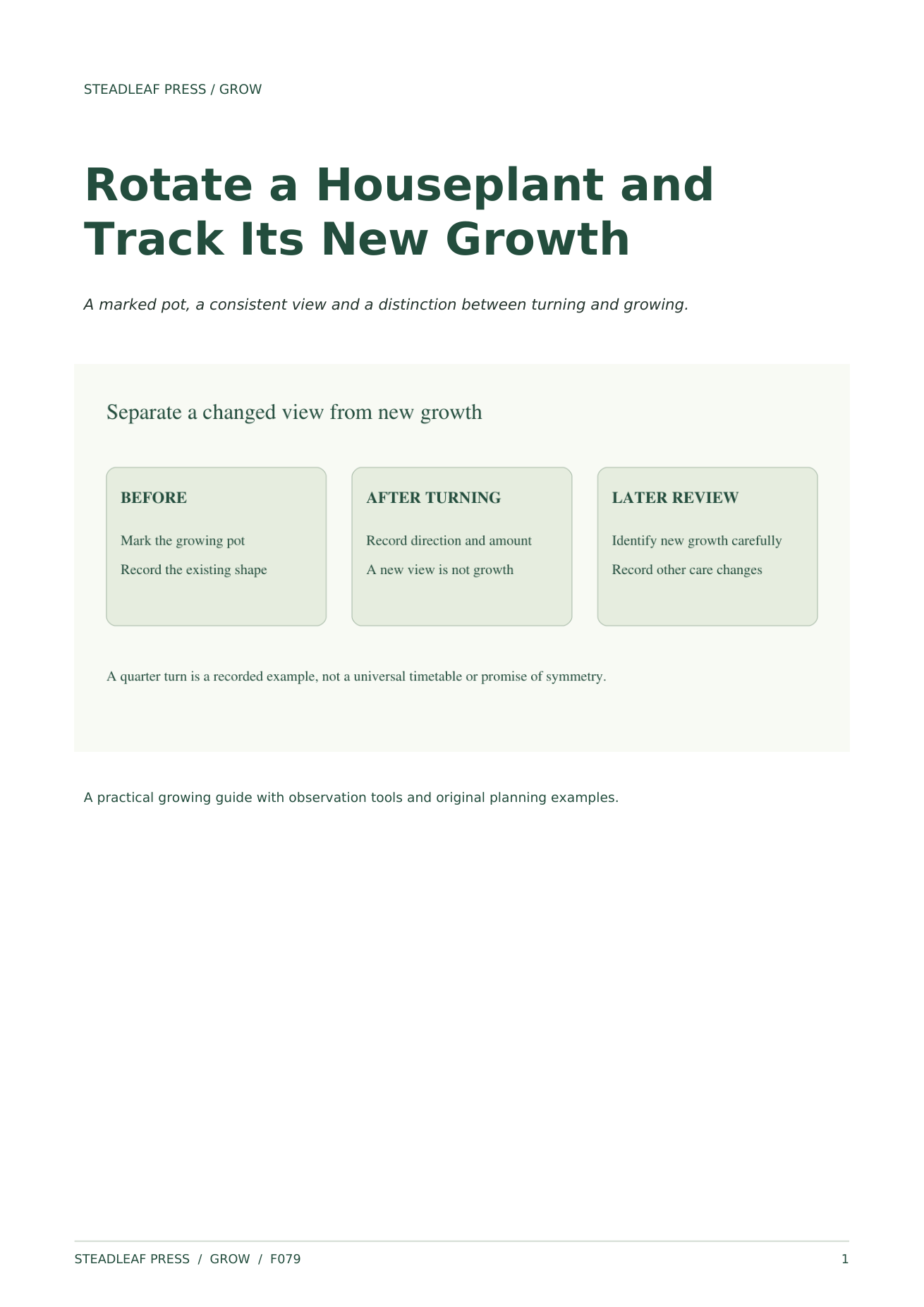
A marked pot, a consistent view and a distinction between turning and growing.
A practical growing guide with observation tools and original planning examples.
STEADLEAF PRESS / GROW / F079 1
Yesterday the fullest side faced the window. Today it faces the room, and the plant looks more balanced from the sofa. That may be a useful change in appearance, but it is not overnight growth. You have changed which side you can see.
This guide is a rotation and observation routine for an identified, established indoor foliage plant in a manageable, stable pot. It is not a way to straighten a damaged stem, repair roots or make every plant symmetrical. A climbing plant attached to a fixed support, a heavy specimen or a plant with sudden collapse needs a different decision before anyone turns the pot.
1. Decide whether rotation is the right task
Illinois Extension recommends rotating indoor plants regularly so different sides receive window light. It also identifies elongated, spindly growth as a possible sign of inadequate light. [1] Those are related but different issues: changing orientation does not create more light in a dim room.
First identify what seems uneven. Is one side fuller? Does a healthy growing tip face the window? Or is the entire plant newly slumped, loose at the base or leaning far enough to threaten the pot's balance? Do not treat all of these observations as the same problem.
For this routine, choose a plant that is otherwise stable and suitable for its current light conditions. If its base is moving, a stem is broken or the pot may fall, pause and address safe placement and the underlying problem. Do not test its balance by pushing it. Do not bend a stem into a position you hope it will eventually occupy.
Check species-specific care before proceeding. Flowering, trained or unusually sensitive plants may have requirements that this general foliage routine does not cover. If a vine is attached to the wall or entwined with another plant, the container cannot simply turn independently of the foliage.
Write a single aim: “Give different sides access to the window light and observe subsequent growth.” Avoid “make it straight by next week.” The first is an action you can document; the second is a result you cannot promise.
STEADLEAF PRESS / GROW / F079 2
2. Establish a reference before touching the pot
Choose a removable marker suitable for the container's finish and place it on the outside of the actual growing pot. A small piece of low-tack tape may work, but test the finish first. Do not mark the leaves, tie a tight loop around a stem or block a drainage hole.
If the growing pot sits inside a decorative cover, marking only the cover can mislead you. Someone may turn the outer cover while the plant stays where it was. Record which container carries the mark. Keep drainage access clear.
Sketch the window at the top of a simple plan view and mark the pot's starting orientation. Take one photograph from a repeatable place in the room. Include the pot rim and an existing stem or leaf you can recognize without attaching anything to it. Note the camera position and approximate height.
This baseline has two jobs. It records which side faces the light, and it helps you distinguish the old shape from anything that grows later. It does not measure light intensity or diagnose the plant.
Baseline card
Plant identification: ____
Location and main light direction: ____
Marker is on the growing pot / another container, explained: ____
Marker's starting direction: ____
Existing unevenness, described without diagnosis: ____
Recognizable old leaf or stem in the photograph: ____
Safe to turn without pulling foliage or fixed supports: yes / no / uncertain
If the last answer is no or uncertain, leave the plant in a safe position and resolve that issue first. A completed observation card does not require a completed turn.
STEADLEAF PRESS / GROW / F079 3
3. Turn the container, not the stem
Clear enough space for the whole plant, including projecting leaves. Check nearby glass, curtains, shelves, cables and other pots. Keep children and pets away while you handle the container, and follow the identified plant's handling precautions. Do not use an unstable chair to reach it.
For a small, manageable pot, hold the container securely and turn it without dragging the foliage or twisting a support fixed elsewhere. Avoid gripping a fragile rim or lifting by the stem. If you cannot move it comfortably, stop and arrange suitable assistance rather than improvising leverage.
A quarter turn is a useful reference because it is easy to record. The RHS office-plant guide suggests a monthly quarter turn. [2] That is a general example, not a universal timetable for every species, season or growing condition. Use applicable species guidance and your observations to choose the review interval.
Record the actual direction and amount immediately. For example: “Quarter turn clockwise, viewed from above; marker moved from the window side to the right side.” This describes a single action. You do not need to turn it several more times to demonstrate the sequence.
Keep the pot in the same suitable position for this orientation exercise. Moving it closer to a window at the same time would change another condition. If its light is unsuitable, improving that position takes priority over keeping an observation tidy; record the relocation as a separate change.
Check that the pot is secure, leaves are free and drainage access remains available. Turning is not an instruction to water. Check moisture separately rather than adding water because you are already caring for the plant.
STEADLEAF PRESS / GROW / F079 4
4. Read the next photograph carefully
Take a photograph immediately after the turn from the same room position. Label it “orientation changed today,” not “growth improved.” The two photographs show different sides of the same plant. Their silhouettes cannot establish that the plant has filled out.
At a later observation, first record whether anyone has turned or moved the pot again. Then look for new growth relative to the recognizable older leaf or stem. Use an additional close view if helpful, without bending the plant to recreate the first picture. Keep the reference marker visible where practical.
Do not turn the pot back solely to make every photograph look identical. Instead, label the orientation and distinguish a room-view photograph from a close view of the chosen growing area. If you cannot confidently identify what is new, record “uncertain.”
Existing bends may remain visible. The routine does not promise their reversal, and no visible new growth during an observation interval is not by itself a reason to turn more frequently. Record what you can see before deciding what to change.
What the record can and cannot show
Observation A defensible entry Do not conclude
The fuller side now faces the room Appearance changed immediately New growth appeared overnight after rotation
A new leaf has opened since the New leaf visible at the recorded Rotation alone caused it baseline growing area
No identifiable new growth No change confirmed during this The plant needs daily turning interval
Plant is newly unstable or Stop the routine and investigate A further turn will repair it damaged safely
Season, watering, temperature and ordinary development can all complicate a home comparison. This is a practical care record, not a controlled growth experiment.
STEADLEAF PRESS / GROW / F079 5
5. Make the next decision from the plant, not the card
At your planned review, consider three outcomes: continue a suitable routine, pause to investigate, or change the growing position after checking the plant's needs. Do not keep rotating merely because a row on the card is blank.
Iowa State explains that window distance, coverings and outside obstructions affect indoor light. It also describes pale or spindly growth and damaged foliage among signs that warrant reconsidering light conditions. [3] A turn in the same unsuitable spot is not a substitute for that assessment. These signs are not unique diagnoses, so check the broader care situation rather than assigning one cause from appearance alone.
If a previously shaded side would now receive strong direct sun, reconsider the exposure for that species. Do not move the plant into stronger sunlight to force a faster response. Stop if turning traps a leaf, strains a vine or makes the pot unsafe.
In a shared room, leave the card where the person caring for the plant will find it. “Reviewed; no turn today” is useful information. It prevents a second person from adding an unrecorded turn in an attempt to help.
Repeatable observation entry
Date and observer: ____
Marker direction before observation: ____
Action: no turn / turn, direction and amount / relocation / pause
Marker direction after action: ____
New growth confidently identified: ____
Existing shape still present: ____
Other changes in care or light since last entry: ____
Photo names and viewpoint: ____
Next review and reason: ____
No new growth confirmed is a valid entry. So is no action.
STEADLEAF PRESS / GROW / F079 6
6. A more honest before-and-after
Fictional example. Nadia's small foliage plant looks fuller towards the window. She marks the growing pot, photographs it and makes one recorded quarter turn. From her chair, it immediately looks better.
She labels that photograph as a change of view. At the next review, she can identify one newly opened leaf, but the older curved stem is still curved. She records both facts without claiming that rotation caused the new leaf or corrected the stem.
Her partner offers to turn it again while watering. Nadia points to the card: today's decision is to observe, not to add another turn. The record has done something useful even before the plant's outline changes. Two people now know what has happened, and neither needs to guess from the way the pot faces the room.
STEADLEAF PRESS / GROW / F079 7
Sources and scope
Primary pages opened on 18 November 2026:
[1] University of Illinois Extension, Houseplants and Indoor Lighting. Regular rotation for exposure on different sides; light suitability and signs of insufficient light. https://extension.illinois.edu/blogs/good-growing/2018-05-31-houseplants-and-indoor-lighting
[2] Royal Horticultural Society, The ultimate guide to office plants, light-care section. Monthly quarter-turn example in an office-care context. https://www.rhs.org.uk/plants/types/houseplants/indoor-plants-for-offices
[3] Iowa State University Extension, How to Care for Houseplants, light section. Window distance, obstructions and signs that prompt reassessment. https://yardandgarden.extension.iastate.edu/how-to/how-care-houseplants
The marker method, photographic comparison, observation cards, stopping rules and fictional example are original conservative editorial guidance. No physical rotation trial, measured improvement, guaranteed symmetry or restoration of existing bends is claimed. This guide does not provide structural support design, pruning or root-repair instructions.