GROW / FREE GUIDE
Check a Houseplant's Identity and Pet-Toxicity Listing
A species-verification and placement checklist, not a promise a plant is safe to chew.
Download the complete free guide
Verify a houseplant's identity, check animal-specific toxicity resources, and assess actual household access.
Includes complete illustrated instructions and any printable worksheets or templates.
Download free PDFRead the complete free guide online
The instructional text is below. For exact-size patterns, illustrations and printable records, use the complete free PDF above.
STEADLEAF PRESS
GROW SOMETHING / MAKE SOMETHING / MEND SOMETHING
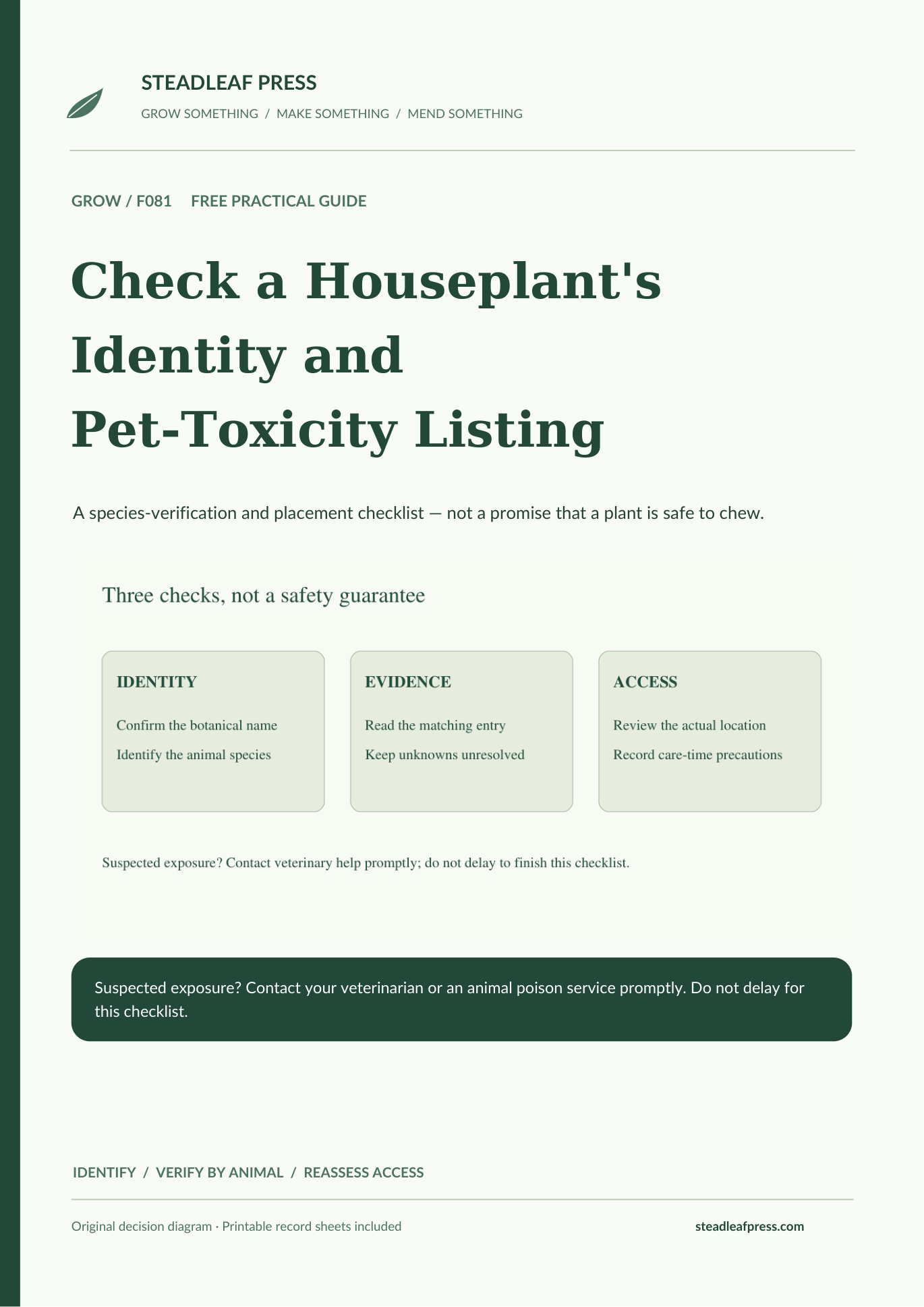
GROW / F081 FREE PRACTICAL GUIDE Check a Houseplant's Identity and Pet-Toxicity Listing
A species-verification and placement checklist — not a promise that a plant is safe to chew.
Suspected exposure? Contact your veterinarian or an animal poison service promptly. Do not delay for this checklist.
IDENTIFY / VERIFY BY ANIMAL / REASSESS ACCESS
Original decision diagram · Printable record sheets included steadleafpress.com A label saying "pet-friendly" leaves several questions unanswered. Which plant is actually in the pot? Which animal does the claim cover? What happens when a trailing stem reaches the floor? This guide helps you turn a broad claim into a recorded decision about one plant in one home.
If exposure may already have happened, stop this checklist. Contact your veterinarian or an animal poison service promptly. Do not delay care to finish identifying the plant. This is a selection and household-planning guide, not a diagnosis or treatment protocol.
1. Give the plant and the animal separate identities
Start with the plant you own, not a similar photograph. Keep its nursery label and purchase information. Record the botanical name as well as the name used by the seller. Photograph the whole plant, its leaves and its label while keeping animals away.
A picture search can suggest an identity; it does not settle a toxicity decision. If the label is missing, inconsistent with the plant or limited to "foliage mix," ask the nursery or a qualified plant-identification service for help. For a mixed planter, list every component. One identified plant does not clear the others.
Write the animal species separately: cat, dog or another animal. Do not convert an entry about cats and dogs into advice for rabbits, birds or reptiles. Ask a veterinarian familiar with that animal when the source does not cover it.
Names sometimes change. If two reputable sources use different botanical names, look for an explicit synonym relationship rather than assuming similar spellings refer to the same plant. Keep both names and the source that connects them. An unresolved name stays unresolved.
Identification record
Plant label, copied exactly: ____
Botanical name checked: ____
Who confirmed the identity, and how: ____
Photograph or label reference: ____
Other plants sharing this container: ____
Animal species in this home: ____
Unresolved identity question: ____
The record is deliberately specific. A useful outcome may be "do not bring this unidentified gift into the pet-accessible room," not a completed shopping list.
STEADLEAF PRESS / GROW / F081 2
2. Open the actual toxicity entry
Use a veterinary or animal-poison resource, not a search-result badge or a retailer's general promise. Open the individual plant entry. Compare its botanical name with your identification record, check the animal species, and save the URL and date.
ASPCA's database is not exhaustive. It also cautions that photographs may differ from individual plants and that eating plant material can cause stomach upset even when a plant is listed as non-toxic. A missing search result is therefore not clearance. [1]
Record the source's classification without expanding it. "Listed as non-toxic to cats" does not mean suitable as cat food, harmless in every amount, or appropriate for every animal. A toxic listing is not cancelled by a reassuring label on the pot.
What you actually found What to record What to do next
Matching plant identity and an Name, animal, classification, URL Continue to the placement review entry for your animal and date
Entry covers a different animal Relevant animal not covered Seek appropriate veterinary guidance
Name is uncertain or a planter Identity unresolved Keep inaccessible; postpone the contains unidentified components decision
No entry, or contradictory advice Evidence unresolved Ask a veterinarian; do not infer safety
Suspected exposure or illness What happened and when Contact veterinary help rather than completing this form
This table is an editorial workflow. It does not assign toxicity severity, estimate an ingested dose or rank urgency between toxic plants.
STEADLEAF PRESS / GROW / F081 3
3. Practise reading names without making a safe-plant catalogue
Two familiar houseplants demonstrate why the botanical name matters.
ASPCA lists spider plant, Chlorophytum comosum, as non-toxic to dogs and cats. [2] That is a named entry for those animals, not permission to let them graze on the pot.
ASPCA lists peace lily, Spathiphyllum, as toxic to dogs and cats, with insoluble calcium oxalates associated with mouth irritation and swallowing problems. [3] A peace lily's popularity as an indoor plant says nothing about its suitability for a pet-accessible position.
The shared word "lily" is particularly misleading. UC Davis distinguishes peace lilies from Lilium lilies and Hemerocallis daylilies, which can cause kidney failure in cats. Very small exposures, including pollen or vase water associated with dangerous lilies, can be serious. UC Davis advises keeping these lilies out of homes with cats and seeking veterinary care immediately after suspected exposure. A high shelf is not an adequate answer to that warning. [4]
These examples are not an identification key. They do not establish the identity of your own specimen, and they are not a complete list of hazardous plants. Use them to practise matching names and reading the scope of an entry.
Evidence record
Confirmed plant name: ____
Animal covered by the entry: ____
Source and exact page URL: ____
Date checked: ____
Classification as recorded in the source: ____
Important limitation or warning: ____
Decision still requiring professional advice: ____
STEADLEAF PRESS / GROW / F081 4
4. Review the whole route of access
Only after the identity and listing are understood should you assess the location. A placement decision is separate from a toxicity classification.
Look from the animal's usual routes. A pot may sit beyond reach while its leaves trail over an accessible chair. A closed room may work differently when someone props the door open. Think about fallen material and the periods when you water, prune or move the plant, not just its tidy display position.
Use the following as a practical household check, not an animal-proof certification:
- Can the animal reach the plant from nearby furniture, shelves or window ledges?
- Could growing stems, dropped leaves or cuttings become accessible?
- Is the pot stable, with no loose support or dangling tie inviting interference?
- Can you care for it without temporarily leaving plant material, potting mix or water within reach?
- Are plant-care products stored separately and used according to their own labels?
- Does every person who cares for the plant understand the same access restriction?
A non-toxic plant entry does not evaluate a particular fertilizer, pesticide, decorative dressing or container. Do not use the plant's listing to clear these separate items.
For a plant listed as toxic, this guide does not endorse keeping it simply because it seems out of reach. Where dependable separation cannot be maintained, choose a different plant or another location outside the pet's environment. For an unidentified plant, postpone access while identification is being resolved.
STEADLEAF PRESS / GROW / F081 5
5. Leave a decision someone else can follow
Avoid the note "safe now." Write what you verified, what remains uncertain and what household action you chose. Keep the identification and evidence records together.
Fictional example: Priya receives a pot labelled only "green lily." She does not assume that means spider plant. She keeps it away from her cat and asks the nursery for its botanical identity. The nursery confirms Chlorophytum comosum, which she checks against the ASPCA entry. Her note says that the entry covers cats and dogs, not that chewing is encouraged. She chooses a stable position without leaves hanging beside the cat's usual chair and keeps the label. The name check and the placement check are two completed tasks, not one guarantee.
Placement and handover card
Plant and animal species: ____
Evidence record location: ____
Decision: choose / postpone / exclude from pet-accessible space / seek advice
Exact location and access restriction: ____
Care-time arrangement for cuttings and water: ____
Who will maintain that arrangement: ____
What would trigger a new check: new plant, new animal, changed location, growth, damaged barrier, or new advice
Unresolved point: ____
Revisit the card when conditions change. Replacing a plant with one carrying the same common name requires checking its identity again. A new animal in the household requires checking whether the evidence covers that species.
STEADLEAF PRESS / GROW / F081 6
6. Keep the emergency note separate from the checklist
Before an incident, identify your regular veterinarian and an out-of-hours veterinary service serving your location. Keep those details where other household members can find them.
If a pet may have eaten a toxic or unidentified plant, contact veterinary help promptly. Tell the clinician the animal species, suspected plant, possible exposure and timing. Keep the label or a photograph available if you can do so without delaying care. Do not wait for a completed identification record or try to determine a harmless amount from this guide.
Do not improvise home treatment or induce vomiting unless a veterinarian or qualified animal poison professional specifically instructs you. [5] The checklist exists to improve decisions before exposure, not to replace professional care afterward.
STEADLEAF PRESS / GROW / F081 7
Sources and scope
Sources directly consulted on 18 November 2026:
[1] ASPCA. Toxic and Non-Toxic Plants. Database scope, identification cautions and limits of non-toxic listings. https://www.aspca.org/pet-care/aspca-poison-control/toxic-and-non-toxic-plants
[2] ASPCA. Spider Plant. Named plant and animal-specific classification. https://www.aspca.org/pet-care/aspca-poison-control/toxic-and-non-toxic-plants/spider-plant
[3] ASPCA. Peace Lily. Named plant, toxicity classification and associated irritation. https://www.aspca.org/pet-care/aspca-poison-control/toxic-and-non-toxic-plants/peace-lily
[4] UC Davis School of Veterinary Medicine. Lily Toxicity in Cats. Distinction between lily groups and urgent veterinary-care guidance. https://healthtopics.vetmed.ucdavis.edu/health-topics/feline/lily-toxicity-cats
[5] ASPCA. What to Expect at the Emergency Veterinarian After a Toxin Exposure. Identifying information and the warning against unsupervised induced vomiting. https://www.aspca.org/news/what-expect-emergency-veterinarian-after-toxin-exposure
The verification records, decision table, access questions and fictional example are original editorial tools. They are not veterinary clearance, a tested animal-containment system or a comprehensive plant-toxicity reference. No exposure experiment, animal trial or physical placement test is claimed.