MAKE / FREE GUIDE
Read a Beginner Knitting Pattern Row by Row
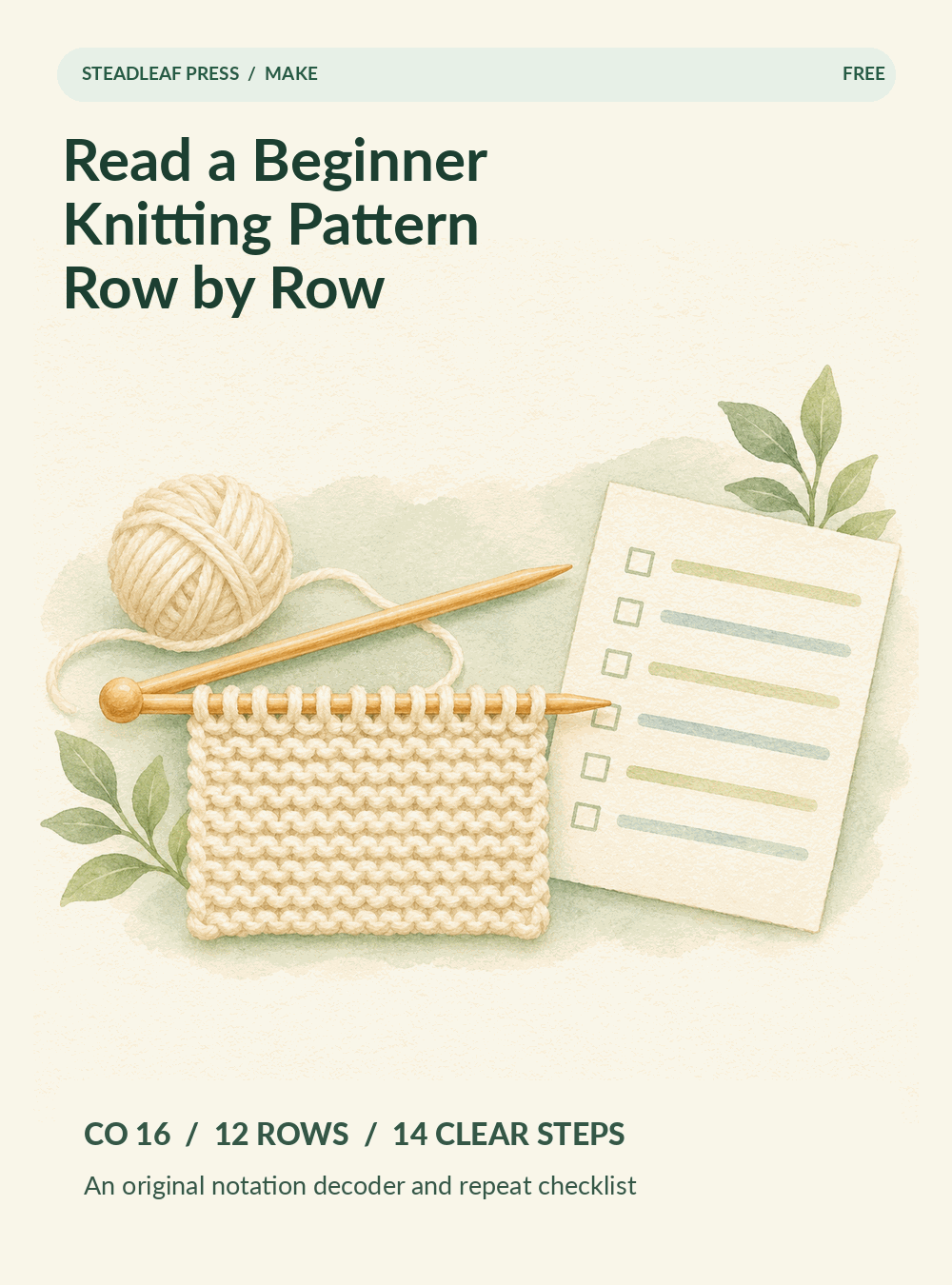
An original 16-stitch, 12-row practice for decoding knit, purl, RS, WS, and repeat instructions
Download the complete free guide
A complete free 14-step guide to reading a beginner flat-knitting pattern: CO, K, P, RS/WS, and three-more-times repeats, with an original 16-stitch 12-row sample and printable row tracker.
Includes complete illustrated instructions and any printable worksheets or templates.
Download free PDFRead the complete free guide online
The instructional text is below. For exact-size patterns, illustrations and printable records, use the complete free PDF above.
STEADLEAF PRESS / MAKE / FREE
Original 16-stitch, 12-row practice pattern A notation decoder, two diagrams, and maker records
FREE / 14 original steps / 2 diagrams / 2 records
No physical knitting, gauge, fit, or printing trials were performed. 1 / 8 STEADLEAF PRESS / MAKE / FREE STP-MAKE-F083 | UNDERSTAND THE PATTERN Understand the pattern Abbreviations, RS/WS, and repeat pairs
Turn a short pattern into one clear row at a time Knitting patterns use abbreviations to make many repeated actions fit on a small page. Instead of trying to remember the whole set of instructions, identify the current row, read the abbreviations in that row, count the stitches it consumes, work across, and mark that row complete. This lesson gives you an original, small flat swatch pattern and its fully expanded twelve-row checklist. It is a decoding exercise, not a garment pattern or a gauge guarantee.
Learn the short words before picking up the needles CO means cast on; BO means bind off; K means knit; P means purl; st and sts mean stitch and stitches; RS means right side (the face designated as the front of this swatch); WS means wrong side (its reverse face); rep means repeat. Thus K16 means knit sixteen stitches, not increase by sixteen. The notation K2, P12, K2 uses all sixteen stitches: two plus twelve plus two. Only abbreviations defined here are required for the included practice pattern.
Understand RS and WS in flat knitting The swatch is worked back and forth, NOT in rounds. Label the face you work on Row 1 as RS. After completing a row and turning, you work on the opposite face. Odd rows are on RS and even rows are on WS in this design. RS and WS are instructions about which face you are working; they do not automatically mean knit or purl. Follow the action explicitly stated for each row.
Read the repeat count without adding extra rows The pattern says to work Rows 3 and 4 once, then repeat Rows 3–4 three more times. That produces four pairs total: Rows 3–4, 5–6, 7–8, and 9–10. Together with Rows 1–2 and Rows 11–12, you make exactly twelve worked rows before the separate bind-off. Treat each repeat as a pair: after a RS row, turn and complete its WS partner before the next pair.
A simple panel lets you see whether you followed the words The middle twelve stitches form a stockinette-like, relatively smooth-looking panel on the designated RS, while the first and last two stitches form knit-every-row garter borders. Two knit-every-row rows begin the swatch and two finish it. All twelve worked rows use exactly sixteen live stitches; no increases, decreases, yarn overs, shaping, garment measurements, or prescribed gauge are included. The fabric may curl slightly in the centre depending on yarn and tension.
Original digital guide | No physical knitting or printing trial 2 / 8
STEADLEAF PRESS / MAKE / FREE STP-MAKE-F083 | PLAN & DECODE Plan & decode The complete original 16-stitch practice card
Materials, scale, and limitations Use smooth practice yarn and two knitting needles suitable for the yarn label, a blunt tapestry needle, a ruler if you want to record actual size, and a pencil for the checklist. Use a cast-on method you already know or F077, and the familiar knitted bind-off from F082. The publisher has not worked a physical sample and makes no stitch-size, fibre-performance, wash, strength, stretch, child-safety, or wearable-fit claims. Needles and yarn can pose risks to children and pets; keep them out of reach and stop if hands hurt.
Legend used in this original example CO 16 sts = put sixteen live loops on the needle. Row 1 (RS) = work the first row while looking at the designated right side. Row 2 (WS) = turn and work on the opposite face. K16 = knit every stitch across this sixteen-stitch row. K2, P12, K2 = knit two, bring the working yarn FORWARD between needle tips, purl twelve, move yarn BACK between the tips into the knit position, then knit two. BO knitwise = use the standard knit bind-off to secure the sixteen live stitches after Row 12. It is a separate finishing action, not Row 13.
Complete compressed pattern as it would appear on a card CO 16 sts. Work flat. Row 1 (RS): K16. Row 2 (WS): K16. Row 3 (RS): K16. Row 4 (WS): K2, P12, K2. Rep Rows 3–4 three more times (Rows 5–10). Row 11 (RS): K16. Row 12 (WS): K16. Turn and BO all 16 sts loosely knitwise. Weave in the yarn tails. This compact card and the expanded checklist describe the SAME work.
The arithmetic check: no hidden stitches K16 consumes sixteen existing stitches and leaves sixteen new live stitches. K2 + P12 + K2 also consumes sixteen and leaves sixteen, because each knit or purl replaces one loop. The repeat alters which row instruction you use, not the stitch count. If there are fifteen or seventeen loops, pause to locate a dropped stitch or an accidental yarn over before proceeding. Never hide a count mismatch by quietly adding or omitting stitches.
Patterns and maker records PATTERN 1 decodes the exact abbreviations and the four repeat pairs. PATTERN 2 shows the twelve rows as a worked-face / action strip, colour coding K and P for instruction reading rather than pretending to show real yarn texture. RECORD 1 captures a row-by-row completion tick and stitch count. RECORD 2 is a decoding/troubleshooting worksheet. Each pattern page has TWO original 50 mm digital scale bars. If printed, compare both bars with a real ruler at 100%; no actual print calibration was performed.
Original digital guide | No physical knitting or printing trial 3 / 8
STEADLEAF PRESS / MAKE / FREE STP-MAKE-F083 | STEPS 01-05 Steps 01-05 Read one row, count sixteen loops, and tick it off
1. Read the whole practice card before casting on Find the cast-on number, the row numbers, the RS/WS labels, the repeat instruction, and the BO direction. Underline the words “three more times.” Notice that this is worked flat and that the bind-off comes AFTER twelve rows.
2. Place the decoding legend beside the pattern Write CO = cast on, K = knit, P = purl, RS = right side, WS = wrong side, rep = repeat, and BO = bind off on RECORD 2. The two letters are abbreviations for actions or faces, not extra stitches.
3. Cast on sixteen live stitches Use F077 or your familiar method. If your method includes a slip knot as the first loop, count it as one of the sixteen. Count sixteen loops on the needle before beginning Row 1. No stitch is added by the words “Row 1.”
4. Work Row 1 on the designated RS Choose the face you will call the right side and work K16 across. This means knit all sixteen original loops one at a time. Count sixteen new loops, mark Row 1 as RS / K16 / complete in RECORD 1, and turn the fabric.
5. Work Row 2 on WS and establish the border You are now facing the reverse side. Knit all sixteen stitches again (K16), count, tick Row 2 as WS, then turn. Two knit-every-row rows form the starting garter band. RS or WS does not itself tell you whether to knit or purl.
Original digital guide | No physical knitting or printing trial 4 / 8
STEADLEAF PRESS / MAKE / FREE STP-MAKE-F083 | STEPS 06-10 Steps 06-10 Read one row, count sixteen loops, and tick it off
6. Read and work Row 3 on RS The abbreviated instruction is K16. Knit sixteen, check the count, and tick Row 3 as the FIRST member of repeat pair 1. Turn to bring WS toward you. Do not start the repeat three extra times before completing its paired WS row.
7. Decode Row 4 as exactly sixteen stitches On WS, knit the first two stitches. Bring yarn FORWARD between the tips and purl the next twelve. Move yarn BACK between tips and knit the final two. Count 2 + 12 + 2 = 16 live stitches. Mark Row 4 as WS and repeat pair 1 complete.
8. Expand the repeat into Rows 5 through 10 Repeat the two-row unit of Row 3 (RS: K16) and Row 4 (WS: K2, P12, K2) three more times. Work these as pairs Rows 5–6, 7–8, and 9–10, turning after each row. Use the expanded twelve-row RECORD 1 to mark every row; never treat “rep” as an extra stitch.
9. Check the alternating faces and the count After completing Row 10, verify the worked sequence: Rows 3, 5, 7, 9 were RS K16 and Rows 4, 6, 8, 10 were WS K2 P12 K2. Each row should have ended with sixteen loops. If an instruction or count was missed, stop and correct that row instead of inventing a compensating stitch.
10. Work Row 11 on RS Turn after Row 10 and face RS. Knit all sixteen stitches (K16). This begins the final two-row knit-every-row band. Mark Row 11 on RECORD 1 before turning the work again.
Original digital guide | No physical knitting or printing trial 5 / 8
STEADLEAF PRESS / MAKE / FREE STP-MAKE-F083 | STEPS 11-14 & REPAIRS Steps 11-14 & repairs Finish the sequence, then diagnose common reading errors
11. Work Row 12 on WS Knit all sixteen once more and count. Mark Row 12 complete. The worked pattern now has twelve rows, not fourteen: two starting rows, eight rows in the four repeat pairs, and two finishing rows. Turn once more to prepare the separate bind-off.
12. Bind off the sixteen live stitches With the RS facing you after the turn, knit two stitches onto the right needle, lift the older of the two (the first-knitted loop) over the newer and off the tip, then repeat [knit one new stitch; pass the older loop over] until one loop remains. Secure a tail through it. A standard loose bind-off is not guaranteed elastic; see F082 for its detailed illustration.
13. Inspect the actual fabric, not an imagined diagram Lay the swatch flat without stretching. Expect a central smooth-looking panel and a knit-every-row border, subject to yarn and handling. Compare the sequence to PATTERN 2 and record any apparent curl or unevenness without claiming a measured gauge, fit, or durable performance.
14. Weave in ends and complete the records Use a blunt tapestry needle to weave ends through several backs of stitches, changing direction where appropriate; trim carefully. Check that each row is ticked and that the abbreviation meanings match RECORD 2. Store needles and loose yarn safely. The finished object is only a practice sample.
Fix, care and preserve
A repeat produced fourteen or sixteen rows The line “rep Rows 3–4 three more times” means AFTER the initial Rows 3–4, three additional pairs beyond the first, making four pairs total. Rows 3–10 comprise eight rows; with Rows 1–2 and 11–12 the total is twelve. Reconcile your actual checklist before proceeding; do not relabel rows to hide missed instructions.
I knitted on a WS row that says P12 RS/WS identifies which FACE you work on, not a default action. On Row 4, 6, 8 or 10 only the first and last two stitches are K, and the twelve centre stitches are P. If you knitted that whole WS row, undo to the mistake and rework it to recover the intended panel.
There are fifteen or seventeen loops, not sixteen The row instructions are stitch-count neutral. A missing stitch may have dropped; an extra may be an accidental yarn-over when moving yarn between knit and purl. Stop before adding new rows. Trace the last completed row; carefully undo or recover the error using appropriate basic repair guidance. Do not force a live loop or try this on a garment as a first exercise.
The work rolls or looks different from the colour strip PATTERN 2 is an instruction map, not a photo, fabric-surface chart or physical size template. Stockinette sections can curl, and actual tension and yarn can change the appearance. Do not stretch to fit the drawing. Record the observation and keep using the line-by-line count rather than assuming the sample must lie perfectly flat.
Original digital guide | No physical knitting or printing trial 6 / 8
STEADLEAF PRESS / MAKE / FREE STP-MAKE-F083 | ORIGINAL DIAGRAMS Original diagrams Notation decoder and full row-action strip
PATTERN 1 / Decode the notation
CO 16 cast on sixteen
RS / WS front face / reverse face
K / P knit / purl
rep repeat rows as directed
BO bind off after 12 rows
K2 + P12 + K2 = 16 live stitches
Repeat pairs: 3-4, 5-6, 7-8, 9-10 (4 pairs / 8 rows)
Two 50 mm reference bars per diagram. Check with a ruler after printing at 100%.
PATTERN 2 / Row-by-row instructions
01 / RS K16 02 / WS K16 03 / RS K16 04 / WS K2 P12 K2 05 / RS K16 06 / WS K2 P12 K2 07 / RS K16 08 / WS K2 P12 K2 09 / RS K16 10 / WS K2 P12 K2 11 / RS K16 12 / WS K16 After Row 12, turn and BO on RS. No hidden Row 13.
Two 50 mm reference bars per diagram. Check with a ruler after printing at 100%.
Original digital guide | No physical knitting or printing trial 7 / 8
STEADLEAF PRESS / MAKE / FREE STP-MAKE-F083 | MAKER RECORDS & REFERENCES Maker records & references Two practical worksheets to record observed results
RECORD 1 / Row tracker RECORD 2 / Decoder & audit
Row 1 / RS / K16 CO cast on
Row 2 / WS / K16 K / P knit / purl
Row 3 / RS / K16 RS / WS right / reverse face
Row 4 / WS / K2 P12 K2 rep repeat
Row 5 / RS / K16 BO bind off
Row 6 / WS / K2 P12 K2 Starting loops 16
Row 7 / RS / K16 Live loops per row 16
Row 8 / WS / K2 P12 K2 Repeat pairs 4
Row 9 / RS / K16 Total worked rows 12
Row 10 / WS / K2 P12 K2 Count error?
Row 11 / RS / K16 Tail woven?
Row 12 / WS / K16 Notes
External technical references (linked, not reproduced):
Craft Yarn Council - How to Read a Knitting Pattern
Craft Yarn Council - Knitting Abbreviations
Knitting & Crochet Guild - Learn Hand Knitting
Original text, charts and cover. No physical knit, printing, fit or safety trials.