MAKE / FREE GUIDE
Choose Safe Paint and Sealant for Decorative Clay
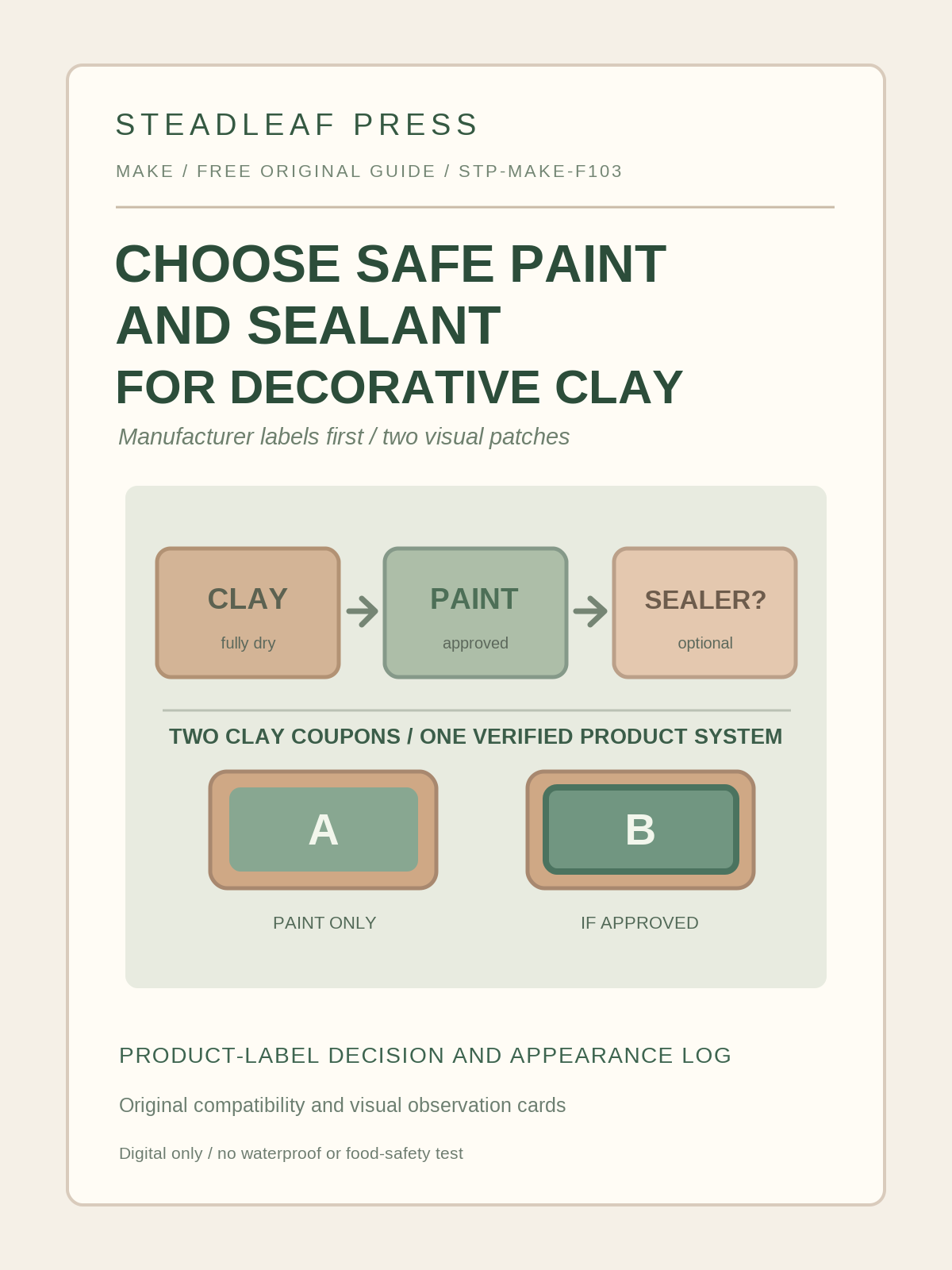
Confirm exact clay, paint and varnish labels; compare an approved paint-only patch A with an optional approved sealed patch B and document appearance without physical safety claims.
Download the complete free guide
Free original adult decorative-clay guide to checking manufacturer-compatible brush-on paint and optional sealant labels, with an original A/B dry appearance patch record.
Includes complete illustrated instructions and any printable worksheets or templates.
Download free PDFRead the complete free guide online
The instructional text is below. For exact-size patterns, illustrations and printable records, use the complete free PDF above.
STEADLEAF PRESS
MAKE / ORIGINAL FREE DIGITAL GUIDE / F103
CHOOSE SAFE PAINT AND SEALANT FOR DECORATIVE CLAY
CLAY PAINT SEALER?
A B
ACTUAL LABELS FIRST / TWO ORIGINAL VISUAL PATCHES
Manufacturer compatibility chart and two maker records
No waterproof, food, chemical or physical safety testing.
STEADLEAF PRESS / FREE MAKE F103 / ORIGINAL GUIDE
Edition: Original FREE Steadleaf Press adult digital instructional guide. Independent art-material safety, technical and editorial review verdict PASS; no physical coating compatibility, waterproofing, strength or exposure trials performed. DIGITAL instructional work only; no actual coating, cured test patch, material compatibility, smell/exposure, child/pet, food-contact, waterproofing, adhesion, physical print or durability trial has been performed by Steadleaf Press.
A good-looking coating is not the same as a safe, compatible one
Air-dry-clay makers do not all give identical paint and sealer instructions. For example, Crayola says its own Air-Dry Clay can be painted after complete drying and acrylic varnish can be considered after a compatibility test, but sealing will not waterproof it. Sculpd provides a product-specific acrylic paint and varnish system and describes protection against moisture, with clear limits on outdoor exposure and food use. A claim made for one precise brand, clay formulation and coating system does NOT transfer to another. Neither a shiny surface nor a label saying "non-toxic" alone certifies skin-contact safety, indoor air safety, food contact, waterproofing, flame resistance, toy safety or weather durability.
Choose only finishes explicitly supported by the actual clay and coating manufacturers and suitable for the room and protective equipment available. Use an adult craft-only, brush-on method; no aerosol sprays, two-part resin, strong solvent, UV/heat cure, unknown thinner or solvent cleaning is part of this activity. If the labels do not establish suitability or the ventilation requirements cannot be fulfilled, do not coat the clay. The uncoated clay is an acceptable finished learning outcome.
The original decision card compares TWO same-brand, fully maker-dried small clay coupons. Both use the same maker-supported brush-applied paint. Coupon A stays paint-only; coupon B optionally receives a maker-compatible brush-on sealant after its paint has fully dried. When sealant compatibility cannot be established, B is a labelled paint-only repeat or NOT ATTEMPTED. There is no pretence that an unsealed B proves varnish compatibility.
Item | A - approved paint alone | B - optional approved sealant
Clay | Same batch and maker-completely dry | Same batch and maker-completely dry
Paint | Exact product/colour, approved for the clay | SAME compatible paint and similar coverage
Optional sealant | None | Exact brush-on product approved for the clay AND chosen paint
Order | Dry clay, approved paint, full paint drying | Dry clay, same paint, full paint drying, approved sealant, full sealant curing
Evidence | Product labels and appearance observations | Product labels and appearance observations, or B marked SKIPPED
Claims prohibited | Food, water, heat, flame, durability, child/pet safety | Same limits, even if coat feels attractive
STP-MAKE-F103 ORIGINAL FREE GUIDE / PAGE 2 OF 15
STEADLEAF PRESS / FREE MAKE F103 / ORIGINAL GUIDE
This is an appearance observation, never a strength or adhesion test. Do not immerse, wash, rub, scrape, bend, lick, heat, smell intentionally, use on food or touch an uncured sample to assess its safety.
Label first: the three-product check
Clay: actual substrate identity and complete drying
Identify the exact air-dry clay maker, product name and required full-drying conditions. Record whether it is formulated for painting, which coating types its own manufacturer approves, the minimum thickness and any relevant warnings. A coating cannot turn partially dry clay into a sufficiently dry substrate; do NOT rely on a surface merely feeling dry. Some products take longer depending on thickness or humidity. Follow the manufacturer FULL dry stage rather than a universal hours number. If clay is damp, flaking, broken, visibly mouldy, dusty or unidentifiable, stop; don't hide a problem under paint.
For a simple sample, prepare TWO small flat round-corner coupons made from the SAME clay batch, nominally around 3 x 3 cm across and 8-10 mm thick, but ONLY when the actual clay maker permits those dimensions. The plan is a paper sketch, not a PDF print-to-scale mould or universal clay thickness recommendation. If your brand calls for a thicker or larger sample, follow it. Begin the coating trial only once both pieces are completely dry by their maker's instructions.
Paint: substrate, exposure and practical instructions
Use an identifiable, adult-appropriate, brush-applied water-based acrylic or other paint ONLY if the manufacturer's statements support it on this fully dried clay. Crayola allows several types of paint on its own dry air-dry clay, but this does not imply all generic paints are compatible with every clay. Record paint name, product ID, label safety warnings, intended materials, necessary ventilation and PPE, surface preparation, primer, number of coats, intercoat interval, complete drying, cleanup and disposal. The precise maker label-not an author's generic recipe-controls these requirements.
If the product uses volatile solvents, spray propellants, aggressive fumes, heat, respirator or specialised extraction requirements beyond your safe work area, do not improvise a workaround: choose a different product whose specified precautions you can meet or do not paint. Avoid handling paint with food utensils, using domestic cooking bowls, breathing vapours deliberately and having children or pets nearby. "Non-toxic" is not a universal permission for skin, eyes, ingestion or pet exposure.
Sealant: it must match BOTH clay and dry paint
The optional finish must be identified down to the specific manufacturer/product, not merely "clear varnish." Verify that its maker approves its use on the actual clay AND over the selected paint (including its cured state). Verify any required base coat, application sequence, brush requirements, thinning, multiple coats, wait between coats, cure time, safety/PPE/ventilation and disposal. If the paint is not fully dry, do
STP-MAKE-F103 ORIGINAL FREE GUIDE / PAGE 3 OF 15
STEADLEAF PRESS / FREE MAKE F103 / ORIGINAL GUIDE
not seal it. If either compatibility link is unverified or prohibited, do not apply sealant and label B as "no sealer/paint-only repeat" or "not attempted."
Crayola warns that sealing its Air-Dry Clay does NOT waterproof it. Sculpd's specifically paired varnish system is described as giving moisture protection to its own clay, while the maker also discourages outdoor use because of harsher conditions. These are product-specific statements, not transferable performance guarantees. This guide never uses outdoor rain, immersion or food testing to declare a finish suitable.
Intended use: dry indoor decoration only
Neither coating nor clay in this digital project is certified as food-safe tableware, a waterproof pot saucer, candleholder, hot-mug coaster, children's toy, wearable, pet ornament or outdoor fixture. Store coupons dry indoors away from water, flames, heat, food and small children or pets. Never assume paint safety can be judged by smell or an attractive finish. Follow actual product hazard labels and local disposal rules.
Three original working patterns
Pattern A - label-evidence decision chain
On paper create three columns: CLAY, PAINT and OPTIONAL SEALANT. Record exact maker and product names, date/lot if available, intended substrate, complete drying and cure, ventilation, PPE and warning icons, cleanup and restricted uses. Draw three approval arrows:
PAINT to COMPLETELY DRIED CLAY; SEALANT to COMPLETELY DRIED PAINT; SEALANT to THAT CLAY. Write one of APPROVED with maker evidence / UNVERIFIED / PROHIBITED / NOT APPLICABLE next to each arrow. If any required arrow lacks documented approval, the coating step must STOP. A retailer's general slogan or a photograph of a shiny object is not compatibility evidence.
Pattern B - two labelled dry appearance patches
A and B are two comparable fully dry, manufacturer-compliant flat coupons. In a product-safe ventilated setting, use the SAME compatible paint to place a small controlled brush patch on each, with the maker's actual number of coats, wait times and preparation. Do not intentionally alter B's paint thickness. Let paint reach its FULL maker-required dry stage before any further coating. A remains paint-only. On B, apply ONLY an approved compatible brush-on sealer and let it fully cure according to its label. If not approved, B remains paint-only or not attempted; record truthfully.
After all relevant drying and curing stages, observe under ordinary light for coverage, colour, streaks, cloudiness, streaking, sheen, yellowing, bubbles, lifting edges and visibly wet or suspect coating. Do NOT scratch, pull, wet-wipe, soak, bend, smell-test, place food or compare hardness by pressure. If uncertain about cure, write PENDING, not PASS. One visually neat patch does NOT prove long-term adhesion, material
STP-MAKE-F103 ORIGINAL FREE GUIDE / PAGE 4 OF 15
STEADLEAF PRESS / FREE MAKE F103 / ORIGINAL GUIDE
health safety, waterproofness or resistance to wear.
Pattern C - the honest conclusion box
The finish-selection result is one of: A suitable paint-only appearance sample; B approved paint-plus-sealer appearance sample; B was only a repeat; B not attempted; or the entire coating exercise stopped for safety/compatibility. Attach the exact manufacturer's statements and visual observations. A good-looking result only means that no obvious visual problem was seen under those limited conditions; it never changes the product's labelled restrictions or certifies an intended wet, food, heat or outdoor use.
Fourteen-step instructions
1. Define one restricted decorative purpose
Write that the result is a DRY INDOOR adult decorative clay finish experiment. Exclude food, drinking vessels, hot items, candle/incense use, water, outdoor weather, toys, wearables and load support. Do not assume the goal is to make clay waterproof.
2. Identify the exact clay and its warnings
Record manufacturer, formula, maker minimum thickness, full drying and intended finish recommendations. If manufacturer is unknown or the substrate is damaged, wet or not identified, stop instead of coating it with a random paint.
3. Find a paint whose maker supports the clay
Inspect the actual paint packaging and manufacturer documentation for suitable dried-air-dry-clay or explicit accepted substrate use. Record brush application, priming, coating and safety requirements. If compatibility or safe ventilation cannot be established, use no paint.
4. Evaluate the optional sealant as a separate decision
Only consider an identifiable brush-on product with manufacturer evidence for BOTH selected dry paint and this clay. Record required coat count and complete cure instructions; do not borrow a varnish recipe from another maker's clay. Mark unverified or prohibited products as SKIP.
5. Organise a safe nonfood craft workstation
STP-MAKE-F103 ORIGINAL FREE GUIDE / PAGE 5 OF 15
STEADLEAF PRESS / FREE MAKE F103 / ORIGINAL GUIDE
Use a stable covered workboard, clean dedicated soft brushes, paper labels A and B, real ruler, recommended PPE and the product-required ventilation. Keep food, children, pets, flames, hot tools, solvent spray and aerosol equipment away. Plan cleanup by each product label.
6. Confirm two maker-completely-dry clay coupons
Use two similar flat samples from the SAME clay batch; the illustrative paper plan is 3 x 3 cm and 8-10 mm thick, only if its clay maker permits. Verify full dryness under the maker schedule. If either still feels or appears moist, or full dryness cannot be established, record PENDING and delay coating.
7. Fill the label-verification grid before painting
Record exact three product names, substrate approvals, label warnings, PPE, room ventilation, coat order, full dry/cure time and cleanup. Mark each required compatibility arrow APPROVED / UNVERIFIED / PROHIBITED. Do not turn uncertainty into approval.
8. Paint coupon A according to the maker
On the clean, fully dry A sample, apply only the accepted paint using a dedicated brush. Use its actual manufacturer instruction for layers and preparation, not a random numerical prescription. Avoid pooling paint and record the colour, start and any immediate visible irregularity.
9. Paint coupon B with the same method
If a B repeat or sealant trial is appropriate, use the SAME paint and comparable supported coverage on the separate fully dried B coupon. Keep material, room conditions and application as comparable as practicable. Record any differences rather than attributing all outcomes to varnish.
10. Wait for the paint's fully dry and overcoat stage
Follow the paint's manufacturer requirements, including any intercoat and overall drying windows. Do not apply a varnish over visibly wet, powdery, bubbling or defective paint. Mark a failed visual appearance and stop the optional sealant if paint has problems.
11. Seal B only if the exact combination is authorised
Use a new suitable clean brush and only an explicitly maker-approved sealer over the fully dried B paint on maker-compliant clay. Follow exact instructions for thickness, number of coats and overcoating. If not approved, leave B painted only and label NO SEALANT COMPARISON or B NOT ATTEMPTED.
STP-MAKE-F103 ORIGINAL FREE GUIDE / PAGE 6 OF 15
STEADLEAF PRESS / FREE MAKE F103 / ORIGINAL GUIDE
12. Observe safe drying or full sealant curing
Leave A and B under appropriate manufacturer-required room conditions, away from contact, pets, food, flames and unapproved heaters. Follow the FULL cure stage for B if a sealer was applied, not just its touch-dry appearance. If the cure status is uncertain, record PENDING and do not handle.
13. Inspect appearance without a physical challenge
In the SAME indoor light, visually note colour, gloss/matte shift, streaks, cloudiness, bubbling, visible cracks, lifted edges or suspicious tack. Record observations ONLY. Never perform scratch tests, rubbing, soaking, washing, sniffing or food contact to claim adhesion or safety.
14. Finish the evidence and restricted-use record
Complete both maker records: clay/paint/sealer details and label evidence, which coupons received which products, timings, visual results and restricted dry indoor use. Store products safely and clean tools and discard paint/varnish according to their exact instructions. Do not let a visually good result override any hazard label or become a waterproof, food-safe, weatherproof or child-safe claim.
Fix, care and preserve
I cannot establish that the paint works on my clay
Mark the PAINT-to-CLAY arrow UNVERIFIED and do not apply it. Generic "craft acrylic" advertising is not a maker-specific substrate statement. Consult the relevant maker or choose a clearly approved combination; doing nothing is a valid outcome.
The sealant label mentions clay but not my paint
Mark SEALANT-to-PAINT UNVERIFIED. Do not apply it over paint. You may leave A painted and B as a labelled paint-only repeat if the paint is already approved. A glossy label does not establish a compatible finished system.
Paint beads, streaks or covers unevenly
Do not pour on extra medium or a heavier coat to hide it. Check whether the paint maker requires primer or another surface preparation; any new procedure requires label support. Record a visually unacceptable result and stop that trial rather than inventing a chemical fix.
STP-MAKE-F103 ORIGINAL FREE GUIDE / PAGE 7 OF 15
STEADLEAF PRESS / FREE MAKE F103 / ORIGINAL GUIDE
The varnish becomes cloudy or yellow
Record the exact makers, paint dry state, applied coats and room conditions. Don't bake, solvent-rub, scrape or wash the coupon to try to reveal a hidden good finish. Incompatibility or premature application is possible; no physical cause was proven.
The paint still looks wet or the sealer remains tacky-looking
Do not touch a suspect coating to see if a finger sticks. Observe the maker's full drying/curing instructions and mark PENDING. If it still appears defective after the specified conditions, record that the visual outcome is unacceptable and do not expose people or household objects to the surface.
The label says waterproof or non-toxic
A product's exact substrate, method and intended-use limitations govern that claim. Crayola expressly states sealed AIR-DRY Clay is NOT waterproof; a matching Sculpd coating may be described differently for that maker's system. Non-toxic language alone never means food-safe, safe for pets to chew, nonflammable, suitable for skin or automatically safe to spray indoors.
Disposal and long-term limits
Follow the clay, paint and sealant maker's actual cleanup and waste directions. No solvent mixture, aerosol or unapproved heat is part of this beginner exercise. Store samples on a dry adult craft shelf out of reach of children/pets, food, water, heat and flames. A one-off appearance test cannot certify long-term durability.
Pattern 1 - Three-column manufacturer-label decision map
A single original printable decision card: CLAY to PAINT to OPTIONAL SEALANT. Record exact maker/product identity, supported substrates, full dry/cure instructions, warnings, PPE/ventilation, disposal and intended-use limitations in each of the three boxes. Draw and mark the three actual compatibility decisions: paint over completely dried clay; sealer over completely dried paint; sealer on that clay. Outcomes are APPROVED (documented maker evidence), UNVERIFIED, PROHIBITED or N/A. If a required arrow is not APPROVED, STOP that coating. This card is not a chemical analysis, SDS substitute or food-contact test.
Pattern 2 - A versus B appearance comparison
Two similarly sized, fully dried maker-compliant clay coupons. A: approved paint, maker full drying and visual
STP-MAKE-F103 ORIGINAL FREE GUIDE / PAGE 8 OF 15
STEADLEAF PRESS / FREE MAKE F103 / ORIGINAL GUIDE
record, NO sealer. B: SAME paint and full drying, then maker-approved brush-on sealer and FULL cure if all approvals exist, then visual record. If no compatible sealer, B is a paint-only duplicate or not attempted, not a coating comparison. Check under ordinary light without physical scratch, wet or force tests.
Record 1 - Product labels and compatibility
Question | Clay | Paint | Optional sealer
Exact maker and formula | __________ | __________ | __________
Product/lot identification | __________ | __________ | __________
Manufacturer substrate approval | __________ | __________ | __________
Required full dry/cure before next layer | __________ | __________ | __________
Ventilation/PPE/contact warnings | __________ | __________ | __________
Food/water/outdoor restrictions | __________ | __________ | __________
URL, label photo or source of claim | __________ | __________ | __________
Paint-to-clay: APPROVED [ ] UNVERIFIED [ ] PROHIBITED [ ]
Sealant-to-paint: APPROVED [ ] UNVERIFIED [ ] PROHIBITED [ ] N/A [ ]
Sealant-to-clay: APPROVED [ ] UNVERIFIED [ ] PROHIBITED [ ] N/A [ ]
Reason for omitted coating / maker warning: ________________________________
Workplace precautions required and satisfied: ______________________________
Record 2 - A/B appearance and truthful endpoint
[ ] Two matching coupons completely maker-dried before finishing.
[ ] Product makers, batches and safety warnings recorded.
[ ] Brush-on application/room ventilation compatible with labels.
[ ] Paint correctly approved for this exact dried clay.
[ ] A and any B paint coats applied comparably under real labels.
STP-MAKE-F103 ORIGINAL FREE GUIDE / PAGE 9 OF 15
STEADLEAF PRESS / FREE MAKE F103 / ORIGINAL GUIDE
[ ] Paint allowed full required dry before optional sealer.
[ ] Sealer ONLY applied where clay/paint/sealer approvals complete.
[ ] B accurately labelled sealed, paint-only repeat or not attempted.
[ ] Full sealant cure or PENDING documented where applicable.
[ ] Visual coverage, sheen, clouding, yellowing, bubbling recorded.
[ ] NO physical scratch, wash, food, water, heat or peel tests.
[ ] Waste and brushes managed by maker instructions.
[ ] Uncured material and finished coupons away from children/pets.
A paint name / full-dry window / visual outcome: __________________________
B sealant name or NO SEALANT / cure status: _____________________________
B visual changes, cloudy/streak/tacky appearance: _______________________
Unverified/prohibited product combinations: ____________________________
No universal waterproof, non-toxic-for-every-use or food-safe claim: [ ]
Next maker-supported small patch to consider (if any): __________________
Technical references, originality and evidence limits
This is an ORIGINAL Steadleaf Press digital adult guide, label triage decision map and two-coupon visual observation exercise. Product labels for the actual ingredients take precedence. Factual background came from these original manufacturer pages and has not been copied into any outside diagram, photograph or proprietary passage:
- Crayola, Can Air-Dry Clay pieces be sealed?: https://www.crayola.com/faqs/can-air-dry-clay-pieces-be-sealed-faq
- Crayola, Do you have any tips for decorating Air-Dry Clay?: https://www.crayola.com/en-ca/faqs/do-you-have-any-tips-for-decorating-air-dry-clay-faq
- Crayola, Can I display Air-Dry Clay pieces outdoors?: https://www.crayola.com/faqs/can-i-display-air-dry-clay-pieces-outdoors-faq
STP-MAKE-F103 ORIGINAL FREE GUIDE / PAGE 10 OF 15
STEADLEAF PRESS / FREE MAKE F103 / ORIGINAL GUIDE
- Sculpd, Safety Information: https://sculpd.com/pages/safety
- Sculpd, Will my piece be waterproof?: https://help.sculpd.com/en-US/will-my-piece-be-waterproof-1777926
- Sculpd Canada, Matte and Gloss Varnish: https://sculpd.ca/products/sculpd-varnish
- Liquitex, Varnishing Acrylics: https://www.liquitex.com/blogs/uncapped/varnishing-acrylics
Digital-only safety boundary: No real clay samples, paint application, product compatibility, personal exposure, cure, adhesion, waterproofing, outdoor, abrasive, food/skin, fire, toy/child/pet, clinical safety, or calibrated printing tests were conducted. A clean-looking painted coupon cannot prove the absence of health hazards or long-term bond failure.
STP-MAKE-F103 ORIGINAL FREE GUIDE / PAGE 11 OF 15
The original full-size diagrams, patterns and printable records are in the complete free PDF above.