GROW / FREE GUIDE
Make a One-Page Plant Identification Label
A reusable plant card and pot tag
Download the complete free guide
Record plant identification evidence, care sources, moisture-check conditions and a traceable review date.
Includes complete illustrated instructions and any printable worksheets or templates.
Download free PDFRead the complete free guide online
The instructional text is below. For exact-size patterns, illustrations and printable records, use the complete free PDF above.
STEADLEAF PRESS / GROW
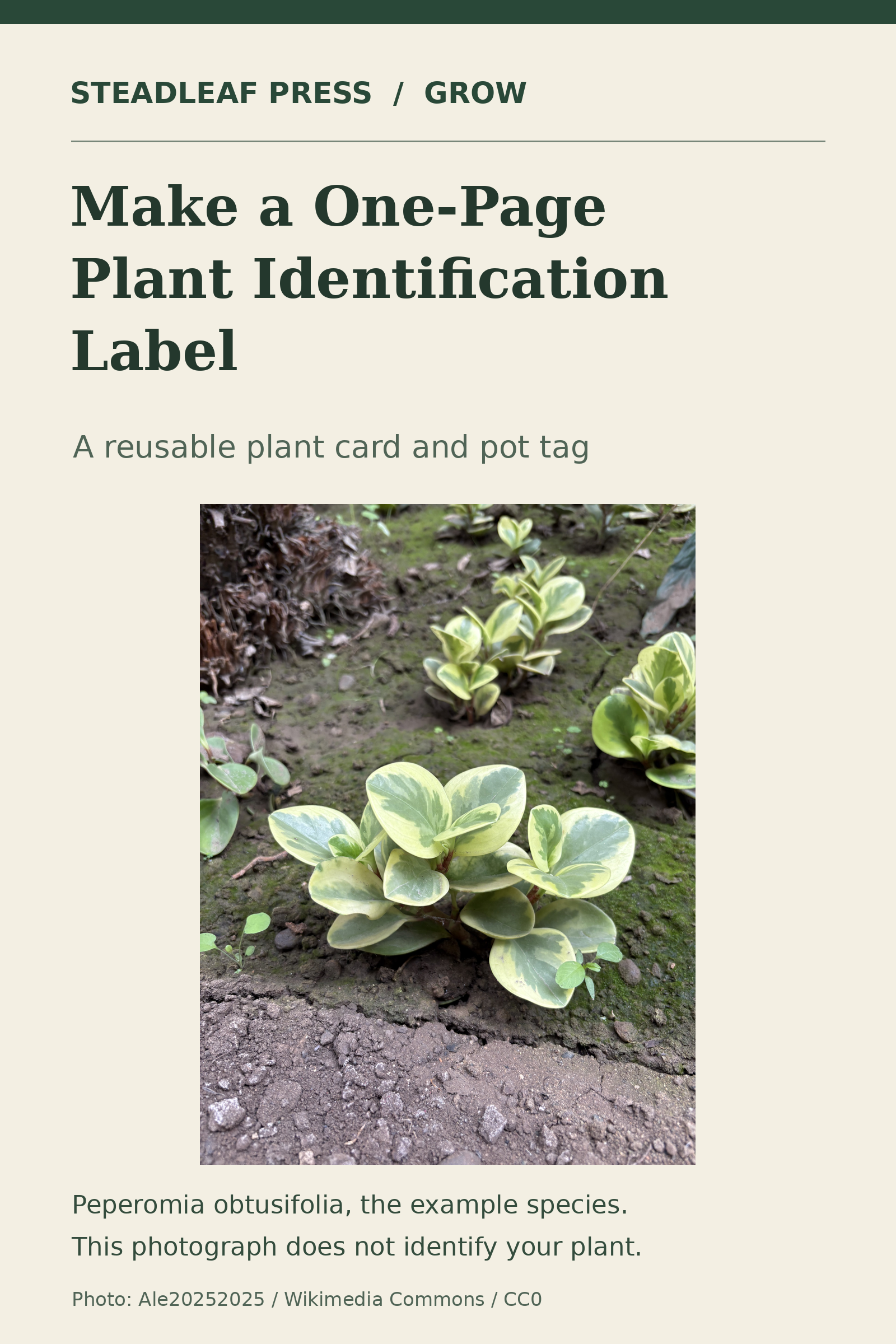
Peperomia obtusifolia, the example species. Not an identification of your plant.
Photo: Ale20252025 / Wikimedia Commons / CC0
STEADLEAF PRESS / GROW / F114 1
A useful plant label answers three ordinary questions: which plant is this, what conditions suit it, and what should I check before watering? It also tells you where the information came from, so a doubtful name or outdated instruction can be corrected.
Build one reusable master card for each plant, then copy the essential lines onto a small pot tag if needed. The card is the reference; the tag is a quick reminder. Neither should turn an uncertain identification into a confident claim.
Give the plant a stable reference number
Choose a short reference such as P07. Keep it with the individual plant even if its name changes, it moves to another room or it receives a different pot. Numbering is especially helpful when two plants share the same common name.
Write the reference on the master card and on a durable tag. Record the current pot description as a secondary clue: “green nursery pot inside cream cover.” Do not rely on that description alone, because covers are easily swapped during watering.
If you divide a plant later, give each resulting plant its own reference and record the connection. The original identity record remains useful, but the two pots will develop separate care histories.
For now, label only one plant from start to finish. A tray of loose labels beside several similar pots is an easy way to create a collection of very tidy mistakes.
STEADLEAF PRESS / GROW / F114 2
Separate a recorded name from a verified identification
Photograph or copy the original label before discarding it. Record the supplier or person who provided the plant and the date received. Preserve spelling, cultivar names and any uncertainty rather than silently correcting unfamiliar words.
Common names can refer to more than one plant, and one plant may have several common names. Oregon State University explains how common names can vary by region and refer to different plants. A scientific name makes research more precise, but writing one down does not itself establish that it belongs to your specimen. Oregon State University, Scientific Plant Names
Use a plain status line:
- Supplier name recorded: copied from the label, not independently checked.
- Identification supported: compared with reliable descriptions and distinguishing features.
- Identification uncertain: a candidate name is being investigated.
- Specialist confirmation: record who confirmed it and what material they examined.
A photograph-matching app can suggest a candidate. Keep that suggestion separate from a confirmed record, particularly when several species or cultivars look similar. If the identity matters for eating, animal exposure or handling irritating sap, obtain appropriate confirmation rather than using this care label as a safety certificate.
STEADLEAF PRESS / GROW / F114 3
Keep name changes traceable
Check spelling and possible synonyms in a botanical reference. Kew provides resources for accepted plant names and synonyms, including Plants of the World Online. Those resources help reconcile names; they do not examine the plant sitting on your shelf. Royal Botanic Gardens, Kew, Data and Digital Resources
Use separate lines for “current name used” and “name received under.” If a reliable source treats the older name as a synonym, note that connection and the source. A corrected identification is different: if evidence shows that the plant was mislabelled, record the old name as a former misidentification, not as a synonym of the newly identified species. Keep the date and reason for the change. The older wording may still appear on receipts or care literature, but advice attached to a mistaken identity needs review.
Do not guess a cultivar from leaf colour alone. “Cultivar not confirmed” is a complete entry. A generic genus-level identification may be enough to begin an enquiry, but it may not support every detailed care instruction.
STEADLEAF PRESS / GROW / F114 4
Write light guidance someone can act on
Copy the plant's light requirement from a suitable species or cultivar source, then describe your actual location separately. “Bright indirect light” is a care description. “Desk beside the east window, behind the sheer curtain” is a location. Keeping both lets you check whether the location continues to meet the requirement.
Add one observation that matters in your setting: whether direct afternoon sun reaches the leaves, whether a blind is normally closed, or whether another plant shades this one. Avoid measuring light by the brightness of a phone photograph.
A label should not prescribe a universal distance from any window. Windows differ in direction, glazing, obstruction and seasonal exposure. Record the place you have assessed, and review it when the plant moves or the light pattern changes.
Use a practical sentence: “Keep at ___, where ___; reassess if ___.” Leave room to update it rather than fitting every season into tiny lettering.
STEADLEAF PRESS / GROW / F114 5
Turn watering guidance into a conditional instruction
A fixed weekday can remind you to inspect a plant, but it should not automatically trigger watering. Oklahoma State Extension lists species, medium, pot size, season and growing conditions among the factors affecting watering frequency. Oklahoma State Extension, Houseplant Care
Write three short lines:
1. Check: the appropriate moisture-assessment method for this plant and medium.
2. Water when: the plant-specific condition that calls for water.
3. After watering: the drainage step for this container arrangement.
Keep an inspection reminder separate, such as “Check during the normal plant round.” That wording allows an early check during unusually warm conditions without turning the reminder into a dose or schedule.
If your source says “allow to dry moderately,” do not invent an exact depth or number of days and attribute it to that source. Learn how to assess this pot, seek clarification when needed and record your observations. Mark any personal working rule as an observation, not a universal requirement of the species.
STEADLEAF PRESS / GROW / F114 6
Use this reusable master card
Keep the following together on one page. Short entries are enough; detailed care history can remain elsewhere.
PLANT REFERENCE: ___
Name and identity
- Common name used: ___
- Scientific name used: ___
- Cultivar, if confirmed: ___
- Original label wording: ___; later name change, date and reason: ___ (record a verified synonym separately from a corrected misidentification)
- Identification status and evidence: ___
- Received from and date: ___
Current care
- Light requirement and source: ___
- Actual location and important exposure: ___
- Moisture-check method: ___
- Watering condition and source: ___
- Drainage or outer-pot instruction: ___
- One important plant-specific caution: ___
Review
- Source links or publication titles: ___
- Card checked on: ___
- Current uncertainty or next question: ___
- Review after: move / repot / seasonal change / new information / other ___
The small pot tag can carry just the reference, name with its identification status, light line, watering trigger and review date. Keep the full source information on the master card. Do not drop “unconfirmed” or an unresolved watering instruction merely to make the tag shorter. If a short tag makes the instruction ambiguous, use the full card rather than shrinking the lettering further.
STEADLEAF PRESS / GROW / F114 7
Work through one example without overclaiming
Suppose a plant arrives labelled Peperomia obtusifolia. You retain that wording, assign P07 and compare the plant with the species description. You have not established a cultivar, so that field stays unconfirmed.
NC State's profile describes bright indirect light and warns that strong direct sunlight can burn foliage. It also identifies overwatering as a problem. The card can carry that light guidance with its source, while leaving the detailed moisture-check instruction to be resolved for the actual pot and medium. NC State Extension Gardener Plant Toolbox, Peperomia obtusifolia
An honest first version might read:
- P07: Peperomia obtusifolia, supplier identity supported by comparison; cultivar unconfirmed.
- Light: bright indirect; current desk position checked for direct afternoon sun.
- Water: assess medium before watering; exact assessment method still to be confirmed.
- Source: NC State species profile; reviewed on ___.
The unfinished watering line is visible. That is better than copying “water every Sunday” because the label seems to need a complete sentence.
STEADLEAF PRESS / GROW / F114 8
Test the label before making copies
Read it as if you were looking after the plant for someone else. Can you identify the correct pot? Can you distinguish an inspection reminder from a watering instruction? Do you know what to do if the medium is still wet or the name remains uncertain?
Ask a helper to explain the care lines back to you without coaching. If they infer a fixed watering schedule or a move into direct sun, rewrite the relevant line. Replace vague shorthand such as “normal water” with the actual condition you mean.
Choose lettering and material that stay legible in their intended position. Do not attach wire tightly around a stem. Keep the label visible without forcing it through a dense root ball, and photograph the finished tag beside its plant as a simple backup.
STEADLEAF PRESS / GROW / F114 9
Review when the record stops matching reality
Update the location after a move and the container details after repotting. Revisit the watering assessment if the new arrangement behaves differently. Date significant changes so old instructions do not compete with new ones.
If the plant leaves your collection, keep its identity evidence with it when appropriate and record that it has left. Retire its reference rather than assigning that number to a new plant; old photographs and care notes should still identify the original specimen. The physical tag can be reused after fully removing its old name and reference and giving the new plant a different number. A reusable blank form is helpful; a half-erased identity is not.
Sources and scope
Oregon State and Kew support careful name handling; Oklahoma State supports checking the factors affecting watering; NC State supplies the limited example care claims. The reference system, master card and helper test are original organisational tools. This label does not certify edibility, toxicity status, disease freedom or a definitive botanical identification.