MAKE / FREE GUIDE
Choose Skin-Contact Findings for Handmade Jewelry
Fourteen practical steps, original contact and material-layer diagrams and two printable maker records.
Download the complete free guide
Original free adult jewellery craft guide to mapping possible skin-contact findings, distinguishing alloys and coatings, documenting supplier claims and making a component decision.
Includes complete illustrated instructions and any printable worksheets or templates.
Download free PDFRead the complete free guide online
The instructional text is below. For exact-size patterns, illustrations and printable records, use the complete free PDF above.
Before you start
A necklace can have a documented metal clasp and an unidentified jump ring. An earring may have a clearly labelled hook but an unlabelled back. The smallest component can matter just as much as the largest. This guide helps you review an entire proposed accessory, not just its most visible metal. You will make a contact map, compare supplier descriptions and keep a material record for every finding that could touch the intended adult wearer's skin. It applies to ordinary decorative jewellery and established, healed piercings where relevant. It does not diagnose allergies, prescribe a material for an individual or teach piercing, chemical testing or metal treatment.
Materials: labelled component packets or supplier listings, a pencil, the two printable planning sheets, two records, a lined tray and small labelled containers. A ruler and magnifier are optional for identifying and visually inspecting parts; neither determines chemical composition. Choose purpose-made components with compatible attachment methods. Work with clean hands on a stable surface and keep small parts and sharp findings away from children and pets. Do not put an unknown finding against skin to test a reaction. If a component is already associated with discomfort or a rash, set it aside rather than using this exercise to reproduce the symptoms.
Plan the contact map and the evidence
Start with three questions for each part: Where might it touch skin? What exactly does the supplier say it is made of? Is that information sufficient for the intended wearer's known requirements? The words gold-tone and silver-tone describe appearance, not an alloy. A plated or gold-filled component has a surface layer and a different underlying material; ask about both and any intermediate layer. An 18K description refers to 18 of 24 parts gold, and a 925 silver description indicates 92.5% silver; neither identifies all remaining constituents. A grade or marketing description is not proof of a particular person's tolerance. The FTC consumer guide explains precious-metal terminology in the US context; this guide does not interpret local labelling law.
Nickel is a common contact allergen, and cobalt and other materials can also cause reactions. A surface layer can wear or become damaged, exposing what lies beneath. For someone with a known allergy, avoid the identified allergen and follow their clinician's advice. Stainless steel grades may contain nickel; a shiny surface, the word surgical, a magnet, a generic hypoallergenic claim or a successful previous wear does not establish the composition or release behaviour of a new component. Record the exact product and supplier, rather than assuming a material name applies to every part in a packet. Use three decisions: DOCUMENTED FOR REVIEW (information is sufficient to continue assessing the proposed design), ASK / HOLD (essential information is missing), or REPLACE (a known unsuitable or damaged part). None means medically cleared or guaranteed safe.
1. Define the intended accessory and wearer requirements
Write the intended object on Record 1: earrings for healed piercings, clip-on earrings, a bracelet, a necklace or another ordinary adult decorative item. Ask the intended wearer about any materials they already know they must avoid, without asking them to perform an exposure trial. If the piece is a gift and the wearer's requirements are unknown, keep the component record with the piece and do not promise that it suits sensitive skin. For a known or suspected allergy, ask an appropriate clinician for individual guidance before choosing a material. This is not a guide to initial piercing jewellery, body implantation or children's accessories.
2. Draw the actual skin-contact map
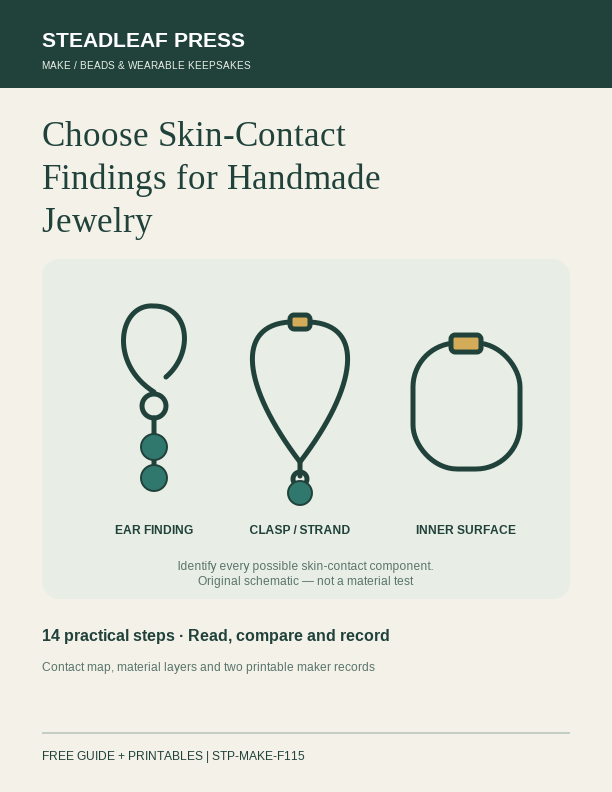
Use Pattern 1 to mark each possible contact point. For an earring include the post or hook, back, fastening mechanism, connecting ring and any drop or cord that can brush the face or neck. For a necklace consider the clasp, both end fittings, beads, crimps and their covers, connector rings and any hanging piece that can rotate against skin. For a bracelet include the entire inner surface, not just the clasp. A component that faces away from skin in a photograph may turn during ordinary wear. If a contact route is uncertain, record it as possible contact rather than leaving it out.
3. Give every component its own identity
Label the packet or listing with a simple code such as E1 for the earring finding, E2 for its back, and E3 for the connector. Record the exact supplier item number, product name, finish and lot if given. If a listing sells several finishes under the same title, capture the selected option, not just the parent listing. Keep different batches separate until their details are confirmed. A replacement jump ring from a mixed box has its own identity; it does not inherit the original hook's description. Photograph or retain the label for personal reference and record the date you checked it.
4. Distinguish a colour name from a material statement
Read the exact listing, including the materials field rather than just the title. A gold-tone hook may be an unspecified gold-coloured metal; a silver-tone clasp may be plated brass, steel or another material. Neither colour tells you what is beneath the surface. Ask for the actual base material or alloy, the coating if any, and the separate material of a spring, back or soldered joint when it could contact skin. Do not infer a metal from colour, weight, price or a magnet. Record the supplier's claim as a claim, with UNKNOWN for missing information.
5. Compare solid alloy, filled and plated descriptions
Use Pattern 2 to distinguish the structural metal from the surface and any intermediate layer. In the FTC consumer terminology, gold-filled material has a mechanically applied gold-alloy layer over a base metal; gold electroplate is a surface deposit. A documented gold-alloy finding is different from a gold-coated finding. A sterling-silver description gives the silver proportion but does not identify every remaining constituent, and a silver-plated item has a different base. Ask about the full construction and finish rather than treating these terms as interchangeable. Do not scrape, file or remove a coating to investigate a finding. Any worn or chipped coating is a reason to review or replace it, not to cover it with a homemade lacquer.
6. Read the stainless steel and other alloy descriptions carefully
If a supplier calls a component stainless steel, request the specific grade and actual surface finish. Some stainless alloys contain nickel; a grade name alone does not establish how much nickel may be released during wear. A titanium, gold, silver or platinum description may also refer to an alloy or a surface coating rather than the whole part. Ask for documentation tied to the exact item and finish. Where nonmetal options are appropriate, check their intended skin-contact use and all concealed metal hardware. Do not create a universal ranking of materials or substitute a grade for a clinician's recommendation.
7. Separate allergy-related claims from supporting evidence
Terms such as hypoallergenic, nickel-free or nickel-safe may appear on packaging. Copy the precise wording and ask what the claim covers: the whole component, a surface only, a material specification, or a measured release result. Nickel content and nickel release are different measurements; a composition statement alone is not a release test. If a supplier refers to a test report, ask which item, finish and method the report covers and whether it applies to the selected lot. Do not assume an unverified badge or a report for a different product proves the current item suitable. Do not invent a numerical threshold, regulatory compliance or allergy guarantee from a generic label.
8. Apply the wearer's known avoidance requirements
Compare the documented materials with the specific requirements already known for the wearer. A person with confirmed nickel allergy should avoid relevant nickel exposure in accordance with their clinician's advice. A finding described only as hypoallergenic is not sufficient to override a known avoidance requirement. Likewise, a nonmetal bead may still have an unknown metal cap or adhesive touching skin. If there is a conflict, record REPLACE; if the information is incomplete, record ASK / HOLD. Do not wear an unknown part briefly to see whether it causes a rash. Clinical patch testing, when appropriate, belongs with a qualified healthcare professional.
9. Ask the supplier focused questions
Use Record 1 and the example questions in Pattern 2. Send the exact item number and selected finish. Ask what the skin-contact surfaces, core, coating and any relevant underlayers are made of; whether the claim covers the matching back or clasp parts; and what documentation supports any nickel-content or release statement. Request a written reply or a current specification linked to the product. Do not ask the supplier to promise that a person will never react. A response that merely repeats the colour or marketing phrase leaves the material unresolved. Keep the question and reply with the packet.
10. Inspect the actual parts before assembly
Once the documents have been reviewed, compare the delivered parts with the recorded option and lot where available. Use good light and, if helpful, a magnifier. Inspect posts, backs, hooks, eyelets, clasp edges and bead entrances for burrs, gaps, coating damage, corrosion or distortion. Confirm that the closure is complete and the attachment is compatible with the intended cord or wire. A clean-looking part is not chemically verified by this inspection. Replace damaged or mismatched parts rather than bending a post, sanding a finish or covering a defect with adhesive. Do not deliberately scratch or use household chemicals to identify the alloy.
11. Compare whole-design options rather than one isolated finding
Imagine two hypothetical earring packets. Option A lists the hook as gold-tone, with no base or back information. Option B identifies the hook and back materials but leaves the connecting ring unlisted. Both designs still have an unresolved possible skin-contact component. Option B supplies more information, not proof of tolerance. Compare each row in Record 2, then request the missing documentation or replace the uncertain components with suitable documented ones. No point score may cancel a known avoidance conflict. Choose a design whose attachment method, closure, finish and wearer requirements can all be considered together.
12. Keep the accepted parts and instructions together
When the material review and ordinary component compatibility review are complete, segregate the selected parts in a labelled compartment with their codes and supplier instructions. Record any required care, assembly or acceptance procedure. Assemble only with methods appropriate to the actual components; an open ring, crimp or threaded connector has its own instructions. Do not combine incompatible finishes or repair a skin-contact surface with unverified paint, nail varnish or glue. If any essential requirement remains unknown, keep the design on hold instead of interpreting this worksheet as clearance to wear it.
13. Recognise when to stop using an accessory
If ordinary wear of a completed piece is appropriate and symptoms develop, stop wearing it and seek suitable medical advice for a persistent, recurrent or concerning reaction. Redness, itching or soreness is not by itself proof of nickel allergy; irritation, other allergens and infection may need professional assessment. Do not re-expose skin to establish a cause. Seek prompt medical care for signs of infection or severe symptoms, and emergency help for breathing difficulty or other signs of a serious reaction. Do not insert jewellery into an unhealed or irritated piercing as part of this guide. Keep the material record to help a clinician or supplier identify the actual components.
14. Record the decision and revisit it after changes
Complete Record 2 for each part and the entire design. Use DOCUMENTED FOR REVIEW, ASK / HOLD or REPLACE. A documented choice can still be unsuitable for an individual; a hold is not a judgement that a product is inherently dangerous. Revisit the map if you replace a clasp, use a different lot, change the intended wearer or notice worn plating, corrosion or a change in closure. Keep the supplier's care instructions and retire damaged or unsuitable items. Store jewellery clean and dry as its manufacturer recommends. Retain the evidence with the finished piece, and do not describe it as universally hypoallergenic, medically approved or guaranteed nickel-free unless a specific, supportable claim actually applies; even then, do not promise individual tolerance.
Fix, care and preserve
The listing gives only a colour. Mark the actual material UNKNOWN. Ask for the base, surface and relevant separate parts rather than inferring them from the photo.
The hook is documented but the back is not. Treat the back as a separate contact part. Keep the design on hold until its material is established or replace it with a suitable documented component.
A coating has rubbed away. Stop using the affected finding. Check the supplier's instructions and replace it when necessary. Do not repaint or scratch it to learn what is beneath.
A report covers a different finish or item. Ask whether the result applies to your exact product and lot. Do not carry an unrelated result into your own record.
An accessory caused irritation. Stop wearing it. Retain the material information and seek advice from a healthcare professional rather than repeating exposure. This guide cannot identify the cause.
Source & evidence boundary
Original Steadleaf English prose, contact map, layer diagrams, decision framework and maker records. Factual context: the American Academy of Dermatology's nickel exposure guidance, DermNet's explanation of jewellery allergy and coatings, and the US FTC's consumer guide to precious-metal descriptions. These references explain general principles, not the composition, compliance or suitability of any specific product. The example listings are hypothetical. Follow the actual supplier instructions and individual healthcare advice when relevant.
- American Academy of Dermatology, Nickel allergy: How to avoid exposure and reduce symptoms: https://www.aad.org/public/diseases/eczema/insider/nickel-allergy - DermNet, Jewellery allergy: https://dermnetnz.org/topics/jewellery-allergy - Federal Trade Commission, Buying Platinum, Gold, and Silver Jewelry: https://consumer.ftc.gov/articles/buying-platinum-gold-and-silver-jewelry
No third-party illustration, pattern or protected instructional passage is reproduced. The publisher has not physically purchased, chemically analysed, measured nickel release, patch-tested, fitted, worn or printed the examples. No certification of biocompatibility, allergy status, legal compliance or strength is implied. The guide is for adult decorative craft planning, not a clinical test, a piercing procedure or a product safety assessment.
The original full-size diagrams, patterns and printable records are in the complete free PDF above.