GROW / FREE GUIDE
Build a Twelve-Week Seed-to-Harvest Diary
A practical observation diary with a twelve-week overview and reusable weekly page
Download the complete free guide
Record and review crop changes and harvest observations over twelve weeks without treating the calendar as a yield guarantee.
Includes complete illustrated instructions and any printable worksheets or templates.
Download free PDFRead the complete free guide online
The instructional text is below. For exact-size patterns, illustrations and printable records, use the complete free PDF above.
STEADLEAF PRESS / GROW Build a Twelve-Week Seed-to-Harvest Diary
A practical observation diary with a twelve-week overview and reusable weekly page.
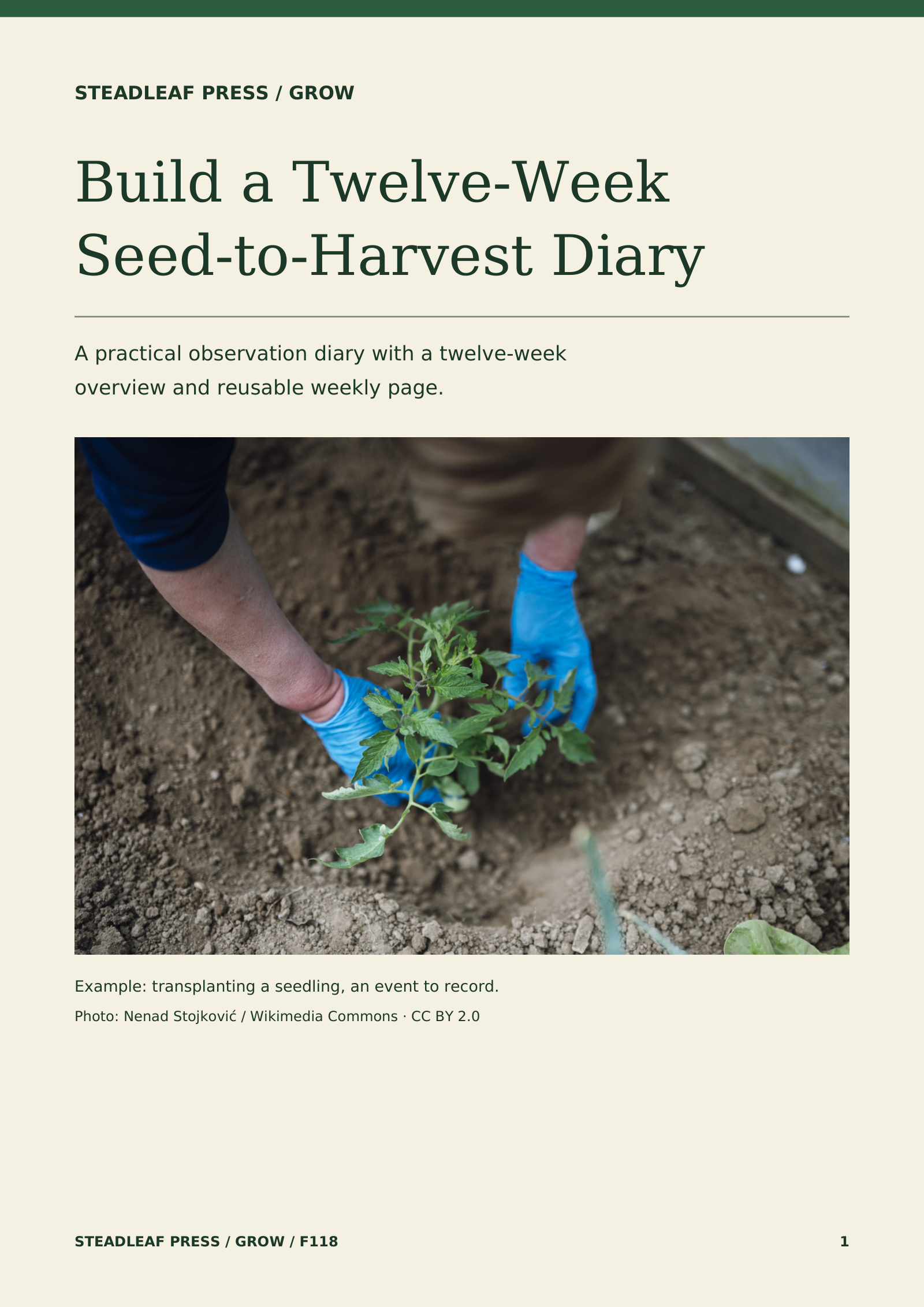
Example: transplanting a seedling, an event to record.
Photo: Nenad Stojković / Wikimedia Commons · CC BY 2.0
STEADLEAF PRESS / GROW / F118 1
Twelve weeks is a useful observation period, not a promise that every crop will be ready to eat. Some plants may produce a harvest within that window; others will still be developing, and some attempts may fail. A good diary records what happened without forcing the plant into a predetermined story.
Choose one crop and one manageable growing space for the first diary. Keep the seed packet and a reliable crop-specific growing guide beside your notes. This journal organises the journey from sowing toward harvest; it does not supply the cultivation requirements for every vegetable or herb.
Choose the question before the seed
Write what you want to learn. Perhaps you want to know whether a particular container and location support a crop, how much attention it requires or when the first usable harvest occurs under your conditions. Make the question small enough to answer from one attempt.
Do not make yield your only possible outcome. Learning that a site receives too little suitable light, or that the care workload does not fit your routine, can prevent a much larger unsuccessful planting later.
Select a known edible crop and cultivar appropriate to the conditions you can provide. Use reputable seed and verify the plant's identity. Never taste an unknown seedling to identify it. Keep treated seed and growing products away from food use and follow their labels.
If you want to compare two methods, first check that both are suitable care. This diary is not a reason to withhold necessary water or expose a plant to damaging conditions.
STEADLEAF PRESS / GROW / F118 2
Make a starting record
University of New Hampshire Extension identifies the seed packet as an important source for sowing depth, spacing, germination conditions and timing. Record the relevant instructions rather than relying on memory or a generic “seeds” routine. Its regional planting dates should not be exported to another location. UNH Extension, Knowing When to Start Seedlings Indoors
Complete these fields:
- Crop, cultivar and seed supplier: ___
- Packet year, lot or identifying details available: ___
- Intended use and plant-specific harvest guidance: ___
- Location and container: ___
- Growing medium and drainage arrangement: ___
- Sowing method, depth and spacing source: ___
- Expected germination range and its stated conditions: ___
- Maturity estimate and what starts its count: ___
- Diary start date and twelve-week review date: ___
- Question for this attempt: ___
Keep the packet or a readable copy. If a direction is missing or unclear, resolve it before sowing rather than filling the gap with an invented number.
STEADLEAF PRESS / GROW / F118 3
Separate the clocks
Record sowing, first visible emergence and any transplanting as different dates. They are different events, and the maturity estimate may use a different starting point from your diary.
University of Maine Extension explains that suppliers' maturity estimates do not all follow an identical convention and that growing conditions influence the actual timing. Check what the particular supplier means rather than assuming the number always begins on sowing day. Treat it as an estimate, not a guaranteed harvest appointment. University of Maine Extension, When Days to Maturity Starts
Define Week 1 as the first seven days of your diary, starting on the date you chose. That makes the pages easy to use. Beside the week number, also record the plant's actual stage. “Week 4, still at early seedling stage” is a valid entry.
If you start another sowing later, give it a separate batch identifier and its own dates. Do not merge it into the first batch to make the record look more successful.
STEADLEAF PRESS / GROW / F118 4
Use the twelve-week overview without prescribing growth stages
The prompts below are questions to ask, not milestones the plant must reach. Use “not yet,” “not applicable” or “unknown” when appropriate. These weekly reviews do not replace the crop's ordinary care checks: act when its condition and guidance require it rather than waiting for the week assigned to a topic.
Diary week Review prompt Actual stage and Action or next question observation
1 Is the starting record ___ ___ complete?
2 What has emerged, if ___ ___ anything?
3 Which observations can I ___ ___ compare reliably?
4 Do the current conditions ___ ___ still match the crop's needs?
5 Has spacing or container ___ ___ use become a relevant decision?
6 What has changed since ___ ___ the first photograph?
7 Is the care workload ___ ___ practical?
8 What stage-specific ___ ___ guidance do I need next?
9 Are there harvest ___ ___ indicators to assess, or is it too early?
10 What has been ___ ___ harvested, lost or left growing?
11 What evidence answers ___ ___ the original question?
12 Continue, repeat with a ___ ___ change, or stop this attempt?
If harvest occurs in Week 4, record it then. If it has not occurred by Week 12, extend the diary when the crop and circumstances justify continuing. The review date is for your learning, not an instruction to harvest an immature plant.
STEADLEAF PRESS / GROW / F118 5
Keep one reusable weekly page
Make a copy of this page for each week:
Week number and dates: ___ Batch identifier: ___
Actual growth stage: ___
Count date: ___; seeds sown: ___; cumulative seedlings observed to emerge: ___; seedlings currently remaining: ___; deliberate thinning and other losses, recorded separately: ___ (use unknown where not reliably countable)
Notable conditions and changes: ___
Care actions actually completed, with dates: ___
Photograph reference and comparison: ___
Losses or concerns, described without an assumed diagnosis: ___
Harvest, if any, with amount and units: ___
One thing learned: ___
One next decision: ___
Use the page during the week rather than reconstructing everything on the final evening. A few short entries are usually more trustworthy than one polished retrospective paragraph.
Keep an event note when something important happens between reviews: a container tips, a move changes the light, a heat event arrives or a helper waters. Record the event without immediately claiming it caused the next visible change.
STEADLEAF PRESS / GROW / F118 6
Count honestly and keep the denominators
If you sowed ten seeds in separately identifiable positions and seven seedlings emerged, record both numbers and the observation date. Keep cumulative observed emergence separate from the number still present: if two of those seven later die, five remain, but seven were observed to emerge. Do not call this a laboratory germination test. It is an observation from your own growing conditions, including any uncertainty about sowing and counting.
If you scattered an uncounted pinch, do not invent a germination percentage. Use a description or an actual seedling count instead. Likewise, distinguish seedlings deliberately thinned according to crop guidance from seedlings that died unexpectedly.
Use consistent units for harvest records. Grams, a count of fruit or another clearly defined measure can work, depending on the crop and your question. “A good handful” may be perfectly adequate for a personal memory, but it is not directly comparable with a weighed harvest.
Keep the date and whether the harvest was the first, a later picking or the final collection. Separate the amount picked on that date from the running total. For example, pickings of 20 g and 15 g give a cumulative total of 35 g; the 35 g is not a third harvest to add again. Record zero when you checked and harvested nothing, and “not recorded” when the amount is unknown. Do not add in produce from another batch without marking it separately.
STEADLEAF PRESS / GROW / F118 7
Describe setbacks without rewriting the experiment
If the attempt stalls, record what you know and what remains uncertain. Check the crop's instructions and suitable diagnostic guidance before making repeated changes. A missed emergence window invites assessment; it does not establish that every seed was defective.
A fictional entry might read: “Week 3: emergence uneven. One end of the container was shaded by another pot until Tuesday. Moved the obstructing pot; did not resow yet. Need to reassess the original sowing against the packet guidance.”
The note preserves a plausible factor without declaring it the sole cause. If you change the growing medium, location and watering approach together, record all three. Later improvement cannot confidently be assigned to one of them.
If the crop is no longer viable or appropriate to continue, close the batch honestly. Record the reason and dispose of material appropriately. Starting again with a new identifier is clearer than erasing the first attempt.
STEADLEAF PRESS / GROW / F118 8
Finish with a useful twelve-week decision
At the review, answer the original question in a short paragraph. State what was observed, what was not established and what you would change next time. Compare actual labour and space with your expectations, not only the harvest.
Choose one outcome: continue this crop; repeat the same setup to see whether the result is consistent; repeat with one justified change; or choose a better-fitting project. A small diary is not a controlled trial, so avoid claiming that it proves a method works for everyone.
Keep the starting record, overview and a few informative photographs together. Your next attempt should begin with evidence you can use, not merely a memory that the previous season was “good” or “bad.”
Sources and scope
UNH supports packet-based preparation; University of Maine supports careful interpretation of maturity estimates. The twelve-week structure, weekly page and outcome review are original journal tools. Crop identity, edible parts, cultivation and harvest readiness require plant-specific guidance beyond this diary.