MAKE / FREE GUIDE
Choose Responsibly Collected Materials for a Project
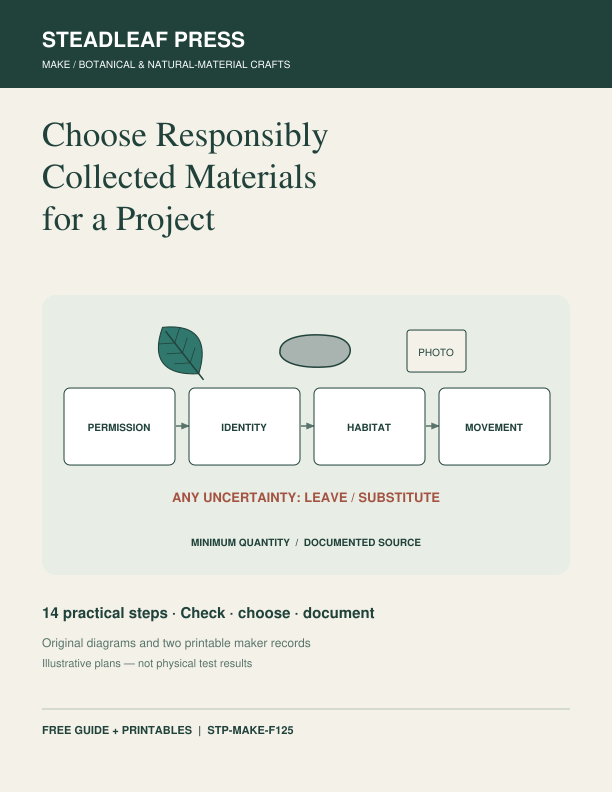
Fourteen practical steps, two original diagrams and two printable maker records.
Download the complete free guide
Plan a small natural-material craft using a documented permission and condition checklist, keeping unsuitable or uncertain specimens out of the project.
Includes complete illustrated instructions and any printable worksheets or templates.
Download free PDFRead the complete free guide online
The instructional text is below. For exact-size patterns, illustrations and printable records, use the complete free PDF above.
Before you start
Finding a leaf, pebble or cone does not automatically give you permission to remove it. For a small craft, the most considerate option may be to use a photograph, a paper substitute or documented material you already own. This guide helps you make and record a small-material choice before collecting anything. It does not give universal permission to collect or transport a species, interpret local law, or certify a specimen safe or pest-free.
Materials: a pencil and the printable records, a current map or location description, applicable site rules and landowner permission, reliable local species identification resources, and labelled containers for already approved suitable materials. A camera is optional for non-contact observations where permitted. No cutting, digging, pruning, harvesting living organisms, moving soil, chemical treatment or collecting unidentified plants is required. Keep natural materials away from food, children and pets.
Plan the project
Define the smallest workable quantity first. Example: one tabletop collage needs three thin leaf shapes, one accent shape and a reserve only if needed. If two suitable previously owned craft leaves are available, the nominal shortfall is one leaf plus one accent, not permission to collect a bag of material. Use a four-gate decision: permitted site and removal; reliable identity and appropriate species; acceptable collection method and habitat impact; and legal movement plus suitable visible condition. Any NO or UNKNOWN means do not collect or move that specimen for this exercise.
Separate the decision to remove something from the decision to bring it indoors. A purchased item may still have an unclear origin or condition. A dry-looking leaf may still carry a pest or residual moisture. If any required information is absent, use a paper silhouette, original photo or documented alternative. The example register uses NEED 4, AVAILABLE 2, SHORTFALL 2; each proposed item is classified USE EXISTING, PERMITTED CANDIDATE, SUBSTITUTE or HOLD. A permission record documents your inquiry, not a legal opinion or safety certificate.
1. Specify the real material requirement
Name the intended craft and list only the forms it needs, such as three flat leaf silhouettes and a single accent. Distinguish appearance from physical requirements. A printed shape may satisfy a visual requirement without removing a natural object. Set a small quantity cap and avoid treating spare material as a reason to gather more than necessary.
2. Inventory materials already owned
Review documented purchased or lawfully obtained craft materials in your own storage. Check identity, source, visible condition and relevance to the project. Do not assume an unlabelled item is permitted or suitable because it has been in a drawer for years. Set unknown material aside without dispersing it. Record the number of usable items and calculate the actual shortfall.
3. Identify the exact proposed collection site
Before any outing, establish who manages the land and what kind of protected designation or access rules apply. Use a current official source for that site; a general map is not collection permission. Parks Canada states that natural and historic objects must be left in place in its protected places. Different jurisdictions and landowners may impose different rules.
4. Verify permission to remove the exact material
Consult the applicable site manager, current rules and landowner as appropriate. Distinguish permission to walk or photograph from permission to take a natural object. Record the location, item type, permitted quantity or limitations, source link or written permission and date. If no reliable permission is available, do not remove anything. A fallen object is not automatically free to take.
5. Confirm identity before considering removal
Use a reliable local identification source or a knowledgeable person to establish what the specimen is. A photo app or similar-looking picture is not sufficient for a doubtful identification. Avoid toxic, irritating, protected, rare, unidentified or invasive plant material. If identity or suitability remains uncertain, leave the item in place. Use an original photograph taken where allowed as a substitute.
6. Consider habitat and cultural significance
Observe without moving the specimen. Leave items that shelter insects or other organisms, contribute to habitat, are attached to living plants, or may have cultural, archaeological or historic significance. Do not disturb nests, rotting logs, bark, soil or water margins to obtain a decorative detail. When an item could be significant, leave it and follow the site authority’s reporting guidance.
7. Check the movement rules before transport
Review applicable plant-health and movement restrictions for the origin and destination, including local rules on wood, seeds, soil and plant material. The Canadian Food Inspection Agency describes how invasive pests can travel on plant material, equipment and wood. Do not move firewood or unfamiliar seed-bearing materials for this craft. If current restrictions are uncertain, use a documented local alternative.
8. Choose the least disruptive option
Prefer a lawful purchased craft item, an already owned specimen or a non-contact image. If removal is explicitly permitted and all other gates are met, take only the minimum suitable fallen material allowed. Do not scrape, cut, dig, prune, strip a plant or remove objects from a habitat feature. Leave enough material for the site’s ecological needs and other visitors.
9. Inspect condition without disturbing pests
Look at the candidate from a safe distance and, only for already permitted familiar material, visually check accessible surfaces. Exclude visible mould, dampness, contamination, sharp broken edges, insects, eggs, webbing and loose seeds. Do not shake, sniff closely, brush or open an unidentified pod. Leave suspect material where it belongs and follow the appropriate local reporting or disposal guidance.
10. Keep approved items identified and separate
If every gate is met and a small removal is allowed, label each approved item with source, identity, date and any relevant limitations. Keep it separate from food and from other craft stock until its condition is assessed. Avoid sealed storage of damp plant matter. A container does not make an item child-resistant or pest-free. Do not move material across a boundary if its movement is not confirmed.
11. Choose a substitute for every uncertain item
For each HOLD, replace the planned shape with a paper cutout, an original sketch or photograph, or documented suitable local craft stock. Preserve the design intent rather than the exact specimen. If an original photograph is not permitted, make an independent generic drawing instead. A substitute can be preferable even when collection would otherwise be allowed.
12. Reconcile the quantities
Use Pattern 2 to compare required forms with suitable existing items and accepted substitutes. Example: four needed minus two suitable existing equals two remaining. If one is a documented permitted candidate and one a paper substitute, the requirement is met without extra removal. Record each destination once; keep uncertain items outside the usable count. Do not write an invented approval.
13. Plan storage and future review
Store only known suitable dry items in a manner appropriate to the material. Keep the source and permission record with the specimen. Reassess after visible deterioration, a changed destination or a different use. Do not assume a previous permission applies to another visit or quantity. If suspect pests or unidentified seeds appear, isolate without spreading them and seek current local guidance.
14. Document the final material decision
Complete Record 2 for each planned item: USE EXISTING, PERMITTED CANDIDATE, SUBSTITUTE or HOLD. Include evidence source and date, identity, allowed quantity, condition and movement restrictions where relevant. No checklist replaces actual permissions or expert identification. If any gate remains unresolved, do not collect or transport; proceed with the safe documented substitutes instead.
Fix, care and preserve
Site permission is unclear. Leave the object and contact the managing authority or choose a substitute.
A species cannot be identified. Do not collect it. Use a generic original drawing or permitted photo.
Plant material may carry pests. Do not move or disturb it; follow relevant authority guidance.
Too many objects were planned. Recalculate the shortfall and use suitable existing materials first.
A purchase has an unclear origin. Ask for documentation or choose another known suitable product.
Source & evidence boundary
Original Steadleaf English prose, calculations, vector artwork, diagrams and maker records. The following sources provide factual context, not certification of this design. Follow actual component instructions and local collection, disposal and plant-movement rules.
Parks Canada, Visitor guidelines https://parks.canada.ca/voyage-travel/regles-rules
Canadian Food Inspection Agency, Stop the spread and help keep invasive species out of Canada https://inspection.canada.ca/en/plant-health/invasive-pests-and-plants/stop-spread
University of Missouri Extension, Drying Flowers and Foliage for Arrangements https://extension.missouri.edu/publications/g6540
No third-party illustration, pattern or protected instructional passage is reproduced. The publisher has not physically made, collected, dried, measured, assembled, printed, fitted or tested the illustrated projects. Dimensions are planning examples, and the worksheets record reader observations only. Adult decorative craft; no safety, preservation, stability or pest-free certification is implied.
The original full-size diagrams, patterns and printable records are in the complete free PDF above.