MAKE / FREE GUIDE
Choose Safe, Clean Packaging for Crafts
Fourteen practical steps, two original diagrams and two printable maker records.
Download the complete free guide
Use an evidence-led sorting process for clean, known paper packaging, with clear hold and reject rules and a six-item selection log.
Includes complete illustrated instructions and any printable worksheets or templates.
Download free PDFRead the complete free guide online
The instructional text is below. For exact-size patterns, illustrations and printable records, use the complete free PDF above.
Before you start
Packaging can be attractive craft stock, but a clean-looking piece is not automatically appropriate for reuse. This guide focuses on simple dry paper and card from known non-hazardous goods. It offers a conservative selection process, not a chemical, microbial or material-safety test. Exclude items with uncertain or hazardous former contents, visible contamination, mould, pests or sharp fragments. The aim is to choose suitable material for a small adult decorative paper project, not to certify waste for another use.
Materials: six candidate descriptions (or six actual pieces of known clean dry paper or card), a protected table, three paper labels reading KEEP / HOLD / REJECT, a pencil, ruler, scissors appropriate only for accepted thin stock, and a clean storage folder. Inspect potentially unsuitable items visually from a safe distance or use written descriptions instead; do not bring hazardous packaging to the craft area. Avoid glass, metal, plastic film and containers with unknown coatings for this beginner exercise. Follow local waste guidance for rejected items.
Plan the project
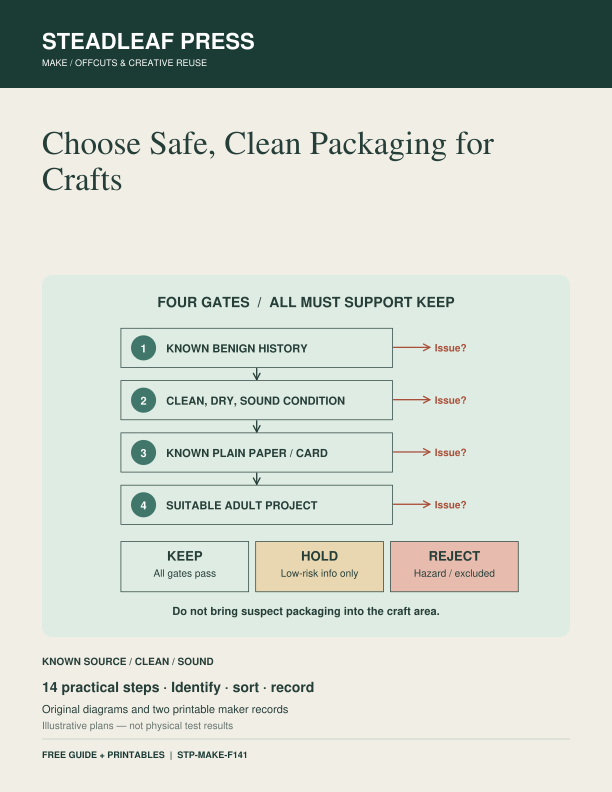
Use a simple gate: (1) known non-hazardous former contents and history; (2) clean, dry, odour-free appearance with no visible mould, pests or residue; (3) sound plain paper/card, no sharp edges, staples or unstable surface, and no personal data or unlicensed imagery in the planned piece; (4) appropriate for the intended adult decorative project and tool. If an actual item may be hazardous, contaminated or sharp, do not handle it further for crafting: REJECT and follow appropriate disposal advice. HOLD is for benign-looking paper with incomplete information or a non-hazardous practical question that can be resolved without unsafe handling.
Log six descriptions or eligible candidates, numbered 1–6. Illustrative desk exercise: clean plain notebook sleeve with known history (potential KEEP); clean dry tissue box from known use, plain area (potential KEEP); uncoated plain shipping insert with known clean history (potential KEEP); card with unknown coating but no known hazard (HOLD for information only, do not cut); greasy takeaway box (REJECT); chemical cleaner packaging (REJECT, do not bring into craft area). This is three potential KEEP, one HOLD, two REJECT in the example, not actual inspection results. A 50 x 50 mm sample can be cut from accepted material only if suitable for the chosen scissors; record the actual result.
1. Define a limited project Choose an adult decorative paper project such as a flat collage or a small dry tag. List the requirements: clean plain paper, sound edges, compatible adhesive and enough usable area. Do not use reclaimed packaging for food contact, medicine storage, children’s products, pet products, wearables, electrical work, heat protection or structural uses. Select purpose-made materials for those uses.
2. Create the three decision labels On a clean table label three areas KEEP, HOLD and REJECT. KEEP is for accepted benign stock, HOLD for a low-risk question pending documentation, and REJECT for excluded candidates. Use descriptions or paper cards for the REJECT category instead of placing potentially unsafe packaging on the table. Do not allow any suspect item to touch accepted materials.
3. Identify what each package held Record the former contents and source for each candidate from labels or reliable personal knowledge. Prefer plain card from ordinary non-hazardous dry goods. Reject packaging from chemicals, pesticides, fuels, solvents, medicines, raw meat or other likely contamination sources even if it looks empty. Do not open unknown containers or smell them deliberately. Follow local advice for appropriate handling and disposal.
4. Assess the storage history Check whether the paper has been kept dry and clean and protected from pests. Exclude anything from a flood, damp basement, contaminated bin or uncertain exposure. If a benign-looking paper has incomplete non-hazardous history, record HOLD for information without cutting it. If there is any suspected contamination, use REJECT rather than trying to investigate it by handling.
5. Look for visible condition problems Without close inhalation or scraping, look for stains, grease, moisture, mould-like growth, insect evidence, shedding fibres and residue. Reject material with such signs. Do not brush, sand, heat, bleach, disinfect or wash suspect paper to make it acceptable. The absence of visible contamination is only one screening factor, not proof of cleanliness.
6. Check material and surface identity For this exercise accept only known sound paper or thin card suitable for ordinary paper craft. Do not use glass, metal, plastic film, multilayer foil or unknown coated packaging. A benign-looking unfamiliar coating may be recorded as HOLD for information, but do not cut or apply solvent to identify it. If the required information cannot be established, exclude it and choose known plain paper.
7. Check for sharp or unstable edges Look for staples, torn metal, sharp rigid plastic or broken glass. Reject those items for this beginner exercise; do not dismantle hazardous or sharp components to salvage the card. Accept thin plain card only if its usable region can be handled with suitable scissors. Set thick rigid card aside for an appropriate specialist method rather than forcing a blade.
8. Check privacy and imagery Examine accepted-looking paper for names, addresses, barcodes tied to personal orders, logos and artwork. Avoid those regions or select plain stock; never expose personal details in a craft photo. Only use imagery you own or have permission to reuse. If the usable plain area is too small, choose another package instead of relying on covering sensitive information with glue or paint.
9. Apply the decision gate to six candidates Number the six descriptions or actual low-risk pieces 1 through 6 and apply the four gates from the plan. Mark KEEP, HOLD or REJECT with the reason. A candidate must meet all applicable KEEP conditions. In the printed example the three ordinary paper items are potential keeps only; actual history and condition still govern. No actual package is certified by the example.
10. Resolve only low-risk hold questions If a HOLD item is benign-looking and the question concerns a missing material description or a practical size issue, use available documentation or choose a different known stock. Do not perform chemical, heat, burn, taste, smell or scratch tests. Record the outcome and update the decision only when the concern is resolved. Otherwise reject the item for this craft.
11. Cut a sample only from accepted stock Choose an accepted flat area and mark a nominal 50 x 50 mm square, avoiding edges, printed personal details and any damage. Cut with suitable scissors on a stable surface. Record actual size and whether the edges stay sound. Stop if the surface flakes or the scissors require force; change to suitable stock. The cut sample checks craft handling only, not material safety.
12. Check the intended adhesive on scrap Choose a labelled compatible paper adhesive and follow ventilation, cleanup and drying instructions. Apply it to an expendable accepted sample and the intended backing; observe ordinary adhesion, distortion and staining after full drying. A poor result means change the material or product. Do not mix cleaners or use an unknown coating as a test surface for solvents.
13. Store accepted materials separately Place dry accepted stock in a clean labelled folder with its source information. Keep holds separate as written records or clearly isolated benign paper if appropriate. Do not keep hazardous, contaminated or sharp rejects in a craft supply box; consult municipal or other appropriate waste guidance. Wash hands and clean the table after ordinary craft handling. Keep materials out of reach of children and pets.
14. Close the record and choose the next project Write the six final decisions and reasons, the number in each category, any unresolved questions and the selected accepted sample. The totals should add to six, with excluded or changed items logged separately. Mark PROJECT STOCK SELECTED or HOLD. This conservative selection method reduces avoidable risks but cannot prove absence of hidden hazards, cleanliness, food-contact suitability or long-term durability.
Fix, care and preserve
Former contents cannot be established. Exclude it from crafting; do not open, smell or test unknown containers.
Paper shows grease, dampness or mould. Reject it and follow appropriate disposal guidance; do not attempt craft cleanup.
Surface is unknown. Keep only a low-risk information hold, then exclude if unresolved.
Staple or sharp edge is present. Reject for this exercise; do not dismantle it to salvage paper.
Usable area is too small. Select another plain accepted piece rather than cutting through sensitive details.
Source & evidence boundary
Original Steadleaf English prose, calculations, vector artwork, diagrams and maker records. The following sources give general craft-safety or paper-care context, not certification of this design. Follow actual product instructions and local disposal guidance.
Health Canada, Arts and crafts safety https://www.canada.ca/en/health-canada/services/home-garden-safety/use-arts-crafts-materials-safely.html Canadian Conservation Institute, Caring for paper objects https://www.canada.ca/en/conservation-institute/services/preventive-conservation/guidelines-collections/paper-objects.html
No third-party illustration, pattern or protected instructional passage is reproduced. The publisher has not physically constructed, cut, washed, measured, woven, fitted or tested these projects. Dimensions are planning examples; worksheets record reader observations only. Adult decorative craft; no safety, heat resistance, permanence, colourfastness or performance certification is implied.
The original full-size diagrams, patterns and printable records are in the complete free PDF above.