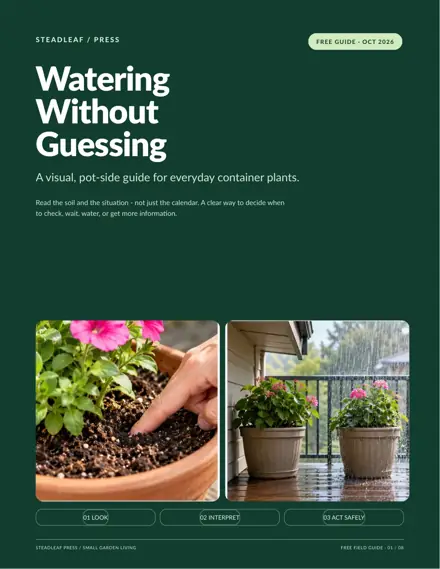
Watering Without Guessing: Free Visual Field Guide
Illustrated, printable decision cards and a 14-check log
A free eight-page visual guide to safer watering checks, drainage clues and next steps for everyday container plants. Includes a pocket decision card and a 14-check printable log.
FREE · No email or checkout
Download free illustrated PDF (8 pages)
For general container-plant learning. The illustrations are examples, not evidence of soil moisture. Always check the actual plant and seek help for inaccessible or unsafe pots.
Read the complete free guide online
Read the instructional text here, or download the complete free PDF above for original diagrams, tables, worksheets and page layout. The original publication is unchanged.
STEADLEAF / PRESS FREE GUIDE · OCT 2026 Watering Without Guessing
A visual, pot-side guide for everyday container plants.
Read the soil and the situation - not just the calendar. A clear way to decide when to check, wait, water, or get more information.
01 LOOK 02 INTERPRET 03 ACT SAFELY
STEADLEAF PRESS / SMALL GARDEN LIVING FREE FIELD GUIDE · 01 / 08
01 / THE REAL STARTING POINT ABOUT ONE MINUTE
Check the pot. Not the calendar.
Different pots dry at different rates. Inspect what you can safely observe, and use what you know about that plant before deciding to water.
Illustrative scene; appearance alone cannot measure moisture. Check outer pots and saucers for retained water.
1 Start with safety. Stay on stable ground. Never lean over a balcony railing or lift or tilt a heavy pot to check drainage. If it is out of safe reach, stop and ask for help.
2 Observe where roots need moisture. If reachable, gently feel the mix at a suitable point below the surface, following the needs of that plant and pot. A dry top alone does not settle the decision.
3 Decide from evidence. Still moist? Usually wait on extra watering. Dry where that plant needs to be checked? Consider gentle watering. Unclear, inaccessible, or drainage unknown? Investigate instead of guessing.
Important: This is for ordinary, safely accessible ornamental plants in pots with functioning drainage. Orchids, succulents, reservoirs, seedlings and specialist plants may need different checks; seek species-specific guidance.
STEADLEAF PRESS / SMALL GARDEN LIVING FREE FIELD GUIDE · 02 / 08
02 / THE CLUES THAT FOOL US Four things that can mislead you.
A symptom or a single photograph is not a moisture measurement. Compare these situations with what you can actually observe.
A dry-looking surface Rain yesterday The top layer can dry while deeper mix is still moist. An overhang may shelter a pot. Light rain may not wet the CHECK BELOW THE SURFACE, SAFELY. root zone.
CHECK THE ACTUAL POT.
Water runs out fast Water in the outer pot Quick runoff can bypass a dry mix or follow a channel. It is Water held around roots can be a problem, not reassurance. not proof that the centre is moist. Do not leave a conventional planted pot standing in retained PAUSE AND INVESTIGATE THE PATH. water.
CHECK RETAINED WATER SAFELY.
The illustrations are AI-generated contextual scenes, not diagnostic photographs or demonstrations of a measured dry/wet threshold. Follow a safe physical check and plant-specific guidance.
STEADLEAF PRESS / SMALL GARDEN LIVING FREE FIELD GUIDE · 03 / 08
03 / A SIMPLE DECISION PATH What should I do next?
Think in decisions, not watering days. This is a bounded guide - not an automatic diagnosis or a promise that one rule fits every plant.
FIRST: Can you check this pot safely? If NO, do not lean, lift or improvise. Record NOT OBSERVED and ask someone who can safely assess it. If YES, continue. ↓
NEXT: Do you know how this plant should be checked?
If NO, identify it or consult plant-specific guidance before deciding how dry the mix should become. If YES, check a suitable reachable point. ↓ WHAT DID YOU FIND?
MOIST UNCLEAR DRY WAIT PAUSE & CHECK. CONSIDER WATER
on extra watering. If the leaves droop or Conflicting observations, blocked only if this fits the plant's needs. Apply look wrong, investigate other causes; do drainage or unsafe access need another gently to the mix and observe what not use appearance alone as a watering safe observation or trusted plant advice. happens rather than pouring an arbitrary trigger. amount.
While watering: Aim at the potting mix, pour slowly and allow absorption. If water races round the rim or pools, stop assuming the root zone was watered; investigate the water path. Empty safely accessible saucers/outer vessels according to the container setup. Avoid overflow to neighbours below.
STEADLEAF PRESS / SMALL GARDEN LIVING FREE FIELD GUIDE · 04 / 08
04 / READING THE WATER PATH Watch where the water goes.
A drip from the bottom is one clue. It cannot tell you everything about moisture at the centre of a pot.
Soaking in Fast edge flow Trapped water
Water gradually enters the growing mix. Check Water escapes beside the mix or too quickly. A Water lingers in a closed outer vessel. Avoid whether the relevant root-zone area needs dry centre may remain; pause, observe, and get leaving an ordinary draining pot soaking in more; do not assume from a drip alone. pot-specific guidance. standing water.
What to do when the path looks wrong
Fast escape: stop, inspect for gaps or a very dry/hardened mix where reachable, and seek plant-appropriate advice. Do not keep adding unlimited water. Pooling: find out whether the pot drains; remove retained water only when it can be done safely. Can't see: do not guess - note the observation as unavailable.
How to read these diagrams: They are original simplified drawings of possible water paths, not a measurement of your plant's moisture or a claim about the exact state of its roots.
Practical checks align with published container-care guidance from the Royal Horticultural Society (RHS). Species, potting mix and local conditions can change the appropriate action.
STEADLEAF PRESS / SMALL GARDEN LIVING FREE FIELD GUIDE · 05 / 08
05 / THREE MOMENTS YOU'LL RECOGNISE Try the decision with a real pot.
“It rained all night.” Your planter is under an overhang. Rain on the balcony floor does not prove the potting mix got wet. Observe the reachable mix before deciding.
NEXT: CHECK THE ACTUAL POT
“The plant looks limp.” The mix still feels moist at an appropriate safe check point. Extra water may not help. Look for heat, plant stress, drainage or other causes; seek advice if it worsens.
NEXT: WAIT ON WATER; INVESTIGATE
“Water rushed through.” Quick drainage does not prove the core is evenly moist. Pause, note what happened, and follow pot- and plant-appropriate advice. Watch where runoff goes.
NEXT: INVESTIGATE THE WATER PATH
Further reading (free): RHS, “How to water containers” · rhs.org.uk/container-gardening/how-to-water-containers and RHS “Container maintenance” · rhs.org.uk/container-gardening/maintenance. These independent free sources provide further plant-care detail beyond this pocket guide.
STEADLEAF PRESS / SMALL GARDEN LIVING FREE FIELD GUIDE · 06 / 08
PULL-OUT / PRINTABLE POCKET CARD KEEP BY THE WATERING CAN
CHECK · WAIT · WATER
One pot at a time. No universal calendar.
1 · SAFETY Can I check from stable ground without reaching across a railing or lifting anything heavy? If not, stop and get help.
2 · PLANT Do I know this plant's watering needs? If not, identify the plant and find reliable guidance before inferring a water need.
3 · MIX What do I actually feel at a safe, plant-appropriate point? Don't decide from a dry-looking surface, rain, wilting or a calendar alone.
WAIT CHECK WATER
Mix is still moist where it matters. If the Unknown plant, mixed signs, water Relevant point is dry and watering fits plant looks unwell, investigate beyond pooling, inaccessible pot or uncertain this plant. Water the mix gently; watering. drainage. observe drainage.
Always pause for these safety signals
An unsafe reach · a heavy pot that cannot be moved safely · a blocked or unknown drain · a closed outer pot full of water · water running toward another balcony · an unidentified plant with specialised requirements.
FREE · Keep this page, share it with a gardening friend, or print another copy. Illustrations teach possible situations. Your real observations decide.
STEADLEAF PRESS / SMALL GARDEN LIVING FREE FIELD GUIDE · 07 / 08
PULL-OUT / PRINTABLE OBSERVATION LOG 14 checks. Not 14 days to water.
Build a clearer picture of your own plants. Record each observation; a check is not a command to water. More than one check can happen in a day.
Pot or plant: _______________________________________ Location/shelter: _________________________________
Plant-specific moisture preference / reliable source: ______________________________________________________________
NO. DATE SAFE CHECKPOINT ACTUAL OBSERVATION NEXT STEP
01
02
03
04
05
06
07
08
09
10
11
12
13
14
Example: “Pot A, sheltered balcony, mix moist at an appropriate safe point - WAIT, recheck when conditions change.” If you cannot reach it safely, write “NOT OBSERVED,” not “DRY.”
This is a practical aid, not a species-specific watering formula or diagnosis. Download or print freely. Published by Steadleaf Press, October 2026. Original explanatory illustrations and AI-generated illustrative scenes, used for context only; no photographs of controlled plant experiments are claimed.