MEND / FREE GUIDE
Choose a Denim Patch Grain Direction
Fourteen practical steps, two original diagrams and two printable repair records.
Download the complete free guide
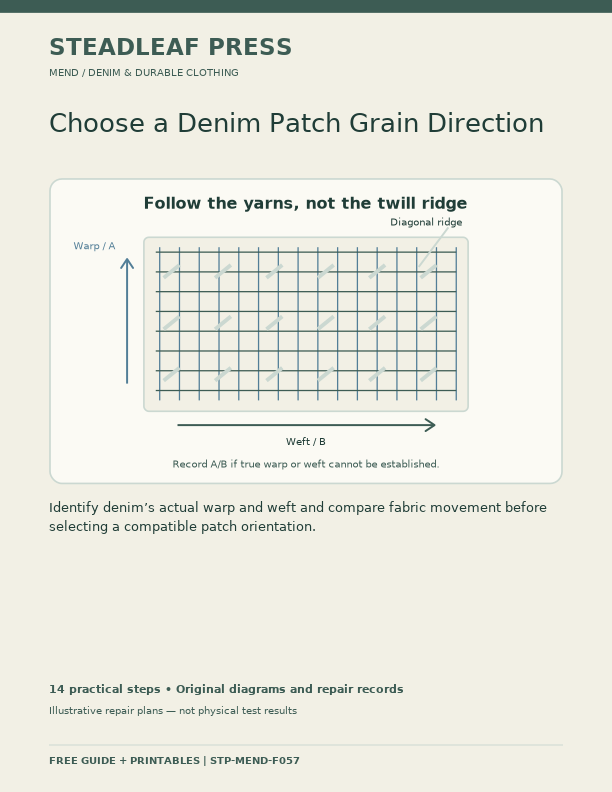
Identify denim’s actual warp and weft and compare fabric movement before selecting a compatible patch orientation.
Includes complete illustrated instructions and any printable worksheets or templates.
Download free PDFRead the complete free guide online
The instructional text is below. For exact-size patterns, illustrations and printable records, use the complete free PDF above.
Before you start
Denim is usually a twill woven fabric. Its diagonal ridge is not a reliable substitute for the lengthwise and crosswise yarn directions. Some denim also contains elastic fibres and behaves differently in the two directions. This guide is a decision and planning worksheet for ordinary adult denim, not a method of certifying stretch or strength. The worked route covers non-stretch woven denim. Stretch denim needs a compatible patch and stitch method that retains movement; refer when uncertain. Do not pull a weak garment to establish its properties.
Materials
Clean garment and potential backing scraps, good light, magnifier, ruler or tape, paper and pencil, care labels, and removable fabric-compatible marking method. Use sound comparable scrap for ordinary gentle handling only. No destructive stretch or load test is required.
FREE • Everyday textile repair • STP-MEND-F057 02
Plan the repair
Observe intact fabric near the wear and look at a selvedge or pattern-cut reference if available. Trace yarn directions at the surface or edge, not the visible twill diagonal. Label warp and weft where supported by evidence; otherwise record directions A and B and uncertainty. Compare backing fibre, weight, drape, care and directional give without pulling damaged cloth. Match corresponding grain directions unless the original construction requires a different compatible method. If an ordinary fabric patch would restrict designed stretch, do not proceed using a rigid woven patch.
FREE • Everyday textile repair • STP-MEND-F057 03
1. Identify the textile
Read the garment label and observe the weave. Record whether the fabric is ordinary denim, stretch denim, coated or technical. Do not infer fibre content solely from its appearance.
2. Find the worn region
Map the area on paper while the garment lies flat. Identify nearby sound cloth and original seams. If the damage is widespread or fabric is weak throughout, refer before considering grain orientation.
FREE • Everyday textile repair • STP-MEND-F057 04
3. Recognize the twill ridge
Look at the diagonal texture under diffuse light. Note that the ridge runs across the yarn system; it is not itself a warp or weft direction. See Pattern 1.
4. Locate the actual yarn paths
Use a selvedge if accessible, reliable garment construction reference, or visible interlacing in an intact area. Follow the actual perpendicular yarn directions rather than relying on the leg outline or diagonal pattern alone.
FREE • Everyday textile repair • STP-MEND-F057 05
5. Label directions honestly
Mark warp and weft only when the evidence is sufficient. Otherwise label two perpendicular directions A and B on your paper map and record what remains uncertain. Avoid cutting the garment to reveal its grain.
6. Observe movement without strain
Note the garment’s known normal movement and label information. Do not tug the damaged area. If compatible sound scrap is available, compare its ordinary gentle handling and recovery in each direction without overstretching.
FREE • Everyday textile repair • STP-MEND-F057 06
7. Compare candidate backing
Identify its yarn directions independently and record its weave, fibre information and care requirements. Compare its thickness, stiffness and directional give to the garment. Match function, not only colour.
8. Check stretch compatibility
If the garment is stretch denim, compare suitable stretch backing and a stitch method designed for that movement. This guide does not prescribe an ordinary rigid patch for elastic denim. Refer if you cannot establish compatibility.
FREE • Everyday textile repair • STP-MEND-F057 07
9. Prepare the backing before sizing
Follow the backing’s appropriate care instructions separately before final cutting. Record its preparation and any visible change. Do not promise shrinkage or dye transfer has been eliminated.
10. Draw the alignment worksheet
Use Pattern 2 to note garment directions, candidate directions, observed give and uncertainty. Draw paired arrows for the chosen orientation. If the warp and weft are uncertain, use clearly recorded local direction marks instead.
FREE • Everyday textile repair • STP-MEND-F057 08
11. Select a provisional orientation
For suitable ordinary non-stretch denim, align corresponding lengthwise and crosswise yarn directions as closely as practical. If the grain cannot be identified reliably, or the original panel is intentionally bias-cut, seek assessment.
12. Plan the repair footprint
Map the complete weakened zone, sound anchor area and nearby seams. Draw the finished and cut backing outlines only after orientation is chosen. Use a separate suitable patch or reinforcement method for actual sewing.
FREE • Everyday textile repair • STP-MEND-F057 09
13. Observe any subsequent repair
If the patch is later attached using an appropriate method, inspect the relaxed cloth for twist, gathering, restriction and a stiff ridge. Compare its original grain marks. Never perform a pull or load test on damaged fabric.
14. Record and reassess
Retain the orientation worksheet and record actual observations during normal wear and permitted care. Refer if the backing distorts, restricts intended movement or the damage extends beyond the patch.
FREE • Everyday textile repair • STP-MEND-F057 10
Fix, care and preserve
The patch diagonal does not match
The twill ridge alone is not the grain. Verify actual yarn directions on both textiles and prioritize compatibility; a surface pattern may differ even when grain matches.
The cloth has stretch but the patch does not
Stop. A rigid backing or stitch row can restrict movement. Choose an appropriate stretch-compatible repair with suitable advice.
There is no reliable warp reference
Record perpendicular directions A and B and uncertainty. Do not assume every seam follows the lengthwise grain; refer if orientation is consequential.
The patch rotates or gathers after sewing
If surrounding cloth remains sound, assess the actual alignment, stitch tension and directional movement. Correct only new stitches if appropriate; do not force the cloth flat.
FREE • Everyday textile repair • STP-MEND-F057 11
Originality and evidence boundary
Original Steadleaf English prose, design, diagrams and records. Follow the actual item, textile and tool instructions. No physical repair, durability, load, strength, washing, flame-resistance or compatibility testing was performed by the publisher. Ordinary adult garments and non-technical household textiles only; no safety or performance certification.
Print the following pages separately if desired. Schematics are illustrative, not full-size cutting patterns. Record only actual observations.
FREE • Everyday textile repair • STP-MEND-F057 12
The original full-size diagrams, patterns and printable records are in the complete free PDF above.