MEND / FREE GUIDE
Decide When Damaged Workwear Is No Longer Protective
Fourteen practical steps, two original diagrams and two printable repair records.
Download the complete free guide
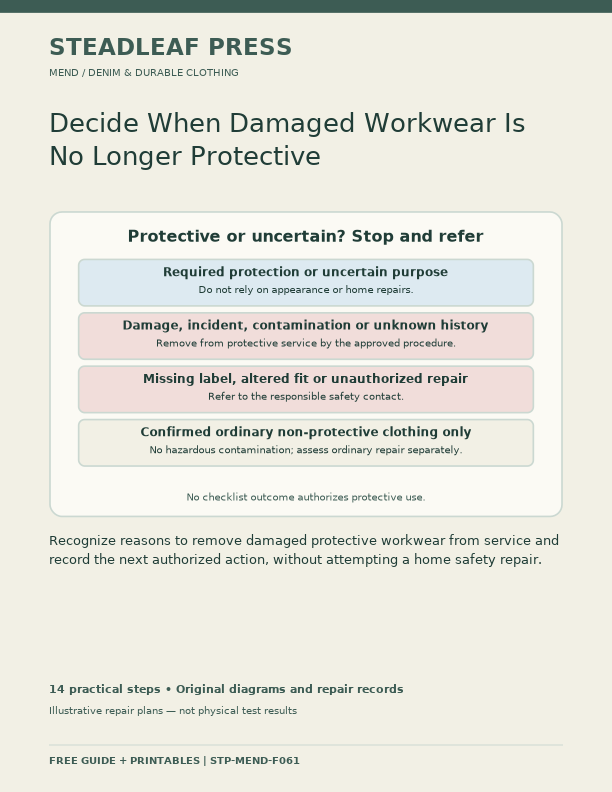
Recognize reasons to remove damaged protective workwear from service and record the next authorized action, without attempting a home safety repair.
Includes complete illustrated instructions and any printable worksheets or templates.
Download free PDFRead the complete free guide online
The instructional text is below. For exact-size patterns, illustrations and printable records, use the complete free PDF above.
Before you start
This is an exclusion and referral guide, not a repair procedure, inspection certification or pass/fail standard. A garment may look intact yet have lost protection. If protective workwear is damaged, contaminated, involved in an incident or of uncertain history, stop relying on it and follow the workplace and manufacturer procedure. Never expose yourself to a hazard to check whether the garment works. Only ordinary non-protective clothing can be considered for the home textile repairs in the other guides.
Materials
Garment identification, manufacturer instructions, workplace hazard and PPE procedure, accessible records, and a pencil. Record information from a safe place; do not handle contaminated clothing or inspect it outside the prescribed procedure. Use suitable replacement PPE before resuming hazardous tasks.
FREE • Everyday textile repair • STP-MEND-F061 02
Plan the repair
First distinguish ordinary clothing from clothing selected for protection. Consider the actual workplace hazard and the specified PPE, not just its appearance or marketing name. Damage, contamination, missing identification, unknown history, failed closures, altered fit or an incident may require isolation and authorized assessment. Follow trained removal and segregation procedures; never bring potentially hazardous contamination into a home. A qualified responsible party must determine disposition using manufacturer instructions and applicable rules. Even an apparently undamaged garment is not cleared by this checklist. See OSHA general industry PPE rule 29 CFR 1910.132(e) (United States), https://www.osha.gov/laws-regs/regulations/standardnumber/1910/1910.132, and CCOHS contamination and decontamination guidance, https://www.ccohs.ca/oshanswers/prevention/p pe/personal-protective-equipment-contamination-and-decontamination.html (accessed November 25, 2026). Local requirements may differ.
FREE • Everyday textile repair • STP-MEND-F061 03
1. Step away from exposure
If the garment may no longer protect you, stop the hazardous task and reach a safe place using the trained procedure. Do not remove protection while still exposed. Notify the responsible workplace contact.
2. Establish the intended use
Check the task and the hazard assessment. Is this ordinary clothing, or is it selected to protect against heat, flame, chemicals, cuts, visibility hazards or another identified risk? Unknown means do not rely on it.
FREE • Everyday textile repair • STP-MEND-F061 04
3. Identify the exact garment
Record model, manufacturer, applicable label information and any service-life information already available. Do not guess the rating from fabric thickness, colour or appearance.
4. Read the responsible instructions
Locate the manufacturer instructions and workplace PPE procedure for inspection, maintenance, authorized repair and retirement. Follow the stricter applicable requirements; ask the responsible safety contact if unclear.
FREE • Everyday textile repair • STP-MEND-F061 05
5. Check incident history
Record known exposure, fire or heat event, chemical contact, snag, impact, prior unauthorized repair or other event that may compromise protection. Do not conduct a reenactment or test exposure.
6. Treat contamination separately
If hazardous contamination is suspected, avoid touching or carrying the garment beyond the approved procedure. Follow trained doffing, segregation and decontamination arrangements. Never wash it at home.
FREE • Everyday textile repair • STP-MEND-F061 06
7. Observe only if safe
Where authorized and safe, record visible holes, tears, thinning, broken stitching, damage to reflective material or coatings and altered closures. Do not scrape, stretch, burn, wet or puncture the garment to investigate.
8. Record fit and coverage concerns
Note reported loss of coverage, damaged fasteners or restricted movement from normal use; do not perform a wearing trial with suspect PPE. Poor fit may also compromise protection.
FREE • Everyday textile repair • STP-MEND-F061 07
9. Flag uncertain information
Record unreadable labels, unknown cleaning history, missing instructions and undocumented repairs. Unknown is a referral trigger, not evidence of safety.
10. Separate from usable equipment
Follow the established workplace process to identify the item as unavailable for protective use and prevent reissue. Do not attach a tag in a way that damages the garment or spreads contamination.
FREE • Everyday textile repair • STP-MEND-F061 08
11. Request authorized disposition
Provide the facts to the responsible safety contact or manufacturer. Ask whether the approved route is inspection, specialist maintenance, authorized repair, or replacement and disposal. Do not make that determination at home.
12. Do not improvise a mend
Do not apply household thread, adhesive, patches, coatings or other alterations to restore PPE. An approved repair procedure may be product-specific and require qualified personnel.
FREE • Everyday textile repair • STP-MEND-F061 09
13. Arrange suitable replacement
Use only the specified suitable PPE provided or approved through the workplace process. Do not return to a hazardous task in suspect equipment while awaiting an answer.
14. Record the actual decision
Record the responsible person, date, disposition and any documented authorization before return to protective service. If no authorization exists, keep the item out of protective use. Do not repurpose contaminated gear.
FREE • Everyday textile repair • STP-MEND-F061 10
Fix, care and preserve
The hole looks small
Size alone does not establish the protective performance of a garment. Remove damaged PPE from service and seek authorized disposition.
The label is missing
Do not infer protection from appearance. Request identification and assessment through the responsible workplace procedure.
A household patch looks strong
A neat repair is not proof of protection. Do not use a home repair as clearance; follow the approved route.
Contamination is suspected
Do not take the item home or handle it outside the prescribed procedure. Consult the responsible safety contact for segregation and disposal.
FREE • Everyday textile repair • STP-MEND-F061 11
Originality and evidence boundary
Original Steadleaf English prose, design, diagrams and records. Follow the actual item, textile and tool instructions. No physical repair, durability, load, strength, washing, flame-resistance or compatibility testing was performed by the publisher. Ordinary adult garments and non-technical household textiles only; no safety or performance certification.
Print the following pages separately if desired. Schematics are illustrative, not full-size cutting patterns. Record only actual observations.
FREE • Everyday textile repair • STP-MEND-F061 12
The original full-size diagrams, patterns and printable records are in the complete free PDF above.