MEND / FREE GUIDE
Choose Darning Yarn for a Wool Sock
Fourteen practical steps, two original diagrams and two printable repair records.
Download the complete free guide
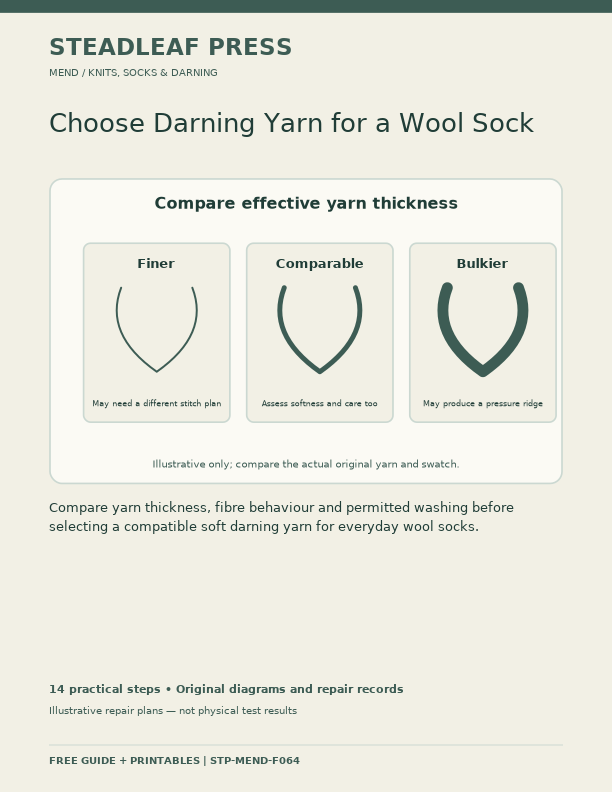
Compare yarn thickness, fibre behaviour and permitted washing before selecting a compatible soft darning yarn for everyday wool socks.
Includes complete illustrated instructions and any printable worksheets or templates.
Download free PDFRead the complete free guide online
The instructional text is below. For exact-size patterns, illustrations and printable records, use the complete free PDF above.
Before you start
A wool sock is knitted to move with the foot, and a repair yarn that is too thick, stiff or prone to different shrinkage can create a ridge. This is a material-selection worksheet for ordinary adult socks, not a repair procedure or a guarantee of wash compatibility. It excludes medical compression socks, protective socks, diabetic-foot-care products and other specialist items. A damaged sock that causes rubbing or pressure should not be worn.
Materials
Clean ordinary sock, care and fibre labels, potential darning yarn samples with known care instructions, light, magnifier, ruler, paper, pencil, blunt tapestry needle and comparable knit scrap. For optional comparison swatches, use only a care method permitted for all tested materials and keep samples separate from the sock.
FREE • Everyday textile repair • STP-MEND-F064 02
Plan the repair
Identify the original knit yarn by visible thickness and construction, label information and ordinary softness. Compare candidates by actual strand size, pliability, fibre content, care requirements and observed behaviour of comparable swatches. A wool or suitable wool-blend darning yarn of similar effective thickness may suit ordinary wool socks; neither fibre name nor nominal yarn weight alone proves compatibility. Avoid bulky yarn or stiff thread. Wash comparison is optional on separate scrap and records actual changes, not a certification. Use a separate suitable darning method after selecting the yarn.
FREE • Everyday textile repair • STP-MEND-F064 03
1. Confirm the sock type
Read the label and identify the sock’s ordinary use. Exclude compression, medical, protective and technical socks. If the sock is uncomfortable or damaged, do not wear it while assessing.
2. Find the wear point
Record the heel, toe or another location, and whether the original knit is merely thin or has missing loops. Widespread weak fabric may need replacement.
FREE • Everyday textile repair • STP-MEND-F064 04
3. Identify the original yarn
Observe a sound nearby stitch and compare it with the worn area. Do not pull yarn from the sock to measure it. Record the fibre label or UNKNOWN.
4. Compare strand thickness
Lay candidate strands beside sound original knitting and compare visually. A multi-ply yarn may have a different effective thickness from its label category.
FREE • Everyday textile repair • STP-MEND-F064 05
5. Compare softness and flexibility
Gently bend candidate strands or a small swatch without sustained tension. Avoid a rigid or scratchy material for a contact area. Record actual observations, not predicted comfort.
6. Check fibre and construction
Record wool content, blends, twist and any reinforcement yarn if known. A suitable compatible blend may be preferable to a thick all-wool yarn; match the actual knit and purpose.
FREE • Everyday textile repair • STP-MEND-F064 06
7. Read care instructions
Compare the sock and candidate yarn labels for temperature, agitation, drying and other restrictions. If care needs conflict or are unknown, select another candidate or seek advice.
8. Prepare comparison samples
Use comparable spare knit and small candidate-yarn swatches rather than the sock itself. Make a few relaxed sample stitches where suitable, keeping strand thickness and stitch density comparable.
FREE • Everyday textile repair • STP-MEND-F064 07
9. Record before observations
On the worksheet, record sample dimensions in a chosen unit, strand appearance, stiffness and any ridge. Note the measurement direction and sample construction.
10. Compare after permitted care
Only if all sample materials permit a common care method, follow that method on the separate samples. Dry as directed; compare relaxed dimensions, felting, texture and colour transfer. If no trial is performed mark NOT CHECKED.
FREE • Everyday textile repair • STP-MEND-F064 08
11. Choose provisional yarn
Prefer a compatible effective thickness, soft hand and care behaviour. Avoid selecting a yarn solely because it is labelled wool or because it looks stronger.
12. Plan a small sample mend
Consider a low-profile flexible darning route and a suitable blunt needle. Do not make a dense hard patch at the heel or toe; seek another method if the yarn produces a ridge.
FREE • Everyday textile repair • STP-MEND-F064 09
13. Observe any later repair
If an appropriate repair is made separately, inspect the relaxed interior and exterior for hard spots, loops and texture differences. Do not use a worn sock to test comfort or strength.
14. Retain the comparison record
Record the actual yarn choice, sample care observations and later ordinary use if suitable. Stop using a sock that rubs, causes pressure, or continues to wear through.
FREE • Everyday textile repair • STP-MEND-F064 10
Fix, care and preserve
The candidate is much thicker
A thick strand may build a ridge. Choose a finer suitable yarn or a compatible effective strand thickness; do not use excess stitches to hide it.
The labels disagree
Do not assume the less restrictive instruction is safe. Choose materials compatible with the sock’s intended care or refer.
The sample changes after washing
Record the actual shrinkage, texture or colour change. A mismatch suggests another yarn may be preferable; one sample does not prove durability.
The repaired sock rubs
Stop wearing the sock. Reconsider the bulk and texture of the repair; replacement may be better than adding more yarn.
FREE • Everyday textile repair • STP-MEND-F064 11
Originality and evidence boundary
Original Steadleaf English prose, design, diagrams and records. Follow the actual item, textile and tool instructions. No physical repair, durability, load, strength, washing, flame-resistance or compatibility testing was performed by the publisher. Ordinary adult garments and non-technical household textiles only; no safety or performance certification.
Print the following pages separately if desired. Schematics are illustrative, not full-size cutting patterns. Record only actual observations.
FREE • Everyday textile repair • STP-MEND-F064 12
The original full-size diagrams, patterns and printable records are in the complete free PDF above.