MEND / FREE GUIDE
Block a Repaired Wool Knit to Restore Shape
Fourteen practical steps, two original diagrams and two printable repair records.
Download the complete free guide
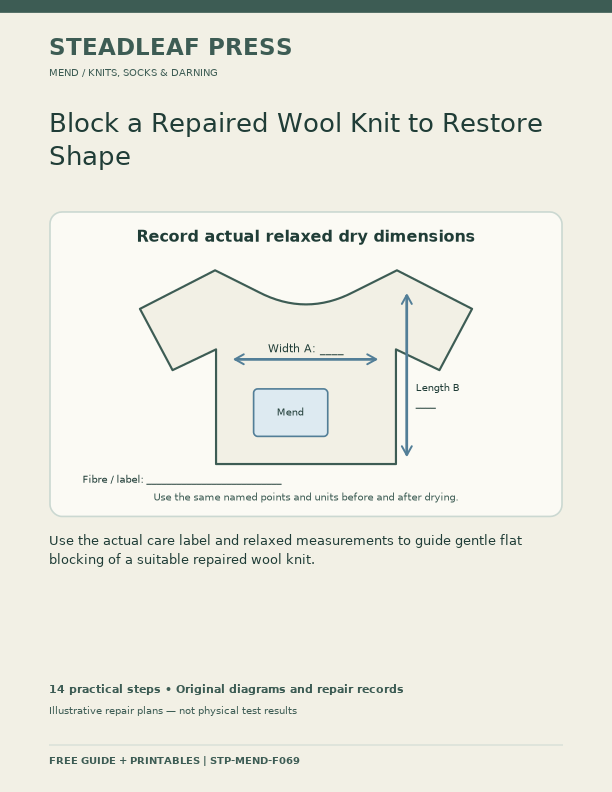
Use the actual care label and relaxed measurements to guide gentle flat blocking of a suitable repaired wool knit.
Includes complete illustrated instructions and any printable worksheets or templates.
Download free PDFRead the complete free guide online
The instructional text is below. For exact-size patterns, illustrations and printable records, use the complete free PDF above.
Before you start
Blocking means allowing a knit to settle to an intended shape under controlled care. It does not restore lost fibres, reverse felting or certify a repair. This worked route is for ordinary adult wool knitwear whose actual care label permits washing by hand and drying flat, with a sound completed repair and no special finish. Do not wet-block dry-clean-only, unknown, fragile, felted, embellished or colour-unstable knitwear without specialist advice. Work off the body.
Materials
Garment and readable care instructions, clean basin, water at the label-permitted temperature, a suitable wool detergent if allowed, several clean colourfast towels, flat ventilated drying surface, ruler or tape, paper and a reliable relaxed shape reference. Avoid heat, vigorous rubbing, twisting or aggressive pinning.
FREE • Everyday textile repair • STP-MEND-F069 02
Plan the repair
Check the fibre blend and care instructions first; do not assume all wool can be wet-blocked. Map relaxed dimensions against a reliable pre-repair measurement or sound garment reference, not a forced target. If hand washing and flat drying are permitted, use the prescribed gentle care process. Support the whole garment when wet, remove excess moisture without wringing, then arrange it flat into its natural shape with minimal manipulation. Allow to dry fully as directed, without forced heat or stretching. If the repair or material becomes unstable, stop shaping and seek advice.
FREE • Everyday textile repair • STP-MEND-F069 03
1. Read the care label
Record fibre content, allowed wash method, temperature, detergent restrictions and drying instructions. If hand washing or flat drying is not permitted or unknown, refer instead.
2. Inspect the completed mend
Check the repaired and neighbouring knit for live loops, unstable yarn, loose ends and previous damage. Do not begin wet care until an appropriate repair is complete.
FREE • Everyday textile repair • STP-MEND-F069 04
3. Establish a shape reference
Use reliable pre-repair relaxed measurements, an intact symmetrical area if applicable, or the garment's known original silhouette. Do not invent a target size or force symmetry in deliberately shaped pieces.
4. Measure while dry and relaxed
Record length and width at named points on a flat surface, with units. Mark the repair location and any existing distortion. See Pattern 1.
FREE • Everyday textile repair • STP-MEND-F069 05
5. Prepare the care area
Use a clean basin and flat surface with clean colourfast towels. Keep the whole wet garment supported when transferring. Follow the label and any detergent instructions.
6. Check colour and trim concerns
If dye transfer, trim compatibility or shrinkage is uncertain, seek advice. Do not experiment with a valuable garment. A compatible sample can inform a decision but does not guarantee the garment result.
FREE • Everyday textile repair • STP-MEND-F069 06
7. Use permitted gentle care
If the actual label permits, immerse or hand wash as directed using the allowed water temperature and suitable detergent if specified. Avoid rubbing, agitation and unnecessary prolonged soaking.
8. Rinse as permitted
If rinsing is required, follow the care and detergent instructions. Support the garment rather than lifting it by a sleeve or the repaired area. Avoid abrupt temperature changes.
FREE • Everyday textile repair • STP-MEND-F069 07
9. Remove excess water
Support the wet knit and gently press out water without twisting. Transfer onto a towel, roll loosely and press gently if suitable. Replace saturated towels as needed.
10. Lay flat in natural shape
Spread the garment on a clean supported drying surface. Smooth by hand toward its reliable relaxed dimensions; do not stretch the mend to fit a target. Keep seams, ribbing and folds in their original arrangement.
FREE • Everyday textile repair • STP-MEND-F069 08
11. Check the repaired region
Observe the knit around the repair for pulling, unstable yarn or uneven shaping. If the repair distorts, stop manipulating it; support flat and seek advice. Do not use weights or forceful pinning.
12. Dry according to care
Let the garment dry fully on the permitted flat surface with suitable air circulation. Avoid a radiator, tumble dryer or direct heat unless specifically permitted; do not hang a water-heavy knit.
FREE • Everyday textile repair • STP-MEND-F069 09
13. Compare dry dimensions
Once dry, measure the same named points in the same relaxed state and units. Record actual changes and texture; no promised restoration or shrinkage result.
14. Document and follow up
Retain the actual care details, dry dimensions and repair appearance. If shape remains distorted, yarn has felted or the repair has loosened, consult a repairer instead of repeating wet blocking.
FREE • Everyday textile repair • STP-MEND-F069 10
Fix, care and preserve
The label is unreadable
Do not infer wet-care suitability from the word wool or from appearance. Obtain product-specific guidance before wet blocking.
The garment remains misshapen
Do not pull to a desired size or pin under sustained tension. Refer if natural shape cannot be regained gently.
The yarn feels felted or stiff
Stop further washing or stretching. Blocking cannot reliably undo felting or damaged fibres; seek advice.
The repair loosens when wet
Keep the garment supported and avoid manipulating the repair. Let it dry as permitted and arrange suitable repair assessment.
FREE • Everyday textile repair • STP-MEND-F069 11
Originality and evidence boundary
Original Steadleaf English prose, design, diagrams and records. Follow the actual item, textile and tool instructions. No physical repair, durability, load, strength, washing, flame-resistance or compatibility testing was performed by the publisher. Ordinary adult garments and non-technical household textiles only; no safety or performance certification.
Print the following pages separately if desired. Schematics are illustrative, not full-size cutting patterns. Record only actual observations.
FREE • Everyday textile repair • STP-MEND-F069 12
The original full-size diagrams, patterns and printable records are in the complete free PDF above.