MEND / FREE GUIDE
Know When a Knit Hole Is Too Large for Invisible Mending
Fourteen practical steps, two original diagrams and two printable repair records.
Download the complete free guide
Assess the missing knit structure and choose a realistic repair route rather than promising an invisible result.
Includes complete illustrated instructions and any printable worksheets or templates.
Download free PDFRead the complete free guide online
The instructional text is below. For exact-size patterns, illustrations and printable records, use the complete free PDF above.
Before you start
An invisible-looking knit repair depends on matching yarn, stitch structure and the condition of the original fabric, not a universal hole diameter. This is a decision worksheet for ordinary adult knitwear with local damage. It is not a restoration guarantee, a full reknitting pattern or a strength certification. Secure visible live loops without pulling. Fragile, felted, widespread, valuable or technical textiles require suitable specialist assessment.
Materials
Clean garment, diffuse light, magnifier, ruler, paper and pencil, locking stitch markers for visible live loops, care label and any known matching yarn or intact comparable swatch. No deliberate pull, cutting or unraveling test is needed.
FREE • Everyday textile repair • STP-MEND-F070 02
Plan the repair
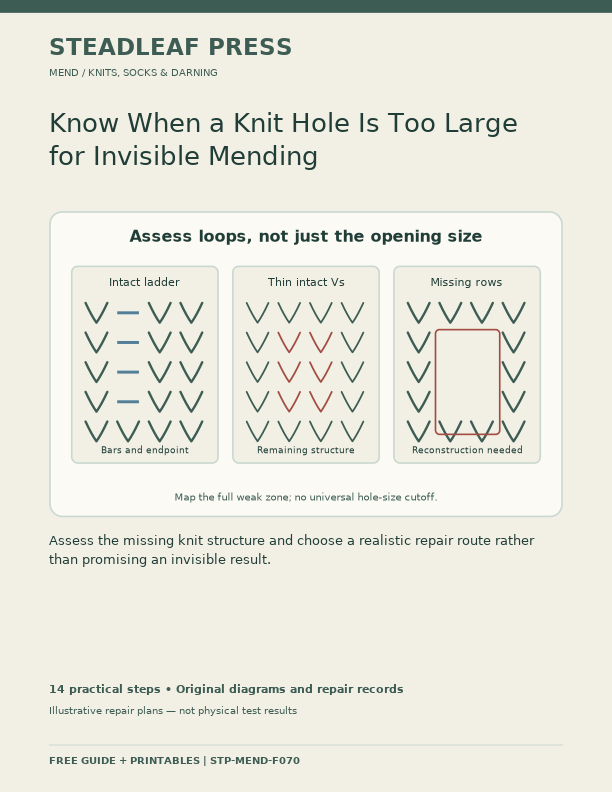
Map the visible opening and surrounding thinning, intact columns and rows, missing loops, loose live stitches, construction and access. Identify whether a simple intact stitch ladder can be recovered, whether stable existing Vs can accept duplicate-stitch reinforcement, or whether missing yarn requires genuine reconstruction. A larger gap, missing rows or unstable surrounding loops may be better suited to a compatible visible knitted patch, specialist reknitting, or replacement. Appearance is a preference, not evidence of strength; no fixed size boundary or promise of invisibility applies.
FREE • Everyday textile repair • STP-MEND-F070 03
1. Observe in relaxed shape
Place the garment flat without stretching the opening. Identify the affected area and record the original knit structure if recognizable.
2. Secure visible live loops
Place locking markers through clearly visible live loops without splitting or pulling yarn. If the number or path is unclear, stop and seek assistance. Do not wear while temporary markers remain.
FREE • Everyday textile repair • STP-MEND-F070 04
3. Measure the full affected zone
Record opening length and width and any surrounding visibly thinned area, with units and location. A small opening with broad weakness may be harder to mend than a larger gap in sound cloth.
4. Count remaining structure
Identify traceable columns and rows near the damage, and note missing, broken or displaced yarn. Do not pull threads apart to establish the count. Mark unknowns.
FREE • Everyday textile repair • STP-MEND-F070 05
5. Assess surrounding anchors
Look for sound loops in each direction and whether they can be reached without dismantling a seam, shaping or lining. Fragile or inaccessible anchors call for referral.
6. Identify pattern complexity
Record plain stockinette, rib, colourwork, lace, shaping or uncertain construction. A matching yarn alone cannot reproduce an unfamiliar structure.
FREE • Everyday textile repair • STP-MEND-F070 06
7. Compare candidate yarn
Record fibre, weight, twist, texture, colour, recovery and permitted care if known. Matching colour does not establish an invisible mend; compare a compatible sample only if available.
8. Consider intact-yarn recovery
If the issue is one dropped column with intact bars and a known upper endpoint, a ladder recovery guide may be appropriate. Broken or missing bars require another route.
FREE • Everyday textile repair • STP-MEND-F070 07
9. Consider preventive duplicate stitch
If a thin patch still has traceable intact Vs and sound surrounding knitting, compatible duplicate stitching may support existing stitches. It cannot replace several missing rows by simply tracing empty space.
10. Consider genuine reconstruction
If small sections are missing but the full stitch structure and sound anchors can be identified, specialist reknitting or an appropriate stitch-reconstruction method may be possible. Do not claim a specific size guarantee.
FREE • Everyday textile repair • STP-MEND-F070 08
11. Consider a visible alternative
A soft compatible knitted backing or decorative repair may be practical when a matching invisible reconstruction is not realistic. It must reach sound material and retain normal movement; use an appropriate separate repair guide.
12. Choose referral or replacement
For wide deterioration, unknown live loops, inaccessible shaping, fragile fibres or inadequate anchors, obtain professional assessment or consider replacement. Never sew a gap tightly closed to hide it.
FREE • Everyday textile repair • STP-MEND-F070 09
13. Record appearance expectations
Document whether a visible mend is acceptable, what yarn match is available and what uncertainty remains. If a repair is undertaken separately, inspect its relaxed appearance without load testing.
14. Record the next action
Use the decision worksheet to choose a provisional route or referral. Note actual subsequent results only. If the repair fails or damage spreads, reassess the whole affected area.
FREE • Everyday textile repair • STP-MEND-F070 10
Fix, care and preserve
The hole looks small but cloth is thin
Map the whole weak area and do not rely on hole diameter. A different backing or specialist repair may be required.
Matching yarn is unavailable
A discreet or deliberate contrast repair may be realistic if suitable. Do not promise an invisible result.
The pattern cannot be followed
Keep live loops secured and refer. A simple stockinette technique may distort ribbing, lace or shaping.
The hole grows during handling
Stop manipulating the knit. Secure accessible live loops and seek help; do not trim it into a regular shape.
FREE • Everyday textile repair • STP-MEND-F070 11
Originality and evidence boundary
Original Steadleaf English prose, design, diagrams and records. Follow the actual item, textile and tool instructions. No physical repair, durability, load, strength, washing, flame-resistance or compatibility testing was performed by the publisher. Ordinary adult garments and non-technical household textiles only; no safety or performance certification.
Print the following pages separately if desired. Schematics are illustrative, not full-size cutting patterns. Record only actual observations.
FREE • Everyday textile repair • STP-MEND-F070 12
The original full-size diagrams, patterns and printable records are in the complete free PDF above.