MEND / FREE GUIDE
Make a Simple Sashiko-Inspired Grid on Scrap Cloth
Fourteen practical steps, two original diagrams and two printable repair records.
Download the complete free guide
Practise a simple original running-stitch grid on scrap cloth, with attention to spacing, intersections and the Japanese tradition that inspires the exercise.
Includes complete illustrated instructions and any printable worksheets or templates.
Download free PDFRead the complete free guide online
The instructional text is below. For exact-size patterns, illustrations and printable records, use the complete free PDF above.
Before you start
Sashiko is a Japanese textile stitching tradition in which repeated running stitches have served both practical reinforcement and decoration. This small exercise is inspired by that broad technique, not a reproduction of a named traditional motif or an authoritative lesson in regional sashiko practices. It is for ordinary medium-weight woven scrap cloth only. Do not apply the exercise to protective clothing, a fragile garment or an unsupported hole. Cultural context: Metropolitan Museum of Art, Sashiko Jacket (Japan, nineteenth century), https://www.metmuseum.org/art/collection/search/50805 ; Museum of Arts and Design, Sashiko Embroidery workshop, https://madmuseum.org/events/sashiko-embroidery-artist-residence-jennie-maydew .
Materials
Two compatible woven cotton scraps (one base and optional backing), compatible smooth contrasting thread, suitable hand needle, ruler, paper, removable cloth-safe marker, clips or basting, and scissors for thread or scrap. Dark plain cloth and pale thread are optional. Use a thimble if appropriate; do not force the needle through thick layers.
FREE • Everyday textile repair • STP-MEND-F073 02
Plan the repair
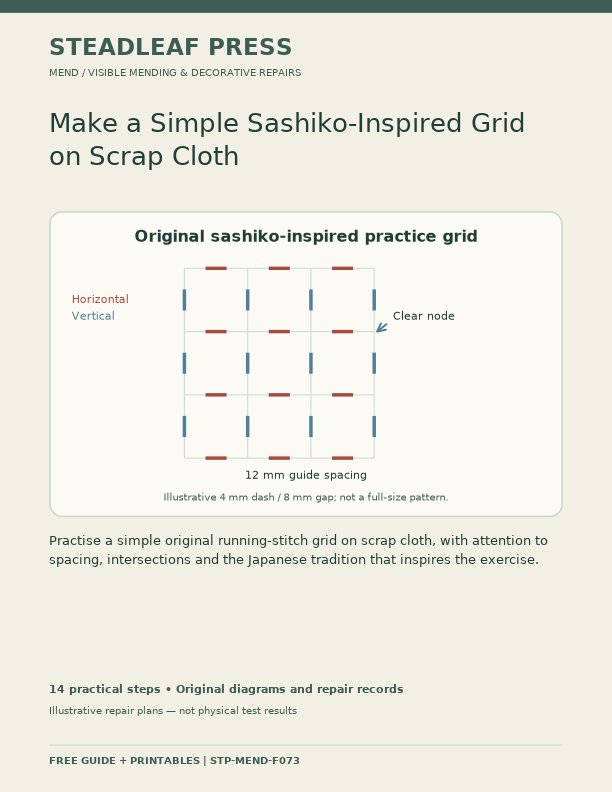
Create an original small practice grid of four horizontal and four vertical lines, approximately 12 mm apart on scrap; use an illustrative dash of 4 mm separated by an 8 mm gap for this layout. Centre each dash between intersections so the horizontal and vertical visible stitches do not meet at the nodes. Adapt the grid and thread to your fabric, keeping the proportions visually consistent rather than treating these measurements as rules of sashiko. Work each line separately with relaxed tension. The sample is a learning exercise, not a physical strength trial. Pattern 1 shows the original grid, and Pattern 2 shows a blank layout and the intersection detail.
FREE • Everyday textile repair • STP-MEND-F073 03
1. Read the cultural note
Recognize sashiko as a Japanese practice with a history of repairing, reinforcing and patterning cloth. This original sampler borrows the running-stitch idea without claiming a traditional named design.
2. Select ordinary scrap
Choose a stable medium-weight woven scrap and optional compatible backing. Avoid a treasured garment or deteriorated textile for the first practice.
FREE • Everyday textile repair • STP-MEND-F073 04
3. Choose thread and needle
Compare smooth thread with the weave and care instructions. Use a needle suited to the thickness; a heavy cord or forced needle can distort the sample.
4. Prepare the layers
Lay the scrap flat with grain directions aligned if using two layers. Baste the perimeter loosely, leaving the sample relaxed.
FREE • Everyday textile repair • STP-MEND-F073 05
5. Draw the grid on paper
Sketch four horizontal and four vertical lines with approximately 12 mm spacing as an example. Mark the intersections as gaps, not stitch targets.
6. Set the dash rhythm
Centre a 4 mm face dash in each 12 mm interval, leaving an 8 mm gap between dashes in the example. Change both dimensions proportionally if the actual fabric needs a different scale.
FREE • Everyday textile repair • STP-MEND-F073 06
7. Transfer the guide
Use a suitable removable marker on the scrap. Draw the outside margins and four lines in each direction. Leave enough sound material beyond each end for securing the thread.
8. Practice the running stitch
Take a few stitches on a spare area, maintaining even relaxed gaps. Adjust the needle, thread and tension before following the main grid.
FREE • Everyday textile repair • STP-MEND-F073 07
9. Sew the horizontal lines
Work each line with a separate short thread or a securely ended route. Start and finish in sound cloth beyond the motif without long floats across the reverse.
10. Sew the vertical lines
Repeat along the vertical guides, keeping each face dash centred between the horizontal lines. Do not pierce the horizontal stitch at an intersection.
FREE • Everyday textile repair • STP-MEND-F073 08
11. Observe the junctions
At each crossing of drawn guides, the visible stitches leave a small clear space. If a dash crosses a node, adjust only the new stitch if the scrap allows it.
12. Secure and clean up
Weave or secure thread ends in sound material without bulky knots. Remove basting and markings by a method permitted for the scrap.
FREE • Everyday textile repair • STP-MEND-F073 09
13. Compare the sample
Observe both faces while flat and relaxed. Note the spacing, consistency and any gathering. This is a visual practice record, not evidence of strength.
14. Record your own version
Write down actual grid spacing, dash and gap lengths, thread and observations. If applying the skill later, select an appropriate separate patch method and keep the cultural attribution.
FREE • Everyday textile repair • STP-MEND-F073 10
Fix, care and preserve
The grid intersections become bulky
Keep dashes clear of crossing nodes in this particular sampler. Remove and redo a misplaced new stitch only if the scrap is sound.
Lines bend or narrow the scrap
Reduce tension and work with the cloth relaxed. Check whether your marking lines follow the grain and whether the backing has shifted.
The reverse has long thread runs
End each line independently or use short discreet paths in sound cloth. Avoid long loops or taut connections.
The sample resembles a familiar design
Describe it accurately as an original simple practice grid inspired by sashiko; do not imply a historic named pattern or invent a regional attribution.
FREE • Everyday textile repair • STP-MEND-F073 11
Originality and evidence boundary
Original Steadleaf English prose, design, diagrams and records. Follow the actual item, textile and tool instructions. No physical repair, durability, load, strength, washing, flame-resistance or compatibility testing was performed by the publisher. Ordinary adult garments and non-technical household textiles only; no safety or performance certification.
Print the following pages separately if desired. Schematics are illustrative, not full-size cutting patterns. Record only actual observations.
FREE • Everyday textile repair • STP-MEND-F073 12
The original full-size diagrams, patterns and printable records are in the complete free PDF above.