MEND / FREE GUIDE
Check Whether an Alteration Changes a Garment’s Drape
Fourteen practical steps, two original diagrams and two printable repair records.
Download the complete free guide
Use reversible basting, consistent comparison and a pin-free wear-test worksheet before cutting or final sewing.
Includes complete illustrated instructions and any printable worksheets or templates.
Download free PDFRead the complete free guide online
The instructional text is below. For exact-size patterns, illustrations and printable records, use the complete free PDF above.
Before you start
Suitable items and exclusions
For ordinary adult garments in stable woven cloth, with an accessible seam or hem and a modest proposed change. This is an observational method, not a guarantee of fit or tailoring competence. Do not use on protective or medical garments, complex structured tailoring, stretch or bias-sensitive fabric you cannot control, or any change that restricts movement. Stop if the garment is damaged or if a change requires cutting before its consequences can be evaluated.
Materials and tools
Clean garment, original care label, mirror, tape measure, removable marker, fine thread for basting, needle, paper, optional camera on a stable stand, and pins or clips only while garment is off-body.
Plan the intervention
Work from the actual item
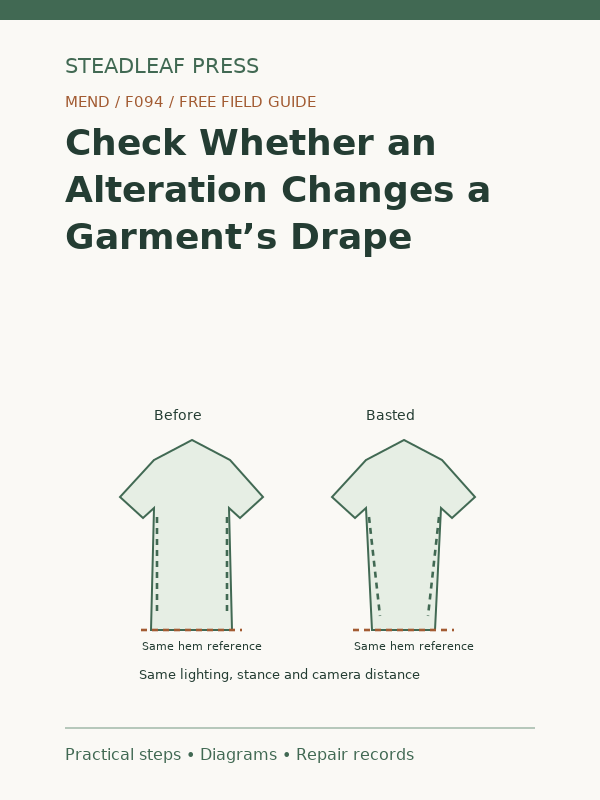
Record how the garment hangs before alteration under the same conditions. Mark reference points such as side seams, hem, shoulder or grain direction. Baste a reversible version of the proposed change without cutting, leaving original seam allowance and construction intact. Remove all pins, then compare a relaxed fit in the same lighting, clothing and stance. Use a few ordinary movement observations; do not force stretches. If the garment twists, pulls or loses desired ease, remove the basting and revise or refer.
Before committing
No cutting or final sewing is justified by an uncertain or uncomfortable basting preview.
Work off the body unless the instruction expressly calls for a pin-free observation.
1. Set the comparison conditions
Choose consistent lighting, mirror or camera position, underclothing and relaxed posture. Use the same conditions before and after. Record date and garment.
2. Inspect construction
Identify fabric type, grain, seam and hem allowances, linings, pockets and fasteners. If the construction is complex or fabric unstable, refer rather than guessing.
Work off the body unless the instruction expressly calls for a pin-free observation.
3. Record original drape
With no pins or tools in the garment, observe the front, side and back at rest. Note hem level, side seam position, folds, and movement room.
4. Mark repeatable reference points
On paper, record a small set of visible landmarks and their reference distances. Optional photos should use the same framing and stance; keep them private if desired.
Work off the body unless the instruction expressly calls for a pin-free observation.
5. Define the alteration
Write the proposed change, location, amount and desired result. For example, taking in each of two side seams by 0.5 cm per seam edge reduces a simple four-edge circumference by about 2 cm; verify actual construction.
6. Check available allowance
Inspect seam allowance and existing stitching off-body. Do not remove original stitches or cut fabric merely to preview a change. If a preview cannot be made reversibly, seek advice.
Work off the body unless the instruction expressly calls for a pin-free observation.
7. Mark off the body
Use removable marks on an accessible seam or hem. Keep alignment marks paired and respect fabric grain. Do not pin fabric on a person.
8. Make the temporary change
Use relaxed removable basting to simulate the planned line. Avoid stretching, bunching or pulling adjacent layers. Retain original material and finish.
Work off the body unless the instruction expressly calls for a pin-free observation.
9. Remove all fitting aids
Account for needles, pins and clips before putting on the garment. Leave only secure, comfortable basting. Do not wear if a loose thread can snag.
10. Repeat the standing observation
Try the garment gently under the same comparison conditions. Compare front, side and back seam position, folds and hem with the baseline.
Work off the body unless the instruction expressly calls for a pin-free observation.
11. Observe ordinary movement
Only if comfortable, observe standing, walking, sitting or normal arm movement as appropriate. No forced range or stress test. Stop immediately for restriction or discomfort.
12. Interpret differences
Look for new diagonal folds, shifted seam, uneven hem, pinching or loss of ease. Differences can arise from posture or lighting; repeat under consistent conditions before drawing a conclusion.
Work off the body unless the instruction expressly calls for a pin-free observation.
13. Revise before committing
Remove only temporary basting if the result is unsuitable. Adjust the planned amount and repeat if safe. If good drape requires changing multiple seams or cutting irreversibly, consult a tailor.
14. Decide and record
Use the comparison worksheet to record retain, revise or refer. Commit to final sewing only after fit and construction are understood; do not claim the preview predicts every fabric response.
Fix, care and reassess
Hem changes on one side
Check consistent stance and seam alignment. Remove temporary basting and review the proposed change.
Diagonal folds appear
They may indicate changed tension or grain alignment; do not assume a single cause. Compare with the original garment.
Movement becomes restricted
Remove the garment and reverse the temporary change. Do not force it.
Basting cannot simulate the finished construction
Mark the result uncertain and seek specialist advice before cutting.
Keep an honest repair record
Originality and limits
Original Steadleaf English prose and vector diagrams. Follow the actual item, material and tool instructions. No physical repair, wash, load, durability, strength or compatibility trials were performed by the publisher. Ordinary adult non-technical textiles only; no safety or performance certification.
Follow-up
Use the two records to document what you actually observed, not what you expect to happen. If the item becomes unsuitable, stop use and seek appropriate advice or replacement.
Decision checkpoint
No cutting or final sewing is justified by an uncertain or uncomfortable basting preview.
The original full-size diagrams, patterns and printable records are in the complete free PDF above.