MEND / FREE GUIDE
Store Repaired Wool Without Crushing Its Shape
Fourteen practical steps, two original diagrams and two printable repair records.
Download the complete free guide
Choose a storage route for repaired everyday wool, with gentle support, care-label checks and periodic visual review.
Includes complete illustrated instructions and any printable worksheets or templates.
Download free PDFRead the complete free guide online
The instructional text is below. For exact-size patterns, illustrations and printable records, use the complete free PDF above.
Before you start
Suitable items and exclusions
For ordinary adult wool or wool-blend clothing that is already repaired and suitable for ordinary use. Check the actual care instructions and construction. This guide does not cover valuable historical textiles, mould or active pest remediation, protective garments, fragile structured tailoring or professional cleaning procedures.
Materials and tools
Care label, clean dry storage surface, appropriate shelf or drawer, smooth breathable cover or suitable clean container, optional plain tissue or clean smooth fabric for support, pencil and records, and a shaped or padded hanger only for an appropriate woven garment.
Plan the repair
Work from the actual item
Determine whether the item is knitted or woven and whether it requires professional cleaning. Store only when clean and fully dry according to its own care. Fold relaxed knitted garments with broad supported folds; avoid compressing a repair or putting heavy items on top. For stable woven wool that is designed to hang, use a shaped hanger appropriate for the garment. A repaired or weakened area may require horizontal support or professional advice. Inspect periodically for moisture, pests or changed shape.
Before committing
Do not use steam, ironing, chemicals or compression to force a repaired wool item into shape. No claim of moth prevention, guaranteed shape retention or repair durability is made.
1. Read the care label
Record fibre and care instructions, including whether home washing is allowed or professional cleaning is indicated. Wool blends and finishes differ; do not assume all wool garments can be washed or steamed.
2. Inspect the repair before storing
Lay the item on a clean surface and examine the repaired region and adjoining cloth visually. Check for new distortion, loose yarns or weak areas. Do not pull the repair or hang a weak knit to inspect it.
3. Choose the cleaning route
Clean the item only as allowed by its original and repair material instructions. If professional care is indicated, inform the cleaner about the repair. If instructions conflict or care is unknown, seek advice before cleaning or storing for a long period.
4. Confirm it is completely dry
Check the garment and thick seams after permitted care without stretching the textile. If any area feels damp, do not pack it. Complete the allowed drying process in an appropriate place away from unsuitable heat or sunlight.
5. Distinguish knits from stable wovens
A knitted sweater generally benefits from folded horizontal support; a stable woven wool garment designed to hang may use a suitable shaped or padded hanger. A heavy or repaired area that cannot be supported by hanging should be stored flat or assessed.
6. Map the repair location
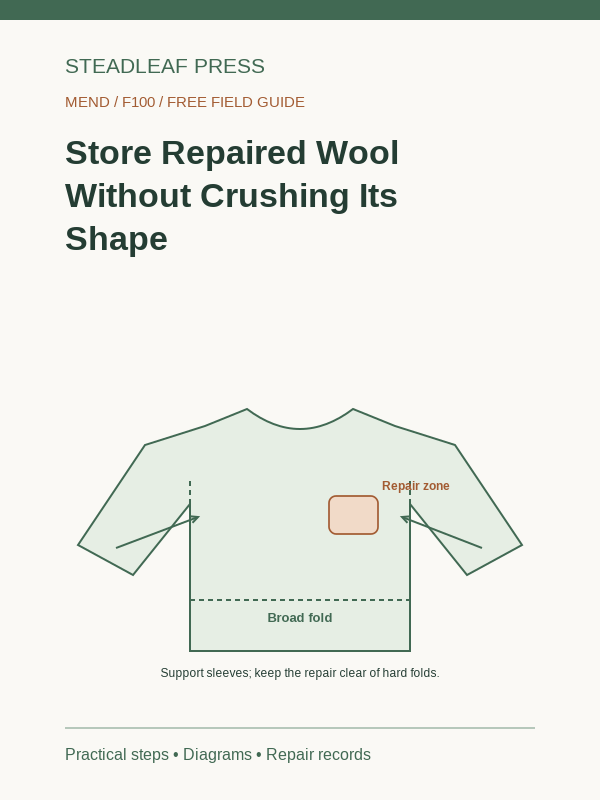
On the worksheet sketch the repair and planned folds. Avoid placing a fold directly on a bulky mend or repeatedly folding the same weak spot when an alternative is available. Preserve the natural relaxed proportions.
7. Prepare the storage space
Choose a clean, dry, smooth shelf or drawer away from damp and direct heat. Remove rough hardware or snagging materials. Allow space for a supported item without crowding or forcing folds.
8. Make a broad supported fold
For a suitable knit, lay it flat, bring sleeves toward the centre without twisting and use broad relaxed folds. If needed, support the fold with clean smooth material, without stuffing or pressing the fabric. Keep the repaired region on a supported plane where possible.
9. Protect the repaired surface
Position the repair so that a closure, rough accessory or another folded item cannot rub or catch it. Do not use tight bands, pins or vacuum compression. A loose suitable cover may reduce snagging; ensure the item stays dry.
10. Choose an appropriate container
Use a clean compatible cover or storage container with adequate volume. Do not pack damp items or tightly stack heavy garments on the repaired wool. If an appropriate closed container is used for clean dry wool, inspect it periodically for moisture and insects.
11. Use hanging only when appropriate
For a stable woven garment designed for hanging, use a clean hanger that supports shoulder shape and does not put pressure on the repair. If the garment sags, stretches or has a weak shoulder or seam, move it to flat support and consult a repairer.
12. Check the stored item periodically
Observe signs of damp, musty odour, insects, new holes, creases or pressure on the repair. If active infestation or mould is suspected, isolate the item without shaking or brushing it around other textiles and seek suitable advice. Do not rely on fragrance as protection.
13. Unpack with full support
Lift the wool with both hands supporting its weight, unfold gently and lay it flat. Let it settle without pulling, steaming or pressing merely to remove a crease. Inspect the repair before ordinary wearing.
14. Record and adjust
Record chosen fold, container, care route and periodic observations. If the shape changes or the repair develops damage, revise the support or seek a suitable repair. No storage method guarantees future shape, cleanliness or pest resistance.
Fix, care and reassess
A thick repair lies on the fold
Choose a different fold or use full horizontal support with sufficient space. Do not press the repair flat.
The knit lengthens on a hanger
Remove it from the hanger, support it horizontally and inspect for damage. Seek advice if the shape does not recover naturally.
Damp or insects appear
Separate the affected item and consult appropriate textile or pest guidance. Do not apply unverified chemicals or heat treatments.
A cleaner is needed before storage
Describe the repair materials and original label to the cleaner. Do not substitute home washing or solvent use.
Originality and evidence boundary
What the publisher provides
Original Steadleaf English prose, vector artwork, diagrams and records. Follow the actual item, material and tool instructions. No physical repair, washing, strength, load, durability, colourfastness, storage or compatibility trial was performed by the publisher. Ordinary adult non-technical textiles only; no safety or performance certification.
What the guide does not establish
Do not use steam, ironing, chemicals or compression to force a repaired wool item into shape. No claim of moth prevention, guaranteed shape retention or repair durability is made.
Further reading
Woolmark, Caring for Wool (general distinction between knitted and woven storage): https://www.woolmark.com/care/care-for-wool/ ; How to Store Wool Clothes: https://www.woolmark.com/care/how-to-store-wool-clothes/
The original full-size diagrams, patterns and printable records are in the complete free PDF above.