Adjust Watering After a Plant Is Repotted
Get to know the new pot, one small check at a time.
Record day-zero changes, choose condition-based actions and keep fourteen blank daily observations without treating them as a watering schedule or recovery deadline.
FREE · No email or checkout
Free practical guide. No email or payment required. Photos are contextual illustrations, not proof of measured conditions or physical trials.
Read the complete free guide online
Read the instructional text here, or download the complete free PDF above for original diagrams, tables, worksheets and page layout. The original publication is unchanged.
STEADLEAF PRESS / GROW Adjust Watering After a Plant Is Repotted
Get to know the new pot, one small check at a time.
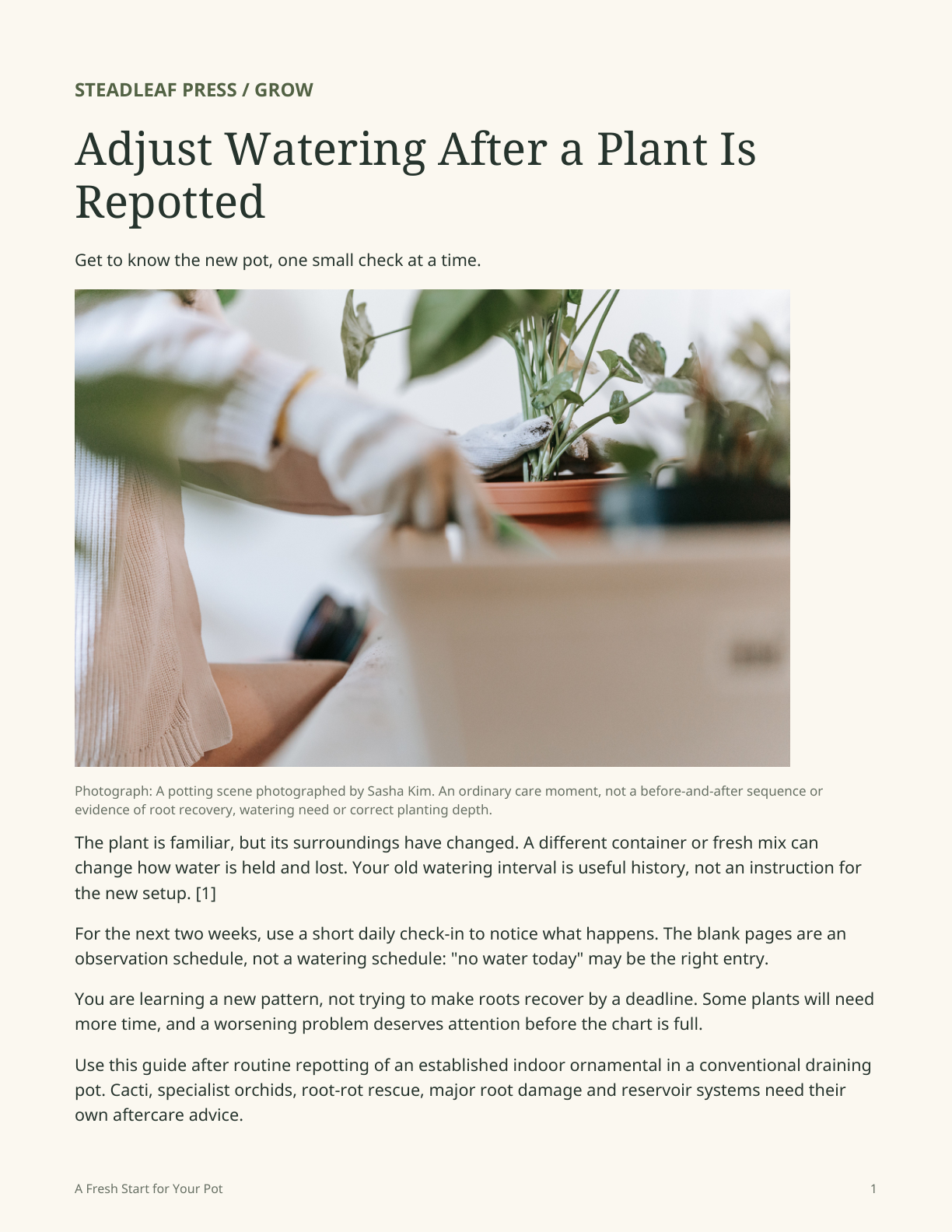
Photograph: A potting scene photographed by Sasha Kim. An ordinary care moment, not a before-and-after sequence or evidence of root recovery, watering need or correct planting depth.
The plant is familiar, but its surroundings have changed. A different container or fresh mix can change how water is held and lost. Your old watering interval is useful history, not an instruction for the new setup. [1]
For the next two weeks, use a short daily check-in to notice what happens. The blank pages are an observation schedule, not a watering schedule: "no water today" may be the right entry.
You are learning a new pattern, not trying to make roots recover by a deadline. Some plants will need more time, and a worsening problem deserves attention before the chart is full.
Use this guide after routine repotting of an established indoor ornamental in a conventional draining pot. Cacti, specialist orchids, root-rot rescue, major root damage and reservoir systems need their own aftercare advice.
A Fresh Start for Your Pot 1
STEADLEAF PRESS / GROW Day 0: reset your starting point
Record what changed
Note the repotting date, plant identity, new container and mix. Record any root disturbance you already observed during the work; do not unpot the plant again to fill in a blank.
A larger volume of fresh mix can stay wet longer around a relatively small rootball. RHS describes this risk in overpotting. It is a reason to observe carefully, not proof that every larger pot is unsuitable. [2]
Starting note Your record
Plant / repotting date
Old and new pot: size, material, drainage
New mix / any added feed on its label
Root disturbance already known / unknown
Initial watering: done, deferred, or uncertain; why
Separate the first watering from later waterings
For routine indoor repotting, Maryland Extension describes watering thoroughly, then waiting for drying before watering again. That is not an instruction to repeat a full watering every day. [3]
There are exceptions: UF/IFAS advises a delay before first watering in its cactus repotting guidance. Do not apply either general instruction to every species or to damaged roots. If your plant's aftercare is uncertain, settle that question with a reliable species guide or horticultural adviser rather than experimenting with a generic waiting period. [4]
Invented example: On day 3, Lee records damp mix and chooses to wait. On day 5, Lee checks again rather than copying the old five-day watering interval. The condition and plant-specific guidance decide the action, not the date.
A Fresh Start for Your Pot 2
STEADLEAF PRESS / GROW Let conditions choose the next action
Use the same accessible observation spots where practical. Note whether you checked the old rootball area or newly added mix, if you can distinguish them without digging. A surface check describes that spot; it does not certify the whole pot.
What you find A sensible response
The checked mix is still wetter than this plant normally Wait and record the condition. Check that collection needs before watering. water is not trapped below the pot.
Drying is consistent with the plant's needs and its Water appropriately, allow free drainage and empty aftercare permits watering. collection water. Record the event.
The new outer mix and accessible rootball area seem Record each observation separately. Do not average different. them into "dry" or add water solely because one patch looks dry. Seek help if you cannot judge the rootball's needs.
Leaves droop while the mix remains wet. Do not automatically add more water. Check drainage and recent conditions; seek advice if decline continues.
Rapid runoff leaves the accessible mix dry, or water will Pause repeated watering and investigate the not drain. mix/container setup. Avoid forceful probing or repeated unpotting.
Symptoms are worsening, the stem base is soft, or you Ask a horticultural adviser promptly with the repotting cannot establish safe aftercare. details and photographs. Do not wait for day 14.
Wilting can occur with both too little and too much water. Iowa State recommends considering the mix and roots' conditions rather than treating wilt alone as a watering signal. [5]
Keep other changes simple: Retain an appropriate, stable location while observing. Avoid adding fertilizer just to make the plant "settle in"; check existing supply and species needs separately. This sheet does not set a feeding restart date.
A Fresh Start for Your Pot 3
STEADLEAF PRESS / GROW Week 1: notice the new pattern
Plant: ____________________ Repotted on: ____________________
Day 1 is the day after repotting. At a convenient daily check-in, look at the plant and collection area, then make a gentle moisture check appropriate to its needs. Record additional checks if conditions demand them. Never force a finger or tool through roots.
Write plain words such as "still damp," "drier at edge," or "not checked." A missed observation stays blank or is marked missed; do not reconstruct it from memory.
Day / date Mix: where and what I Plant / drainage observations Action and reason checked
1 /
2 /
3 /
4 /
5 /
6 /
7 /
Actions can include: wait, water and drain, empty trapped water, or seek advice. A daily row is not a daily watering prompt.
Week 1 note: What is different from the old pot? ____________________
________________________________________________________________
A Fresh Start for Your Pot 4
STEADLEAF PRESS / GROW Week 2: use what you have noticed
Continue the same simple observations. If you use pot weight as an extra clue, establish new references for this pot and mix; the old assembly's feel no longer describes the same setup. Lift only a small, manageable pot, supported at its base.
Day / date Mix: where and what I Plant / drainage observations Action and reason checked
8 /
9 /
10 /
11 /
12 /
13 /
14 /
At the end of two weeks
What I learned about drying: __________________________________
Which observations helped me decide: ___________________________
What still needs attention: ____________________________________
Keep observing if the pattern is unclear. Day 14 is a review point, not proof of root recovery or a deadline to resume an old routine. A plant may not need watering during this whole period; another may need it more than once.
A Fresh Start for Your Pot 5
STEADLEAF PRESS / GROW Sources and photograph
Primary guidance checked 2 November 2026. The two-week schedule, comparison prompts and example are original editorial tools, not a completed experiment or a biologically fixed recovery period.
1. Virginia Cooperative Extension. Properly Watering Container Houseplants, SPES-804P. Mix, container and environment influence drying. https://www.pubs.ext.vt.edu/SPES/spes-804.html
2. Royal Horticultural Society. Overpotting. Fresh-mix volume and prolonged wetness around a small rootball; no root-pruning or foliar-feeding procedure adopted. https://www.rhs.org.uk/prevention-protection/overpotting
3. University of Maryland Extension. Potting and Repotting Indoor Plants. Distinction between initial watering and subsequent drying checks; no root-cutting, additive or universal mix recipes adopted. https://extension.umd.edu/resource/potting-and-repotting-indoor-plants
4. UF/IFAS Gardening Solutions. Cactus, repotting section. Example of plant-group-specific first-watering advice, not a waiting rule for all houseplants. https://gardeningsolutions.ifas.ufl.edu/plants/houseplants/cactus/
5. Iowa State University Extension and Outreach. Why is my houseplant wilting? Both wet and dry conditions can underlie wilt. https://yardandgarden.extension.iastate.edu/faq/why-my-houseplant-wilting
Photograph credit: Sasha Kim, "Person Planting a Plant in a Pot," Pexels photo 9413722. Used under the Pexels License. Full frame proportionally resized and JPEG-encoded for print; no retouching or generated alteration. No endorsement implied; original retained privately.
Source: https://www.pexels.com/photo/person-planting-a-plant-in-a-pot-9413722/
License: https://www.pexels.com/license/