Map Sunlight on a Balcony or Windowsill
Find where the sun reaches, when you saw it, and what still needs checking.
Make a height-specific, one-day sunlight map, time-stamped light-state log and honest uncertainty-led conclusion.
FREE · No email or checkout
Free practical guide. No email or payment required. Photos are contextual illustrations, not proof of measured conditions or physical trials.
Read the complete free guide online
Read the instructional text here, or download the complete free PDF above for original diagrams, tables, worksheets and page layout. The original publication is unchanged.
STEADLEAF PRESS / GROW Map Sunlight on a Balcony or Windowsill
Find where the sun reaches, when you saw it, and what still needs checking.
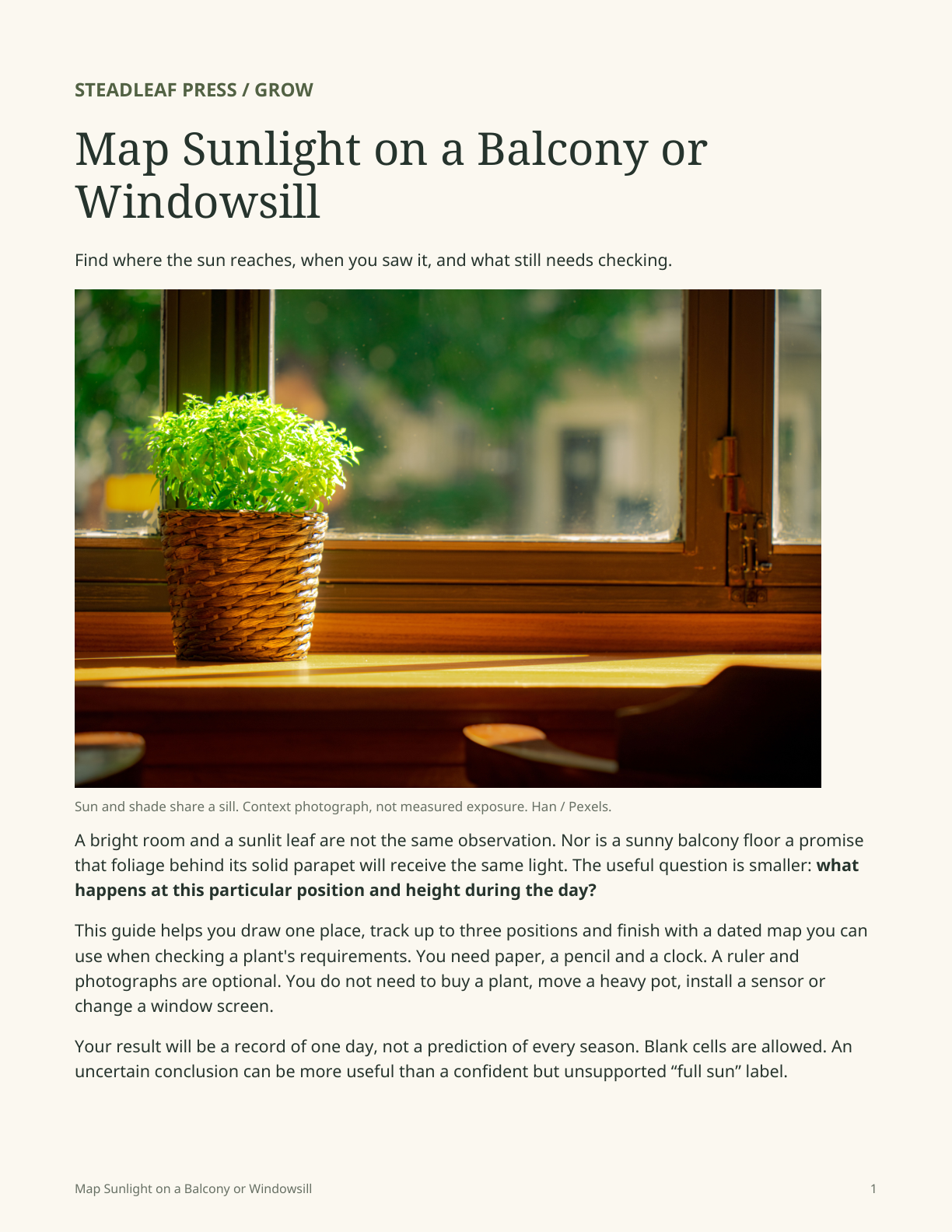
Sun and shade share a sill. Context photograph, not measured exposure. Han / Pexels.
A bright room and a sunlit leaf are not the same observation. Nor is a sunny balcony floor a promise that foliage behind its solid parapet will receive the same light. The useful question is smaller: what happens at this particular position and height during the day?
This guide helps you draw one place, track up to three positions and finish with a dated map you can use when checking a plant's requirements. You need paper, a pencil and a clock. A ruler and photographs are optional. You do not need to buy a plant, move a heavy pot, install a sensor or change a window screen.
Your result will be a record of one day, not a prediction of every season. Blank cells are allowed. An uncertain conclusion can be more useful than a confident but unsupported “full sun” label.
Map Sunlight on a Balcony or Windowsill 1
STEADLEAF PRESS / GROW Start with a safe, repeatable place
Choose either an accessible indoor windowsill or a balcony you are permitted to use. Observe from a stable floor position. Do not climb on furniture, lean beyond a railing, reach through a window or put paper, pots or a phone where they could fall. Never look directly at the sun to decide whether it reaches a spot.
Keep the window's normal safe opening, door movement and walking route clear. A good light position is not automatically a permitted plant position. This exercise does not assess balcony loading, rail attachments, building alterations or fire/escape access. Leave uncertain installation questions for the property manager or an appropriately qualified local professional; you can still make observations from a safe place.
Leave curtains and blinds in their usual daytime position. Record that position rather than arranging an unrealistically bright day. If you normally close a blind in the afternoon, include that ordinary change. You are mapping light available during real life, not the maximum possible exposure.
For an indoor plant, glass, nearby buildings, trees and window treatments all affect the light environment. Human vision adapts to brightness, so the words “looks bright” are not a reliable measurement of intensity. This guide records visible sun access; it does not measure lux, PPFD or the daily light integral. [1]
Foliage and window bars occupy different layers. Context only, not a recommendation for the pictured plants. Đức Bằng Nguyễn / Pexels.
Map Sunlight on a Balcony or Windowsill 2
STEADLEAF PRESS / GROW Give every position an address and a height
Draw the place from above as a simple rectangle or outline. Mark the window or balcony opening, nearby walls, fixed furniture and areas that must stay clear. Drawing skill is irrelevant: a labeled box is enough.
Choose A, B and C, or only two positions if that is all the usable space allows. Describe each precisely enough to find it again. “Left end of sill, in front of the fixed pane” is better than “by window.” If useful, add the approximate distance from the glass or a fixed edge. Keep one unit throughout.
Next draw a small side view. Mark the support surface and the observation height, where the intended foliage would be. If no plant has been chosen, choose a plausible height and label it as an assumption-not as a plant requirement. A later plant with foliage above or below this height needs another check.
You can judge the light at that height from a safe side-on view, or briefly hold a plain card there without blocking the incoming light yourself. The card is only a visual aid for locating a beam; it is not a calibrated light meter. Do not leave it against a heater or on an exposed balcony. If you cannot observe the height safely, label it unobserved instead of improvising a raised platform.
Why both drawings? A top view helps you return to the same horizontal position. A side view prevents an easy mistake: mapping the floor, then applying that result to leaves above a rail, below a window frame or deep behind the glass. Plant placement must account for distance, window size and obstructions, not compass direction alone. [2, 3]
SIDE VIEW - invented, not to scale
outside illustrated ray passes through glass
B: higher point
frame A: lower point illustrated ray blocked
support / sill
Teaching diagram: one sill, two different layers
Imagine a window above a deep sill. Position A is near the glass at a low observation height; B is farther into the room at a higher observation height. In the side view, the lower frame blocks the illustrated beam toward A, while a beam through the glazing reaches B. In the top view, A and B remain separate locations. This is an invented geometry example, not a drawing of your window or a prediction that raising a plant is safe or beneficial. Its lesson is to label the observed height before interpreting the map.
Map Sunlight on a Balcony or Windowsill 3
STEADLEAF PRESS / GROW Record what you see, then record why
Use two separate labels. First record the state at the observation point. Then note the apparent cause or context. These are practical recording codes created for this guide, not scientific light-level categories.
State code What to record What it does not establish
D - direct A beam of sunlight reaches the observation Its intensity, duration between visits, or point; clear glass alone does not make it suitability for a plant. indirect.
P - patchy or filtered The point alternates between lit and unlit A fixed percentage of full sun. patches, or an obvious filter interrupts the beam. Describe it.
N - no direct beam No direct beam reaches the point at this That the spot is dark, permanently shaded seen check. The area can still receive diffuse or unsuitable for every plant. light.
? - unobserved or You missed the check or cannot confidently Zero sunlight. unclear distinguish the state.
Then add a cause/context note: clear sky; cloud; wall/frame; overhang; foliage; blind/curtain; mixed; unknown. Only name a cause you can actually support. If the sky is clouded and no beam is visible, write N / cloud, not “permanent building shade.” If you were away, write ? / missed, not N.
A crisp sun patch can help identify a beam, but shadow sharpness alone is not a dependable intensity test. Glare, pale walls and a bright photograph can be misleading. Reflected light matters, yet an observation of glare is not an extra hour of direct sun. Do not add mirrors or reflective panels for this exercise. [1, 4]
Map Sunlight on a Balcony or Windowsill 4
STEADLEAF PRESS / GROW Follow the day without inventing the gaps
Choose a day when you can return to the same positions and distinguish at least some changes in sunlight. Start while there is daylight, before any direct sun you expect to see if practical, and continue through the usable daylight period. Record the actual first and last checks. Do not claim to have covered sunrise to sunset if you did not.
A roughly hourly visit is a useful starting rhythm for a small map. Add closer checks when a beam is approaching or leaving a position. Adapt to your local daylight, responsibilities and safety: this is an observation plan, not an alarm schedule you must obey. General sun-mapping guidance supports repeated checks through the day; this guide deliberately keeps each check as a snapshot rather than converting tally marks into exact hours. [5]
At each visit, write the time, the sky condition, and D/P/N/? for each position. Check the same height each time. Add a short cause note where it changes the interpretation. If your body or card shaded the point, move aside safely and look again; do not record your own shadow as a building obstruction.
For the drawing, trace or describe the beam boundary at a few useful moments. Label every outline with its time and height. You need not redraw the entire space hourly. Two or three clearly labeled outlines are more readable than an untidy stack of unlabeled patches. Use separate panels if boundaries cross too much.
If you take reference photographs, use the same safe viewpoint and include a fixed landmark such as a window corner. Keep private neighboring interiors and identifying addresses out of the frame. A photograph is a memory aid for shapes and positions, not a light-meter reading. Do not compare automatically brightened photographs as though they measured intensity.
Map Sunlight on a Balcony or Windowsill 5
STEADLEAF PRESS / GROW Keep the gaps visible
What the clock can honestly tell you
A D at 10:00 and another D at 11:00 establish two directly sunlit observations. They do not establish uninterrupted sun between them. A cloud or narrow moving shadow may have passed while you were elsewhere.
If you observe the sun arriving between two checks, report a transition window, such as “not direct at 09:40; direct at 09:55; arrival somewhere between.” Do not choose a minute inside that gap merely to make a neat total.
Only total durations you actually followed continuously, and distinguish them from estimated intervals. A deliberately invented example: direct sun watched without interruption from 11:10 to 11:35 gives 25 observed minutes. Everything before and after remains separately recorded or unknown. This is a minimum observed duration, not the day's full total. Overlapping watched intervals must not be counted twice.
For a first map it is entirely acceptable to report “direct at these times; total duration not established.” That result guides the next check without pretending to replace a light measurement.
INVENTED TEACHING INTERVAL - not an observation record
25 watched minutes
before: unknown 11:10 11:35 after: unknown
Make your one-day map
Use the two worksheets that follow together. The map sheet fixes positions and heights; the log sheet records time. Keep their date and location nickname the same. Print extra log sheets for longer days or closer checks.
Map Sunlight on a Balcony or Windowsill 6
STEADLEAF PRESS / GROW Worksheet 1 - place and height
Location nickname: ____________________ Date: ____________________
Local time zone: ____________________ Season: ____________________
Indoor sill / balcony: ________________ General region, optional: ________________
Normal curtain/blind position and expected changes: __________________________________
Top-view drawing area: draw the opening, fixed boundaries, keep-clear space and A-C. Add time-labeled beam outlines only where you actually observed them.
TOP VIEW / time-labeled sun patches
Side-view drawing area: mark the support, window frame/rail/overhang where relevant, and the observation heights. If more than one height is used, give each a separate point label; do not mix its observations with another point.
SIDE VIEW / labeled observation heights
Point Repeatable position / distance Observation height and reference surface
A ____________________ ____________________
B ____________________ ____________________
C ____________________ ____________________
First observation: __________ Last observation: __________
Unobserved part of day: ______________________________________________________
Map Sunlight on a Balcony or Windowsill 7
STEADLEAF PRESS / GROW Worksheet 2 - time and evidence
Location nickname: ____________________ Date: ____________________
Codes: D direct; P patchy/filtered; N no direct beam seen; ? unobserved/unclear.
Actual Sky / weather A B C Cause, change or uncertainty time
______ __________ ___ ___ ___ ____________________
______ __________ ___ ___ ___ ____________________
______ __________ ___ ___ ___ ____________________
______ __________ ___ ___ ___ ____________________
______ __________ ___ ___ ___ ____________________
______ __________ ___ ___ ___ ____________________
______ __________ ___ ___ ___ ____________________
______ __________ ___ ___ ___ ____________________
______ __________ ___ ___ ___ ____________________
______ __________ ___ ___ ___ ____________________
______ __________ ___ ___ ___ ____________________
______ __________ ___ ___ ___ ____________________
A continuously watched interval, if any: point ____ from ____ to ____; state ____.
Was it watched throughout? yes / no. If no, describe checks instead of claiming a duration.
Important missed check or ambiguous cause: _______________________________________
Map Sunlight on a Balcony or Windowsill 8
STEADLEAF PRESS / GROW Turn the record into a modest conclusion
Read across each row to compare positions at the same time. Read down each point's column to see its pattern through the day. Do not rank A against B using photographs taken on different days or at different heights.
Worked example - entirely fictional
At an imaginary indoor sill, A is near the left pane and B is behind a frame divider. Both observations use the same stated height. At 09:20 the sky is clear: A is D and B is N, with the divider apparently blocking B. At 10:20 both are D. At 11:20 both are N under cloud. The observer misses midday. At 14:20 both are N and the usual blind is closed.
The supported conclusion is: A had an earlier direct-sun observation than B; both had direct sun at 10:20; later absences of a beam have different recorded causes. Midday remains unknown. It is not “A gets five hours of sun” or “B is a low-light location.” To resolve the difference, repeat the early transition on a clear day; to understand midday, observe that missing period. The closed blind is part of the real routine, not a failure of the map.
Your conclusion card
Most useful observed difference between points: __________________________________
Evidence: point(s) __________; time(s) __________; height(s) __________.
What I still do not know: ______________________________________________________
One next check that would resolve it: ___________________________________________
This map is ready to inform plant-specific research / needs another observation day.
Do not move an existing plant abruptly into stronger exposure to “test” the map. Checking a location does not require exposing a plant to it. Light requirements, acclimation, drainage, temperature, wind and safe access all still matter. A sunny balcony and a window-lit indoor position are not interchangeable environments. [3, 4]
Map Sunlight on a Balcony or Windowsill 9
STEADLEAF PRESS / GROW Keep the date attached
The sun's route and daylight length change with season and latitude. Nearby buildings and overhangs can intercept that changing route. Trees can also alter the picture as leaves emerge or fall. A November map should not be relabeled as a summer map; repeat observations in the season relevant to the plant you intend to grow. [6, 7]
Compass direction is background information, not a verdict. Northern-hemisphere guidance about southern windows should not be transferred uncritically to a southern-hemisphere home; tropical sun paths need local interpretation too. Record actual observations before relying on an orientation rule. [6]
Recheck when the meaningful conditions change: a plant is moved to another height, furniture blocks the opening, a blind routine changes, an outside obstruction changes, or the intended growing season arrives. You need not remake the whole guide for every passing cloud. Keep the original date and add a new sheet when a new comparison will answer a real question.
Before choosing any plant, verify its exact species/cultivar needs and suitability for your climate, household and site. This guide makes no species, edible-use, child/pet-safety or invasive-status recommendation. Building permission and safe drainage remain separate checks. A completed light map is one useful piece of evidence-not permission to install a container.
Finished means: positions and heights are identifiable; the log is dated; missed periods are visible; your conclusion stays within the evidence; and the next unresolved question is named. That is a good day's gardening work even before there is a plant in the space.
Map Sunlight on a Balcony or Windowsill 10
STEADLEAF PRESS / GROW Sources and image notes
Primary sources checked 2 November 2026. The recording codes, paired-height worksheet, uncertainty method and fictional teaching example are original editorial tools, not a validated scientific protocol. No real home was surveyed for this publication.
1. UF/IFAS, Light for Houseplants. https://gardeningsolutions.ifas.ufl.edu/plants/houseplants/light-for-houseplants/
2. Iowa State University Extension, How to Care for Houseplants. https://yardandgarden.extension.iastate.edu/how-to/how-care-houseplants
3. University of Minnesota Extension, Lighting for Indoor Plants and Starting Seeds. https://extension.umn.edu/garden-and-home/yard-and-garden/gardening-in-minnesota/lighting-for-indoor-plants
4. NC State Extension, Plants Grown in Containers. https://content.ces.ncsu.edu/extension-gardener-handbook/18-plants-grown-in-containers
5. Michigan Department of Natural Resources, Make a Sun Map to Prepare for Tree Planting. https://www.michigan.gov/dnr/managing-resources/landowner-resources/sun-map
6. Australian Government, Your Home: Shading. https://www.yourhome.gov.au/passive-design/shading
7. Iowa State University Extension, Right Perennial, Right Place: Presentation Notes. https://www.extension.iastate.edu/m astergardener/files/documents/Right%20Perennial%2C%20Right%20Place%20-%20January%202026.pdf
Real photographs, separate from the examples
Cover: A Plant on a Windowsill, Han / Pexels. A small leafy plant in a wicker cover sits on a warm wooden sill with sunlit and shaded areas. Source: https://www.pexels.com/photo/a-plant-on-a-windowsill-18099440/ .
Interior: Plants on Windowsill, Đức Bằng Nguyễn / Pexels. Pots and foliage at different heights stand beside decorative metal window bars. The photograph invites attention to layers and obstructions; it does not show our invented A/B positions. Source: https://www.pexels.com/photo/plants-on-windowsill-22735671/ .
Both images use the Pexels License: https://www.pexels.com/license/ . Source files are reproduced in full frame, proportionally scaled without botanical alteration. No photograph was generated. These are separate contextual scenes, not a measured time series or Steadleaf growing trial. Their exact species, light quantities, drainage arrangements and household safety have not been certified; do not treat the pictured collection as a recommended planting combination. No photographer endorses this guide. Original stock files are retained privately for production, not offered as standalone stock downloads.
Original guide text, paired-view map sheet and observation log by Steadleaf Press. Free to read and download.