Choose Containers with Working Drainage
A lovely pot starts with a clear way out for water.
Inspect one empty container and its complete drainage route, record visible evidence, and choose ready, adjust and recheck, or another container.
FREE · No email or checkout
Free practical guide. No email or payment required. Photos are contextual illustrations, not proof of measured conditions or physical trials.
Read the complete free guide online
Read the instructional text here, or download the complete free PDF above for original diagrams, tables, worksheets and page layout. The original publication is unchanged.
STEADLEAF PRESS / GROW Choose Containers with Working Drainage
A lovely pot starts with a clear way out for water.
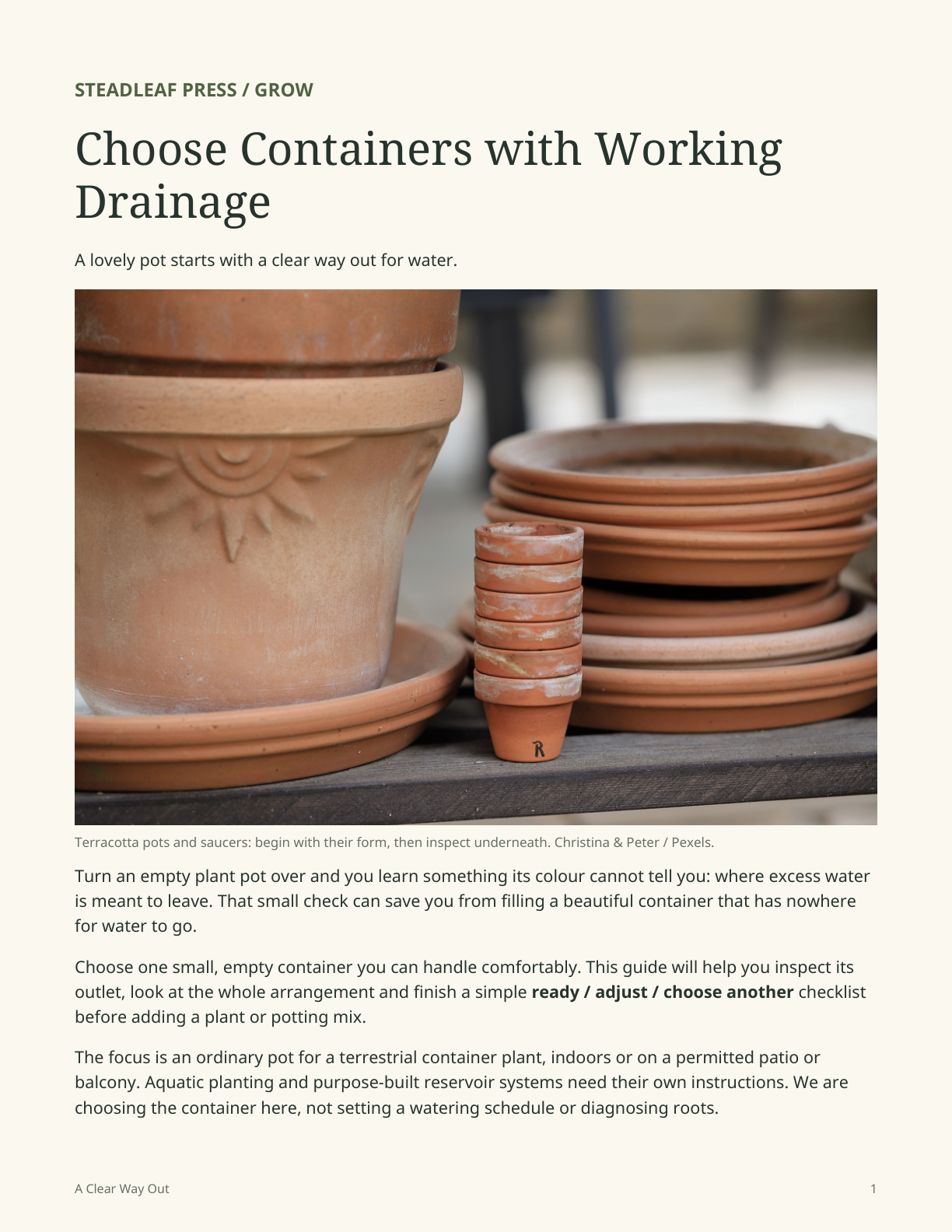
Terracotta pots and saucers: begin with their form, then inspect underneath. Christina & Peter / Pexels.
Turn an empty plant pot over and you learn something its colour cannot tell you: where excess water is meant to leave. That small check can save you from filling a beautiful container that has nowhere for water to go.
Choose one small, empty container you can handle comfortably. This guide will help you inspect its outlet, look at the whole arrangement and finish a simple ready / adjust / choose another checklist before adding a plant or potting mix.
The focus is an ordinary pot for a terrestrial container plant, indoors or on a permitted patio or balcony. Aquatic planting and purpose-built reservoir systems need their own instructions. We are choosing the container here, not setting a watering schedule or diagnosing roots.
A Clear Way Out 1
STEADLEAF PRESS / GROW Start with the underside
Set the empty pot on a clear, stable surface in good light. Look inside, then carefully turn it to see the bottom. Find the actual opening between the inside and outside. A circle moulded into plastic, a shallow recess or a closed plug can look promising without being an open drain. [1]
Three useful observations
An open outlet: You can identify where it passes through the container wall. Check for packaging, a sticker or loose debris covering it. Keep your fingers away from rough or sharp edges.
A marked but closed outlet: Read the container's instructions. If it has an intended removable plug, follow that procedure before filling. If opening it would mean drilling, cutting, breaking or forcing unfamiliar material, choose an already-draining pot instead; those alterations are outside this guide.
No identifiable outlet: Treat it as a decorative outer container rather than an ordinary direct-planting pot. A suitable removable inner pot can provide the growing container, or you can choose a different pot. [1]
Draw the opening's position on your checklist. Record what you can see rather than guessing that a pot is ready because it is sold beside plants.
Left: underside. Right: interior. Specialist bonsai pots with mesh-covered holes, not a mesh-installation guide. Ragesoss / Wikimedia Commons, CC BY-SA 3.0.
A Clear Way Out 2
STEADLEAF PRESS / GROW Follow the path beyond the hole
An opening is one part of the arrangement. Put the empty pot in its intended position and look at what surrounds the outlet: its own base, a saucer, an outer pot or a wrapper. Does that arrangement leave a route for water to escape, and can you reach the place where it collects? Drainage and the supporting surface need to work together. [2]
The diagram follows a simple route: potting mix, through an open outlet, to accessible collection space. The section shows an ordinary pot above a separate saucer, with a gap through the pot bottom and space beneath the base. Its arrow describes a route, not a measured flow rate.
For an ordinary pot with a separate saucer, check that the base is stable and the outlet is not sealed by the fit. Choose a saucer you can inspect and remove water from; an attached design that hides or traps runoff is a poor match for that task. [3]
For a decorative outer pot, try the empty inner pot in place. It should be removable without wedging or forcing. You need room to handle it and access the inside of the outer container. A fit that is easy now may be awkward once foliage spreads, so allow for the plant as well as the rim. [1][3]
You do not need to fill a pot with water to finish this visual inspection. Seeing an open route is useful, but it does not measure how a future planted mix will drain.
Growing mix
Open outlet
Accessible collection space
ORDINARY POT + SEPARATE SAUCER / SECTION SCHEMATIC / NOT TO SCALE
A Clear Way Out 3
STEADLEAF PRESS / GROW Choose a material you can live with
The best-looking pot is more enjoyable when it also suits your space and care habits. Material changes moisture loss and handling, but it does not replace an outlet. [4]
Material What it changes What to check on this pot
Unglazed terracotta Porous walls can lose moisture more Sound rim and base, an open outlet, quickly than nonporous walls. manageable weight and suitability for the intended weather.
Plastic or resin Usually light to handle; nonporous Stable shape, no brittle cracks, open outlets walls retain moisture better than and an indoor/outdoor rating appropriate to unglazed clay. the location.
Glazed ceramic The glazed surface is less porous; the Whether a drain exists, sound edges and finished pot may be heavy. base, and whether you can manage the whole arrangement.
Check the manufacturer's outdoor and frost guidance for the actual product rather than assuming that its material alone makes it weatherproof. A pot that is light when empty will become heavier with wet mix and a plant. [2][4]
Match the growing pot's size to the plant's roots and species needs. A large decorative shell does not mean you need to fill all of it with growing mix. For an indoor plant, a much larger pot can leave excess mix wet for too long; choose the growing container deliberately rather than simply picking the biggest one. [5]
A Clear Way Out 4
STEADLEAF PRESS / GROW Give gravel the right job
A layer of stones beneath the potting mix does not turn a sealed bowl into a draining pot. It also does not improve drainage through the mix in a pot that already has a hole. Water can collect in the finer mix above the coarse layer, leaving less useful root space. Use the container's outlet and an appropriate potting mix instead. [2][3]
This is different from a purpose-built self-watering planter. Its reservoir, overflow and water-delivery parts are an intentional system. Identify the model and read its setup instructions before treating it as an ordinary pot or changing any plug. [3]
One small choice, made clearly
These are invented inspection examples, not product tests.
The blue bowl: There is no outlet. A nursery pot fits inside, but its rim catches under the bowl's narrow neck. Decision: choose another outer container with an accessible opening, or use a different draining pot. The blue bowl can keep another decorative job.
The terracotta pot: The outlet is open and the base sits steadily in a removable saucer. The size suits the intended plant and the whole setup can be handled. Decision: ready for the next step - selecting the appropriate mix and potting method.
The light plastic pot: The underside has a marked circle, but it is still closed. Decision: adjust only by the manufacturer's intended plug procedure, then inspect again; otherwise choose a pot supplied with open drainage.
A Clear Way Out 5
STEADLEAF PRESS / GROW Your pot and drainage-path checklist
Use one sheet per candidate. Mark yes, needs a change or not yet known. Any unresolved outlet or access problem means pause before filling.
Container / description: ______________________________________
Intended plant and location: __________________________________
Growing pot, decorative outer pot, or designed reservoir? ___________
Check My observation Next step
I can identify an actual open outlet in the growing pot.
Packaging, a closed plug or the base does not seal that outlet.
The chosen saucer or outer pot allows an accessible escape / collection route.
I can inspect and manage the collection space without an awkward lift or wedged inner pot.
The pot is sound and stable; size, material and location suit the intended use.
Sketch the outlet and what sits beneath it. Add an arrow showing where water would go.
My decision: READY / ADJUST AND RECHECK / CHOOSE ANOTHER
The one change or question to settle: ___________________________
A Clear Way Out 6
STEADLEAF PRESS / GROW Make the next step easy
Ready: Keep the checklist with the plant's name. Choose an appropriate container mix and potting method, then check the outlet remains clear when you set up the planted pot. Ordinary collected runoff will still need attention; a drainage hole is not a substitute for observing moisture before watering. [2][5]
Adjust and recheck: Write down the specific change, such as using a removable saucer or a better-fitting outer pot. Make that change while the container is empty, then repeat the relevant checklist row.
Choose another: Keep a container for a different purpose if it cannot offer an accessible drainage arrangement. You have learned something useful before committing roots, mix and effort to it.
Keep the inspection comfortable
Inspect a small empty pot, not a heavy planted one. Do not pull a plant out by its stem to see underneath, handle cracked sharp pottery, or improvise drilling and cutting. For a large container, get suitable help or choose a design you can inspect in place. Keep runoff off vulnerable furniture and away from balcony edges; follow the building's placement and water-discharge rules.
This checklist is an original planning aid. The photographs show real containers, and the diagram explains a route; neither certifies a particular pot's performance. Plant identity, light, climate, mix and ongoing care still matter. For plants within reach of children or pets, check the exact species separately before planting.
A Clear Way Out 7
STEADLEAF PRESS / GROW Sources
1. Iowa State University Extension and Outreach, How to Select Quality Plant Containers. Drainage openings, plugs, double pots and container selection. https://yardandgarden.extension.iastate.edu/how-to/how-select-quality-plant-containers
2. NC State Extension, Extension Gardener Handbook, Chapter 18: Plants Grown in Containers. Drainage route, size, growing media and the limits of gravel layers. https://content.ces.ncsu.edu/extension-gardener-handbook/18-plants-grown-in-containers
3. University of Illinois Extension, Container Drainage Options. Accessible saucers, double pots, gravel and designed reservoir systems. https://extension.illinois.edu/container-gardens/container-drainage-options
4. University of Illinois Extension, Container Material Choices. Porosity, moisture loss, material and handling considerations. https://extension.illinois.edu/container-gardens/container-material-choices
5. University of Illinois Extension, Get Started: Houseplants. Container size and drainage considerations for indoor plants. https://extension.illinois.edu/houseplants/get-started
Sources checked November 2, 2026. Steadleaf's observation sequence, decision examples and worksheet are original editorial synthesis. We do not reproduce drilling, sealed-pot tipping or chemical-cleaning instructions from source pages. No physical trial or measured drainage performance is claimed.
A Clear Way Out 8
STEADLEAF PRESS / GROW Photograph credits
Cover: Christina & Peter, Stack of Terracotta Pots in Garden Setting, Pexels. Real pots and separate saucers on wood illustrate material and form; their outlets are not visible. The weathered appearance is not an assessment of condition. https://www.pexels.com/photo/stack-of-terracotta-pots-in-garden-setting-37397147/
Used under the Pexels License. https://www.pexels.com/license/
Interior: Ragesoss, Bonsai pots with mesh over drainage holes, Wikimedia Commons, July 6, 2008. Left: underside; right: interior. The visible openings have coarse mesh secured by wire. This specialist example helps locate the holes; it does not prescribe mesh or wiring for an ordinary plant pot or demonstrate water flow. https://commons.wikimedia.org/wiki/File:Bonsai_pots_with_mesh_over_drainage_holes.jpg

The interior photograph is licensed CC BY-SA 3.0. That photograph and its resized reproduction retain this license; the license does not apply to the entire guide. https://creativecommons.org/licenses/by-sa/3.0/
Both photographs retain their full frame. Changes by Steadleaf: proportional resampling for print-resolution placement and JPEG/PDF encoding only. No retouching, relighting or generated imagery. Original photographer processing is not excluded. Original photo files are retained privately for production; the interior photo's reuse rights remain available under its stated license.