Choose a First Plant for Your Actual Light
One indoor spot, four plant candidates, and a decision you can explain.
Observe direct and indirect light at the intended leaf position, classify the spot provisionally, compare four candidates and choose one with conditions—or defer.
FREE · No email or checkout
Free practical guide. No email or payment required. Photos are contextual illustrations, not proof of measured conditions or physical trials.
Read the complete free guide online
Read the instructional text here, or download the complete free PDF above for original diagrams, tables, worksheets and page layout. The original publication is unchanged.
STEADLEAF PRESS / GROW Choose a First Plant for Your Actual Light
A practical guide to one indoor spot, four plant candidates, and a decision you can explain.
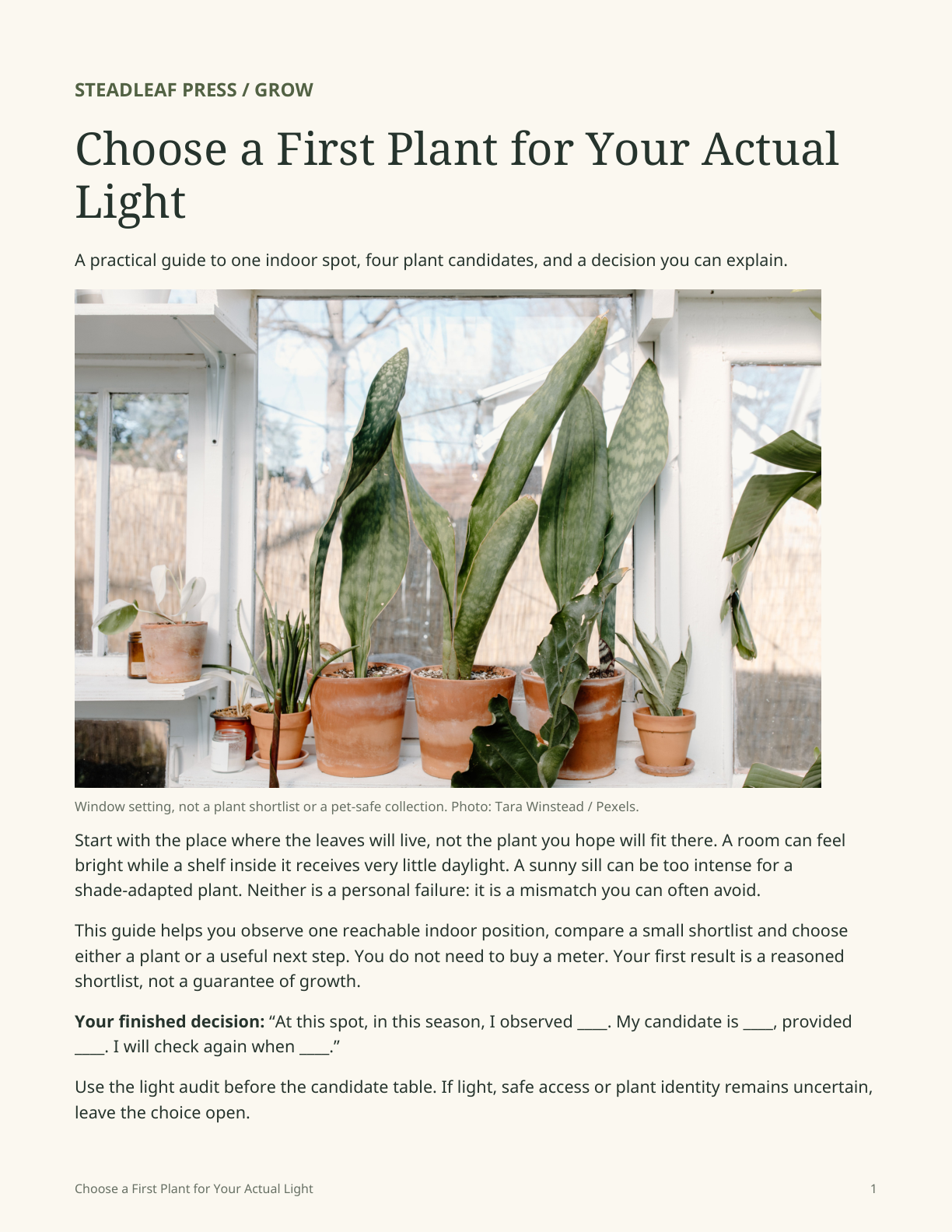
Window setting, not a plant shortlist or a pet-safe collection. Photo: Tara Winstead / Pexels.
Start with the place where the leaves will live, not the plant you hope will fit there. A room can feel bright while a shelf inside it receives very little daylight. A sunny sill can be too intense for a shade-adapted plant. Neither is a personal failure: it is a mismatch you can often avoid.
This guide helps you observe one reachable indoor position, compare a small shortlist and choose either a plant or a useful next step. You do not need to buy a meter. Your first result is a reasoned shortlist, not a guarantee of growth.
Your finished decision: “At this spot, in this season, I observed ____. My candidate is ____, provided ____. I will check again when ____.”
Use the light audit before the candidate table. If light, safe access or plant identity remains uncertain, leave the choice open.
Choose a First Plant for Your Actual Light 1
STEADLEAF PRESS / GROW Look at the leaves' position
Direct and indirect describe different things
Direct sun means the sun's rays reach the proposed leaves through the window. A visible sun patch moving across the position is useful evidence. Clear glass alone does not turn direct sun into indirect light. Do not look at the sun to check it.
Indirect daylight reaches the spot without the sun's beam falling on it. It may be bright beside an unobstructed window or very weak behind furniture. “No direct sun” therefore does not, by itself, tell you which plant will grow there. [1, 2]
A photograph is useful for remembering where a shadow fell, but camera exposure can make a dark corner look bright. Your eyes also adapt. A phone light app can help compare two positions on the same device, but its reading is approximate; do not treat an app number or a sharp shadow as a calibrated plant-light measurement. [2]
Direction is a clue, not a verdict
In temperate Northern Hemisphere locations, a south-facing window often receives more sun; in temperate Southern Hemisphere locations, north-facing windows often play that role. East generally brings morning exposure and west afternoon exposure. Latitude, time of year and local shading change the pattern. Near the tropics, seasonal solar position makes a simple north/south rule especially unreliable. Record what actually happens at the intended height. [3, 13, 16]
Move your attention from the window to the exact spot. Note the distance from glass, whether the position is off to one side, the normal curtain or blind setting, screens, exterior trees, balconies and neighbouring buildings. A large bright window does not make every surface in its room equivalent. [1]
Observe ordinary use. If the blind normally stays closed during work hours, audit it closed. A plant cannot use the light that would be available only under a routine you will not maintain.
Choose a First Plant for Your Actual Light 2
STEADLEAF PRESS / GROW Make a small light audit
Use this page as a working note, or copy it into a notebook. The check is observational, not a laboratory test. A bright day and a dull day are useful contrasts; do not postpone indefinitely waiting for perfect weather.
Name the spot
Exact location and leaf height: ______________________________
City or region, hemisphere, date and season: ___________________
Window direction, if known: _________________________________
Distance from glass and whether directly in front or to one side: __________
Usual blinds, curtains, screen and outside obstructions: _________________
Observe through the day
Check after daylight begins, around the middle of the day and later in the afternoon while it is still light. Add observations if a beam appears between checks. Write “not checked” rather than guessing.
Check Time and weather Sun beam at leaf position? What blocks or changes the light?
Morning __________ Yes / No / Not checked __________
Middle of day __________ Yes / No / Not checked __________
Later __________ Yes / No / Not checked __________ daylight
Extra check __________ Yes / No / Not checked __________
If you see a beam, note its observed arrival and departure: __________. If you missed either end, write “duration unknown.” Three snapshots cannot prove the number of sunlight hours.
Choose a First Plant for Your Actual Light 3
STEADLEAF PRESS / GROW Read your audit before choosing
Turn observations into a provisional description
Choose the closest statement, then use the decision table.
A. Shaded but daylit: no direct beam seen; the plant position has daylight but noticeably less than the open window area.
B. Bright indirect: close to a useful daylight opening; no direct beam at the leaves during the observed periods.
C. Sunny: a beam reaches the leaves for a meaningful part of the day; observed duration or remaining uncertainty is recorded.
D. Uncertain or very dim: daylight is heavily obstructed, the spot is deep inside the room, or essential observations are missing.
These are practical descriptions, not measured thresholds. If you cannot confidently separate A from D, compare a safer position closer to the window or seek a competent light assessment before committing to a plant.
My description and unresolved question: __________________________
Variegated cast iron plants near a window, with an unidentified cutting in front. Do not infer a light category or pet safety from the scene. IMG_7024 - rrei320, CC BY 2.0.
Choose a First Plant for Your Actual Light 4
STEADLEAF PRESS / GROW Compare four candidates
Read across the table, not just down the plant names. “Tolerates” is not a promise that a plant will remain dense, colourful or fast-growing. These candidates are grown here as indoor ornamentals, not food.
Candidate Best starting match A reason to reject or Space and root check Dogs and change the spot cats
Cast iron plant - A shaded but Direct sun at the leaves; Upright clump can reach ASPCA lists Aspidistra elatior genuinely daylit a windowless corner is about 60 cm tall; allow non-toxic spot; indirect light not rescued by a “low leaf clearance and a light” label draining pot
Spider plant - B, useful indirect Strong direct sun, or a Leave room for arching ASPCA lists Chlorophytum daylight; medium narrow ledge where leaves and hanging non-toxic comosum indoor light arching leaves and runners; inspect plantlets will be drainage repeatedly caught
Baby rubber B, bright indirect Strong direct sun; Compact to about 60 cm ASPCA lists plant - light persistently wet mix. in maturity; allow for non-toxic Peperomia Low-light tolerance is not cultivar size and a obtusifolia the preferred long-term draining pot placement
Jade plant - C, a sunny indoor A dim shelf; abrupt Fleshy leaves and ASPCA lists Crassula ovata position with some transfer into hot intense increasingly woody toxic; afternoon sun; reachable by a stems; use a stable exclude protection chewing pet draining pot, not a tiny where pets permanent display cup can reach it
Species needs and sizes: [4-7]. Pet classifications: [8-11]. The green-leaved species or ordinary forms are the starting point; a cultivar's dimensions and light response can differ. Verify the botanical name on the label. “Rubber plant” can mean other plants, and “jade” can be used loosely.
For D, choose no plant yet. Move the proposed spot, reduce an obstruction only if practical, or investigate suitable supplemental lighting separately. This is a valid finished decision. Buying the toughest-looking plant is not a substitute for usable light.
For A, begin with cast iron plant as a candidate, not an automatic answer. For B, compare spider plant's spread with peperomia's more compact shape. For C, consider jade only after the pet-access and heat checks. If none fits, change the shortlist rather than forcing a match.
Choose a First Plant for Your Actual Light 5
STEADLEAF PRESS / GROW Check identity before choosing
A specimen photograph helps you notice leaf form; it does not prove the light level, watering history or identity of a different plant offered to you. Use the botanical name and an authoritative species reference together. Do not identify an unknown plant from this guide alone.
Spider plants have narrow, arching leaves; many cultivated forms have white stripes. Their runners may carry small plantlets. Baby rubber plants have thick, rounded to oval leaves on branching stems. Those differences are more useful than a shared shop label such as “easy indoor plant.” [4, 5]
Left: spider plant, Maja Dumat, CC BY 4.0. Right: baby rubber plant, Jerzy Opiola, CC BY-SA 4.0. Leaf shape and growth habit matter; these photographs are not light measurements. Full credits and source links appear at the end.
Choose a First Plant for Your Actual Light 6
STEADLEAF PRESS / GROW Check access and drainage
Pet information is not child information
ASPCA’s spider-plant species entry lists it as non-toxic to dogs and cats; a 2019 ASPCA article also warns that ingestion may cause mild gastrointestinal irritation. Keep it away from chewing pets. [8,17]
The ASPCA classifications in the table apply to dogs and cats, not every animal and not people. “Non-toxic” does not mean edible or harmless in any quantity. Keep all pots, loose mix, fallen leaves and plant parts away from children and chewing animals. A high shelf is not a reliable barrier to a climbing cat.
Ontario Poison Centre warns that all plants, including non-toxic ones, can be choking hazards and should be kept out of young children's reach. A pet-toxicity table is not a child-safety assessment. Do not use one species' listing to clear a similar-looking plant. For a suspected exposure, contact the appropriate local poison service or veterinarian with the plant's name; do not use this guide to decide treatment. [8-12]
The pot must work as well as the position
Use a container with an unobstructed drainage hole and a way to catch water without leaving the roots sitting in it. A decorative outer pot is workable only when the inner pot can be removed, drained and inspected. Choose a stable, reachable support; do not perch a heavy pot on a narrow sill or place watering tasks over electrical equipment. [13]
Unglazed terracotta generally dries faster than plastic or glazed containers. That changes how often you need to inspect the mix; it does not establish a universal watering day. Jade needs drying between waterings, while the other candidates have their own moisture needs. Check the actual mix and species guidance instead of watering every plant together. [7, 13]
Choose a First Plant for Your Actual Light 7
STEADLEAF PRESS / GROW Three decisions you can learn from
These examples are invented to demonstrate reasoning. Their observations are not measurements, grow trials or reports from real homes.
A bright room is not the same as a bright shelf
Mina wants a plant on a shelf across from her window. Her audit records daylight in the room, but the shelf is behind a tall bookcase and she cannot distinguish A from D. She does not label it “low light” and buy a cast iron plant. She tries a reachable position beside the window, audits that position and leaves her plant choice undecided until then.
What matters: she changed the location question before choosing a species. The original shelf remains without a plant.
Light fits but the shape does not
Eli observes useful indirect daylight at a clear window-side table, with no beam during several checks. Both spider plant and baby rubber plant remain candidates. A spider plant's arching leaves would extend into the nearby walkway; a modest peperomia fits the available clearance better. Eli checks the exact botanical name, mature size and drainage before choosing.
What matters: a candidate passed the light screen but failed a practical space screen. The decision is conditional, not a claim that all peperomias suit this table.
A sunny window does not settle the safety question
Rae observes direct sun at a broad sill and considers jade. Her cat climbs onto the sill and chews leaves. She rules jade out rather than relying on a label saying “easy care.” She considers a protected indirect-light position elsewhere and repeats the audit for a different candidate.
What matters: changing the species or placement is preferable to treating a toxic plant as safe because its light needs fit.
Write your own conditional choice
My candidate and botanical name: _________________________________
The observation that supports it: __________________________________
The condition that could rule it out: ________________________________
My next action - choose / observe again / move the spot / defer: __________
Choose a First Plant for Your Actual Light 8
STEADLEAF PRESS / GROW Settle in and check again
A new plant may have grown under different light. Avoid an abrupt move from a sheltered display into strong sun; increase exposure gradually and watch for damage. Keep leaves from pressing against cold winter glass or being heated by a radiator or vent. Recheck the same spot when seasons change, nearby trees leaf out, or curtains and furniture move. [14, 16]
Take one reference photo and note the date if that helps you remember the plant's condition. Do not brighten the image and then use it as evidence that light improved. Record the ordinary curtain setting and pot position with it.
Over the following weeks, look for the direction and spacing of new growth, leaf loss or bleaching. Pale stretched growth can be a clue to inadequate light; bleached or scorched patches can follow excessive exposure. These signs are not diagnoses on their own. Watering, roots, temperature and pests can produce overlapping problems. Revisit your audit and species reference before making several changes at once. [14, 15]
A simple check-in: Is the actual light still what I recorded? Can I inspect and drain the pot safely? Is there a new access risk? Has the plant changed, and what else changed at the same time?
Do not respond to uncertain light by adding fertilizer. Fertilizer is not a replacement for the energy supplied by light. If the spot cannot provide suitable conditions, moving the plant or deciding not to keep one there is a better result than repeatedly replacing it. [14, 15]
Your first plant does not have to fill the whole room. One sound match, in a spot you can care for, is enough to begin.
Jade leaf detail. Photo: S.G.S., CC0. Fleshy foliage does not remove the need for suitable light, drainage or pet precautions.
Choose a First Plant for Your Actual Light 9
STEADLEAF PRESS / GROW Sources and photograph notes
Species, care and safety references were checked on 2 November 2026. This is general indoor gardening guidance, not individual medical or veterinary advice. It does not certify physical growth trials, instrument readings or outdoor hardiness. No outdoor planting or disposal into the wild is recommended; local climate and invasive-species rules require separate checks.
1. Iowa State University Extension, How to Care for Houseplants. https://yardandgarden.extension.iastate.edu/how-to/how-care-houseplants
2. University of Florida IFAS, Light for Houseplants. https://gardeningsolutions.ifas.ufl.edu/plants/houseplants/light-for-houseplants/
3. ABC Gardening Australia, Light Up Indoors. https://www.abc.net.au/gardening/how-to/light-up-indoors/102110534
4. NC State Extension Plant Toolbox, Chlorophytum comosum. https://plants.ces.ncsu.edu/plants/chlorophytum-comosum/
5. NC State Extension Plant Toolbox, Peperomia obtusifolia. https://plants.ces.ncsu.edu/plants/peperomia-obtusifolia/
6. NC State Extension Plant Toolbox, Aspidistra elatior. https://plants.ces.ncsu.edu/plants/aspidistra-elatior/
7. NC State Extension Plant Toolbox, Crassula ovata. https://plants.ces.ncsu.edu/plants/crassula-ovata/
8. ASPCA, Spider Plant. https://www.aspca.org/pet-care/aspca-poison-control/toxic-and-non-toxic-plants/spider-plant
9. ASPCA, American Rubber Plant (Peperomia obtusifolia). https://www.aspca.org/pet-care/aspca-poison-control/toxic-and-non-toxic-plants/american-rubber-plant
10. ASPCA, Cast Iron Plant. https://www.aspca.org/pet-care/aspca-poison-control/toxic-and-non-toxic-plants/cast-iron-plant
11. ASPCA, Jade Plant (Crassula argentea, synonym of C. ovata). https://www.aspca.org/pet-care/aspca-poison-control/toxic-and-non-toxic-plants/jade-plant
12. Ontario Poison Centre, Plants. https://www.ontariopoisoncentre.ca/for-families/common-poisons/plants/
13. University of Arizona Cooperative Extension, Indoor Plant Selection and Care. https://extension.arizona.edu/publication/indoor-plant-selection-and-care
14. University of Missouri Extension, Caring for Houseplants. https://extension.missouri.edu/publications/g6510
15. University of Minnesota Extension, Lighting for Indoor Plants and Starting Seeds. https://extension.umn.edu/garden-and-home/yard-and-garden/gardening-in-minnesota/lighting-for-indoor-plants
16. Australian Government Your Home, Shading. https://www.yourhome.gov.au/passive-design/shading
17. ASPCA, Is That Houseplant Safe for Your Pets? (27 February 2019). Spider-plant ingestion caution, read alongside its species entry. https://www.aspca.org/news/houseplant-safe-your-pets
Choose a First Plant for Your Actual Light 10
STEADLEAF PRESS / GROW Real photographs and how to read them
All photographs depict real plants; none was generated. They are licensed reference images, not photographs of a Steadleaf growth experiment. Exposure, watering and growing history cannot be established from their appearance. Images are reproduced without botanical alteration; sizing for layout does not change the depicted plants. No photographer or institution is endorsing this guide.
Cover photograph: Potted Plants Beside a Window, Tara Winstead, Pexels License. A collection of upright leafy plants in terracotta pots stands at pale window frames. This is a setting, not the four-species shortlist or a pet-safe collection; no light quantity is inferred. Source: https://www.pexels.com/photo/potted-plants-beside-a-window-7663284/ . License: https://www.pexels.com/license/ .
Window photograph: IMG_7024, rrei320, CC BY 2.0. Variegated cast iron plants stand near a window; an unidentified cutting is also visible in a glass. The additional plant is not a recommendation or a pet-safety example. Source: https://www.flickr.com/photos/27673266@N05/2582887667/ . License: https://creativecommons.org/licenses/by/2.0/ .
Spider plant: Form, Maja Dumat, CC BY 4.0, via NC State Plant Toolbox [4]. A green-leaved spider plant arches out from a brown pot on a wooden surface. It illustrates leaf shape and space needs, not measured illumination. License: https://creativecommons.org/licenses/by/4.0/ .
Baby rubber plant: Form, Jerzy Opiola, CC BY-SA 4.0, via NC State Plant Toolbox [5]. Thick green oval leaves and slim flower spikes rise from terracotta pots among other conservatory plants. The photograph remains under CC BY-SA 4.0; unrelated surrounding plants are not part of this guide's shortlist. License: https://creativecommons.org/licenses/by-sa/4.0/ .
Jade leaf detail: Shape, S.G.S., CC0 1.0, via NC State Plant Toolbox [7]. Rounded fleshy jade leaves show the succulent form. A leaf detail alone cannot reliably identify an unknown plant. License: https://creativecommons.org/publicdomain/zero/1.0/ .
Original guide text and audit by Steadleaf Press. Free to read and download; no plant purchase is required to use the decision process.