Check a Shelf Before Adding a Grow Light
A calmer plant corner begins with a shelf that fits the whole job.
Document support, geometry, exact model instructions, electrical/water access and light-output evidence, then continue with instructions, revise the plan or pause unresolved requirements.
FREE · No email or checkout
Free practical guide. No email or payment required. Photos are contextual illustrations, not proof of measured conditions or physical trials.
Read the complete free guide online
Read the instructional text here, or download the complete free PDF above for original diagrams, tables, worksheets and page layout. The original publication is unchanged.
STEADLEAF PRESS / GROW Check a Shelf Before Adding a Grow Light
A calmer plant corner begins with a shelf that fits the whole job.
A grow light can make a small plant collection easier to place, but a shelf is more than a surface for pots. It must accommodate weight, foliage, the fixture, its mounting hardware and the ordinary business of watering and cleaning.
Before buying or installing anything, use this guide to check one proposed shelf and one exact light model. The result is a practical decision: continue with the manufacturer's instructions, change the plan, or pause until missing information is resolved. A good-looking photograph is inspiration, not a safety certificate.
This is a pre-installation planning guide for ordinary indoor, factory-prewired plug-in lights. It does not teach electrical work, structural alterations, wiring, plug replacement or construction of a humid growing cabinet. If a product needs electrical connections or a shelf needs structural work, use an appropriately qualified professional instead.
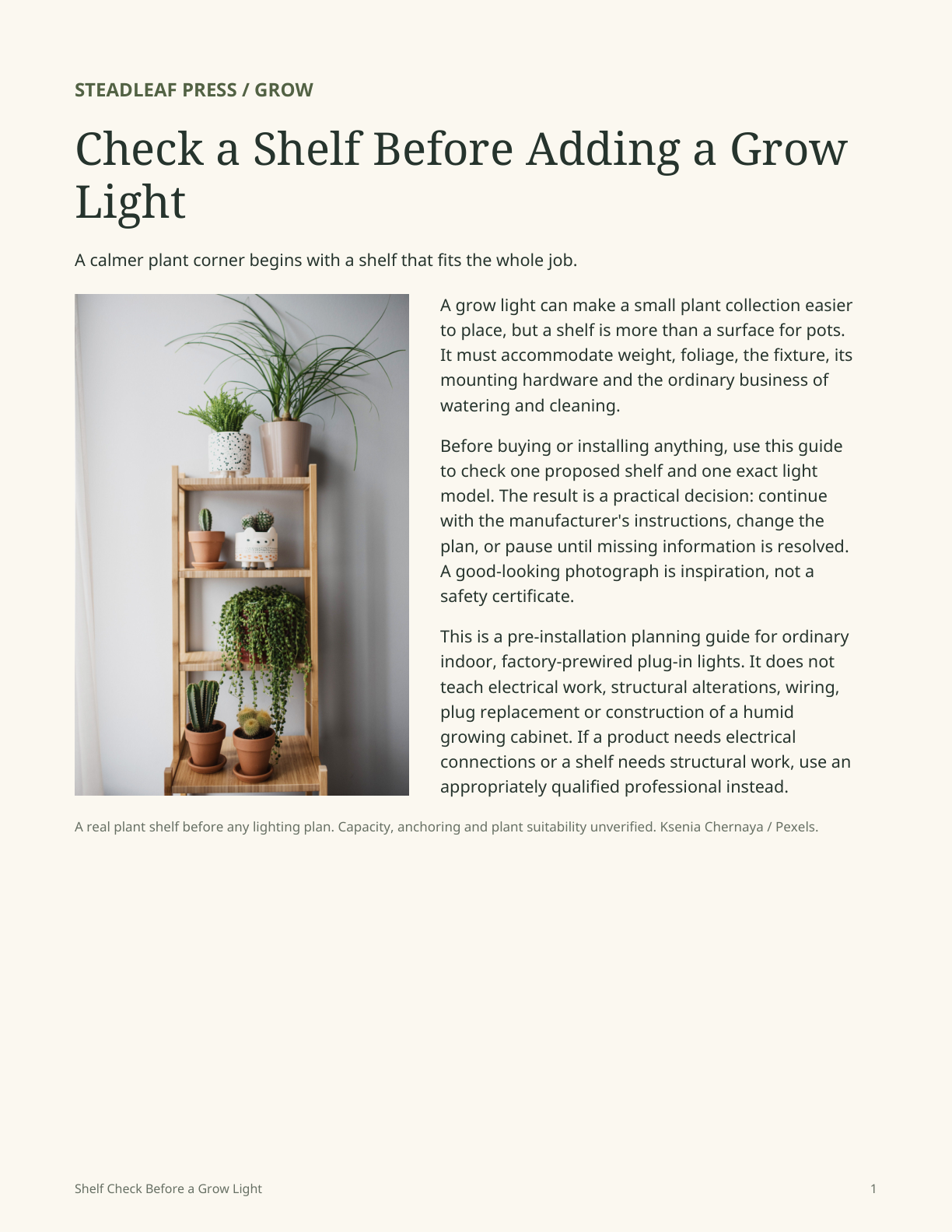
A real plant shelf before any lighting plan. Capacity, anchoring and plant suitability unverified. Ksenia Chernaya / Pexels.
Shelf Check Before a Grow Light 1
STEADLEAF PRESS / GROW Start with a real plant and an empty plan
Write down the plant's exact identity, current size and purpose: maintaining a foliage plant, growing seedlings or supporting flowering are different tasks. Find suitable horticultural guidance for that plant and stage before choosing the light output or operating duration. One shelf of mixed plants may not share one useful lighting setting. [1]
Sketch the usable shelf area and note nearby curtains, books, heaters, walkways and places where children or pets can reach cords or pots. Include the normal watering route. Can you remove a pot, carry it to a sink or tray, let it drain and return it without reaching over electrical equipment?
Do not begin by filling the shelf to see what it will hold. Find the shelf's model, assembly instructions and rated capacity first. A photograph cannot reveal its anchoring, fasteners, hidden damage or load rating.
The photographs in this guide: two real views of the same wooden plant shelf. No grow light is installed. Its capacities, anchoring, plant identities and lighting conditions are unverified. Neither the plant grouping nor the curtain proximity is a recommended lighting arrangement.
A second view of the same shelf. Curtain proximity and mounting space must be checked, not copied. Ksenia Chernaya / Pexels.
Shelf Check Before a Grow Light 2
STEADLEAF PRESS / GROW Check support before checking brightness
A shelf that is sound for a few dry objects may not be suitable for watered containers plus lighting. Record the manufacturer's limit for each shelf and for the whole unit, including any conditions about evenly distributed loads, wall fixing or assembly. A total-unit rating is not automatically a per-shelf rating.
Include pots, moist growing medium, retained water, trays, plants, fixture and mounting parts in the planned load. Count only items actually supported by each shelf or attachment point; a lamp hung from the shelf above loads that support, too. Use reliable weights or conservative documented estimates, and record uncertainty. This is a planning inventory, not a home load test.
Inspect for wobble, bowing, loose joints, corrosion, cracked parts or water-damaged material. Follow the shelf manufacturer's assembly and anti-tip instructions. Tall or top-heavy furniture and climbing children create risks even when it looks stable. Keep access and stability in mind, not only whether a pot fits. [2]
Stop this plan if: the capacity is unknown, the shelf is damaged, required anchoring cannot be achieved, or the proposed mounting method is not permitted. Ask the manufacturer or a competent professional; do not invent a load limit from the shelf's appearance.
Support inventory
Record Your evidence Decision if missing or unsuitable
Shelf model and intended use Manual / label / manufacturer answer Do not assume a decorative unit supports this use
Per-shelf and total capacity, Exact rating and source Pause; do not test by adding heavy including conditions pots
Planned load on each support Pots, water, trays, plants, fixture and Revise the arrangement if it exceeds a hardware verified limit
Stability, condition and Inspection plus assembly instructions Repair or replace appropriately before required anti-tip measures proceeding
Shelf Check Before a Grow Light 3
STEADLEAF PRESS / GROW Measure the space the plant will actually occupy
Measure the clear opening above the supporting shelf surface. Then account for the fixture and its approved mounting arrangement, the tray and pot, and the foliage above the pot. Include the plant's likely growth before the next review, not just its sale-day height.
Use the lowest relevant light-emitting surface to the nearest leaves for the planned light-to-leaf gap. Keep the manufacturer's required clearance to walls, ceilings, shelf material and other objects as separate checks. A horticultural canopy distance is not a substitute for a safety clearance. [3,4]
A simple headroom check
H = clear height above the shelf surface.
F = space occupied below the upper support by the fixture and approved mounting arrangement.
P = height from the shelf surface to the tallest planned leaf, including tray and pot.
G = H - F - P = the remaining proposed light-to-leaf gap in this simple vertical arrangement.
Use one unit throughout. This calculation only describes geometry. It does not certify the mounting, shelf strength, ventilation, electrical safety or plant-light adequacy. Angled or side-mounted lights need their own layout rather than this simplified calculation.
Invented example: H = 60 cm, F = 8 cm and P = 32 cm leave G = 20 cm. If the exact fixture's instructions or plant-specific lighting plan need more room than that, the combination fails the check. Twenty centimetres is not a recommended distance. A taller plant would reduce the gap further.
Also check width and depth. Leaves must fit without pressing against the fixture, curtain or wall, and you must be able to remove the pot. Adjustable mounting is helpful only when that adjustment is explicitly allowed and the support remains suitable.
Shelf Check Before a Grow Light 4
STEADLEAF PRESS / GROW A visual headroom check
Simplified side view; not to scale. H is the clear opening, F the fixture and mounting space, P the pot/tray/plant height, and G the remaining light-to-leaf gap. G = H - F - P. Separate clearances and safety requirements still apply.
Upper support
F
G
H
P
Supporting shelf surface
Draw your own arrangement below. Include the driver, approved mounting, leaves, removal route and separate required clearances.
Shelf Check Before a Grow Light 5
STEADLEAF PRESS / GROW Read the exact model's instructions, not the headline
Find the full manual and specification sheet for the exact model and revision. Keep them with your notes. A product photograph, a marketplace title or a general brand FAQ is not a substitute. If those documents disagree, ask the manufacturer before using the product.
Specification to find What you need to establish Pause when...
Factory-prewired plug-in use Correct supply, plug and intended Wiring, plug modification or an household use; no assembly of adapter workaround is needed electrical connections
Dimensions, weight and Fixture plus driver and hardware fit; A clip, adhesive or improvised hanger mounting mounting surface, orientation and would replace an approved method hardware are permitted
Clearances and ventilation Required distances to surrounding The shelf, curtain or cabinet prevents objects, allowable enclosure and compliance ambient conditions
Environmental rating Whether the complete equipment is “LED” or “water-resistant” is the only permitted in the actual dry/damp/wet evidence conditions
Safety certification and Certification appropriate to your The mark/model cannot be verified or warnings country, matching product identity, eye/exposure warnings cannot be and readable warnings followed
Controls and accessories Timer/dimmer compatibility, any A convenient accessory is not driver placement limits and permitted compatible or its rating is unknown connections
In Canada, Health Canada advises checking recognized Canadian certification marks such as CSA, cUL or cETL on electrical products. Elsewhere, check your local electrical-safety authority's requirements. A mark for one jurisdiction is not automatically approval for another, and a safety mark does not promise enough light for your plant. [5]
UL's horticultural-lighting guidance treats installation, environmental protection and optical exposure as distinct issues. An IP or damp-location rating is not permission to pour water over a fixture or its connectors. Follow the exact product instructions and keep the arrangement within its intended use. [3]
Shelf Check Before a Grow Light 6
STEADLEAF PRESS / GROW Separate useful plant light from marketing numbers
The question is not “How many impressive watts are on the box?” It is “What reaches the planned leaf area, at this distance and setting, for a suitable duration?” [1,6]
Label or measurement What it can tell you What it cannot establish alone
Electrical input watts (W) Power drawn by the equipment Plant-usable light at the leaves; advertised equivalent watts are not actual input
Lumens Brightness weighted for human vision A dependable plant-light target across different spectra
PPF, in micromoles per second Total photosynthetic photon output How evenly that output reaches your from a source shelf
PPFD, in micromoles per Photon flux density at a stated surface Whole-shelf performance unless square metre per second position distance, settings and a distribution map are supplied
Colour or “full spectrum” Some information about appearance Sufficient intensity, safe placement or wording or spectrum suitability for every plant
Ask for a PPFD distribution map or equivalent useful performance data at the proposed height and setting. Check the footprint, edge values and test conditions, not just the bright centre. Manufacturer data describe that test arrangement; walls, reflectors, angles and your actual setup may differ. Do not convert a single centre reading into a whole-shelf guarantee. [6]
Compare the data with reliable guidance for your plant and stage. If the useful area is too small, change the layout or candidate light rather than crowding pots or reducing safety clearances. If the information is insufficient, write “performance not established” and ask for it. No paid app is required to complete this checklist.
A phone camera or uncalibrated light app is not proof of plant-usable output. Likewise, a timer does not make a weak light adequate or justify running every plant under continuous light. Determine the operating duration from suitable plant guidance and the actual daylight contribution; this guide prescribes no universal hours or PPFD threshold. [1]
Shelf Check Before a Grow Light 7
STEADLEAF PRESS / GROW Plan water, cords and ordinary access
Choose a position with an appropriate reachable outlet and a dry, unobstructed cord route. Keep cords out of walkways and away from pinching, sharp edges and heat. Do not hide them under rugs or route them where watering runoff can reach plugs, drivers, timers or connections. Damaged or overheating electrical parts are a stop condition, not something to cover with tape. [5,7]
Do not use extension cords as a permanent wiring solution or connect power strips in a chain. Do not overload outlets or accessories. If the location needs another outlet, changed wiring or advice about circuit capacity or ground-fault protection, ask a qualified electrician. This is not a reason to improvise around the problem. [7]
Plan to water removable pots away from electrical equipment and return them after drainage. A saucer is not a guarantee against spills. Keep water containers and misting away from the light and its power components; follow the manual's instructions for disconnecting power before handling or cleaning. Never handle a wet plug or wet energized equipment.
Allow safe access for switching off, inspection and removal. Keep combustible objects and curtains outside the specified clearances; do not drape fabric over the light to reduce glare. Arrange the fixture so people are not routinely looking directly into it, and follow any optical-exposure warnings. LEDs can produce heat: do not assume the word LED eliminates ventilation or clearance requirements. [3,8]
Shelf Check Before a Grow Light 8
STEADLEAF PRESS / GROW Make the decision before installation
Use the checklist as a gate, not a score. Several good answers do not cancel one unresolved safety requirement.
Gate Ready to continue Change or pause
Support Ratings, condition, load and required Unknown rating, damage, unsuitable stability measures documented mounting or unresolved anchoring
Space Plant, pot, fixture, approved mounting Geometry works only by ignoring a and all clearances fit, with care access requirement
Electrical and water Suitable equipment, outlet and dry Wiring workaround, damaged parts, cord/watering plan; instructions wet connection risk or missing understood instructions
Plant performance Useful output/coverage and duration Marketing claims only or unverified can be matched to the actual plant leaf-level performance
My shelf-and-light record
Shelf model / manual location: __________________________________
Light model / manual revision: __________________________________
Plant identity, purpose and guidance source: _____________________
Shelf W x D / clear H: _________________________________________
Fixture and mounting F / plant height P / remaining G: _____________
Verified capacities / planned loads: ______________________________
Clearances, environment and certification checked: _________________
PPFD coverage data, distance and setting: _________________________
Watering route / outlet and cord plan: ____________________________
Decision: continue with instructions / change plan / pause
Unresolved question and who can answer it: _______________________
“Continue” means the planning checks are documented. It is not an installation inspection or guarantee. Follow the actual manuals, and recheck as foliage grows, pots change or the arrangement is moved.
Shelf Check Before a Grow Light 9
STEADLEAF PRESS / GROW Sources
Primary guidance checked 2 November 2026. This guide provides an original planning checklist and an explicitly hypothetical geometry example. No physical shelf loading, electrical testing, light measurement or plant-growth trial was performed.
1. Iowa State University Extension, Important Considerations for Providing Supplemental Light to Indoor Plants. Light quality, intensity, duration and terminology. https://yardandgarden.extension.iastate.edu/how-to/growing-indoor-plants-under-supplemental-lights/important-considerations-providing-supplemental-light-indoor-plants
2. Health Canada, Furniture, appliance and television tip-overs. Stability, intended use and manufacturer's assembly/anchoring instructions. https://www.canada.ca/en/health-canada/services/household-products/furniture-appliance-television-tip-overs.html
3. UL Solutions, Horticultural (Grow) Lighting. Distinct installation, environmental and optical-safety considerations; not a consumer installation manual. https://www.ul.com/sites/default/files/2024-10/CT25981653_Horticultural_Lighting_Infosheet_FINAL.pdf
4. Feit Electric, GLP24H/V/60W/LED manufacturer manual, linked from the exact model page. Consulted only to verify that mounting and surrounding-object clearances are model-specific; its electrical-connection procedures are outside this guide. No product recommendation. https://www.feit.com/products/2ft-led-plant-grow-light-glp24h-v-60w-led
5. Health Canada, Electrical product safety. Canadian certification and electrical-product precautions. https://www.canada.ca/en/health-canada/services/home-safety/electrical-products.html
6. University of Missouri Extension, Controlled Environment Agriculture: Understanding Grow Lights. PPFD distribution, stated height, coverage and plant requirements; commercial-system recommendations are not adopted here. https://extension.missouri.edu/publications/g6987
7. Electrical Safety Foundation International, Extension Cord Safety Tips. https://www.esfi.org/extension-cord-safety-tips
8. U.S. Fire Administration, Appliance and Electrical Fire Safety. Lamp clearances and electrical precautions. https://www.usfa.fema.gov/prevention/home-fires/prevent-fires/appliance-and-electrical/
Shelf Check Before a Grow Light 10
STEADLEAF PRESS / GROW Photograph credits
Cover: Green Plants on Brown Wooden Shelf, Ksenia Chernaya / Pexels. https://www.pexels.com/photo/green-plants-on-brown-wooden-shelf-3952029/
Interior: Plants on Brown Wooden Shelf, Ksenia Chernaya / Pexels. Another view of the same shelf, not a before-and-after test. https://www.pexels.com/photo/plants-on-brown-wooden-shelf-3952023/
Both photographs: Pexels License. https://www.pexels.com/license/ Full frames retained and proportionally scaled; no retouching or generated changes. Photographs show wooden shelves, pots and foliage; no grow light is installed. They do not verify load capacity, anchoring, plant identity, electrical safety or light performance. No photographer endorsement is implied. Raw stock photographs remain private production material, not standalone customer downloads.
The headroom diagram is an original simplified teaching drawing, not an installation plan. No generated photographs are used.