Understand Potting Mix Basics
Choose the mix for the plant, not the prettiest promise on the bag.
Read actual product information against plant identity and stage, compare two candidates and choose use as directed, ask one more question, or a different mix.
FREE · No email or checkout
Free practical guide. No email or payment required. Photos are contextual illustrations, not proof of measured conditions or physical trials.
Read the complete free guide online
Read the instructional text here, or download the complete free PDF above for original diagrams, tables, worksheets and page layout. The original publication is unchanged.
STEADLEAF PRESS / GROW Understand Potting Mix Basics
Choose the mix for the plant, not the prettiest promise on the bag.
A bag of growing mix can look surprisingly complicated. There may be leaves on the front, unfamiliar ingredients on the back and several products that all sound suitable. You do not need to become a soil scientist to make a thoughtful choice.
Start with one plant and one job. This guide helps you read the label, recognise what common ingredients contribute and decide use as directed, ask one more question or choose a different mix. The comparison sheet works with a bag you already own or a product description you are considering; no purchase or extra testing equipment is required.
We focus on selecting a prepared mix for ordinary container growing. Detailed recipes, fertilizer programmes, repotting methods and hydroponic systems are separate projects.
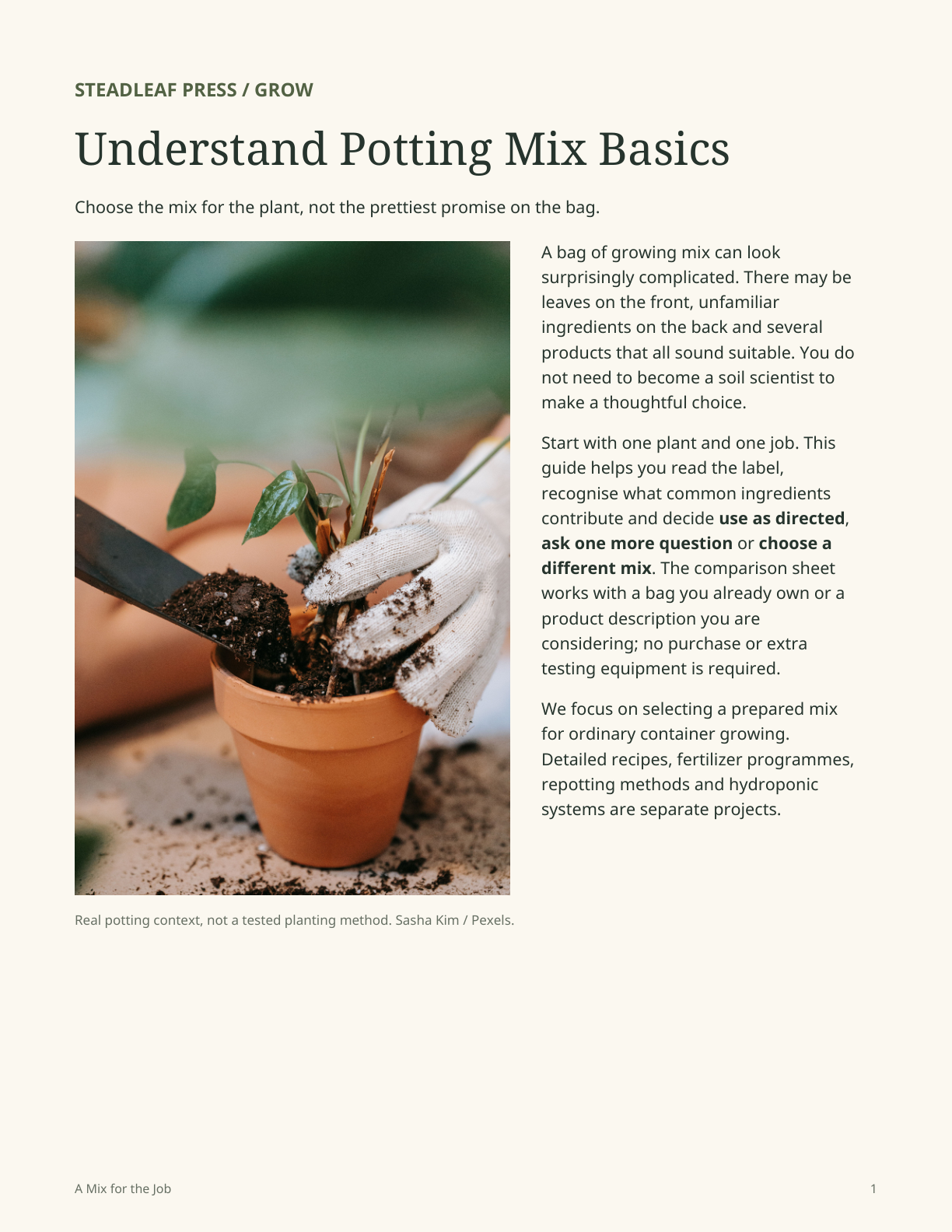
Real potting context, not a tested planting method. Sasha Kim / Pexels.
A Mix for the Job 1
STEADLEAF PRESS / GROW First, name the job
Write the plant's botanical name if you know it, its life stage and what you plan to do: sow seeds, pot on a young plant, or repot an established one. Add any known species-specific mix requirement. A seed tray, an established houseplant and an orchid grown in a coarse bark system are different jobs. [1][2]
Then check the product's intended use. Packaging terms vary: potting mix, growing medium and potting soil can describe container products. In UK guidance, potting compost often means a prepared growing medium, not simply the compost from a garden heap. Read the use statement rather than deciding by the word on the front. [2][3]
A useful first sort
Prepared container mix: The label explicitly includes your kind of container use. Continue to the ingredient and direction checks.
Garden soil, topsoil, mulch or soil improver: Do not assume it can replace the whole growing medium in an ordinary pot. Garden soil behaves differently when confined in a container, and a product meant to improve outdoor soil has a different job. [2][3]
A single component: A bag of perlite, coir or bark may be an ingredient rather than a complete prepared mix. Check whether it is sold ready to grow in, needs preparation, or is meant to be blended according to a specific method.
My plant / stage / job: ________________________________________
The label's intended use: ______________________________________
A Mix for the Job 2
STEADLEAF PRESS / GROW What a mix does for roots
A growing medium supports the plant while providing a balance of water and air around its roots. The spaces among particles matter as much as the particles themselves. Water and air move through those spaces; a root zone that remains filled with excess water has less room for air. [4]
This is why a small pot is not just a tiny patch of garden. A prepared container medium is designed for that restricted space. The whole formulation, particle sizes, container and handling all influence its behaviour. [1][4]
Learn the ingredient roles
These are broad roles, not a recipe or a ranking. [1][5]
Label ingredient A useful starting idea Question to keep in mind
Peat or coconut coir Common water-holding base components. What preparation and wetting directions does this product give?
Processed bark Particle size can contribute different Is this part of a container formulation, or amounts of air space and water retention. landscape mulch?
Perlite Expanded mineral material commonly used How is it used in this complete mix? One to create air-filled spaces. ingredient is not a performance guarantee.
Vermiculite Holds water and some nutrients. Does the finished formulation suit this plant and stage?
Compost Can contribute nutrients and organic Is it one component of a prepared mix, or a matter; properties vary with its source and separate soil improver? processing.
You cannot reliably identify a mix's full ingredients, proportions, pH or fertilizer content from its colour or a photograph. Use the label and product information for that.
A Mix for the Job 3
STEADLEAF PRESS / GROW Read the back in four passes
1. Intended plants and stage
Find the actual use statement and exclusions. A general-purpose blend may suit generalist container plants; seed/cutting, acid-loving and other specialist uses may need a different formulation. “Suitable for plants” is less useful than a clear match to your job. [2]
2. Ingredients and properties
Look for the component list and any stated pH or specialist suitability. If your plant has a particular requirement, verify it rather than assuming all bags of the same colour have the same mix. If choosing peat-free, look for that explicit statement; “organic” or “natural” alone does not establish it. [2]
3. Added materials
Record any fertilizer charge, slow-release feed or wetting agent the label mentions. Wetting agents help water enter a medium; they are not a fertilizer. An initial nutrient addition is not an instruction to add another dose immediately. Use the product directions together with the plant's needs before planning feeding. [4][5][7]
4. Preparation and handling
Read whether the mix is ready to use, needs moisture added, or has other preparation steps. Keep the directions, safety information and storage advice with the product. If the label is damaged or the material has been decanted into an unmarked tub, recover its identity before relying on a guess.
A good question for the supplier is specific: “Is this product intended for this plant and stage, and is any fertilizer already included?” You can record the answer on the comparison sheet.
A Mix for the Job 4
STEADLEAF PRESS / GROW Follow the selection path
Your job or observation A sensible next step
An ordinary container plant with no Look for a prepared container mix whose stated uses include the plant or identified specialist requirement appropriate plant group. Then check ingredients and directions.
Sowing seeds or rooting cuttings Look for an explicit seed/cutting use and check the chosen plant's propagation method. Do not assume the mix for a mature plant is interchangeable.
A plant with a known acid-loving or Match that specific requirement to verified product information. other specialist requirement “Multipurpose” does not answer every specialist question.
A plant grown in a coarse bark or Follow that plant's growing-medium guidance rather than moving it into a another specialised system fine general-purpose mix by default.
Only a soil improver, mulch, Pause. Confirm its intended role or select a documented prepared mix for unidentified material or single this job. component is available
The plant-use branches reflect the primary guidance in [1][2]; the decision sequence is Steadleaf's practical synthesis. A suitable mix still needs an appropriate container with drainage and care matched to the actual plant.
A Mix for the Job 5
STEADLEAF PRESS / GROW Three imaginary labels
These short descriptions are invented for practice, not real products or recommendations.
A: “Soil improver - mix into beds and borders.” For an established houseplant in a pot, this is not an explicit container-growing use. Decision: choose a different product for the job.
B: “Prepared houseplant potting mix - includes starter fertilizer; see feeding directions.” If its stated uses and properties match your plant, continue with those directions. Record the existing feed instead of automatically adding more.
C: “Coir block - expand before use.” This tells you a preparation step, not whether it is a complete mix for your plant. Decision: ask about intended use and nutrition, or choose a clearly documented prepared mix.
Texture is visible; the formulation is not. Teona Swift / Pexels.
A Mix for the Job 6
STEADLEAF PRESS / GROW Compare two mixes without guessing
Leave a field marked unknown if the information is absent. An unanswered essential question is a reason to ask, not a reason to fill in a hopeful answer.
Plant / botanical name: ________________________________________
Life stage and job: ____________________________________________
Known specialist requirement, if any: ____________________________
Read from the actual label Candidate A Candidate B
Product name and exact intended use
Main ingredients / stated properties
Fertilizer or wetting agent mentioned
Preparation, handling and storage directions
Unanswered question for this plant or task
My choice: USE AS DIRECTED / ASK / CHOOSE A DIFFERENT MIX
Why this fits the job: __________________________________________
One thing to check before opening: ______________________________
Keep a photo or copy of the label with this sheet, including the product name and any batch information. Your own label record will be more useful later than a memory of the bag's colour.
A Mix for the Job 7
STEADLEAF PRESS / GROW Open the bag with a little care
Set up in an open, well-ventilated place. Wear gloves, keep your face away from the bag opening, avoid raising or breathing dust and moisten dry media before use as directed. Follow the label and local public-health protective-equipment guidance; RHS also advises considering a dust mask for dusty materials. Wash your hands after handling, especially before eating. Fold or close the bag when finished and follow its storage directions. [6]
Handle the prepared mix gently. Firmly compressing it can reduce air-filled spaces; do not try to make a loose mix “better” by packing it hard or stacking filled pots on it. [1]
You can finish today's task without opening a bag at all: identify the plant, read the label and settle the essential questions first. That is a useful bit of gardening preparation in its own right.
Keep the choice connected to the plant
Use the chosen product as directed rather than adding a handful of several amendments by habit. If you change mixes, pay attention to how that actual plant and pot dry; the old watering calendar is not a property of the new bag. This guide supplies a selection method, not measured drainage results, a universal recipe or a feeding schedule.
Check the plant's identity and household suitability separately if children or pets can reach it. Keep mix and additives stored out of their reach, following product safety directions.
A Mix for the Job 8
STEADLEAF PRESS / GROW Sources
1. Iowa State University Extension and Outreach, Randall Vos, Potting Media: Components and Handling, March 10, 2025. Ingredient roles, particle-size effects and gentle handling. https://yardandgarden.extension.iastate.edu/article/2025/03/potting-media-components-and-handling
2. Claire Thorpe, RHS peat-free campaign manager, Demystifying compost and growing media products at the garden centre, Peat Free Partnership. Product uses, specialist blends, ingredient variation and peat-free wording. https://peatfreepartnership.org.uk/demystifying-compost-and-growing-media-products-at-the-garden-centre/
3. University of Minnesota Extension, Starting your garden and containers off right, May 9, 2024. Read the bag's use and distinguish container mix from garden soil. https://extension.umn.edu/about/our-stories/news/starting-your-garden-and-containers-off-right
4. University of Maryland Extension, Growing Media (Potting Soil) for Containers. Root support, air/water spaces and prepared-media ingredients. https://www.extension.umd.edu/resource/growing-media-potting-soil-containers
5. University of New Hampshire Extension, What is the best soil for potted plants?, January 24, 2020. Prepared-media ingredients and fertilizer or moisture-retaining additions. https://extension.unh.edu/blog/2020/01/what-best-soil-potted-plants
6. Royal Horticultural Society, Minimising health risks in the garden. Practical potting-media handling precautions. https://www.rhs.org.uk/advice/health-and-wellbeing/minimising-health-risks-in-the-garden
7. University of Massachusetts Amherst, Tina Smith and Douglas Cox, Bagged Potting Mixes and Garden Soils for Home Gardeners. Wetting agents and label-declared additions. https://www.umass.edu/agriculture-food-environment/home-la wn-garden/fact-sheets/bagged-potting-mixes-garden-soils-for-home-gardeners
Sources checked November 2, 2026. The decision path, invented labels and comparison sheet are original editorial synthesis. No product purchase, physical growing trial, laboratory test or measured mix performance is claimed.
A Mix for the Job 9
STEADLEAF PRESS / GROW Photograph credits
Cover: Sasha Kim, Person Putting Soil on a Potted Plant, Pexels. A gloved hand, trowel and terracotta pot provide real potting context. This is not a planting-depth or root-handling demonstration, and no species or mix composition is verified by the image. https://www.pexels.com/photo/person-putting-soil-on-a-potted-plant-9413771/
Interior: Teona Swift, Crop Horticulturist with Soil on Gardening Trowel, Pexels. Dark, uneven-textured material and pale particles are visible above a bucket. Their appearance cannot establish ingredients, proportions, pH, fertilizer content or performance. The hand holds the tool; this is a texture illustration rather than a complete handling-safety demonstration. https://www.pexels.com/photo/crop-horticulturist-with-soil-on-gardening-trowel-6913399/
Both are real photographs under the Pexels License. https://www.pexels.com/license/
Full frames retained. Changes by Steadleaf: proportional resampling to print-resolution placement and JPEG/PDF encoding only. No retouching, relighting or generated imagery; original photographer processing is not excluded. Raw stock originals remain private production assets, not standalone customer downloads.