Choose Between Top Watering and Bottom Watering
Two useful routes. One thoughtful choice.
Choose top, bottom or defer using access, handling and pot condition; complete drainage and record a reasoned choice.
FREE · No email or checkout
Free practical guide. No email or payment required. Photos are contextual illustrations, not proof of measured conditions or physical trials.
Read the complete free guide online
Read the instructional text here, or download the complete free PDF above for original diagrams, tables, worksheets and page layout. The original publication is unchanged.
STEADLEAF PRESS / GROW Choose Between Top Watering and Bottom Watering
Two useful routes. One thoughtful choice.
A watering method should fit the pot in front of you. You might pour onto an accessible mix surface, or let a small pot take up water from below when leaves crowd the opening. Neither method earns a permanent place on every plant's calendar.
Start with a plant that actually needs water. Then choose the route you can manage, observe and finish properly. The comparison and reusable card in this guide help you make that choice without buying a new watering system.
This guide covers ordinary draining pots with established indoor ornamentals. Follow separate instructions for reservoir planters, hydroponics, mounted plants, propagation trays and specialist growing systems.
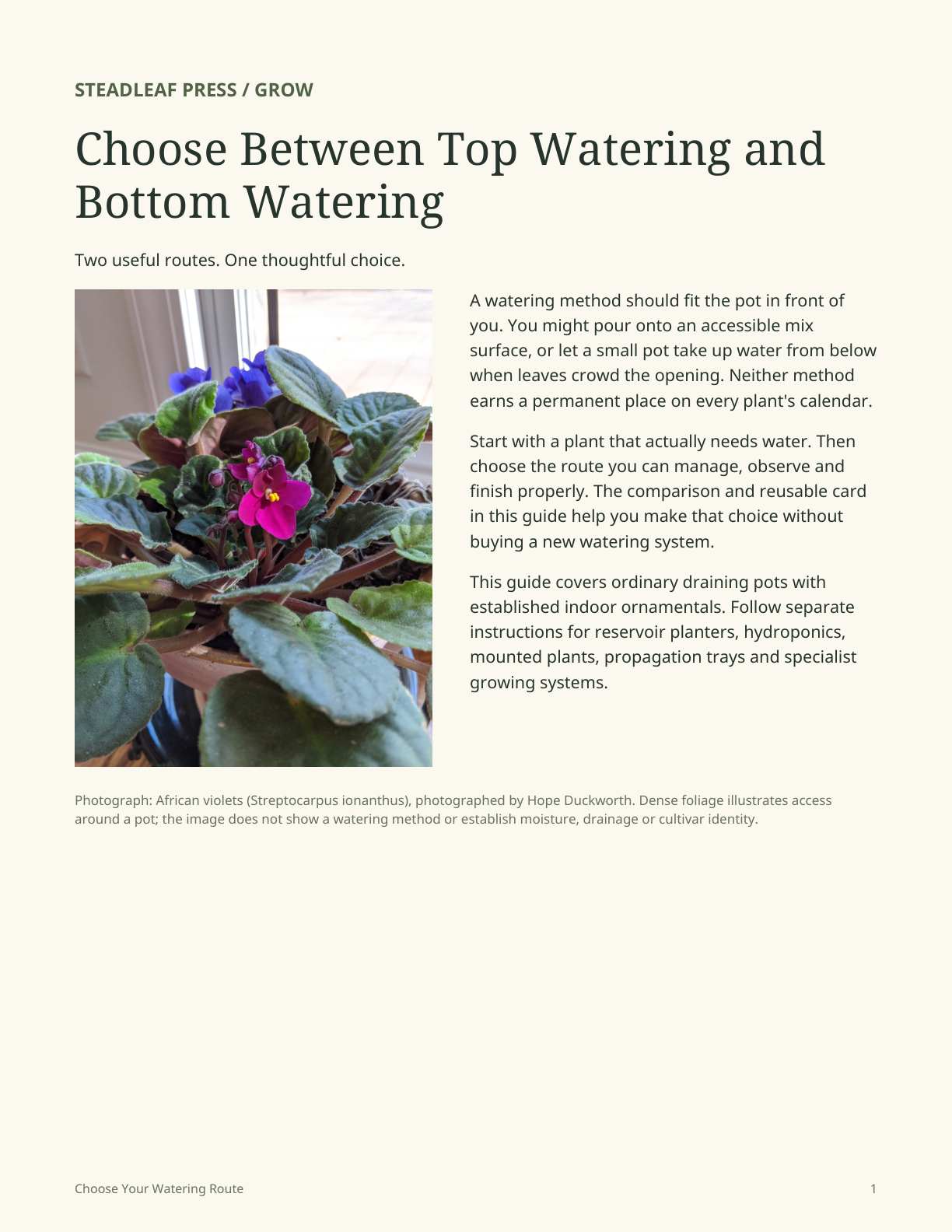
Photograph: African violets (Streptocarpus ionanthus), photographed by Hope Duckworth. Dense foliage illustrates access around a pot; the image does not show a watering method or establish moisture, drainage or cultivar identity.
Choose Your Watering Route 1
STEADLEAF PRESS / GROW Choose a route for this pot
Top watering delivers water onto the mix, beneath the foliage. Bottom watering lets mix absorb water through the pot's lower openings. Dense foliage can make the second route convenient, but top watering can also keep leaves dry when the spout reaches the mix. [1, 2]
Your situation Useful starting choice Check before proceeding
You can reach the mix and collect Top watering. Aim at the mix rather than runoff easily. showering the leaves.
Leaves crowd the opening and the Consider bottom watering. The base must have openings and small pot is easy to move. the pot must stand securely in a suitable basin.
The plant is heavy, fragile or Use a safe in-place approach or get Can you collect and remove awkward to carry. suitable help. drainage without tipping or straining?
Mix is already too wet for this plant. Neither method today. Recheck its condition and drainage rather than changing the direction of more water.
A pale crust or repeated salt Do not rely on bottom watering as Review water and fertilizer history; concern needs investigation. the remedy. choose a plant-appropriate response.
Water bypasses dry mix or uptake Pause and reassess. A different route may help some seems uneven. mixes, but repeated unobserved soaking is not a diagnosis.
Make the choice small: "For this pot, at this watering, I will try ______ because ______." You can choose differently at a later watering.
The lifting and access checks are practical planning prompts. They do not require moving a plant simply to complete the table.
Choose Your Watering Route 2
STEADLEAF PRESS / GROW Picture the two paths
TOP: onto the mix BOTTOM: through base openings
Collect runoff, then empty. Remove from basin, then drain.
BOTH END WITH FREE DRAINAGE Water paths, not water levels: Original schematic, not to scale. Arrows show direction rather than speed or measured wetting.
Different entry, shared finish
The entry route changes; the need to finish draining does not. Illinois Extension describes removing a bottom-watered pot once moisture has travelled upward and is evident at the surface. Maryland Extension advises emptying excess collection water after either method. [3, 4]
A helpful distinction
Brief, observed bottom watering is not the same as leaving an ordinary pot in a permanent reservoir. A purpose-built self-watering container has its own design and instructions. Do not turn an ordinary decorative outer pot into that system by leaving water in its base. [1]
Observation, not a stopwatch: Water uptake varies with the mix and container. A universal soaking duration or basin depth would hide those differences. Stay with the task and check progress rather than leaving a pot overnight.
Choose Your Watering Route 3
STEADLEAF PRESS / GROW Complete the watering you chose
Route A: from the top
Place the pot where runoff can be collected safely. Use a gentle, controllable flow onto the mix, reaching around the surface where practical without flooding the rim. Let water enter the mix rather than forcing a fast pour.
Allow excess to leave through the drainage openings, then empty the collection. Top watering with drainage can carry dissolved salts out; keeping that runoff under the pot defeats the clean finish. A single watering is not proof that a salt problem has been corrected. [2, 4]
Route B: from the bottom
Use a clean, stable basin and fresh water suitable for the plant. Set a small, manageable draining pot upright so water contacts its base openings without reaching over the rim or wetting the crown. Watch for moisture moving into the mix.
Check the accessible mix surface for moisture arriving from below. When it has wicked through, remove the pot and let excess drain. If uptake stalls or remains uncertain, remove it and investigate the setup rather than extending the soak indefinitely. Illinois Extension uses moisture reaching the surface as the practical removal cue; this is not a measurement of every pocket inside. [3]
Keep the finish simple
Support the pot itself when moving it, not its stems. Empty the basin or saucer, dry spills and return the plant only when it can be handled safely. Do not reuse another plant's drainage or bath water. Water movement between nursery containers can spread plant disease; fresh water for each household pot is a conservative hygiene precaution, not a claim that every shared bath causes infection. [5]
One important limit: Bottom watering does not wash salts downward and out. Maryland Extension advises against it as the management method for mineral or fertilizer salt deposits. Repeated crusting, persistent wetness or decline calls for assessment, not alternating methods blindly. Salt-flushing quantities and rescue treatments are outside this comparison. [6]
Choose Your Watering Route 4
STEADLEAF PRESS / GROW Your next-watering choice card
Use this blank card when watering is genuinely due. It records a decision, not a test you must perform on every plant.
Decision Your note
Plant and growing pot
What tells me water is needed?
Can I reach the mix and collect runoff?
Can I safely move and drain this pot?
Choice: top / bottom / defer
Reason for this choice
What I observed during watering
Drained, collection emptied, next check
Two invented examples
A crowded little pot: Jo confirms the mix is ready for water. Leaves make the opening awkward, but the small draining pot is easy to lift. Jo chooses a supervised bottom watering and records whether moisture reaches the accessible surface before removing and draining it.
An easy-to-reach pot: Sam can direct a narrow spout under the leaves and empty the saucer safely. Sam chooses top watering. There is no need to try bottom watering just because another plant uses it.
Take away one habit: Choose for the plant and setup, then finish the job. The best method is the one you can use attentively without ignoring drainage or the plant's actual need.
Choose Your Watering Route 5
STEADLEAF PRESS / GROW Sources and photograph
Primary horticultural sources checked 2 November 2026. The comparison, diagram and choice card are original editorial tools. Examples are invented, not growth trials.
1. Virginia Cooperative Extension. Properly Watering Container Houseplants, SPES-804P. Method mechanics, access and separate self-watering systems; fixed soaking numbers and broad leaf-sensitivity claims are not adopted. https://www.pubs.ext.vt.edu/SPES/spes-804.html
2. University of Tennessee Extension. Caring for Indoor Plants, W1128-B, watering section, p. 4. Keeping foliage dry and drainage/salt considerations. https://uthort.tennessee.edu/wp-content/uploads/sites/228/2023/11/W1128B.pdf
3. Illinois Extension. Watering: Houseplants. Upward wetting and removal cue. Water-treatment claims elsewhere on the page are not used. https://extension.illinois.edu/houseplants/watering
4. University of Maryland Extension. Watering Indoor Plants. Top/bottom definitions and emptying collection water; no fixed schedule or water-treatment recipe adopted. https://extension.umd.edu/resource/watering-indoor-plants
5. UC Nursery and Floriculture Alliance. Recognizing Water-Related Disease Issues in Container Nurseries. Nursery evidence informing a conservative household hygiene precaution. https://ucnfa.ucdavis.edu/news/recognizing-water-related-disease-issues-container-nurseries/
6. University of Maryland Extension. Mineral and Fertilizer Salt Deposits on Indoor Plants. Limits of bottom watering when managing deposits. https://extension.umd.edu/resource/mineral-and-fertilizer-salt-deposits-indoor-plants
Photograph credit: Hope Duckworth, "Streptocarpus ionanthus, Cabarrus County, NC," hosted by the NC State Extension Gardener Plant Toolbox. CC BY 4.0. Full frame proportionally sized and JPEG-encoded for print; no retouching or generated alteration. Original photograph rights remain under CC BY 4.0.
Source: https://plants.ces.ncsu.edu/plants/streptocarpus-ionanthus/
License: https://creativecommons.org/licenses/by/4.0/