Choose a Mix for Cacti and Other Succulents
Start with the plant. Then choose its root environment.
Identify the relevant plant group, compare drainage/aeration/water retention and choose, clarify or wait with a completed mix-selection card.
FREE · No email or checkout
Free practical guide. No email or payment required. Photos are contextual illustrations, not proof of measured conditions or physical trials.
Read the complete free guide online
Read the instructional text here, or download the complete free PDF above for original diagrams, tables, worksheets and page layout. The original publication is unchanged.
STEADLEAF PRESS / GROW Choose a Mix for Cacti and Other Succulents
Start with the plant. Then choose its root environment.
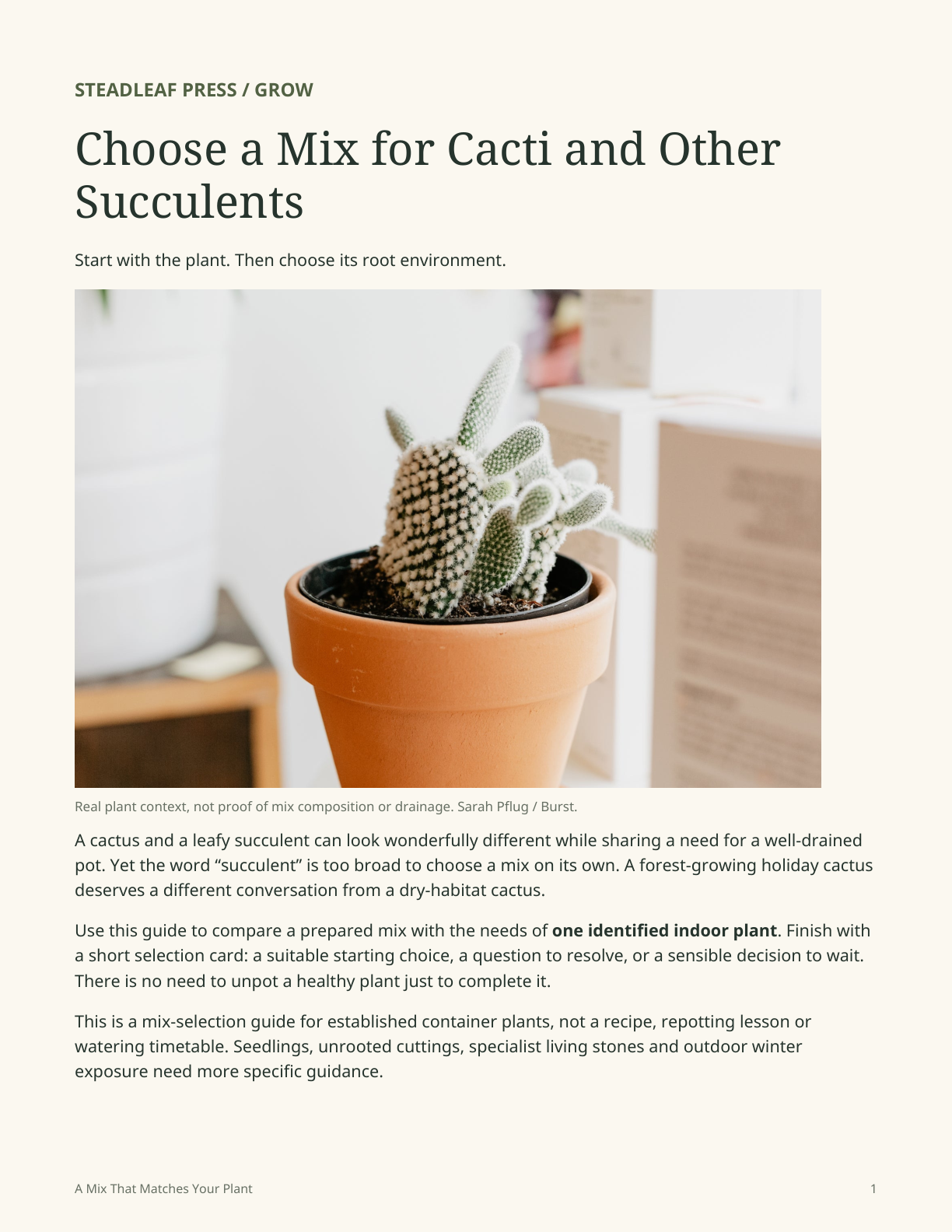
Real plant context, not proof of mix composition or drainage. Sarah Pflug / Burst.
A cactus and a leafy succulent can look wonderfully different while sharing a need for a well-drained pot. Yet the word “succulent” is too broad to choose a mix on its own. A forest-growing holiday cactus deserves a different conversation from a dry-habitat cactus.
Use this guide to compare a prepared mix with the needs of one identified indoor plant. Finish with a short selection card: a suitable starting choice, a question to resolve, or a sensible decision to wait. There is no need to unpot a healthy plant just to complete it.
This is a mix-selection guide for established container plants, not a recipe, repotting lesson or watering timetable. Seedlings, unrooted cuttings, specialist living stones and outdoor winter exposure need more specific guidance.
A Mix That Matches Your Plant 1
STEADLEAF PRESS / GROW First, find your plant's branch
Cacti belong to one plant family; “succulent” describes water-storing plants across several families. Being a succulent does not make every plant a desert plant. RHS explicitly distinguishes rainforest epiphytic cacti from the more familiar dry-habitat kinds. [1]
What you have Start here What to confirm
An identified dry-habitat A prepared cactus/succulent mix Exact species, indoor conditions and the cactus intended for free drainage maker's intended use
An identified non-cactus A prepared succulent mix is a Its own care guidance, including growth succulent adapted to dry useful candidate, not an automatic and resting periods conditions prescription
Thanksgiving or Christmas A well-drained medium that also Holiday-cactus guidance, not a desert cactus (Schlumbergera species supports its greater moisture watering routine or hybrids) needs
A plant labelled only Keep the label and seek a reliable Botanical name and whether it is a “succulent,” or an unfamiliar identification first dry-habitat or forest plant cactus
Iowa State says a special cactus mix is not required for holiday cacti: a well-drained all-purpose potting soil can work. This does not mean that every cactus-labelled bag is unsuitable. Read the intended use and check the actual plant's needs. [2]
A useful first question: “Is this mix suitable for this named plant in an indoor draining pot?” That is more helpful than “Which succulent soil is best?”
Schlumbergera truncata, source identification: NC State. Maja Dumat / CC BY 4.0.
A Mix That Matches Your Plant 2
STEADLEAF PRESS / GROW Compare drainage, aeration and water storage
These are related, but different jobs. Drainage lets excess water leave the root zone. Aeration gives roots access to air through pore spaces. Water storage keeps some moisture available after drainage. Roots need a workable balance, not the driest possible material. [3]
Candidate or feature What it can contribute Your selection check
Prepared cactus/succulent mix A convenient starting medium for Confirm the named plant and intended many dry-adapted indoor plants use; the label alone does not describe [4] every growing situation.
Well-drained general potting Can suit holiday cacti without a Check that it is a container medium and mix specialist cactus product [2] supports drainage, rather than choosing solely for extra water retention.
Coarse components such as Can help form a more open Read the full blend. A visible handful of perlite or suitably sized bark medium; bark and perlite have coarse pieces does not reveal its air different properties [3] capacity.
Water-retaining components Help retain water; that is a Match the whole medium to the plant such as peat or vermiculite function, not automatically a instead of rejecting an ingredient by defect [3] name.
Garden soil, or gravel under an Neither is a shortcut to a suitable Choose a container medium and an open unsuitable mix container root environment [3,4] drainage outlet; do not rely on a bottom gravel layer.
This is a qualitative comparison, not a ranking or a measured trial. Ingredient size, proportions and the finished blend matter. We do not assign a universal mineral percentage or promise that any bag dries in a set number of days.
A Mix That Matches Your Plant 3
STEADLEAF PRESS / GROW Read the bag in a useful order
1. Intended plants and use. Look for container-growing directions and compare them with your plant's botanical name. “Cactus,” “succulent” and “houseplant” are starting clues, not substitutes for that match.
2. The complete blend. Note the listed components and any information about drainage or water retention. A photograph or an ingredient list without quantities cannot establish measured air space. If the description is unclear, write one precise question rather than inventing a recipe to correct it.
3. Added fertilizer and preparation. Record whether the mix includes feed, plus any wetting, storage or handling directions. Choosing a mix is not a reason to add extra fertilizer. Leave feeding decisions to the label and the plant's care guidance.
4. The pot and place. The same mix behaves within a particular container and home. Check drainage holes, the planned pot size and material, light, temperature and your observations of moisture. A larger volume of mix or a different pot can change drying; a bag cannot compensate for an unsuitable growing site. [3,4]
Simple starting choice: for many dry-adapted succulents, Iowa State recommends commercial cactus/succulent mixes as a practical option for beginners. Start with a suitable prepared product rather than mixing several ingredients without a species-specific reason. [4]
Keep the task comfortable
Read the bag's handling label and local health advice. Work in a ventilated place, keep your face away from an opened bag, avoid raising dust, wear gloves and wash hands afterwards. Follow dust-control and protective-equipment directions; RHS advises moistening dry media before handling. Keep mixes and plants away from children and pets, and check the exact plant's hazards separately. Do not squeeze or handle spines to identify a cactus. [5]
A Mix That Matches Your Plant 4
STEADLEAF PRESS / GROW Two choices, not one universal answer
Invented example - a known dry-habitat cactus. Lina has identified her plant and checked its care guidance. Bag A is a prepared cactus/succulent container mix; Bag B is described mainly for moisture-retentive hanging baskets. She records Bag A as the better-supported starting candidate, checks its directions and confirms that her pot drains. She does not turn the comparison into an untested percentage recipe.
Invented example - a flowering holiday cactus. Sam's plant is a Schlumbergera hybrid, not a desert cactus. He finds a well-drained container mix supported by holiday-cactus guidance. He asks whether a bag labelled “cactus” is suitable for this specific plant rather than assuming either yes or no. He keeps mix selection separate from deciding when the plant actually needs repotting.
University of Minnesota emphasizes both drainage and aeration for holiday cacti, alongside their relatively greater moisture needs. A forest origin does not mean roots should sit in wet, heavy media or collected water. [6]
Choose, clarify or wait
Choose: the identified plant, intended medium and draining container agree. Keep the label and note your reasons.
Clarify: one important detail is missing. Ask the supplier or a horticultural advisory service a specific question, using the plant's name and your growing conditions.
Wait: identity is uncertain, the container has no outlet, or the plant has unexplained decline. Resolve that issue before treating a new mix as the answer.
Your useful result today can be a clear decision on paper. It need not be a bag opened or a plant moved.
A Mix That Matches Your Plant 5
STEADLEAF PRESS / GROW Your plant-to-mix selection card
A blank planning sheet. Record information you actually have; leave unknowns as questions.
Checkpoint My notes
Botanical name and reliable care source __________________________________
Dry-habitat / holiday cactus / other / __________________________________ uncertain
Indoor place, pot material and drainage __________________________________ outlet
Candidate A: intended use and components __________________________________
Candidate B, if useful: intended use and __________________________________ components
Preparation, added feed and handling __________________________________ directions
Main fit question still unanswered __________________________________
Choose / clarify / wait - and my reason __________________________________
Keep this card with the bag label. If you later change mix or pot, record what changed before drawing conclusions about the result.
A Mix That Matches Your Plant 6
STEADLEAF PRESS / GROW Sources
Primary horticultural guidance checked 2 November 2026. The chart, examples and selection card are original editorial tools; no physical growth trial, timed drainage test or measured air-capacity test was performed.
1. Royal Horticultural Society. How to grow houseplant cacti and succulents. Dry-habitat versus epiphytic distinction. https://www.rhs.org.uk/plants/types/cacti-succulents/houseplants/growing-guide
2. Iowa State University Extension and Outreach. All About Holiday Cacti. Identity and well-drained potting-medium options. https://yardandgarden.extension.iastate.edu/how-to/all-about-holiday-cacti
3. NC State Extension. Extension Gardener Handbook, Chapter 18: Plants Grown in Containers. Media properties, components and container context. https://content.ces.ncsu.edu/extension-gardener-handbook/18-plants-grown-in-containers
4. Iowa State University Extension and Outreach. Growing Succulents Indoors. Prepared mixes and drainage. Its general recommendations are not applied to every succulent or adopted here as a universal recipe. https://yardandgarden.extension.iastate.edu/how-to/growing-succulents-indoors
5. Royal Horticultural Society. Minimising health risks in the garden. Media handling and hygiene. https://www.rhs.org.uk/advice/health-and-wellbeing/minimising-health-risks-in-the-garden
6. University of Minnesota Extension. Holiday cacti. Drainage, aeration and moisture context. https://extension.umn.edu/garden-and-home/yard-and-garden/gardening-in-minnesota/holiday-cacti
A Mix That Matches Your Plant 7
STEADLEAF PRESS / GROW Photograph credits
Cover: Fluffy No-Touch Plant, Sarah Pflug / Burst. A real pale-spined cactus in a dark inner pot and terracotta-coloured outer pot, beside light wood and a bright wall. The source does not establish its exact species. Soft-looking spines are not an invitation to touch; the image is context, not proof of mix composition, drainage or care results.
Source: https://www.shopify.com/stock-photos/photos/fluffy-no-touch-plant License: Burst License, permitting commercial and noncommercial use and adaptation. https://www.shopify.com/stock-photos/licenses/shopify-some-rights-reserved
Interior: Schlumbergera truncata, Maja Dumat, via NC State Extension Plant Toolbox. Pink flowers and flattened green stems above a nursery pot on a wooden surface. Identification is attributed to the source; the photograph does not demonstrate root-zone moisture or the medium's properties.
Source: https://plants.ces.ncsu.edu/plants/schlumbergera-truncata/ License: Creative Commons Attribution 4.0 International. https://creativecommons.org/licenses/by/4.0/
Both are genuine photographs. Whole frames are retained with proportional print-resolution reduction and JPEG/PDF encoding only; no generated alteration, retouching or before/after claim. Original files and rights evidence are retained. No photographer or institution endorsement is implied. The CC BY image remains reusable under its license; the Burst original is not offered as a standalone stock download.