Choose a Plant Location Before Buying It
Make a little room for a plant that fits your life.
Complete a take-along site card and exact-plant matching worksheet, resolve key mismatches and choose match, adjust or wait before bringing the plant home.
FREE · No email or checkout
Free practical guide. No email or payment required. Photos are contextual illustrations, not proof of measured conditions or physical trials.
Read the complete free guide online
Read the instructional text here, or download the complete free PDF above for original diagrams, tables, worksheets and page layout. The original publication is unchanged.
STEADLEAF PRESS / GROW Choose a Plant Location Before Buying It
Make a little room for a plant that fits your life.
It is lovely to bring home a plant you have fallen for. It is even lovelier to know where it will live, how you will water it and what room it will have to grow.
Start with one real place in your home. Give it a short description, take a few measurements and bring that information to the plant label-not the other way round. Your finished worksheet will help you choose match, adjust or wait, with a clear next step for each.
This guide focuses on an indoor houseplant position. You can use the same questions to prepare for a balcony plant, but add local outdoor climate, wind, rain, building and seasonal requirements before making that choice.
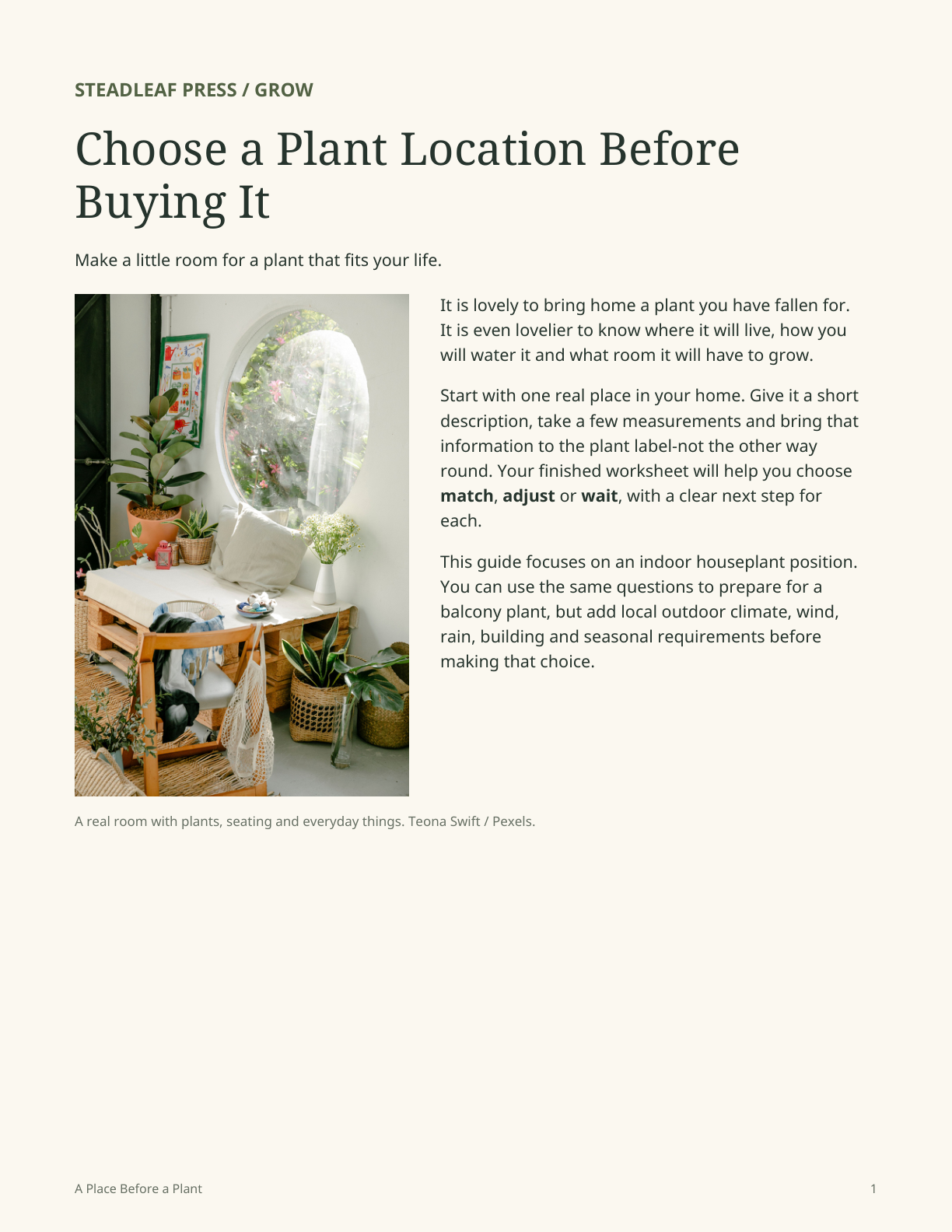
A real room with plants, seating and everyday things. Teona Swift / Pexels.
A Place Before a Plant 1
STEADLEAF PRESS / GROW Give the place a name
“Near the window” is a beginning. “The left end of the living-room cabinet, with the leaves just above the windowsill” is a place you can return to and describe.
Write the room, surface and proposed leaf height. Note how far it is from the window and whether the plant would sit in front of the glass or off to one side. Look at that exact position at several useful times through the day, with your usual blinds or curtains. Record direct-sun patches, nearby obstructions and the date and weather. Window direction helps explain the setting; the actual spot matters more than the compass label alone. [1]
Include an ordinary day at home in your thinking. Does a curtain close across the space? Does a chair slide into it? Is the door regularly open to cold air? A good plant corner works with the room as it is used.
Choosing for the conditions you already have is often easier than trying to rebuild the room around a demanding plant. Nebraska and Maryland Extension both put the growing location at the centre of selection. [2,3]
Think about foliage, chair movement and care access. Check nearby heating at your own site. Natalia Sevruk / Pexels.
A Place Before a Plant 2
STEADLEAF PRESS / GROW Leave room for the grown-up plant
Measure three things: the usable width, the usable depth and the clear height above the supporting surface. Then consider the plant's expected spread, the pot and tray, and the room your hand needs to reach the growing medium.
The little nursery pot is only today's footprint. A plant may grow wider, taller or trail below the shelf. Ask for the mature dimensions and habit of the exact species or cultivar, and check them against a horticultural reference. A compact cultivar and a full-sized species may need different homes.
Try the routine before the purchase. Can you lift or slide the proposed pot safely for watering? Can you see the back of the leaves? Can you remove collected water without tilting it over a book, socket or polished surface? Choose a stable support and an accessible position that leaves doors and walking routes free.
For a small, light setup, an empty pot or a paper outline can help you picture the footprint. Use your own measurements; keep the mock-up clear of heaters, flames, wet areas and walking routes. A heavier or hanging arrangement needs its support and fixings checked separately.
A Place Before a Plant 3
STEADLEAF PRESS / GROW My take-along site card
Fill this in at home. A photo of the card and the empty position makes a useful reminder when reading a label or asking for help.
Site name / room: __________________________________________________
Supporting surface / proposed leaf height: _____________________________
Usable width × depth × clear height, with units: _________________________
Window relationship / distance / direction if known: _____________________
Light checks: date, time, weather and direct-sun observations: _____________
_________________________________________________________________
Usual curtains / obstructions / seasonal change to revisit: _________________
Temperature or air conditions to check: drafts / heat outlet / other: _________
Watering place / tray access / route for moving the pot: ___________________
People or pets who can reach this position: _____________________________
Care routine: when I can check the plant / help while away: ________________
One question this spot still needs answered: ____________________________
A Place Before a Plant 4
STEADLEAF PRESS / GROW Turn the label into a plant profile
Start with the botanical name, then the cultivar name if one is given. Keep the tag or take a clear photograph. A label such as “foliage mix” or “rubber plant” leaves too much unresolved for a confident match.
Look up the exact plant in an extension, botanic-garden or comparable horticultural reference. Bring the source back to these five questions:
Plant-profile question What to write down
What light does it prefer? Direct-sun tolerance, preferred exposure and any cultivar differences
How much space will it use? Expected height, spread, upright/trailing habit and room for the pot
What room conditions suit it? Temperature, drafts and humidity needs relevant to your home
What does its care involve? Moisture preference, drainage and access for checking and watering
Does it fit this household? Exact-identity safety check, reach, spines or irritating sap where relevant
Ask a specific question when a label is vague: “Does this cultivar tolerate the afternoon beam I recorded?” is more useful than “Is it easy?” For size, ask “How wide is this likely to become indoors?” rather than relying on the width of the plant in front of you.
One household check
Use the botanical name when checking pet toxicity; the ASPCA database distinguishes plants by identity and animal. Its “non-toxic” category does not mean a plant is food, and plant material can still upset a cat or dog's stomach. For young children, keep plants and loose plant parts out of reach and retain the name tag; even non-toxic plants can present a choking hazard. Human and animal safety lists are not interchangeable. [4,5]
A Place Before a Plant 5
STEADLEAF PRESS / GROW See a match take shape
Worked example: the room and measurements below are invented. The plant facts come from the cited references. This is a demonstration of the worksheet, not a recommendation for either photograph.
The candidate is Peperomia obtusifolia, sometimes called baby rubber plant. NC State describes a preference for bright indirect light, sensitivity to strong direct sun and drafts, and a broad height and width range of 6 inches to 2 feet-about 15 to 61 cm. That range is a planning prompt; ask about the particular cultivar and include its pot and care space. [6]
ASPCA lists this exact species as non-toxic to cats and dogs. That classification belongs to Peperomia obtusifolia, not every plant sold with “rubber plant” in its common name. Keep the household check above in the plan. [7]
In the invented room What the comparison reveals Decision
A: a shelf with 35 cm usable The young plant fits today, but the Wait on A; find a roomier location or width and 40 cm clear height broader species-size range leaves a verify a genuinely suitable compact growth problem cultivar
B: a cabinet area with 90 cm More room is available; the Adjust first: reserve the footprint, usable width, 70 cm depth and description is a promising starting verify the exact plant and pot fit, and 110 cm clear height, near a point for comparing the plant's light complete any missing light checks window with daylight and no preference direct beam during recorded checks
B after the remaining checks Light, growing room, household Match: prepare that position before support the match, with a access and the care routine can be bringing the plant home stable support and accessible considered together tray
The helpful move was not finding the biggest number of “yes” answers. It was resolving the one thing that could make the location fail. A pleasant-looking corner with inadequate growing space remains a mismatch.
A Place Before a Plant 6
STEADLEAF PRESS / GROW Your plant-to-site matching worksheet
Candidate botanical name / cultivar: __________________________________
Reference or label checked / date: _____________________________________
Site name from your card: ____________________________________________
Use M for a supported match, A for an adjustment you can actually make, and ? for an unanswered question. Add the evidence or next action beside the code.
Check What the plant needs What this site offers M / A / ? and next action
Light at leaf height ______ ______ ______
Mature spread + ______ ______ ______ height, pot + access
Temperature / ______ ______ ______ drafts / humidity
Moisture care / ______ ______ ______ drainage / tray access
Household identity / ______ ______ ______ reach constraints
Routine / help while ______ ______ ______ away
The most important unresolved item: ___________________________________
A feasible adjustment, if there is one: ___________________________________
Who or what can answer the remaining question: _________________________
A Place Before a Plant 7
STEADLEAF PRESS / GROW Choose match, adjust or wait
Match means the important requirements are supported by what you know about this site and exact plant. Clear the space, plan the pot-and-tray arrangement and keep the label with your records.
Adjust means there is one specific, manageable change: clearing a wider part of a stable cabinet, choosing another position or making watering access easier. Make the change first, then compare the site again. A promise to remember an inconvenient task every day is less useful than a setup that makes care easy.
Wait means a key requirement is unknown or incompatible: identity, adequate light, growing room, household access or a care demand you cannot meet. Write down the next question. Leaving a plant behind today is a good decision when it makes room for a better match later.
Once the location fits, look over the individual plant before taking it home. Check leaf undersides and leaf joints for pests or damage, and ask about anything that concerns you. Maryland Extension recommends choosing a healthy specimen as well as a suitable type. [3]
My next step
Decision: MATCH / ADJUST / WAIT
Before bringing the plant home, I will: _________________________________
The question I will ask or check: _______________________________________
The place I will prepare: ______________________________________________
The first routine check I will make after arrival: __________________________
You do not need the perfect plant collection. One well-chosen place and a plant that belongs there is a lovely beginning.
Keep the card useful
Your light notes describe the checks you made, not every hour or season; revisit them after a meaningful change. Published plant sizes are ranges, and photographs illustrate room context rather than measured growing conditions. Use this workbook as a decision aid, with plant-specific guidance for the care details.
A Place Before a Plant 8
STEADLEAF PRESS / GROW Sources
Primary sources checked 2 November 2026. The site card, matching worksheet and room example are original editorial material. No purchase, physical plant trial or room measurement was performed by Steadleaf.
1. University of Minnesota Extension, Lighting for indoor plants and starting seeds. Actual light, window relationships and obstructions. https://extension.umn.edu/garden-and-home/yard-and-garden/gardening-in-minnesota/lighting-for-indoor-plants
2. Nebraska Extension, Guide to Selecting Houseplants, G837. Location, light, temperature, humidity and available care time. General winter prescriptions not adopted. https://extensionpubs.unl.edu/publication/g837/guide-to-selecting-houseplants
3. University of Maryland Extension, Selecting Indoor Plants. Fit to home conditions and checking the individual plant. Regional compass shortcuts not adopted. https://www.extension.umd.edu/resource/selecting-indoor-plants
4. ASPCA, Toxic and Non-Toxic Plants. Exact identity, animal-specific classifications and ingestion caution. https://www.aspca.org/pet-care/aspca-poison-control/toxic-and-non-toxic-plants
5. Ontario Poison Centre, Plants. Identification, name tags, child access and choking hazards. https://www.ontariopoisoncentre.ca/for-families/common-poisons/plants/
6. NC State Extension Gardener Plant Toolbox, Peperomia obtusifolia. Light preferences, draft sensitivity and species height/spread range. https://plants.ces.ncsu.edu/plants/peperomia-obtusifolia/
7. ASPCA, Blunt Leaf Peperomia. Exact Peperomia obtusifolia classification for dogs and cats. https://www.aspca.org/pet-care/aspca-poison-control/toxic-and-non-toxic-plants/blunt-leaf-peperomia
A Place Before a Plant 9
STEADLEAF PRESS / GROW Photograph credits
Cover: Teona Swift, “Cozy room with wooden furniture and round window overlooking green garden,” Pexels. A bright round window, wood and wicker furniture, seating and several plants show how a plant corner shares space with daily life. https://www.pexels.com/photo/cozy-room-with-wooden-furn iture-and-round-window-overlooking-green-garden-6850596/
Interior: Natalia Sevruk, “Cozy Living Room with Sunlit Indoor Plants,” Pexels. A planted cabinet beside a chair and window invites a useful question: what space will the foliage and everyday care need? Visible heating pipe/radiator elements are a reminder to check the actual site, not a placement recommendation. https://www.pexels.com/photo/cozy-living-room-with-sunlit-indoor-plants-34772398/
Both are real photographs under the Pexels License, retained full-frame with proportional resizing and PDF encoding. No retouching or image generation by Steadleaf; original photographer processing is not excluded. The pictured plants are not the Peperomia worked example and have no implied species, pet-safety or growing-condition assessment. Raw photos remain private production assets. https://www.pexels.com/license/