Choose Plants for an East-Facing Window
Three different plants, one better question: what does your morning window actually offer?
Choose or defer African violet, Phalaenopsis hybrid or Hoya carnosa using four morning-light branches, species-specific space/moisture checks and a completed choice card.
FREE · No email or checkout
Free practical guide. No email or payment required. Photos are contextual illustrations, not proof of measured conditions or physical trials.
Read the complete free guide online
Read the instructional text here, or download the complete free PDF above for original diagrams, tables, worksheets and page layout. The original publication is unchanged.
STEADLEAF PRESS / GROW Choose Plants for an East-Facing Window
Three different plants, one better question: what does your morning window actually offer?
An east-facing window can be a lovely place to begin: flowers close enough to enjoy with breakfast, or a vine beside a well-used chair. But the word east is only the beginning of the decision. A neighboring wall, a deep overhang or a closed blind can matter more than the compass label.
Use this guide to choose between an African violet, a moth orchid and a wax plant - or decide that the location needs changing first. Each brings a different shape and care commitment. The result is one candidate matched to an observed morning pattern, not a shopping list for every east-facing room.
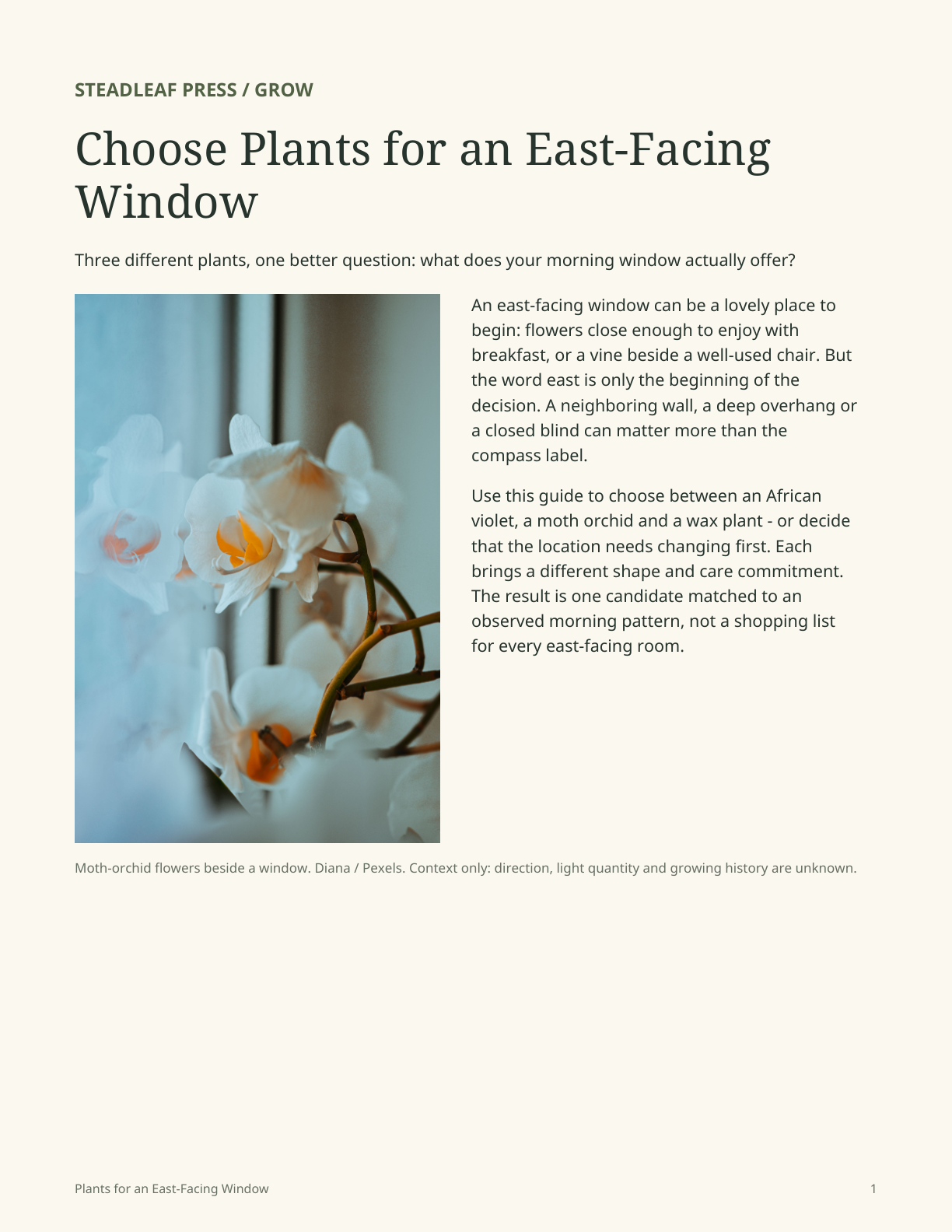
Moth-orchid flowers beside a window. Diana / Pexels. Context only: direction, light quantity and growing history are unknown.
Plants for an East-Facing Window 1
STEADLEAF PRESS / GROW Start with your morning, not a compass promise
East-facing windows commonly receive morning rather than afternoon sun. That pattern is a useful starting expectation, not a guaranteed number of hours. Latitude, season, the exact window angle and obstructions change what reaches the leaves. A southeast or northeast window is not identical to due east. [1]
If the direction is uncertain, use a reliable building plan or map, or check a compass away from metal that may interfere. Record uncertainty instead of forcing a label. Do not look at the sun to establish direction.
Choose the proposed leaf position on a stable indoor surface. Check it during the part of your morning when light can arrive, again later in the morning, and once after the expected beam has passed. Adjust these checks to local daylight and your routine; there is no universal clock-time schedule.
At each check, note four things:
Is a direct beam reaching the leaves, or only the floor or wall nearby?
Does the spot still receive useful-looking daylight after the beam moves away?
What is in the path: building, tree, overhang, screen, glass treatment or curtain?
Is the normal setup different - for example, blinds usually stay closed until noon?
Clear glass alone does not make a sunbeam indirect. A sheer can soften light but can also reduce too much of it. Observe the leaves' side of the fabric, with the covering in its normal position. [1,10]
Do not turn three observations into an exact sun-hour total. If you miss the start or end of a beam, write “duration unknown.” A cloudy morning may need a clear-weather follow-up before you can choose a branch confidently.
Plants for an East-Facing Window 2
STEADLEAF PRESS / GROW Find your morning-light branch
This is an original decision aid, not a calibrated light test. Brightness is provisional until you have enough evidence for the particular plant; a photograph cannot measure it.
Your actual window pattern Decision before choosing a plant Where the shortlist fits
A. Morning beam, then Separate a protected position from All three can be considered in suitable substantial indirect daylight the beam; note any heat and how long bright indirect light; do not assume exposure is actually observed they all want the same direct exposure
B. Strong or prolonged beam, Change or filter the exposure safely Protect African violet and moth orchid; hot ledge, or reflected glare and recheck. Do not use a new plant place Hoya in bright indirect light as a test object rather than treating it as a sunproof substitute
C. Beam blocked, but a nearby Lack of direct sun alone is not a A promising indirect-light site for any open window area remains rejection; assess the remaining of the three if light is sufficient; well daylit daylight and space flowering is not assured
D. Deep, heavily obstructed or Pause the plant choice. Compare a None is recommended merely normally curtained spot; safely accessible brighter position or because the window faces east brightness uncertain obtain an appropriate light assessment
Two east windows, two different decisions
Hypothetical home 1: a clear morning beam crosses the sill, but the nearby table remains outside it and well daylit. Branch A suggests checking that protected table position for an African violet or moth orchid; Hoya is also an option if there is room for vines.
Hypothetical home 2: the east window faces a close wall and the intended shelf is deep inside the room. Branch D means “not yet,” not “buy a low-light version.” The compass direction does not rescue the shelf.
These examples are invented teaching situations. They do not describe the photographs, whose window directions and light measurements are unknown.
Plants for an East-Facing Window 3
STEADLEAF PRESS / GROW The morning-light candidate decision chart
Read across for the care commitment as well as the appearance. These are indoor ornamental candidates, not edible plants. “Candidate” means worth considering after the location checks, not a promise of flowering.
Candidate Best reason to choose Morning-window Reason to reject this it starting position choice
African violet - horticultural A low rosette and Bright indirect light; You cannot keep its mix hybrids, formerly flowers in a modest protect foliage from a moderately moist without Saintpaulia; now footprint strong or prolonged leaving it wet, or the Streptocarpus beam rosette cannot fit clear of glass
Moth orchid - Phalaenopsis Arching flower spikes Bright indirect light near There is no room for hybrids and a plant you can lift the opening; gentle leaves, aerial roots and out to water and drain morning exposure may spikes, or you cannot suit, but assess locally drain its pot fully
Wax plant - Hoya carnosa A lasting foliage vine; Bright indirect light, with You want a small flowers are a possible a supported or trailing permanent rosette or later bonus route away from the would water on the same window operation moist-mix routine as the violet
The shortlist deliberately offers different plant forms rather than three versions of the same care routine. A successful choice must pass both the light branch and its own practical checks. [2-5]
Plants for an East-Facing Window 4
STEADLEAF PRESS / GROW African violet: a small rosette, not a tiny sun-lover
African violets are now placed in Streptocarpus, although Saintpaulia remains common on labels. Here “African violet” means the familiar horticultural African-violet group, not every plant in Streptocarpus and not outdoor Viola. [2]
Choose one when you want flowers at tabletop height and can check moisture regularly. Standard cultivars can spread much wider than their sale pot suggests; miniature and larger forms differ. Ask for the named cultivar's expected spread rather than treating all violets as windowsill-sized. [3]
Start in bright indirect light. North or east windows are often useful, but a long direct beam can damage foliage. The preferred location is the one with sufficient light and protection, not automatically the strip nearest the glass. [2,3]
Use a lightweight, draining mix and a pot with drainage. Aim for moderately moist, not waterlogged, roots; do not leave the pot standing in collected water. Avoid cold water on the leaves. These needs make a violet a poor match for someone who wants to let every pot dry thoroughly between checks. [3]
Choose it if: the rosette fits your protected, well-lit position and careful moisture checks appeal to you.
Pass for now if: the only available place receives unmanageable direct sun, or you cannot check the plant without moving fragile leaves against the window.
African violet: real flowers and fuzzy foliage. Anita Bozic / CC0. Cultivar unspecified.
Plants for an East-Facing Window 5
STEADLEAF PRESS / GROW Moth orchid: leave room above and below
Choose a Phalaenopsis hybrid when the display you want is an arching flower spike rather than a compact cushion of leaves. Identify the genus: “orchid” alone covers plants with very different requirements.
An east window can suit these orchids. Maryland Extension recommends indirect light from east or west windows; New York Botanical Garden describes gentle morning sun at an unobstructed east window in its local climate. That is a reason to assess your own morning, not a rule that all morning sun is gentle everywhere. [4,5]
Allow space for broad leaves, tall or arching flower spikes and aerial roots. Roots outside the pot are normal for Phalaenopsis; do not cut them simply to make the plant fit. Keep the arrangement clear of the window handle and curtain. [4]
These orchids need an airy, fast-draining growing medium, not a tightly packed pot of ordinary garden soil. Bark and moss do not dry at the same rate. Check the actual medium and water as it approaches dryness, then drain fully; do not leave the pot in runoff. The chart is not a weekly watering calendar. [5]
Choose it if: you can lift the pot for watering, let it drain and return it without catching the spike.
Pass for now if: the flower stalk fits only by pressing against glass, or a decorative outer pot prevents you from checking for standing water.
Phalaenopsis flowers; horticultural cross unidentified. Diana / Pexels.
Plants for an East-Facing Window 6
STEADLEAF PRESS / GROW Hoya carnosa: choose the vine before the flowers
Hoya carnosa is a climbing, evergreen wax plant. Choose it for the leaves and the vine's shape first; flowering depends on maturity and conditions and may take time. The common name “wax plant” is not enough to identify every plant sold under it. [6]
Its starting match here is bright indirect light. Give it a stable place with a planned trailing or supported route. Do not let growth enter a window hinge, wrap around blind cords or hang into a busy walkway.
Use a loose, fast-draining mix and a container that drains. Allow the mix to dry between watering rather than maintaining the violet's moisture pattern. Both excessive wetness and excessive dryness can cause problems: “dry between waterings” does not mean neglect indefinitely. [6]
A small nursery plant is not a permanent size. Before choosing it, sketch where the vine can grow and how you will lift or reach the pot for checks. This is a placement plan, not an instruction to install a ceiling hook or modify the building.
Choose it if: you want a foliage vine, can give it room, and prefer checking for drying before watering.
Pass for now if: there is no safe route for stems or you need predictable flowers soon. Handle cut stems carefully and avoid contact with sap; wash hands after plant handling.
Young Hoya carnosa in a container. saiberiac / CC BY 4.0. A botanical reference, not a model installation.
Plants for an East-Facing Window 7
STEADLEAF PRESS / GROW Make the choice safe and revisitable
Confirm identity before the household check
ASPCA lists African violet (Saintpaulia spp.), Phalaenopsis orchid (Phalaenopsis sp.) and honey plant (Hoya carnosa) as non-toxic to dogs and cats. These are the listed identities, not a blanket clearance for every plant with a similar common name. [7-9]
For Hoya carnosa, Singapore's NParks profile also flags ingestion concerns and potentially irritating sap. These references do not offer identical safety wording; this guide does not resolve that difference into a universal “safe plant” claim. Keep Hoya away from children and pets and avoid sap contact. [11]
Non-toxic does not mean edible, harmless to chew or safe for children to handle unsupervised. Keep plants, loose medium, fertilizers, stakes and small clips out of reach. Pet listings are not a human ingestion assessment. Avoid sap contact, and do not use this shortlist to identify an unknown plant from a photograph. If ingestion or a reaction occurs, seek appropriate veterinary or medical advice rather than relying on the guide.
Recheck when the window changes
Seasonal sun paths, leafing or bare trees, changed blinds and neighboring structures can alter the same location. Revisit the morning branch after a noticeable change; use your local season rather than a fixed month. [1]
After bringing a correctly identified plant home, observe the chosen position and its root conditions. Do not rush to add more sun or water because a flower fades or a leaf changes; these can have several causes. Check the species guidance and the actual pot before making a major change.
A stable table or shelf, drainage, room for growth and access for care matter as much as an attractive window. Do not place pots on a narrow unsafe ledge or block an exit. No plant from this list needs you to climb, lean out or remove a screen to assess its location.
Plants for an East-Facing Window 8
STEADLEAF PRESS / GROW My east-window choice card
Window/location: __________________________________________________
Direction confirmed or uncertain: ____________________________________
Date, season and weather during checks: ______________________________
Normal curtain/blind/screen setting: __________________________________
Morning beam at leaf position, including unknown periods: ______________
After the beam passes, what daylight remains?: ________________________
Main obstruction or heat concern: ____________________________________
My branch: A / B / C / D. Evidence: ____________________________________
Candidate and exact label name: _____________________________________
Why its care routine fits me: _________________________________________
Expected leaf/vine/spike space and safe surface: ________________________
Drainage and watering access confirmed: ______________________________
Pet/child access and identity check: ___________________________________
One reason I would change this choice: _______________________________
Next observation or seasonal trigger: _________________________________
Decision: proceed with one candidate / change the placement first / wait for better light evidence.
A good “not yet” is a completed decision. You have avoided asking a plant to compensate for a place that has not been understood.
Plants for an East-Facing Window 9
STEADLEAF PRESS / GROW Sources
Original morning-pattern branches, comparison chart, hypothetical examples and choice card by Steadleaf Press. No plant-growth trial or physical light measurement was performed. Sources checked 2 November 2026. Photographs illustrate identity or context; they do not verify an east-facing window or ideal growing conditions.
1. Iowa State University Extension, How to Care for Houseplants, Light section. Window direction, distance, coverings and obstructions. https://yardandgarden.extension.iastate.edu/how-to/how-care-houseplants
2. Royal Horticultural Society, How to Grow African Violets. Naming, bright indirect light and light protection. https://www.rhs.org.uk/plants/african-violets/growing-guide
3. Iowa State University Extension, All About African Violets. Size variation, east-window context and root/moisture care. https://yardandgarden.extension.iastate.edu/how-to/all-about-african-violets
4. University of Maryland Extension, Care of Phalaenopsis Orchids. East/west indirect light, aerial roots and flower-spike space. https://extension.umd.edu/resource/care-phalaenopsis-orchids-moth-orchids
5. New York Botanical Garden, Phalaenopsis. Regional gentle-morning-light guidance and airy medium/watering. https://libguides.nybg.org/phalaenopsis
6. North Carolina Extension Gardener Plant Toolbox, Hoya carnosa. Species identity, bright indirect light, habit and drainage. https://plants.ces.ncsu.edu/plants/hoya-carnosa/
7. ASPCA, African Violet (Saintpaulia spp.). Dog/cat non-toxicity listing. https://www.aspca.org/pet-care/aspca-poison-control/toxic-and-non-toxic-plants/african-violet
8. ASPCA, Phalaenopsis Orchid. Dog/cat non-toxicity listing. https://www.aspca.org/pet-care/aspca-poison-control/toxic-and-non-toxic-plants/phalaenopsis-orchid
9. ASPCA, Honey Plant (Hoya carnosa). Dog/cat non-toxicity listing. https://www.aspca.org/pet-care/aspca-poison-control/toxic-and-non-toxic-plants/honey-plant
10. University of Florida IFAS, Light for Houseplants. Clear-glass direct light and limits of visual brightness labels. https://gardeningsolutions.ifas.ufl.edu/plants/houseplants/light-for-houseplants/
11. Singapore National Parks Board, Hoya carnosa. Ingestion and sap-contact caution; considered alongside the narrower ASPCA pet listing. https://www.nparks.gov.sg/florafaunaweb/flora/1/4/1411
Plants for an East-Facing Window 10
STEADLEAF PRESS / GROW Photograph credits
Moth orchid beside a window: Diana (Pexels profile Diana), Blooming Orchid with Tender Petals on Windowsill. Phalaenopsis appearance/source tags; cultivar and cross unidentified. The image does not establish window direction, light quantity or growing success. https://www.pexels.com/photo/blooming-orchid-with-tender-petals-on-windowsill-7239271/
Pexels License: https://www.pexels.com/license/ The original stock photograph remains private production material, not a standalone customer download. No photographer endorsement is implied.
African violet: Anita Bozic, Clusters of Blue Flowers Held Above the Fuzzy Leaves, via NC State Extension Plant Toolbox, labeled Streptocarpus ionanthus. Used as a horticultural African-violet example, cultivar unspecified. Source: https://plants.ces.ncsu.edu/plants/streptocarpus-ionanthus/
License: CC0 public-domain dedication. https://creativecommons.org/publicdomain/zero/1.0/
Hoya carnosa: saiberiac, Young Plant in Container, via NC State Extension Plant Toolbox. The source identifies Hoya carnosa; the photograph illustrates its young vining form, not a recommended hanging installation. https://plants.ces.ncsu.edu/plants/hoya-carnosa/
License: Creative Commons Attribution 4.0 International. https://creativecommons.org/licenses/by/4.0/
All three are real photographs. Full frames retained and proportionally resized for the layout; no crop, recoloring, retouching or generated imagery. Photo rights do not imply endorsement by the photographers or source institutions. The descriptions, decision branches and blank choice card are original editorial work.