Choose Plants for a North-Facing Window
Make room for foliage, not a promise that any dark corner will do.
Choose or defer Aspidistra elatior, Chamaedorea elegans or Aglaonema modestum after comparing usable near-window and decorative positions, checking geography, actual beams, space, drainage and access.
FREE · No email or checkout
Free practical guide. No email or payment required. Photos are contextual illustrations, not proof of measured conditions or physical trials.
Read the complete free guide online
Read the instructional text here, or download the complete free PDF above for original diagrams, tables, worksheets and page layout. The original publication is unchanged.
STEADLEAF PRESS / GROW Choose Plants for a North-Facing Window
Make room for foliage, not a promise that any dark corner will do.
A quieter window can be a wonderful place for leaves: broad, upright blades or a soft spray of fronds. The trick is to give the plant the window's useful light, rather than asking it to decorate the darkest part of the room.
This guide helps you choose a cast iron plant, a parlor palm or a carefully identified Chinese evergreen. First, decide whether your actual placement deserves a plant at all. Then match the leaf shape, space and care routine to your home. You will finish with one candidate and one definite position - or a sensible reason to wait.
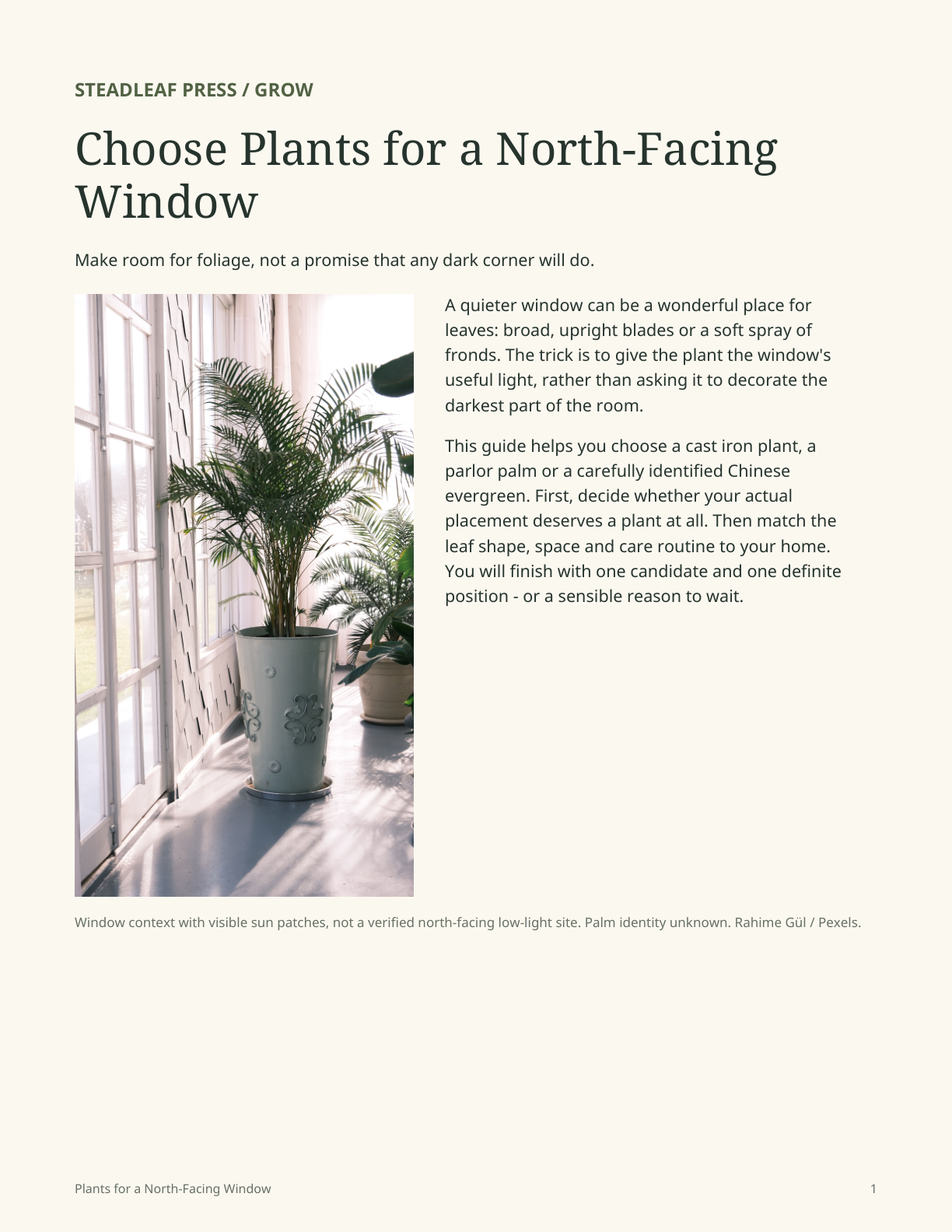
Window context with visible sun patches, not a verified north-facing low-light site. Palm identity unknown. Rahime Gül / Pexels.
Plants for a North-Facing Window 1
STEADLEAF PRESS / GROW North is a clue, not a light reading
In temperate Northern Hemisphere homes, a north-facing window is often a lower-light starting point. Minnesota Extension includes several foliage plants for such locations. But that regional advice is not a worldwide compass rule. In much of Australia, north-facing glass can receive substantial winter sun. Latitude, season, buildings, trees and overhangs all change the result. [1,2]
Check your actual window rather than assuming north means no sun. If a beam reaches the proposed leaves, use the direct-light branch below. Do not look at the sun to establish direction; a reliable plan or map is a better starting point. Write “direction uncertain” if it is uncertain.
Low-light tolerance is not a substitute for daylight. Plants still need light to sustain themselves; lower light can mean slower growth and less water use. A specimen staying green for a short time does not establish that the position will support it long-term. [1]
The cover photograph shows a window, a potted palm and visible sun patches on the floor. Its orientation, species and growing history are unknown. It illustrates a place to observe, not a verified north-facing or low-light planting.
Plants for a North-Facing Window 2
STEADLEAF PRESS / GROW Give the leaves a fair starting position
Choose two possible places before choosing the plant: A, safely near the usable window opening, and B, the decorative position you originally had in mind. They may be the same place. Mark where the leaves would sit, not just where the pot would stand.
Compare them during local daylight with curtains and blinds in their normal positions. Check at more than one part of the day, including any time a beam might reach the window. Notice whether a wall, furniture, deep reveal or dense canopy blocks the view of the bright opening. Record cloud conditions and anything you could not observe.
You are making a practical comparison, not measuring plant-usable light. Human eyes adapt to dimness; a phone photograph can brighten a dark room automatically. Neither a pleasant-looking photo nor the ability to read a page proves that a particular plant has enough light.
What you find Placement decision What happens next
A receives daylight from an Prefer A, provided it is stable and Consider the shortlist; do not promise open window area; B is leaves clear the glass and window the same result at B noticeably farther into the dim operation room
Both positions are heavily Defer the plant choice rather than Find a more usable window position or blocked, normally curtained or treating “low light” as permission seek a plant-specific light assessment uncertain
A direct beam reaches the This is not simply a low-light site, Find a protected indirect-light position proposed leaves whatever the compass says and observe it again before using this shortlist
The best-lit place is cold, Reject that particular placement Try a stable nearby alternative; drafty, unstable or inaccessible brightness does not cancel the other for care problems
No fixed distance from glass works for every window. A small obstructed opening and a broad unobstructed one do not create identical conditions. Keep leaves off cold glass, away from heat outlets and clear of handles and curtains. Never use an unsecured high shelf to solve a light or pet-access problem.
Plants for a North-Facing Window 3
STEADLEAF PRESS / GROW A shortlist with three different commitments
These are foliage choices, not a promise of flowers or rapid filling-out. Read the final column before choosing. Exact identity matters: a common name or a similarly shaped leaf is not enough.
Candidate What it brings Light and care starting Choose something else point if...
Cast iron plant - Aspidistra Broad upright leaves Lower-light candidate; You need a tiny elatior and a calm, substantial avoid direct sun. Draining permanent footprint or shape mix, with moisture want fast growth checked rather than automatic watering
Parlor palm - Chamaedorea Fine fronds and a Bright indirect light is Fronds cannot spread elegans softer, spreading preferred; lower light clear of traffic, glass and silhouette tolerated. Let the mix dry curtains slightly, not remain soggy
Chinese evergreen - Plain green, A documented Children or chewing pets Aglaonema modestum lance-shaped foliage low-light-tolerant species; can access it, or the exact indirect light and a plant identity is uncertain draining pot
The cast iron plant and parlor palm have exact ASPCA entries listing them as non-toxic to cats and dogs. Chinese evergreen is listed as toxic. Those categories do not make any plant edible or certify it safe for children. [3-8]
Plants for a North-Facing Window 4
STEADLEAF PRESS / GROW Cast iron plant: let the shape stay simple
Aspidistra elatior suits someone who enjoys broad leaves without expecting a quick transformation. NC State describes it as slow-growing, suitable for containers and lower-light situations, with a strong preference for shade rather than direct sun. Its outdoor shade description is not an indoor light measurement. [3]
Think about the full leaf spread, not only the pot width. A small plant may eventually need a floor-level or low-table position with room around it. Measure that space before committing. Choose a stable pot with drainage and a suitable draining mix; drought tolerance is not a reason to ignore moisture indefinitely. [3]
Good fit: a protected, daylit position where broad leaves can remain clear of the window and you are happy with unhurried growth.
Not a rescue plant: if the only available position is a closed-curtain recess, improve the placement first. Do not use its common name as a guarantee against every form of neglect.
Photograph description: variegated Aspidistra elatior leaves beside a wooden window. Cultivar and exposure are not established; other plants in the frame are not shortlist recommendations.
Aspidistra elatior. rrei320 / CC BY 2.0. Botanical form reference.
Plants for a North-Facing Window 5
STEADLEAF PRESS / GROW Parlor palm: leave air around the fronds
Chamaedorea elegans is a different choice from a broad-leaved Aspidistra. Its fronds occupy space sideways as well as upward. Nursery pots often contain several seedlings, so the apparent “bush” is not necessarily one branching palm. Allow room to reach the pot without repeatedly bending foliage. [4]
NC State recommends bright indirect light while noting tolerance of lower light. That distinction matters: choose the usable window area rather than assuming the palm prefers a dim corner. A north-window label is only a starting suggestion in the source's regional context. [4]
Use a well-drained medium and let it dry slightly between waterings. Avoid cold drafts and standing water. Check the mix before watering; a palm in a dimmer position may not follow the same routine as another plant in a sunnier room. [1,4]
Good fit: you want fine-textured foliage and can leave a generous, accessible space around it.
Identity and access: ASPCA's non-toxic listing is specifically for Chamaedorea elegans, not everything sold as a palm. NC State separately notes that juice from its fruit can irritate skin. Keep plant parts out of mouths and avoid unnecessary contact with fruit juice. [4,7]
Photograph description: a small potted Chamaedorea elegans with several slender stems and green fronds. Cindy Christian's botanical reference identifies the species, not the light adequacy of your home.
Chamaedorea elegans. Cindy Christian / CC BY 4.0.
Plants for a North-Facing Window 6
STEADLEAF PRESS / GROW Chinese evergreen: a choice with an access limit
Here the candidate is Aglaonema modestum, not any colorful plant sold under the broad Chinese-evergreen name. Clemson describes this species' plain green, lance-shaped foliage and tolerance of very low light. Many Aglaonema cultivars and hybrids differ; do not transfer that description to an unidentified red or silver plant. [5]
Treat this as an option only after the placement passes the earlier checks. Tolerance is not evidence that an unlit shelf will work. Use indirect light, a pot with drainage and a mix that does not stay waterlogged. Clemson advises allowing the upper layer to dry between waterings while avoiding prolonged excessive wetness. [5]
The important limit is access. ASPCA identifies Aglaonema modestum as toxic to dogs and cats because of insoluble calcium oxalates; chewing can irritate the mouth and cause other symptoms. NC State also warns of human irritation from Aglaonema tissues and sap. Do not choose it where a child or pet could chew or handle it unsafely. [8,9]
Good fit: an accurately identified foliage plant in an adult-managed position with reliably restricted access.
Choose another option: access cannot be controlled, or the plant is labeled only “assorted tropical.” Even the other candidates still need sensible placement and supervision.
No photograph is offered as identification proof for this candidate. Retain the scientific-name label and confirm it with a knowledgeable grower or plant specialist.
Plants for a North-Facing Window 7
STEADLEAF PRESS / GROW Keep the choice revisitable
Make one placement decision, then watch the real plant rather than repeatedly rearranging it for photographs. Record a baseline description of its leaves and position. Check moisture when you check the plant; do not add water merely because growth is slow.
A change in foliage, unusually extended stems or leaf loss is a reason to reassess, not a diagnosis of light alone. Root conditions, watering, temperature and pests can also matter. If decline continues, get plant-specific help rather than moving a stressed plant straight into strong sun. [1,4,5]
Revisit the window when the season changes, trees leaf out, an overhang changes the sky view or your curtain routine changes. A position chosen in one season is not a permanent light certificate.
My north-window choice card
Window / room: ______________________________________________
Location and season: _________________________________________
Direction known or uncertain: _________________________________
Position A / proposed leaf height: ______________________________
Position B / why it differs: ____________________________________
What blocks light in the normal daily setup? ____________________
Direct beam observed / not observed / uncertain: ________________
Observation dates, weather and gaps: __________________________
My decision: choose a candidate / change position / defer
Exact plant name and reason: __________________________________
Space, drainage and access checks still needed: _________________
What will trigger my next placement review? ____________________
A completed card can end with “not yet.” That is a successful result when it prevents an unsuitable plant from becoming another thing to worry about.
Plants for a North-Facing Window 8
STEADLEAF PRESS / GROW Sources
Primary guidance checked 2 November 2026. This is an original editorial decision aid, not a measured light test or a record of physical plant trials. Regional advice is applied with local observation; no universal lux threshold is prescribed.
1. University of Minnesota Extension, Lighting for indoor plants and starting seeds. Light sufficiency, lower-light growth and water use; regional window examples. https://extension.umn.edu/garden-and-home/yard-and-garden/gardening-in-minnesota/lighting-for-indoor-plants
2. Australian Government, Your Home: Orientation. Northern solar access in Australia and seasonal/site effects. https://www.yourhome.gov.au/passive-design/orientation
3. NC State Extension Gardener Plant Toolbox, Aspidistra elatior. https://plants.ces.ncsu.edu/plants/aspidistra-elatior/
4. NC State Extension Gardener Plant Toolbox, Chamaedorea elegans. https://plants.ces.ncsu.edu/plants/chamaedorea-elegans/
5. Clemson Cooperative Extension, Chinese Evergreen (Aglaonema) Care, Cultivation & Growing Guide. Species distinctions and indoor care. https://hgic.clemson.edu/factsheet/chinese-evergreen-aglaonema-care-cultivation-growing-guide/
6. ASPCA, Cast Iron Plant: Aspidistra elatior. Dog/cat classification. https://www.aspca.org/pet-care/aspca-poison-control/toxic-and-non-toxic-plants/cast-iron-plant
7. ASPCA, Parlor Palm: Chamaedorea elegans. Dog/cat classification. https://www.aspca.org/pet-care/aspca-poison-control/toxic-and-non-toxic-plants/parlor-palm
8. ASPCA, Chinese Evergreen: Aglaonema modestum. https://www.aspca.org/pet-care/aspca-poison-control/toxic-and-non-toxic-plants/chinese-evergreen
9. NC State Extension Gardener Plant Toolbox, Aglaonema. Genus-level human irritation and drainage cautions, not exact-species identification. https://plants.ces.ncsu.edu/plants/aglaonema/
Plants for a North-Facing Window 9
STEADLEAF PRESS / GROW Photograph credits
Cover: Indoor Sunlit Palm Plant by Window, Rahime Gül / Pexels. Pexels License. Full frame, proportionally scaled; no retouching. Palm identity and window orientation unknown. https://www.pexels.com/photo/indoor-sunlit-palm-plant-by-window-30412457/ License: https://www.pexels.com/license/
Cast iron plant: IMG_7024, rrei320 / Flickr; species attribution from NC State Plant Toolbox, CC BY 2.0. Full frame, proportionally scaled; no retouching. Species identified by source. https://www.flickr.com/photos/27673266@N05/2582887667 License: https://creativecommons.org/licenses/by/2.0/
Parlor palm: Chamaedorea elegans houseplant, Cindy Christian / NC State Plant Toolbox, CC BY 4.0. Full frame, proportionally scaled; no retouching. Species identified by source. https://plants.ces.ncsu.edu/plants/chamaedorea-elegans/ License: https://creativecommons.org/licenses/by/4.0/
All three are real photographs. None establishes direction, measured light, a safe planting arrangement or a tested growing result. No generated images are used.