Tell Compaction From Normal Potting-Mix Settling
A lower surface is a clue, not a command to repot.
Record height and function separately, check competing causes and choose watch, correct a known cause or investigate further.
FREE · No email or checkout
Free practical guide. No email or payment required. Photos are contextual illustrations, not proof of measured conditions or physical trials.
Read the complete free guide online
Read the instructional text here, or download the complete free PDF above for original diagrams, tables, worksheets and page layout. The original publication is unchanged.
STEADLEAF PRESS / GROW Tell Compaction From Normal Potting-Mix Settling
A lower surface is a clue, not a command to repot.
A little more space below the rim can be perfectly ordinary. What matters is how the mix and plant are behaving together. This guide helps you look at one pot, notice what has changed and choose a useful next step without digging through healthy roots.
Make a simple observe / check / act card for an ordinary indoor plant in potting mix and a pot with drainage holes. You will finish with one of three decisions: keep watching, correct an obvious care or drainage problem, or investigate the root environment before repotting.
Specialist orchid media, hydroponics, aquatic plants and designed self-watering systems need their own guidance. Bring a notebook, a phone camera if useful and your plant's care information. No special meter is required.
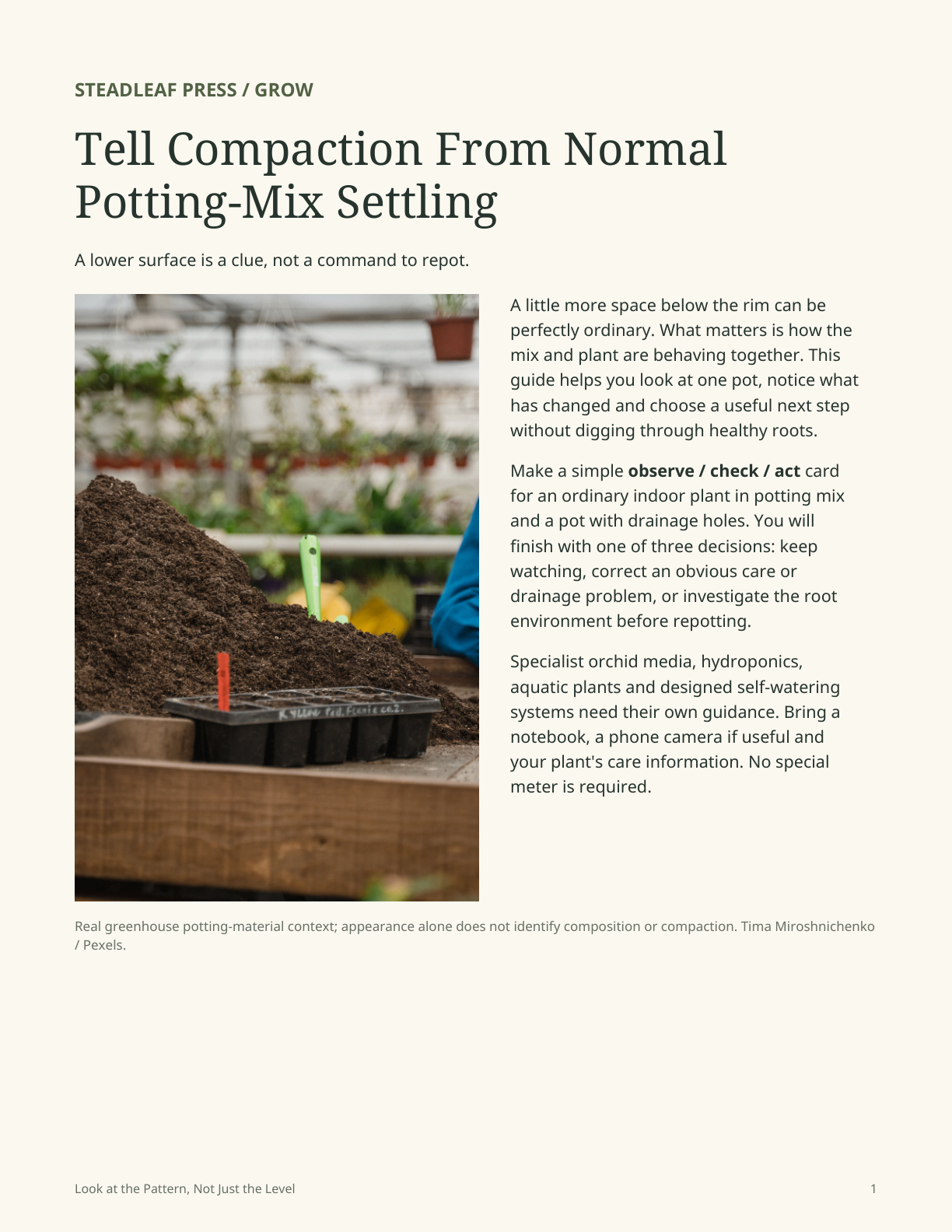
Real greenhouse potting-material context; appearance alone does not identify composition or compaction. Tima Miroshnichenko / Pexels.
Look at the Pattern, Not Just the Level 1
STEADLEAF PRESS / GROW First, separate height from function
Settling describes a change in level. Compaction describes a reduction in pore space. These are not perfectly separate categories. Fresh mix can settle after watering; older organic ingredients can also break down, reducing volume and changing the balance of air and water. [1,2]
A surface that sits lower than it used to does not, by itself, tell you whether roots have enough air. A small early change followed by familiar watering behaviour is different from continuing shrinkage together with persistent wetness or poor wetting.
Think in two columns: What can I see? What has the pot started doing differently? Keep those answers separate until you have checked the other likely causes.
There is no universal number of millimetres of settling, minutes of drainage or days between waterings that diagnoses harmful compaction in every mix and pot.
Visible space between mix and rim. This ruler is not a compaction test or a target depth; keep tools out of the roots. Kathleen Moore / NC State Extension, CC BY 2.0.
Look at the Pattern, Not Just the Level 2
STEADLEAF PRESS / GROW A gentle inspection, in four steps
1. Remember the starting point
Note when the plant was last potted, if known. Did the level change soon afterwards, gradually over a long time, or after a spell of very dry mix? Record any recent move, cooler room, lower light, new cover pot or change in watering. Write "unknown" instead of inventing a baseline.
2. Look without digging
From the side, notice the gap below the rim, the plant's existing soil line and any visible roots. From above, note uneven washout, a gap at the pot wall, a surface crust or a crowded mat of roots. Take a picture from the same angle next time. Keep the root ball in its pot for this first inspection.
3. Check the simple drainage route
If the pot is safely manageable, look at the accessible outlets and any saucer or outer cover. Empty collected water and remove an obvious external obstruction without poking into the root ball. Support the container, not the foliage. An outlet you cannot inspect stays an unknown, not a presumed blockage. [3]
4. Observe at the next genuinely needed watering
Use your plant's normal moisture check and care needs first. When watering is due, notice whether water enters the surface, runs down a wall gap or collects on top. Afterwards, notice whether the mix has actually moistened where you can check gently, and whether runoff can escape. A damp surface alone does not describe the whole root zone. Do not add extra water just to run a test. [3,4]
Look at the Pattern, Not Just the Level 3
STEADLEAF PRESS / GROW Read the pattern, not one symptom
What you notice What it may mean Useful next check
Lower surface after recent Ordinary settling may be enough Keep the planting depth unchanged and potting; familiar wetting and to explain it compare at the next care check. drying; plant steady
Very dry mix pulled away from Dry shrinkage and poor rewetting, Check whether the root zone is still dry; the wall; water escapes around not proof of dense wet mix use plant-appropriate rewetting guidance. the edge
Pot stays wetter than its A mix problem is possible, but so Check those causes before deciding that previous pattern; plant are excess watering, trapped the mix needs replacing. declines runoff, a large pot or changed conditions
Exposed roots or roots Root crowding or lost surface mix Seek a plant-specific root/repotting crowding accessible outlets; may be involved assessment; do not cut or pull roots just to increasingly rapid drying complete this card.
Dry shrinkage is described by Illinois Extension; wetness and wilting have several possible causes in Iowa State's diagnostic guidance. Illinois also lists root crowding among repotting indicators. These are decision clues, not a diagnosis from appearance. [3,4,5]
Look at the Pattern, Not Just the Level 4
STEADLEAF PRESS / GROW Choose the smallest helpful action
Keep watching
If the plant is stable, its planting depth is intact and wetting/drying remain appropriate, leave the roots alone. Save today's photo or note and compare during your next normal care check. A lower level is not a reason to press the surface flat or buy a bigger pot.
Correct what you can actually identify
If runoff is trapped, empty it and restore free drainage. If watering has been too frequent for the current conditions, return to moisture-led care. If very dry mix is shedding water around its edges, address rewetting rather than labelling it compaction. Get guidance suited to the plant and medium; avoid household-detergent recipes or repeated flooding. [3,4]
Investigate a persistent problem
If poor wetting or prolonged wetness continues after those checks, or the plant is deteriorating, ask a local extension service or knowledgeable grower to assess the plant, mix and roots. Bring the card and photographs. Old, broken-down mix may need replacement even when the plant does not need a larger pot. Repotting timing and root handling should suit the species and its condition. [5,6]
Look at the Pattern, Not Just the Level 5
STEADLEAF PRESS / GROW Protect the planting depth
Do not fill a sinking pot back to the rim by burying the stem base or crown. A plant that has sunk with its whole root ball is different from a little mix washed away from the surface. Keeping the original planting depth matters. [2,5]
If previously covered roots are exposed, note the location and seek a suitable surface correction. A light surface adjustment may sometimes be enough; it cannot repair a poorly functioning root zone underneath. Leave a full top-layer refresh or repotting sequence for the appropriate task. [2]
Kind to roots, useful to you: avoid tamping, repeated squeezing or pushing sticks through the pot to "make air holes." This inspection does not require unpotting, scraping off roots or mixing new ingredients into an occupied root ball. If handling bagged mix later, follow its label and local dust/hygiene guidance; wash your hands after plant care.
Two invented examples
A recently potted plant: the surface is slightly lower, the crown remains at its original soil line, and normal watering still moistens the mix. Decision: photograph and watch, rather than automatically topping up.
An older pot: the mix is staying wet longer, but inspection finds water inside its decorative cover. Decision: remove that water and correct the routine first. If the problem persists, investigate the mix and roots. Finding one cause does not prove there are no others.
Look at the Pattern, Not Just the Level 6
STEADLEAF PRESS / GROW Your inspection and action card
Plant / exact identity if known: ______________________________
Date / last potting date or unknown: __________________________
Mix / pot / outer cover, if known: ______________________________
Observation Today Next normal care check
Surface level / existing planting depth __________________ __________________
Wall gap, crust, washout or visible __________________ __________________ roots
Moisture and wetting behaviour __________________ __________________
Outlets / collected water / unknowns __________________ __________________
Plant condition / recent environment __________________ __________________ change
My decision: keep watching / correct a known cause / investigate further
One action and why: _________________________________________
What would make me change that decision? _____________________
Next check date: ______________ Question to ask: ______________
This is a blank record for your own observations, not a completed experiment. Check sooner if the plant deteriorates; do not wait for the written date to respond to a developing problem.
Look at the Pattern, Not Just the Level 7
STEADLEAF PRESS / GROW Sources
Primary horticultural references checked 2 November 2026. The observation card, examples and decision sequence are original editorial tools, not a validated compaction test.
1. Iowa State University Extension, How do I determine the amount of soil needed to fill a container or raised bed? Settling after filling. https://yardandgarden.extension.iastate.edu/faq/how-do-i-determine-amount-soil-needed-fill-container-or-raised-bed
2. NC State Extension, Extension Gardener Handbook, chapter 18: Plants Grown in Containers. Watering-in, pore-space changes, planting depth and surface exposure. Only those principles are used here; no detergent treatment or fixed repotting schedule. https://content.ces.ncsu.edu/extension-gardener-handbook/18-plants-grown-in-containers
3. Iowa State University Extension, Diagnosing Houseplant Problems from Improper Environmental Conditions. Distinct wet/dry causes and environmental checks. https://yardandgarden.extension.iastate.edu/how-to/diagnosing-houseplant-p roblems-improper-environmental-conditions
4. Ken Johnson, Illinois Extension, Helpful tips for creating a successful container garden. Dry shrinkage, wall gaps and rewetting difficulty. https://extension.illinois.edu/blogs/good-growing/2022-04-08-helpful-tips-creating-successful-container-garden
5. Illinois Extension, Repotting. Root-crowding indicators, species variation and original planting depth. https://extension.illinois.edu/houseplants/repotting
6. Iowa State University Extension, How to Care for Houseplants. Breakdown of older mix and appropriate repotting decisions. https://yardandgarden.extension.iastate.edu/how-to/how-care-houseplants
Look at the Pattern, Not Just the Level 8
STEADLEAF PRESS / GROW Photograph credits
Cover: Tima Miroshnichenko, Soil on Top of a Table. A real mound of material and seedling tray on a wooden greenhouse bench. The composition, moisture and compaction of the material are not established by its appearance. Source: https://www.pexels.com/photo/soil-on-top-of-a-table-6509135/
Pexels License: https://www.pexels.com/license/
Interior: Kathleen Moore, Figure 18-9, Reservoir space is measured after initial watering, NC State Extension Gardener Handbook. A real ruler beside the surface and rim of a planted pot. It illustrates the space being observed, not a recommended depth, compaction reading or instruction to insert a tool among roots. Source: https://content.ces.ncsu.edu/extension-gardener-handbook/18-plants-grown-in-containers
Creative Commons Attribution 2.0: https://creativecommons.org/licenses/by/2.0/
Both photographs retain their full frames. Changes: proportional print-resolution resampling where needed and PDF image encoding only. No retouching, recolouring or generated imagery. Original photographer processing is not excluded. The photographs are not Steadleaf plant trials, before/after comparisons or species recommendations. The CC BY photograph retains its stated licence; no additional restriction is imposed on that image.