Divide a Crowded Clumping Plant
Division Criteria and Step Sequence
Decide whether division fits, prepare destinations, lift and separate viable rooted sections safely, replant at species-appropriate depth and record aftercare.
FREE · No email or checkout
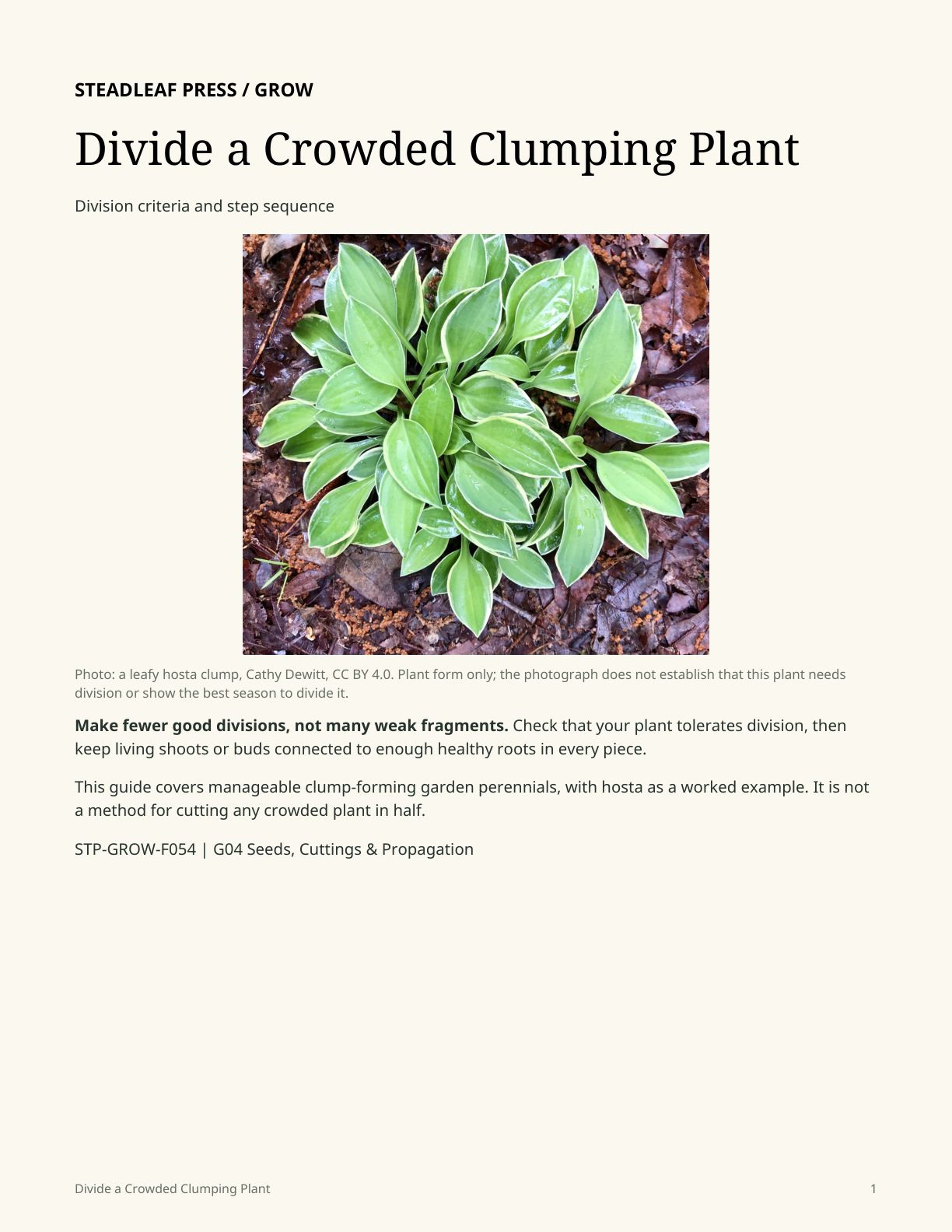
Free practical guide. No email or payment required. The photograph shows a leafy hosta clump; plant form, not a crowding diagnosis or division demonstration or endorsement.
Read the complete free guide online
Read the instructional text here, or download the complete free PDF above for original diagrams, tables, worksheets and page layout. The original publication is unchanged.
STEADLEAF PRESS / GROW Divide a Crowded Clumping Plant
Division criteria and step sequence
Photo: a leafy hosta clump, Cathy Dewitt, CC BY 4.0. Plant form only; the photograph does not establish that this plant needs division or show the best season to divide it.
Make fewer good divisions, not many weak fragments. Check that your plant tolerates division, then keep living shoots or buds connected to enough healthy roots in every piece.
This guide covers manageable clump-forming garden perennials, with hosta as a worked example. It is not a method for cutting any crowded plant in half.
STP-GROW-F054 | G04 Seeds, Cuttings & Propagation
Divide a Crowded Clumping Plant 1
STEADLEAF PRESS / GROW Decide whether division fits
Crowding, reduced performance or an old bare centre can be reasons to consider division in suitable perennials. They are not proof that division will fix poor light, drought, pests or disease. Healthy mature hostas do not need routine division just to remain healthy. [1, 2]
Decision What to establish first
Consider dividing Identified species tolerates division; a healthy clump has outgrown its space or you want more plants.
Wait Plant is newly established, badly stressed, flowering heavily, or the weather and aftercare are unsuitable.
Use another approach Plant has a difficult deep taproot, a single inseparable growing point, or unknown division requirements. Research the species before lifting.
False indigo (Baptisia) and butterfly weed (Asclepias tuberosa) are poor beginner choices because of difficult root systems. Being perennial does not mean being easy to divide. [1]
What a viable piece needs
The crown is the junction where shoots meet roots. Plan pieces that each retain living shoots or growth buds, healthy crown tissue and attached roots. A handful of loose leaves or a rootless shoot is not a complete division. Do not assume every bare root piece can become a new plant.
Hosta example: Iowa State advises at least two or three emerging points plus a good share of crown and roots per section. That is hosta guidance, not a universal count for every species. [3]
Divide a Crowded Clumping Plant 2
STEADLEAF PRESS / GROW Choose timing and prepare the landing place
Use plant stage and local conditions
For hosta, spring as growing tips emerge is a useful beginner window. Other perennials differ: some are divided after flowering or in another season. Check a species-specific guide and your local climate instead of copying a calendar month from another region. [2, 4]
Choose a cool, cloudy day where possible. If soil is dry, water ahead of time so the root zone is moist, not waterlogged. Avoid frozen ground, saturated soil and hot drying weather. For a suitable autumn division in a cold climate, leave roughly four to six weeks before the ground freezes for establishment. [5]
Prepare before lifting
Have the receiving holes or draining pots ready, with suitable soil or potting mix, labels and water. Allow space for the plant's mature size. Keep a shaded spot and damp covering available for exposed roots if there is a short delay. [2, 4, 5]
Clean soil and debris from tools before disinfecting them with a suitable product used according to its label. Never mix disinfectants or put them on roots. Use gloves and sturdy footwear. Choose a manageable clump; get help if its weight or toughness exceeds your tools or strength. [6]
Do not start without a destination: leaving divided roots exposed while you search for pots defeats the preparation.
Divide a Crowded Clumping Plant 3
STEADLEAF PRESS / GROW Lift and separate deliberately
1 Loosen the whole root ball
Work a spade or garden fork around the clump, outside the crown, loosening the root ball before lifting. Support the root mass from underneath. Do not haul the plant out by its leaves or force it against roots that are still anchored. Gently remove loose soil so you can see the structure. [4, 5]
2 Find a useful separation line
Look for natural gaps between rooted shoots or crown sections. Try gentle hand separation when the structure allows it. For a dense hosta clump, a sharp spade or suitable garden knife may be needed. Rest the clump securely and keep hands, feet and helpers out of the cutting path. Stop rather than using uncontrolled force. [2]
3 Check each proposed piece
Before each separation, trace its shoots or buds down to attached roots. Retain generous roots rather than chasing the maximum number of pieces. Keep divisions shaded and roots moist during the work. [2, 5]
An old, dry dead centre may be discarded while healthy outer sections are kept. Soft, foul-smelling or spreading dark tissue is different: pause, isolate suspect material and seek plant-specific diagnosis. Do not distribute it or assume cutting around it cures disease. [1]
Success at this stage: a few sturdy rooted sections with living growing points, not a pile of disconnected foliage.
Divide a Crowded Clumping Plant 4
STEADLEAF PRESS / GROW Replant and follow through
Set each division promptly into a hole roomy enough for its roots. Replant at the species-appropriate depth; for the hosta example, keep the previous soil level rather than burying the crown. Backfill gently and water to settle the soil around roots. [1, 2]
For dormant bare-root hosta divisions, the crown sits level with surrounding soil and growing tips remain visible at the surface. Do not transfer this exact depth rule to peony eyes, iris rhizomes or an unidentified plant. [2]
Aftercare is part of division
Label the plant and date. Check moisture around the root zone, not only the dry-looking surface. Keep the soil appropriately moist while roots establish, without leaving it saturated or a pot standing in water. Mulch can conserve moisture; keep it away from the hosta crown. [1, 2]
Check again after watering, on the following day and through establishment, especially in dry or windy weather. Wilting calls for checking moisture, drainage and exposure, not automatically adding more water. Do not repeatedly dig up a division to look for new roots.
If immediate planting becomes impossible, pot the sections temporarily and protect them in shade or part shade, watering as needed. Replant in their permanent place as soon as practical. [1]
Allow recovery: a newly divided perennial may not bloom well straight away. More fertilizer is not a substitute for intact roots, suitable placement and steady aftercare.
Divide a Crowded Clumping Plant 5
STEADLEAF PRESS / GROW Bench check before each division
Go only when these are true
[ ] I know the species and have checked that it tolerates division. [ ] There is a reason to divide; the plant is not merely large and healthy. [ ] Timing, weather and the aftercare plan suit this species. [ ] Receiving holes or pots, labels and water are ready. [ ] Tools are clean and used safely; the clump is manageable. Check every piece not just the first
[ ] Living shoots or buds remain connected to crown tissue and roots. [ ] Roots are generous enough for this species, not stripped to bare stubs. [ ] I have not kept suspect decaying tissue to increase the count. [ ] Exposed roots stay shaded and moist until replanted. [ ] Replanting depth and mature spacing are appropriate. [ ] Each section is watered, labeled and scheduled for another check. Pause point: if you cannot identify viable rooted sections, stop dividing. Protect the root ball and get species-specific help rather than making smaller random pieces. My next check: date __________ time __________ One thing still needed: ________________________________________________________
Divide a Crowded Clumping Plant 6
STEADLEAF PRESS / GROW Keep a division record
Use this page for one parent clump. Note the actual condition and follow-up rather than assuming every section will survive.
Decision to record My notes
Plant name and reason for division __________________________ __________________________
Species guidance and chosen timing __________________________ __________________________
Date and number of rooted sections __________________________ __________________________
New locations and planting depth __________________________ __________________________
Follow-up moisture and plant condition __________________________ __________________________
Next action: observe / adjust watering or exposure / seek diagnosis / postpone further division What I would change next time: ________________________________________________________ ________________________________________________________
Divide a Crowded Clumping Plant 7
STEADLEAF PRESS / GROW Sources and photo credit
Primary guidance checked 2 November 2026. Hosta-specific advice is labeled; division timing, frequency and depth are not universal.
1. Iowa State University Extension - Reasons, exceptions and division sequence.
2. University of Minnesota Extension - Hosta planting and division.
3. Iowa State University Extension - Hosta timing and viable sections.
4. Royal Horticultural Society - Dividing perennials and aftercare.
5. University of Minnesota Extension - Division timing, root protection and exceptions.
6. University of Minnesota Extension - Cleaning tools and containers.
Photo: Cathy Dewitt, form, hosta gallery image 23031, via NC State Plant Toolbox, CC BY 4.0. Full frame proportionally resized and JPEG encoded. No endorsement implied or additional restrictions on the licensed photograph. This plant-form image is not a diagnosis of crowding or a division demonstration.
Scope: an original Steadleaf Press decision aid and practical sequence, not advice to divide every species or a guarantee of recovery. Seek local horticultural advice for uncertain identity, suspected disease or a difficult large clump.