Pair Trailing and Upright Blooms in One Planter
A two-layer planning sheet for a flowering container, with room left for the gardener as well as the plants.
A two-layer planning sheet for a flowering container, with room left for the gardener as well as the plants.
FREE · No email or checkout
Read the complete free guide online
Read the instructional text here, or download the complete free PDF above for original diagrams, tables, worksheets and page layout. The original publication is unchanged.
STEADLEAF PRESS / GROW
Pair Trailing and Upright Blooms in One Planter
A two-layer planning sheet for a flowering container, with room left for the gardener as well as the plants.
A practical growing guide with observation tools and original planning examples.
STEADLEAF PRESS / GROW / F083 1
A trailing flower can soften the rim of a pot. An upright one can give the display a clear outline. The difficulty is not finding two attractive plants. It is making sure their future shapes and their care requirements can share the same space.
This guide produces a paper arrangement before you plant. It is for an accessible, stable container in an already suitable position. It does not specify brackets, balcony loads, hanging systems or a universal number of plants per pot. The two layers are visual roles above the growing medium, not separate layers of soil or buried root balls.
1. Give the two roles names
Call the upright flowering choice U and the trailing flowering choice T. Use exact cultivar or series names wherever available. A broad plant name may include both compact and vigorous forms.
RHS lists upright bedding choices and trailing choices separately; its trailing examples include Calibrachoa, ivy-leaved pelargoniums and trailing forms of petunia and verbena. These are leads for investigation, not proof that any two named plants make a suitable pair. Check their individual needs and mature dimensions. [1]
Container design is often described with three roles: a tall focal plant, a middle filler and a trailing spiller. Missouri Extension describes this vocabulary and emphasizes avoiding crowding while matching growing requirements. [2] Our two-role sheet is a deliberately simpler editorial exercise, not a claim that every pot needs all three roles or exactly two individual plants. Do not add a filler merely because a formula seems incomplete.
Identity card
U: exact name ____; label or supplier reference ____
T: exact name ____; label or supplier reference ____
Flowering period expected locally: U ____; T ____
Growth habit confirmed for these particular choices: ____
If the plant's identity or habit is unclear, postpone the pairing. A nursery display in full bloom does not tell you what the combination will look like several weeks later.
STEADLEAF PRESS / GROW / F083 2
2. Check the shared conditions before the colours
Illinois Extension identifies compatible light and moisture requirements as a condition for combining plants. [3] A shared pot does not let you provide two independent root environments simply by watering one side more often.
Make the following comparison using plant labels, named-cultivar information and local horticultural advice. Record the information source, not just a tick. Blank information is a question to resolve, not permission to proceed.
Question U T Shared plan or unresolved conflict
Suitable light at this ____ ____ ____ actual site
Moisture and drainage ____ ____ ____ requirements
Suitable growing medium ____ ____ ____
Local temperature and ____ ____ ____ planting season
Mature height, spread ____ ____ ____ and trailing reach
Feeding and routine ____ ____ ____ maintenance guidance
Stop at a genuine conflict. Keep the plants in separately managed suitable containers or choose a different partner. Moving a sun-loving plant behind another plant is not a reliable way to turn the pot into two different sites.
Check household access separately, including children and animals that may reach flowers or hanging stems. Decorative use does not establish that a plant is edible or safe to chew. Confirm species-specific concerns before buying.
STEADLEAF PRESS / GROW / F083 3
3. Draw both the view and the working space
Choose where you will usually see the planter. Illinois Extension places a taller focal plant towards the back of a front-view display and nearer the middle of a display seen from all sides. [3] Treat that as a starting arrangement, not an instruction to squeeze roots against the wall of a container.
Draw a top view of the actual planting opening. Mark the main viewing side, the direction of the light and the place from which you can safely water. Those three directions may differ.
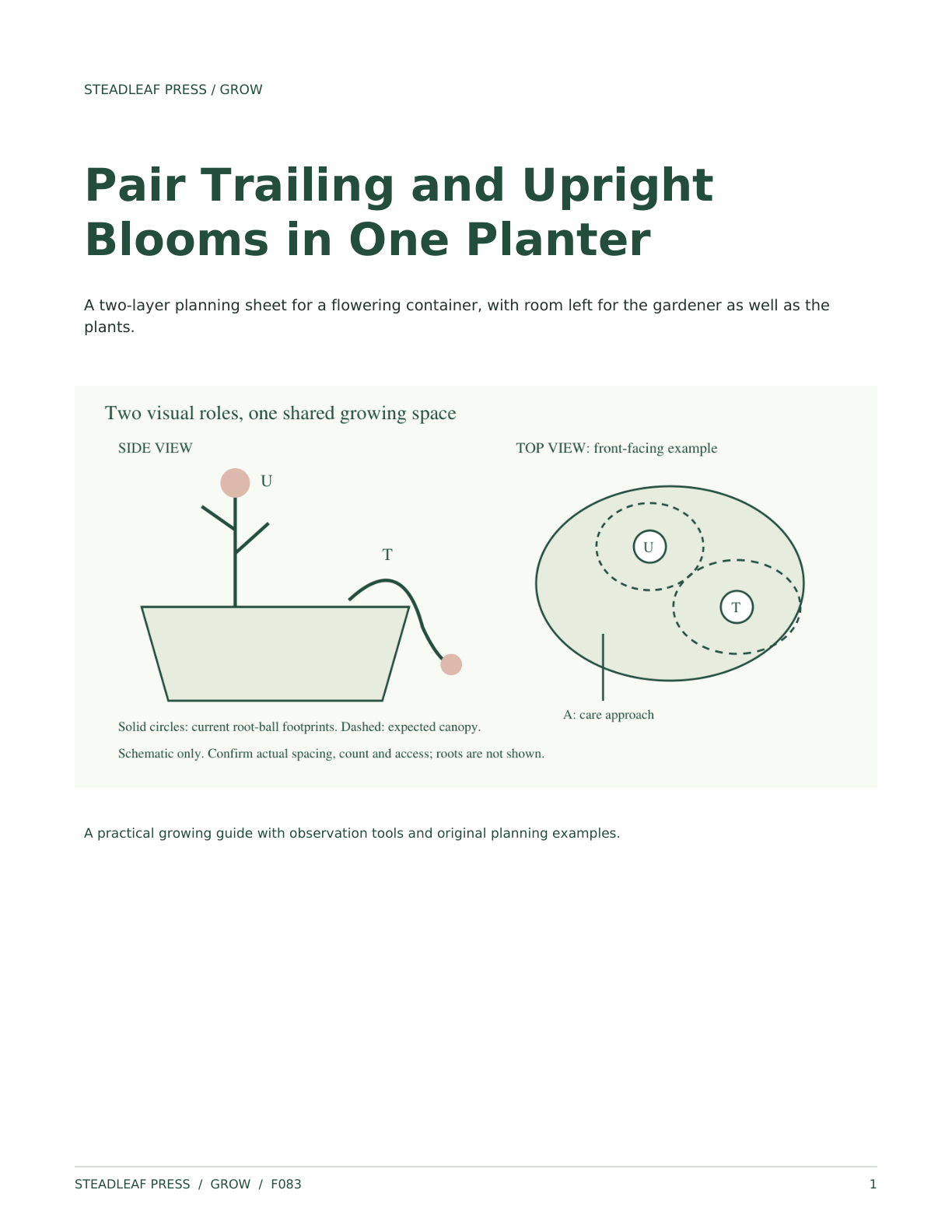
Use solid outlines for the current nursery root-ball footprints. Use dashed outlines for the expected above-ground spread, based on the named plants' guidance. They describe different things. Neither outline is a reliable prediction of the underground root system.
Two-layer sketch key
Mark Side view Top view What it must not imply
U Upright flowering outline Proposed planting A universal safe height or above the rim position and expected stake requirement canopy
T A trailing outline passing Proposed position and Permission to bend or tie over an appropriate edge anticipated direction of a stem over the rim spread
A A reachable route for A reserved approach, not A fixed centimetre watering and inspection another planting position clearance that suits every gardener
The sketch is schematic, not to scale until you add actual measurements. Plant count remains undecided until the container and named plants' spacing and root-space requirements have been checked. A diagram containing U and T symbols does not prescribe one of each for every pot.
For a front-view display, try U towards the rear portion and T towards a visible edge. For an all-round display, try U nearer the centre and choose a trailing direction that stays clear of circulation and maintenance. If the expected trail would cross a step, catch in a door or obscure drainage inspection, change the plan before planting. Do not rely on lifting a heavy planted container later to make access possible.
Sketch annotations
Container's usable internal dimensions: ____
Actual plant spacing or container recommendation, with source: ____
Expected outline at the intended review date, and uncertainty: ____
Accessible watering point: ____
Where draining water can go safely: ____
Space that must remain clear: ____
STEADLEAF PRESS / GROW / F083 4
4. Test the arrangement without committing the roots
On a safe, stable working surface, rehearse the positions with the plants still in their nursery pots if they are small enough to handle comfortably. Otherwise use paper markers. Do not balance nursery pots on a narrow rim or work over an exposed drop.
Look from the normal viewing position. Then look from your watering position. Can you identify both plants, reach the growing medium and inspect the relevant drainage arrangement without forcing a hand through stems? Does the upright outline hide the flowering part of T? Is the apparent fullness coming from plants that will soon need more room than the container offers?
Take a reference photograph or keep the paper sketch. Move the markers rather than repeatedly pulling planted roots out of the medium. If the container only works when the root balls are compressed or the planting advice is ignored, use fewer plants or a different suitable container. Recheck the safety and location of any replacement container; a heavier pot is not automatically an acceptable substitute.
Fictional example: Lina likes a compact upright candidate and a trailing candidate. Their labels indicate compatible conditions, but the trailing plant's expected reach would cover the front watering point in her first sketch. She moves that proposed position to the side on paper. From there it would extend into a narrow passage. She abandons the shared-container arrangement and keeps the two candidates in separate suitable pots. The useful outcome is a rejected layout before purchase, not a forced photograph-ready combination.
STEADLEAF PRESS / GROW / F083 5
5. Transfer the plan without turning it into a planting formula
Use appropriate container planting instructions and the named plants' guidance for medium, planting depth and spacing. This sheet does not override them. Follow local seasonal advice: RHS cautions against putting tender summer container plants outside before local frost risk has passed. [1] Its UK shopping calendar is not a worldwide planting calendar.
Place plants to develop their own habits. Do not bury a trailing plant deeply to lower its visible height or force its stems over an edge. If achieving the drawing requires an unsuitable planting depth or damaging manipulation, revise the drawing.
Record the final arrangement rather than pretending it exactly matches the sketch:
Date and named plants: ____
Actual positions or attached photograph: ____
Change from the paper layout and reason: ____
Care guidance kept with the planter: ____
First planned observation date: ____
A shared pot needs a shared care plan. Feeding products and rates should follow the plants' needs and product directions. The example fertilizing routines in display-garden articles are not universal instructions for this pair.
STEADLEAF PRESS / GROW / F083 6
6. Review the relationship, not just the flowers
At the next check, compare the arrangement with the initial photograph or drawing. Separate what you see from what you think caused it.
Observation Record Next question
U obscures part of T Which part, and from which view? Is this merely visual overlap, or does the growing situation need assessment?
T reaches a working or walking Actual direction and obstruction Can the arrangement remain space safely accessible?
One plant shows damage or weak Location, date and changes Are light, moisture, pests or growth another issue involved?
Both are accessible and growing What remains usable? Is any change actually necessary? acceptably
Do not assume that a weak trailing plant only needs more water, or that cutting back the upright one is automatically the answer. Check the species' pruning guidance and the growing conditions before intervening. If a planting must be changed, seek an appropriate removal or repotting method rather than pulling interwoven roots apart to restore the drawing.
The successful plan is not the fullest pot on day one. It is a composition you can maintain without treating either plant, or your own access, as spare space.
STEADLEAF PRESS / GROW / F083 7
Sources and scope
Sources directly consulted on 18 November 2026.
[1] Royal Horticultural Society. Containers: summer selection. Used for growth-habit examples, compatible selection and local frost timing, not its larger-display plant-count suggestion. https://www.rhs.org.uk/container-gardening/summer-selection
[2] University of Missouri Extension. Container gardening: Thrillers, fillers and spillers. Used for design vocabulary and compatible, uncrowded combinations. Its fertilizer, container-material and minimum-volume prescriptions are not adopted here. https://extension.missouri.edu/news/container-gardening-thrillers-fillers-and-spillers
[3] University of Illinois Extension, Illinois Master Gardeners. Gazebo Containers. Used for viewing-direction placement and compatible light/moisture needs. The site's own fertilizing routine is not a general recommendation. https://extension.illinois.edu/mg/gazebo-containers
The two-role sketch, comparison sheet, access check and fictional example are original editorial planning tools. They are not cultivar trials, structural approval or guarantees of flowering. No physical planting or print trial is claimed.