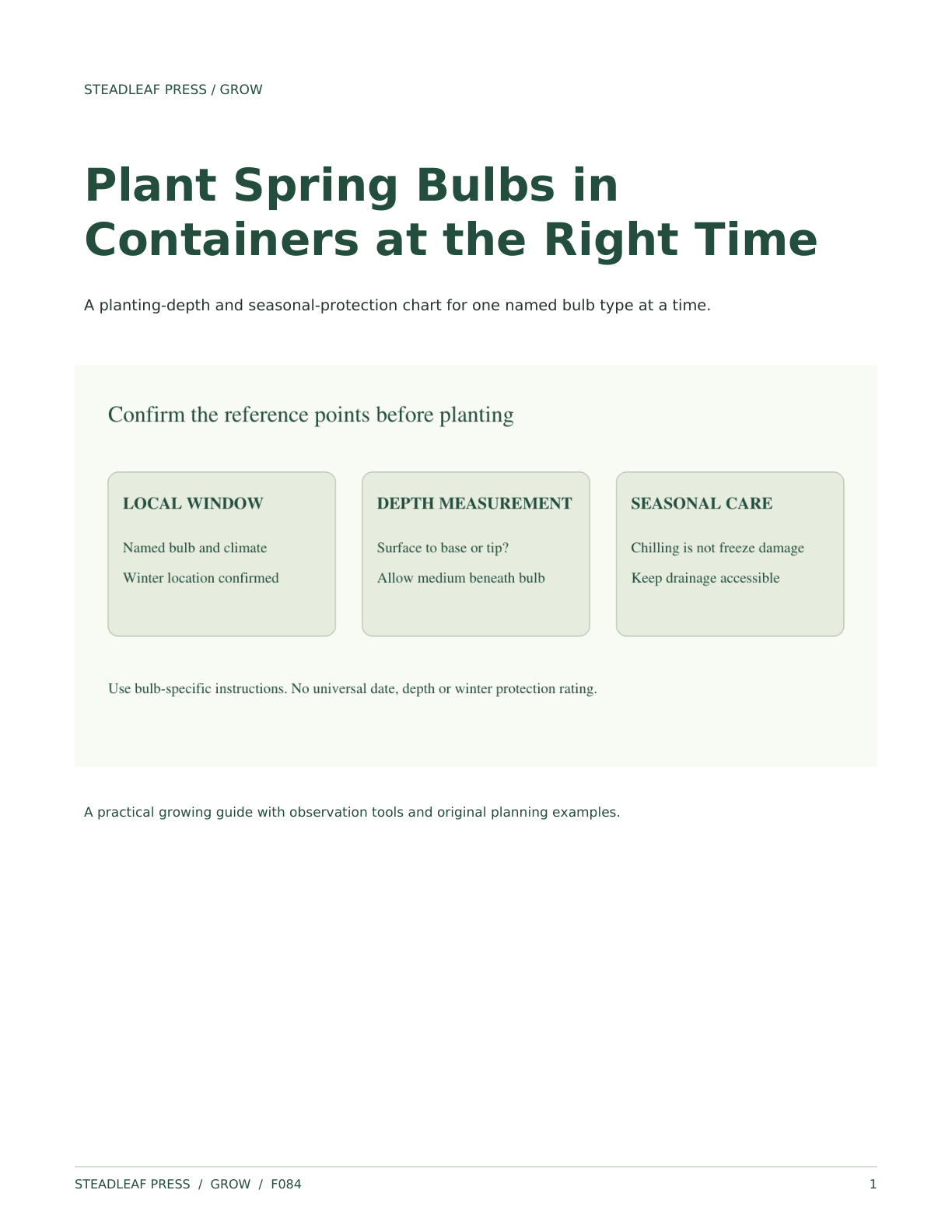
Plant Spring Bulbs in Containers at the Right Time
A planting-depth and seasonal-protection chart for one named bulb type at a time.
A planting-depth and seasonal-protection chart for one named bulb type at a time.
FREE · No email or checkout
Read the complete free guide online
Read the instructional text here, or download the complete free PDF above for original diagrams, tables, worksheets and page layout. The original publication is unchanged.
STEADLEAF PRESS / GROW
Plant Spring Bulbs in Containers at the Right Time
A planting-depth and seasonal-protection chart for one named bulb type at a time.
A practical growing guide with observation tools and original planning examples.
STEADLEAF PRESS / GROW / F084 1
The useful date is not simply the day bulbs appear in a shop. It is the planting window that fits the bulb, your climate and the place where its container will spend winter. Resolve those three things before filling the pot.
This guide is for dormant spring-flowering bulbs intended for a seasonal outdoor display. It is not an indoor forcing recipe, a refrigerator-chilling schedule or a layered bulb-pot tutorial. Start with a single named type so that its instructions can be followed without reconciling several depths and flowering times at once. Already-growing potted bulbs need their own planting advice; do not bury their foliage using a dormant-bulb rule.
1. Identify what you bought
Keep the label with the bulbs. Record the botanical name where given, cultivar, intended flowering season and whether the supplier says they have been prepared for indoor flowering. Do not substitute a guide for tender summer bulbs merely because the packet also says bulbs.
University of Minnesota Extension distinguishes hardy spring-flowering bulbs, which need a cold period, from tender summer-flowering types. Its purchasing guidance advises rejecting soft or mouldy bulbs and checking for damage. [1] Inspect before potting, rather than hiding a questionable bulb among healthy ones.
First decision card
Name and cultivar: ____
Dormant bulbs, growing plants or prepared indoor bulbs: ____
Supplier's intended use: ____
Condition on arrival: ____
Local advice applies to this bulb and an outdoor container: ____
Keep ornamental bulbs labelled and apart from food, especially onions and garlic. Do not taste them to identify them. Check species-specific handling and household-access cautions, including access by children and animals. If identity is uncertain, stop and ask the supplier.
STEADLEAF PRESS / GROW / F084 2
2. Translate the season, not just the month
RHS gives autumn planting guidance for many spring bulbs, with different UK timings for daffodils and tulips. [2] Minnesota Extension describes a different cold-climate calendar and the aim of root development before the ground freezes. [1] These are regional examples, not two dates to average.
Use a local horticultural service or a knowledgeable supplier to confirm the window for your named bulb in a container. Ask explicitly about containers; advice for bulbs insulated by garden soil is not automatically a winter plan for an exposed pot.
Item to confirm Your entry Evidence or adviser
Local autumn planting window for ____ ____ this bulb
Whether the bulb needs special ____ ____ treatment in this climate
Outdoor winter location suitable ____ ____ for the planted pot
Action if the normal planting ____ ____ window has passed
Expected flowering season, not a ____ ____ promised date
Do not solve a missed autumn window by keeping dry bulbs until the following spring without advice. RHS warns that prolonged storage and late planting can reduce flowering. [2] Nor should you improvise a warm living-room winter: required chilling and protection from damaging cold are different needs. If your climate or available storage cannot meet the bulb's requirements, choose a locally suitable alternative or buy an appropriate growing plant later.
STEADLEAF PRESS / GROW / F084 3
3. Make the depth instruction unambiguous
Read the packet's complete depth statement. Does its number describe the distance from the finished medium surface to the bulb's base, or the amount of medium above its tip? Those are different measurements. If it does not say, ask before planting.
RHS's general border example uses a bulb's height and a hole depth; its container guidance also uses a depth multiple. [2] Minnesota gives a general diameter-based rule while prioritizing the individual bulb's packet instructions. [1] Do not combine the height from one rule, the multiplier from another and an assumed measuring point from memory.
Depth translation card
Exact supplier instruction: ____
Instruction specifically suitable for this bulb in a container: ____
Measurement starts at: ____
Measurement ends at: ____
Confirmed depth, with unit: ____
Bulb height used in your drawing: ____
Spacing instruction and whether it means edge gap or centre distance: ____
Worked arithmetic example, not a planting recommendation: suppose the confirmed instruction says the base must sit 12 cm below the finished surface and your bulb is 4 cm tall. The medium above the tip would then be 8 cm. If an instruction instead required 12 cm of cover above the tip, the base would be 16 cm below the surface. The example demonstrates why the reference point matters; it does not prescribe either depth for your bulbs.
Draw a vertical section of the pot with four separate marks: rim, finished medium surface, bulb tip and bulb base. Add the growing medium required beneath the bulb, using appropriate container guidance. Leave the watering space specified by that planting method. The pot must accommodate the whole arrangement, not merely the cover above the bulb.
If the chosen container is too shallow, change the container or the plan. Do not omit the medium beneath the bulb, compress the bulb into the bottom or silently reduce the planting depth to make the drawing fit. This guide deliberately gives no universal pot size, bulb count or layer count.
STEADLEAF PRESS / GROW / F084 4
4. Choose the winter plan before planting
RHS notes that roots in containers are more exposed to cold than those in the ground and that winter waterlogging is another risk. [3] A bulb described as hardy is not therefore guaranteed to survive every winter in every above-ground pot. A frost-proof container describes the container, not the cold tolerance of its contents.
Use this chart as a set of questions for local advice, not as a temperature-rating table.
Situation Decision before planting What to keep checking
Local advice supports outdoor Record the actual suitable location Drainage, moisture and condition container overwintering and any specified protection of the pot
Severe cold or repeated freezing Obtain a bulb-specific Whether the chosen place really makes the proposed site protected-container plan, including stays within that plan unsuitable actual temperature requirements
Winters may not supply the Ask about locally suitable bulbs or Do not invent a chilling duration or required chilling a supplier-managed option household refrigerator method
Winter rain collects around or Correct the drainage arrangement Water must not remain trapped beneath the pot or choose another suitable position around the container
No suitable place or safe handling Postpone this container project or Do not rely on an emergency move method exists choose a different seasonal display after the pot becomes heavy
An unheated garage is a location description, not a temperature guarantee. Wrapping a pot is not proof that its contents are protected through a severe freeze. Obtain a method appropriate to your bulb and climate rather than copying a photograph of someone else's insulation.
Keep access, drainage and building rules intact. Do not add improvised ballast, block an exit, place a heavy container on an unverified support or lean outside a window to manage it. If the planned position changes the load or mounting arrangement, that needs a separate suitability check.
STEADLEAF PRESS / GROW / F084 5
5. Plant once the decisions are resolved
Use a sound container with working drainage and a growing medium suitable for the selected bulbs. Follow the confirmed packet and container instructions for orientation, depth and spacing. This is not a guide to cutting drainage holes or building supports.
Measure against the intended finished surface while you work. Label the pot immediately. Record what was actually planted, not just the planned shopping list. RHS's bulb-pot guide describes containers with drainage and a suitable potting medium; it also describes multi-layer displays, but that more complex arrangement is outside this single-type worksheet. [4]
Follow the relevant initial watering instructions and ensure excess water can escape. Continue to inspect the pot through winter rather than assuming dormancy means no care. Use the bulb-specific moisture guidance: neither a permanently saturated pot nor one forgotten until completely dry is the goal. [2]
Completed planting record
Actual planting date and bulb name: ____
Container and medium: ____
Depth and measuring points checked: ____
Actual count and spacing: ____
Winter location and advice followed: ____
Next inspection and person responsible: ____
STEADLEAF PRESS / GROW / F084 6
6. Change care as growth changes
When shoots appear, review the care plan for active growth and current weather. Do not put a pot into a warm room simply to accelerate the timetable unless you are deliberately following a separate, appropriate forcing method. Growth stage is more informative than a fixed watering day.
RHS's pot guide advises watering as spring growth develops without waterlogging and allowing foliage to die down naturally after flowering. [4] Keep the leaves' needs in the plan even when the flowers have faded. A flowering display is not finished on the day you remove its last bloom.
Fictional example: Mina has bought dormant bulbs but has not confirmed whether her exposed terrace is suitable for overwintering them. Rather than plant first and improvise protection later, she asks a local adviser about that exact container position. She also discovers that the packet's depth means base-to-surface, not cover above the tip. She redraws the pot section before choosing a container. The useful result is a specific plan, not a guarantee that every bulb will flower.
At the end of the display, record the outcome honestly: shoots observed, flowers observed, damaged bulbs or unresolved problems. Do not treat failure to flower as proof of one cause. Keep the label and your depth and winter records when seeking advice.
STEADLEAF PRESS / GROW / F084 7
Sources and scope
Sources directly consulted on 18 November 2026.
[1] University of Minnesota Extension. Planting bulbs, tubers and rhizomes. Regional timing, bulb condition, individual planting instructions and chilling distinction. Ground-soil amendments and mulch depths are not transferred to pots. https://extension.umn.edu/garden-and-home/yard-and-ga rden/gardening-in-minnesota/planting-bulbs-tubers-and-rhizomes
[2] Royal Horticultural Society. Bulbs: planting. UK seasonal guidance, explicit border-depth example, container care and storage limitations. General depth rules are not substituted for a confirmed bulb-specific instruction. https://www.rhs.org.uk/plants/types/bulbs/planting
[3] Royal Horticultural Society. Growing plants in containers. Cold exposure and winter drainage risks. The article's ballast suggestion is not adopted. https://www.rhs.org.uk/container-gardening/growing-plants-in-containers
[4] Royal Horticultural Society. How to plant bulbs in a pot. Container setup and aftercare. Layering, numerical multi-layer dimensions, gravel topdressing and animal mesh are not prescribed here. https://www.rhs.org.uk/plants/types/bulbs/how-to-plant-bulbs-in-a-pot
The translation cards, seasonal decision chart and arithmetic example are original editorial tools. They do not certify a container installation, supply a universal winter-protection method or promise flowering. No planting, chilling or physical print trial is claimed.